

The Complete Guide to Finance and Accounting Outsourcing
As your business grows, keeping up with invoicing, reporting, and other financial tasks can become a challenge. When your most experienced employees spend more time managing transactions than helping you make decisions, it may be time to rethink your finance team’s structure.
Finance and accounting outsourcing gives you access to the talent and capacity you need without rebuilding your entire department. Whether you outsource specific tasks or build a dedicated team, you can expand your capabilities while keeping control of your financial operations.
This finance and accounting outsourcing guide covers everything you need to know, from services and operating models to costs, benefits, and potential risks. You’ll also learn how to decide if outsourcing is right for your business and how to make it work.
Finance and Accounting Outsourcing at a Glance
The finance and accounting outsourcing industry continues to expand as businesses look for specialized talent, greater efficiency, and smarter financial operations. Here’s what recent industry research reveals:
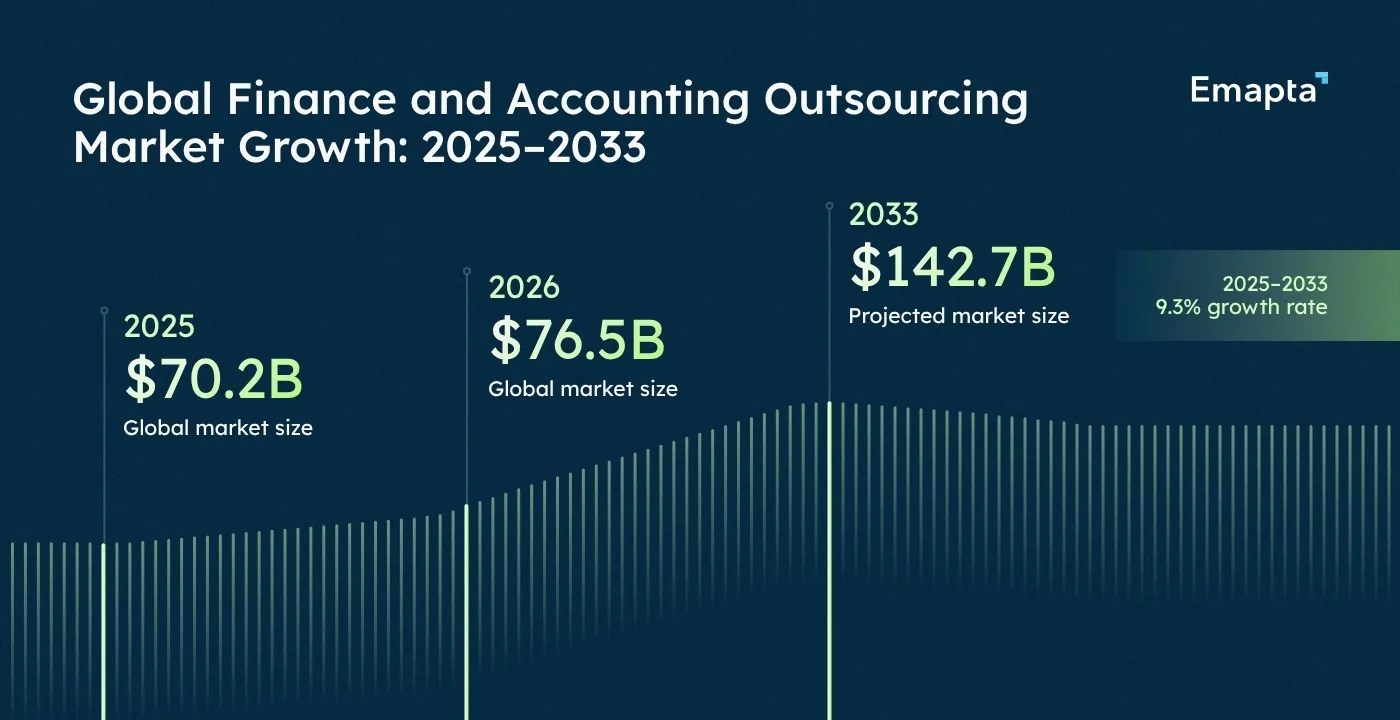
- $70.2 billion global market: According to Grand View Research’s 2026 report, the finance and accounting BPO market was valued at $70.2 billion in 2025 and is estimated to reach $76.5 billion in 2026.
- 9.3% projected CAGR: The market is projected to grow at a compound annual growth rate of 9.3% from 2026 to 2033, reaching $142.7 billion by 2033.
- 36.2% market share for North America: The region represented the largest share of global finance and accounting BPO revenue in 2025.
- 54.5% of revenue from order-to-cash services: These processes, covering activities from customer orders through payment collection, accounted for the largest service segment in 2025.
- 59% AI adoption in finance: Gartner’s 2025 survey found that 59% of finance leaders reported using AI in their finance functions, with accounts payable automation and anomaly detection among the leading applications.
- 6.6% decline in U.S. accounting graduates: The AICPA’s 2025 Trends Report found that accounting degree completions fell to 55,152 in the 2023–2024 academic year.
What does this mean for your business? Finance and accounting outsourcing is becoming an increasingly established option for accessing expertise and managing growing workloads.
With automation changing how financial work gets done and accounting talent remaining a consideration for employers, you have an opportunity to rethink how your finance team operates, combining the right people, technology, and external support to meet your business needs.
What Is Finance and Accounting Outsourcing?
Finance and accounting outsourcing services let you assign some or all your accounting and finance operations to an external company or team.
Rather than hiring every professional locally, you arrange for qualified people or a service provider to support specified responsibilities under an agreed operating model.
Consider a growing retail company. Its internal finance manager knows the business, understands cash requirements, and advises leadership. Yet that same manager is also chasing receipts, reconciling accounts, and resolving invoice exceptions.
Outsourcing transactional work could free up more time for forecasting and business decisions, provided the new team has defined responsibilities and review procedures.
The term finance and accounting BPO usually refers to business process outsourcing, where an external provider delivers agreed processes and service levels.
An outsourced accounting team, meanwhile, may consist of named professionals who work in your systems and follow your procedures. Both approaches fall under the broader outsourcing category, but they offer different levels of day-to-day control.
How Does Finance and Accounting Outsourcing Work?
Outsourced finance and accounting works best when you define a scope of work, choose a delivery model, grant controlled access to the necessary systems, and manage performance against agreed expectations.
The handoff should include more than job descriptions: it needs process instructions, escalation paths, review points, and named owners.
Here are some useful tips to ensure that your finance and accounting outsourcing operations run smoothly.
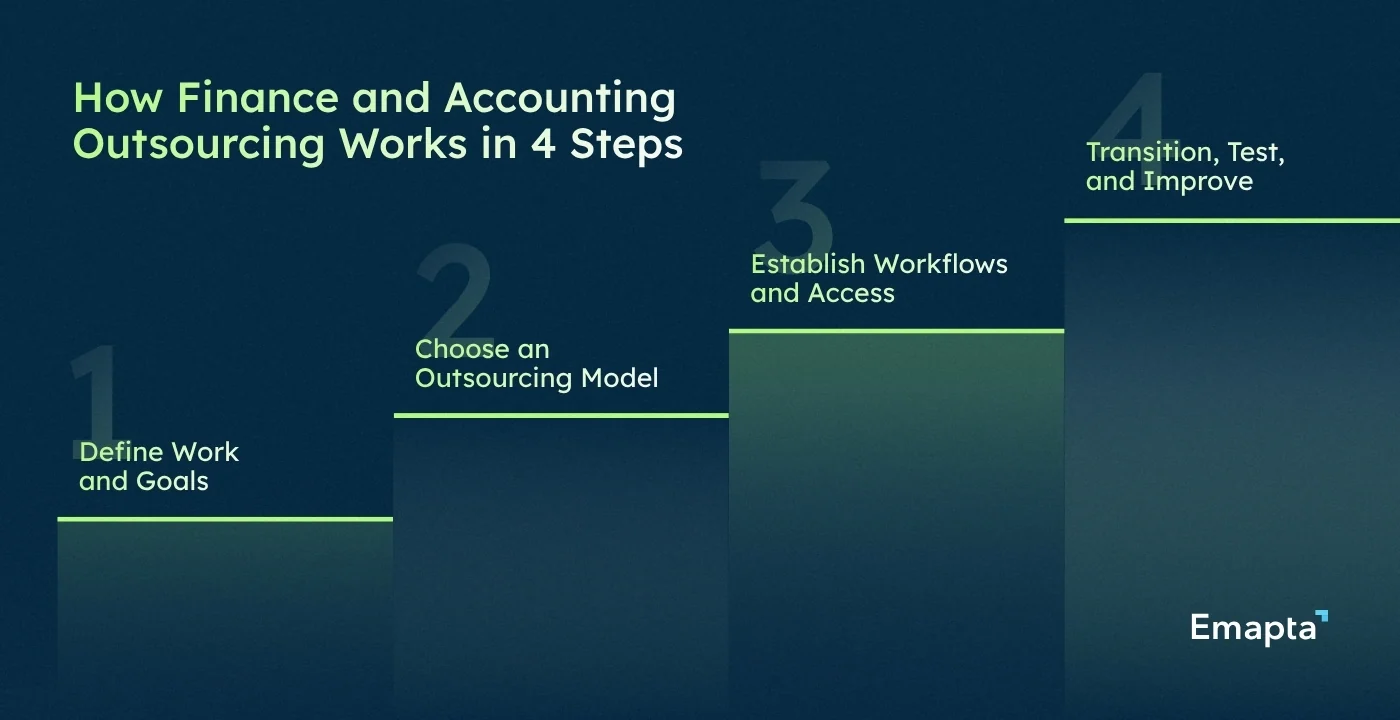
1. Define the work and the outcome
Start with the problem you want to solve. Is your close taking too long? Are collections inconsistent? Do you need technical accounting knowledge or simply more capacity during busy periods?
Before approaching a provider, document:
- Tasks and responsibilities: The activities you want to outsource and the decisions that must remain internal.
- Workload: Transaction volumes, reporting requirements, and seasonal fluctuations.
- Deadlines: Processing schedules, month-end closing dates, and escalation times.
- Current challenges: Recurring errors, delays, skills gaps, and inefficient workflows.
- Expected outcomes: The improvements you’ll use to measure success.
For example, saying “we need accounting support” gives a provider little direction. Saying “we need daily bank reconciliations for eight entities, with exceptions escalated within one business day” gives both parties something concrete to design around.
2. Choose among finance and accounting outsourcing models
Finance and accounting outsourcing can take several forms, depending on how much control you want to retain, the responsibilities you’re transferring, and the level of support your business needs.
| Model | How it works | Best suited for |
|---|---|---|
| Traditional Finance & Accounting BPO | Provider manages defined processes and service delivery | Standardized, repeatable processes |
| Dedicated global staffing | Named professionals work exclusively for the client under its direction | Companies seeking direct control and long-term team integration |
| Project-based outsourcing | External specialists deliver a defined assignment | Temporary or specialized requirements |
| Hybrid model | Internal and external teams share responsibilities | Companies balancing control, capacity, and specialist expertise |
A hybrid approach is common in practice: keep financial strategy and final approvals internally while assigning routine preparation and selected specialist tasks to outside professionals.
What matters is documenting exactly where the provider’s responsibilities end and yours begin.
3. Build the workflow and access structure
Agree on the chart of accounts, reporting calendar, standard operating procedures, communication channels, and software access. Connect work to your existing systems where possible instead of creating an additional spreadsheet-based process.
Use role-based permissions from the beginning. Someone preparing a payment batch, for example, should not automatically receive authority to approve or release it.
Also specify who can change supplier banking details and how those changes are independently verified.
4. Transition, test, and improve
Conduct a controlled handover. Work through sample transactions, complete a parallel review where appropriate, and confirm that the new team can handle unusual cases before removing existing safeguards.
Compare results with the baseline established before outsourcing.
What Finance and Accounting Functions Can You Outsource?
When deciding which finance and accounting functions to outsource, start with repeatable accounting tasks and analytical activities where you can put the right qualifications, supervision, and controls in place.
The sensible boundary is less about whether a task is “basic” or “advanced” and more about its sensitivity, judgment requirements, and the level of oversight you can provide.
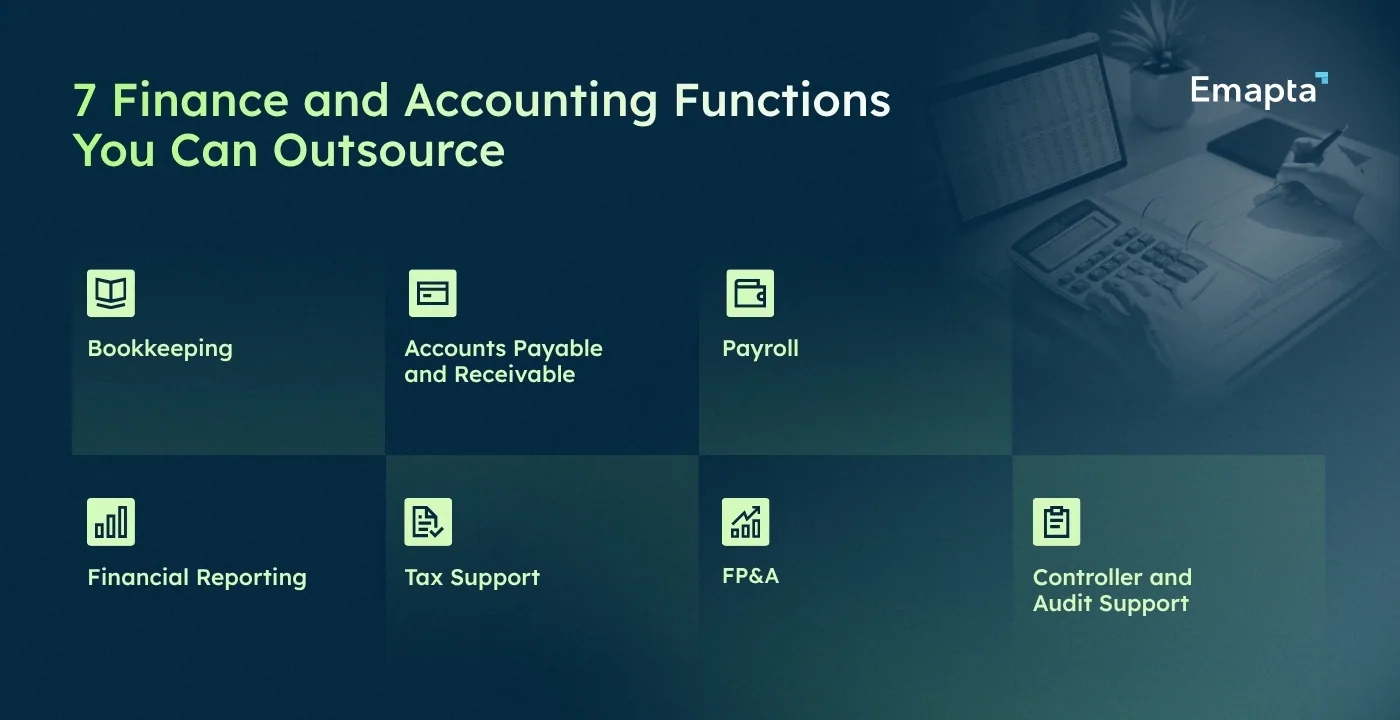
a) Bookkeeping and general ledger accounting
Bookkeeping includes transaction coding, journal preparation, account maintenance, bank reconciliations, and ledger cleanup. These activities are good candidates when transaction volume is high and your policies are documented.
Make sure there are clear responsibilities for accounting policy, unusual adjustments, and the final review of financial statements.
b) Accounts payable and accounts receivable
AP and AR outsourcing can help you manage incoming payments, outgoing expenses, and the processes that keep cash flowing through your business.
Common activities include:
- Accounts payable: Invoice processing, document matching, payment preparation, approval routing, and discrepancy resolution.
- Accounts receivable: Customer invoicing, payment allocation, aging reports, collections follow-up, and account reconciliation.
The biggest operational benefit often comes from consistent follow-through, not simply processing more transactions.
c) Payroll administration
An external team can help collect time records, maintain employee changes, prepare payroll inputs, reconcile payroll accounts, and coordinate with local payroll providers.
However, payroll regulations vary significantly by jurisdiction. Your company still needs clear oversight of tax withholding, employment obligations, privacy rules, and the final release of funds.
d) Financial reporting and month-end close
External professionals can prepare reconciliations, working papers, accruals, management reports, and supporting schedules.
This is especially useful when your internal team spends too much time gathering data and too little time explaining what changed.
e) Tax preparation and compliance support
Qualified specialists can organize tax records, prepare schedules, research applicable requirements, and support filings.
The level of work that can legally be performed, reviewed, or signed by external professionals depends on the jurisdiction and engagement. Confirm licensing and regulatory requirements rather than assuming all tax activities are transferable.
f) FP&A and management accounting
An outsourced finance team can also support budgeting, forecasting, variance analysis, pricing models, and financial dashboards.
This work requires more business context than transactional processing, so regular conversations with department leaders become essential.
g) Controller, audit, and specialist support
Outsourced professionals can support your controller with financial reporting, internal controls, audit preparation, and compliance documentation.
You can also bring in specialists for technical accounting, financial analysis, or complex reconciliations when your internal team needs additional expertise.
However, final financial approvals, accounting policy decisions, and regulatory responsibilities should remain with appropriately authorized professionals.
7 Finance and Accounting Outsourcing Benefits
The strongest benefits from Finance & Accounting outsourcing come when you match the work to the right operating structure.
If you are still deciding what belongs within that scope, start with the fundamentals of Finance & Accounting outsourcing before comparing the potential outcomes.
1. Give your internal team room to focus
When your controller spends an afternoon investigating missing invoices, that is an afternoon unavailable for cash planning or advising management.
Moving well-defined processing work to another team can help senior employees return to responsibilities that need their business knowledge.
2. Access skills you cannot easily hire locally
You might need a payroll specialist, tax accountant, financial analyst, and experienced bookkeeper, but not enough work to justify four local full-time positions.
External hiring markets and flexible models can help you assemble the right mix of skills instead of stretching one generalist across unrelated specialties.
3. Adjust capacity as workloads change
A new product line or seasonal peak can quickly increase transaction volumes. With the right contract, you can add support to particular processes without redesigning your entire finance department each time demand changes.
4. Improve process consistency
Outsourcing creates an opportunity to document processes that have been living in employees’ heads. Standardized checklists, close calendars, exception logs, and escalation rules make daily work less dependent on any one person.
5. Gain better visibility into performance
Outsourcing contracts typically require finance and accounting teams to define outputs and service expectations. You can use that discipline to establish measures your in-house function may not have tracked consistently, including close cycle time, invoice exception rates, reconciliation aging, and collection effectiveness.
6. Build continuity into critical processes
Your finance operation should not stop when one employee takes leave or resigns. A well-designed external team can support cross-training, documented handovers, and coverage arrangements.
Ask exactly who supplies backup and whether a replacement can access the right systems without weakening controls.
7. Bring a fresh perspective to inefficient workflows
External professionals often notice duplicated approvals, incomplete documentation, or reports nobody uses. Invite them to identify improvements, provided process owners review, and approve any changes affecting accounting policy or controls.
What Are the Risks and Challenges of Finance and Accounting Outsourcing?
The risks of outsourcing finance and accounting are manageable, but they do not disappear because you sign a service agreement.
Most problems arise when organizations transfer responsibility faster than they transfer knowledge, controls, and decision rights. Some of the most common challenges are the following:
- Limited visibility: Without access to ongoing work, errors can build up unnoticed. Establish regular reporting, progress reviews, and access to supporting records.
- Communication gaps: Unclear responsibilities can delay issue resolution. Define response times, escalation contacts, and process owners.
- Inconsistent quality: Experience with one accounting system or jurisdiction doesn’t guarantee expertise in another. Evaluate qualifications, test relevant skills, and establish quality checks.
- Data and fraud exposure: External teams may handle sensitive financial information. Apply strict access controls and separate payment preparation from approval.
- Vendor dependence: Relying heavily on one provider can complicate future transitions. Maintain process documentation, system ownership, and a clear exit plan.
Finance and Accounting Outsourcing vs. an In-House Team
Choosing between outsourcing and internal hiring depends on your business priorities, available resources, and the level of support your finance operations require.
Both models offer advantages, and the right choice often involves combining them to meet your needs.
| Consideration | In-house finance team | Outsourced finance team |
|---|---|---|
| Talent acquisition | Recruited through your internal hiring process and local talent market. | Access to additional talent markets, with recruitment support depending on the provider. |
| Operational control | Direct oversight of employees, priorities, and daily workflows. | Can offer similar day-to-day control through dedicated staffing or defined service delivery through managed outsourcing. |
| Business knowledge | Develops familiarity with company operations through ongoing collaboration. | Builds the same understanding through structured onboarding and integration with internal teams. |
| Scalability | Team expansion follows internal recruitment and workforce planning. | Additional capacity can be introduced through established recruitment and staffing processes. |
| Specialized expertise | Expertise is developed internally or acquired through direct hiring. | Provides access to professionals with specialized accounting and finance experience across different markets. |
| Technology and systems | Uses company-selected systems and internal IT support. | Can work within existing company systems or use provider-supported platforms. |
| Cost structure | Includes salaries, benefits, recruitment, technology, and operating expenses. | Typically involves service or staffing fees, with costs varying by scope, location, and operating model. |
| Team continuity | Supported through internal succession planning, cross-training, and retention initiatives. | May include provider-supported replacement, backup staffing, and continuity planning. |
| Implementation time | Depends on internal recruitment, onboarding, and training requirements. | Depends on provider capabilities, talent availability, and the complexity of transitioning work. |
| Security and compliance | Managed through internal policies, systems, and governance procedures. | Supported through shared controls, provider safeguards, and continued company oversight. |
A hybrid approach can give you strengths of both models. Keep financial strategy, policy decisions, and approvals internally while external professionals support accounting processes, reporting, and specialized tasks.
Is your current finance hiring model delivering the best return?
Use Emapta’s CFO Workforce ROI Calculator to evaluate the financial impact of your current hiring approach and explore the potential value of a dedicated global team.

Onshore vs. Nearshore vs. Offshore Finance and Accounting Outsourcing
The location of your outsourced team affects communication, available skills, local market costs, and the regulations you must consider.
Choose based on your workflow’s needs rather than assuming one geography or proximity is always best.
- Onshore outsourcing: Work is handled by a provider in your own country. This can simplify local collaboration and access to professionals familiar with domestic business practices, although costs may reflect local labor market conditions.
- Nearshore outsourcing: Your team operates in a nearby country, often with significant workday overlap. For U.S. companies, markets such as Colombia can support real-time collaboration with internal departments.
- Offshore outsourcing: Work is performed in a more distant country, potentially providing access to established talent markets and different cost structures. Greater time zone differences may require additional coordination but can also support overnight processing.
The right location depends on how your team works. If your finance professionals regularly collaborate with operations and leadership, shared working hours may matter more than geographic distance alone.
How Much Does Finance and Accounting Outsourcing Cost?
Finance and accounting outsourcing costs depend on the work, delivery model, location, experience required, technology, transaction volume, and the controls you expect the provider to maintain.
A bookkeeping package for a small company may be priced very differently from a dedicated team supporting multiple legal entities and complex reporting deadlines. Compare proposals based on a consistent scope, not only the headline monthly fee.
Common pricing models
Providers structure finance and accounting outsourcing costs differently depending on the scope, workload, and level of support required. The most common pricing models include:
- Fixed monthly fee: A predictable recurring charge for defined services. Best suited to consistent workloads, although additional requests may incur extra charges.
- Per-transaction pricing: Charges based on the number of invoices, payments, or other items processed. Useful for standardized, measurable workflows.
- Hourly or project fee: Payment based on time spent or a specific assignment. Often used for accounting cleanup, migrations, or specialist support.
- Dedicated team fee: A recurring charge for assigned professionals, typically based on their roles, experience, location, and included support services.
Each model has different implications for your budget. Before comparing quotes, confirm which services, technology, management responsibilities, and additional expenses are included.
Calculate the total cost, not just the quoted price
A fair comparison includes the work you will continue doing internally.
Build a total-cost estimate covering provider fees, transition effort, software, integration, security reviews, internal oversight, potential travel, and contract-exit costs. Compare it against fully loaded internal employment and operating expenses.
Rather than relying on an unverified savings percentage, build two or three scenarios using actual quotes and measured costs.
What could your finance team save with a different hiring model?
Use Emapta’s CFO Quick Savings Estimator to explore potential cost savings based on your location, finance roles, and team size.

When Should You Outsource Finance and Accounting?
Outsourcing makes sense when the volume, complexity, or skill requirements of your finance work exceed what your current structure can manage efficiently.
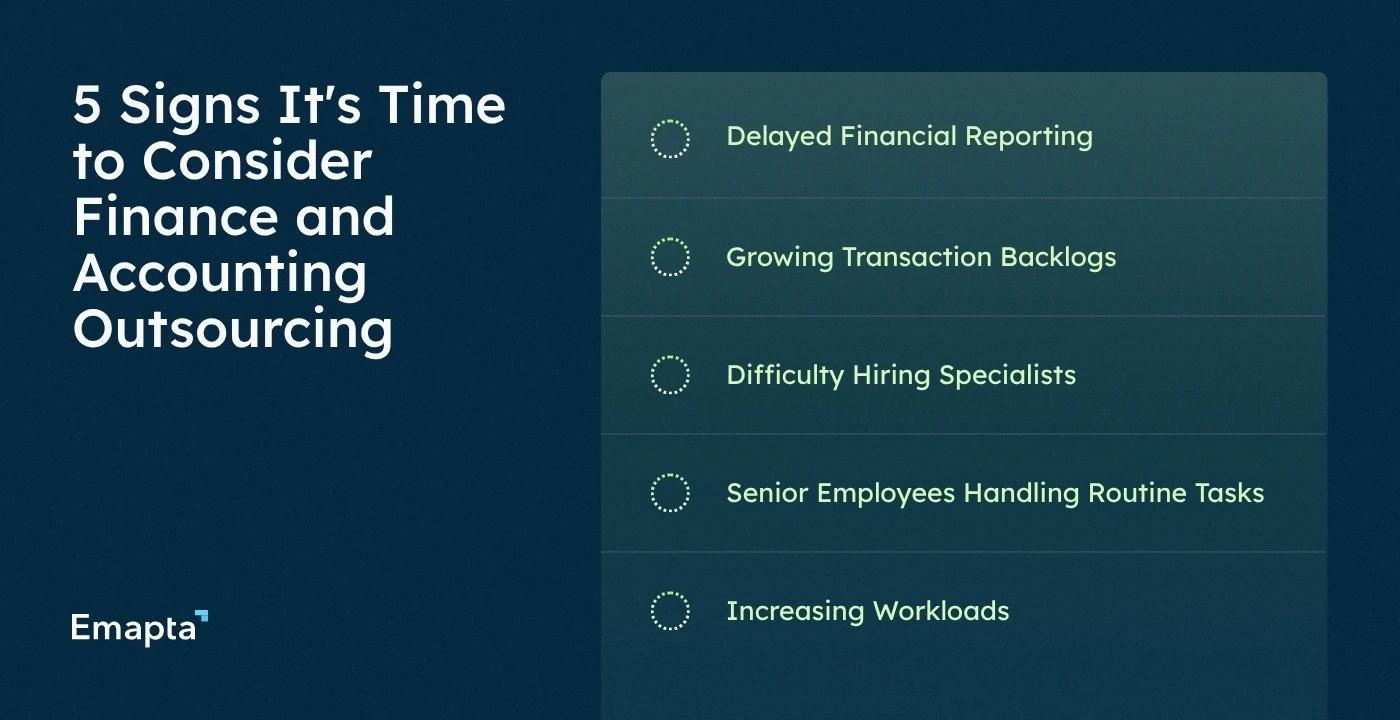
You may be ready to consider outsourcing if:
- Your month-end close regularly runs late, affecting reporting and decision-making.
- Your team struggles to keep up with transactions, reconciliations, or collections.
- Specialized finance roles are difficult to fill, creating gaps in expertise.
- Senior employees spend too much time on routine tasks, leaving little capacity for analysis.
- Business expansion is increasing workloads faster than your current team can support.
If several of these signs sound familiar, use a more detailed guide on when to outsource accounting to assess your readiness before moving work outside your team.
The best time to explore outsourcing is often before these challenges become critical. You’ll have more time to document processes, onboard professionals, and introduce changes without disrupting daily operations.
How efficient is your finance team?
Take Emapta’s 3-minute CFO Efficiency Audit to benchmark your finance operations, uncover potential inefficiencies, and identify opportunities for improvement.

How AI Is Changing Outsourced Finance and Accounting Operations
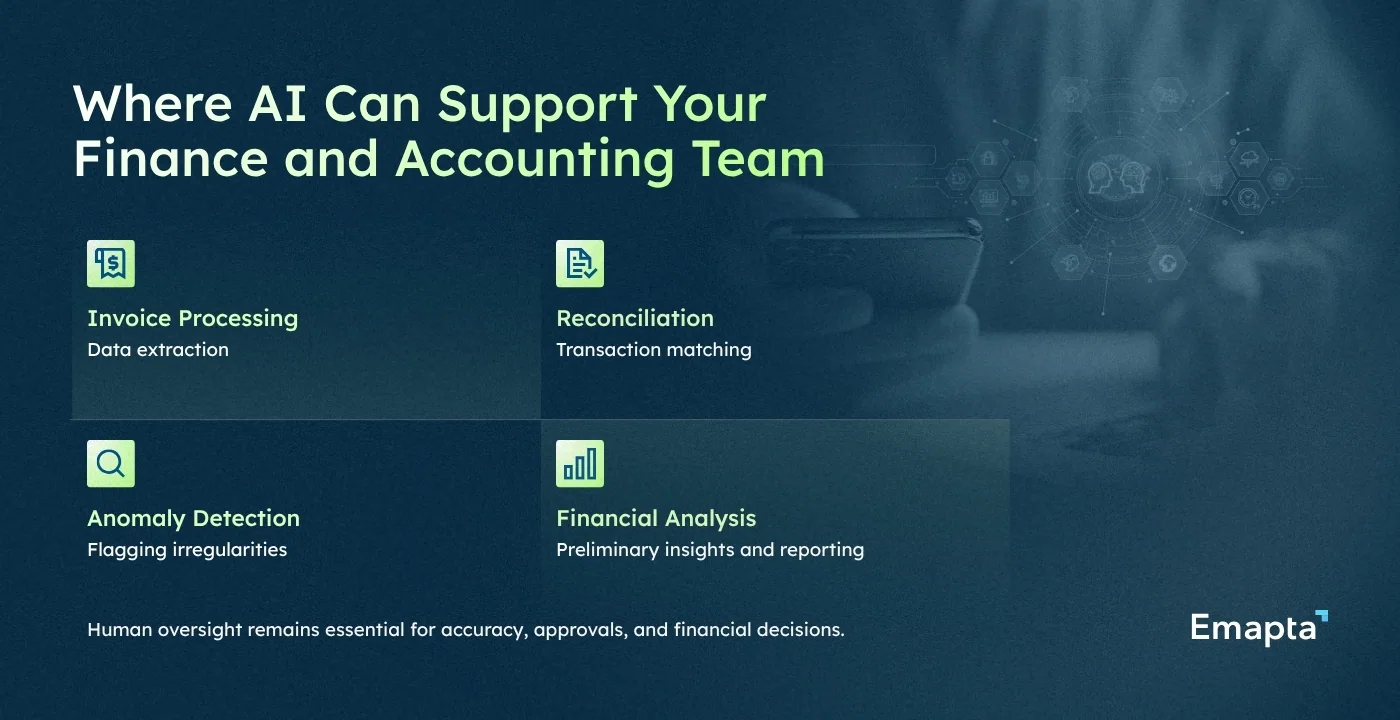
AI in finance and accounting outsourcing can help teams capture data, classify transactions, detect anomalies, retrieve information, and prepare preliminary analysis.
The bigger opportunity is not replacing judgment. It is reducing repetitive effort so qualified professionals can investigate exceptions and advise the business.
A 2025 Gartner survey of 183 CFOs and senior finance leaders found that 59% reported using AI in their finance function. Among respondents using AI, common use cases included knowledge management, AP automation, and error or anomaly detection.
Where AI can help
In AP, optical character recognition and AI-assisted extraction can pull invoice information into a workflow. In reconciliations, matching tools can identify likely pairs and flag exceptions. In FP&A, analysts may use AI to prepare commentary drafts or explore patterns that merit investigation.
Still, every step needs a control. An invoice may be read incorrectly. An unexpected transaction may be legitimate. A generated financial explanation can sound confident while relying on incomplete data.
Have people review material exceptions, verify source records, and approve consequential outputs.
How to implement AI within your team
When evaluating an AI-enabled provider, ask which tools are used, whether your data trains external models, who can approve automated actions, how outputs are tested, and whether the process maintains a reliable audit trail.
The NIST AI Risk Management Framework offers a starting point for governance conversations.
Finance and Accounting Outsourcing Security and Compliance
Outsourced finance and accounting work can be secure, but the security of your arrangement depends on how information is accessed, monitored, retained, and protected. A vendor’s assurances are of little relevance in the face of evidence that the appropriate controls actually operate within your real workflow.
A common mistake is to review cybersecurity only after choosing a provider. By then, you may have designed an arrangement that requires unnecessarily broad access to payroll, banking, and personal information. Bring your IT, legal, risk, and finance representatives into the selection process early.
Protect access and payment approval
Strong financial controls should apply whether your employees work in-house or through an external provider. Before granting access to company systems, establish the following safeguards:
- Individual user accounts: Give each professional identifiable credentials instead of sharing logins.
- Multifactor authentication: Add verification requirements to protect sensitive systems.
- Role-based permissions: Limit access to the information and functions required for each position.
- Separate payment responsibilities: Keep payment preparation, approval, and release appropriately segregated.
- Activity monitoring: Maintain logs of sensitive actions and review access regularly.
- Access removal procedures: Revoke permissions promptly when employees leave or change responsibilities.
Your provider should support these safeguards, but your internal finance, IT, and compliance teams must remain involved in overseeing them.
Understand certifications and assurance reports
ISO/IEC 27001 concerns an information security management system. A SOC 2 report addresses controls relevant to the trust services criteria, while a SOC 1 report is specifically relevant to controls at a service organization that may affect a customer’s internal control over financial reporting.
These reports answer different questions; none automatically certifies every activity you plan to outsource.
The AICPA’s service-organization reporting overview explains the distinctions. Request the relevant report, examine its scope and dates, note exceptions, and identify controls your own organization is expected to operate.
Check privacy, data transfers, and professional obligations
Depending on the information and countries involved, privacy laws may impose rules on processing agreements, access, retention, and cross-border transfers. If EU personal data is involved, for instance, review GDPR processor obligations and applicable international transfer mechanisms with qualified counsel.
Accounting and tax responsibilities also need attention. Outsourcing does not relieve your company of filing duties, reporting accuracy, or governance obligations.
Establish who prepares, checks, signs, submits, stores, and can retrieve each record. Additional industry requirements may apply to financial institutions or healthcare information.
How to Build and Manage an Outsourced Finance and Accounting Team
Building an effective remote finance and accounting team starts with role design and consistent management. The best teams feel connected to your business because they understand what the numbers mean, who relies on their work, and how success will be judged.
If you need a more detailed setup plan, then the following steps may give you a better idea of how to put together a remote accounting and finance team.
Step 1: Decide what stays internal
Identify the decisions you will retain, such as accounting policy approval, bank authorization, financial sign-off, strategic planning, and discussions with auditors or regulators. Then define which preparation, analysis, and routine execution tasks can be assigned elsewhere.
This avoids a common source of frustration: hiring someone to prepare management reports but not giving them enough business context to explain the results. Map every deliverable to a decision-maker and an accountable reviewer.
Step 2: Hire for the actual work
A general job title is rarely enough. Specify accounting standards, software, industries, entity complexity, transaction volumes, language requirements, and close deadlines. Separate required experience from skills that can be trained during onboarding.
For instance, a bookkeeper handling high-volume e-commerce transactions needs different experience from an FP&A analyst supporting a subscription business.
Evaluate candidates through relevant work examples and clear communication, not credentials alone.
Step 3: Create a practical onboarding plan
Give new staff access to approved process documents, sample reports, reporting deadlines, and a named point of contact. Introduce them to people upstream and downstream of their work, including operations, payroll, sales, and procurement.
Step 4: Manage outcomes and improvement
Use a small scorecard that combines timeliness, quality, and business impact. Helpful measures include:
- Close completion: Actual close date against the agreed calendar.
- Reconciliation quality: Number and age of unresolved items.
- AP accuracy: Share of invoices processed without rework.
- AR effectiveness: Aging trends and follow-up resolution.
- Forecast quality: Variance between forecast and actual results, interpreted with relevant context.
- Team stability: Retention, backup coverage, and progress in cross-training.
Finance and Accounting Outsourcing Best Practices
Successful outsourced finance operations start with clear responsibilities, consistent communication, and measurable outcomes. Follow these practices to establish a reliable working relationship:
- Document before you delegate: Record workflows, approval limits, deadlines, and common exceptions before transferring responsibilities.
- Start with a manageable pilot: A single entity, process, or reporting cycle can reveal whether the provider understands your systems and standards.
- Keep ownership visible: Assign clear responsibility for accounting judgments, data issues, approvals, and performance reviews.
- Make communication part of the process: Establish working hours, reporting expectations, escalation procedures, and regular check-ins.
- Revisit controls after automation: Review safeguards whenever new technology changes how transactions are processed or approved.
These practices help ensure your outsourced team becomes an effective extension of your finance operations rather than a separate function that requires constant intervention.
Common Finance and Accounting Outsourcing Mistakes
Many outsourcing challenges are preventable. They happen when the organization concentrates on getting work off someone’s desk without deciding what the new process should deliver.
These are the most common mistakes to avoid:
Choosing the cheapest proposal without comparing scope
A low headline fee can exclude onboarding, exception handling, reporting, or supervision.
Compare quotes using the same assumptions, ask for examples of additional charges, and include your retained internal costs.
Moving a broken process unchanged
If the current workflow produces late or unreliable data, moving it elsewhere may just shift the problem.
Fix unclear approvals, incompatible records, and incomplete documentation before moving the function externally.
Treating offshore employees as disconnected support
People perform better when they understand the company, its customers, and what leaders need from the figures.
Introduce outsourced professionals to stakeholders, include them in relevant meetings, and explain the business impact of their work.
Giving broad access for the sake of speed
Shared credentials, unrestricted exports, and combined payment permissions may look convenient during implementation; they also weaken accountability.
Set access around roles and review privileges as responsibilities change.
Measuring only cost savings
If outsourcing reduces the monthly bill but causes longer close times or inaccurate cash reporting, it has not solved the underlying issue.
Track service quality, control effectiveness, internal time regained, and financial outcomes alongside costs.
Finance and Accounting Outsourcing Trends and Future Outlook
Finance and accounting outsourcing is moving beyond the idea of relocating inexpensive transaction processing. Buyers increasingly expect digital workflows, specialized expertise, secure collaboration, and teams that contribute to better decision-making.
These trends will shape how finance and accounting operations develop in the future.
AI will reshape tasks before it replaces entire functions
As extraction, classification, and first-draft analysis improve, routine steps may become faster. However, businesses will still need people who can verify unusual entries, explain results, maintain controls, and respond to changing regulations.
Expect role descriptions to place more emphasis on systems knowledge, analysis, and judgment.
Buyers will ask more detailed security questions
Cybersecurity and data governance are now operating requirements, not items to address after signing.
Providers should be able to explain their subcontractors, device controls, access logging, incident response, and how they handle AI-related data in ways that finance leaders can understand and assess.
The location decision will become more task-specific
Businesses may use overlapping working hours for collaborative analysis while distributing standardized processing across different schedules.
A single company could reasonably use onshore specialists for regulated advice, nearshore analysts for daily collaboration, and another delivery location for defined operations.
Performance will matter more than headcount alone
The relevant standard will be whether the finance team closes reliably, resolves issues quickly, and gives leadership usable information.
As technology changes task volumes, contracts and internal scorecards will need to evolve from measuring inputs toward measuring useful results.
How to Choose a Finance and Accounting Outsourcing Provider
The right finance and accounting outsourcing provider should be able to explain how it will deliver your particular work, who will perform it, and how quality and security will be maintained. A polished sales presentation can’t replace specific answers to those questions.
Begin by sharing a realistic description of your environment: legal entities, accounting systems, reporting frequency, transaction volumes, specialist requirements, and current bottlenecks.
Ask each provider to propose a scope and operating model against the same facts. Then evaluate these areas:
- Relevant experience: Has the provider supported similar processes, systems, jurisdictions, or business models? Ask for concrete examples, not just an industry list.
- Talent and qualifications: How are professionals evaluated? Who handles replacement, training, supervision, and continuity? What certifications or licenses are required for your scope?
- Control and transparency: Will you manage named team members, receive a defined service output, or use a combination? Who owns priorities and approvals?
- Security evidence: What independent assurance reports, policies, incident processes, and access controls can the provider show for the actual services offered?
- Commercial clarity: Which services are included, what triggers extra fees, and how will capacity changes or termination work?
- Cultural and operational fit: Can the team communicate clearly, operate within your deadlines, and challenge an incorrect assumption without hesitation?
- Implementation approach: Is there a realistic transition plan, with milestones, acceptance criteria, documentation, and ownership on both sides?
If retaining direct management is a priority, consider finance and accounting solutions that let you oversee daily workflows and integrate external professionals into your operations.
Depending on your business needs, accounting outsourcing solutions can also help you access specialized expertise and support specific financial processes.
Regardless of the approach you choose, make sure you understand the responsibilities, level of control, and services included before committing to a provider.
Conclusion
Finance and accounting outsourcing works best when it solves a clearly defined business problem.
You may want a faster close, more dependable transaction processing, specialist expertise, or room for your internal leaders to focus on planning. The model you choose should be built around that objective.
Start with a process you can describe and measure. Check the true costs, protect access to financial data, establish approval boundaries, and give your outsourced professionals enough context to succeed.
As you learn what works, you can expand the arrangement without sacrificing control.
Frequently Asked Questions (FAQ)
Finance and accounting outsourcing is the assignment of defined accounting or finance tasks to an external provider or team. These tasks may include bookkeeping, transaction processing, payroll support, reporting, and financial analysis. Your organization still retains accountability for oversight and relevant legal obligations.
Common functions include bookkeeping, AP, AR, payroll administration, general ledger support, bank reconciliations, monthly reporting, tax preparation support, and FP&A. More specialized work can also be outsourced when qualified professionals, appropriate review, and jurisdiction-specific requirements are in place.
Costs vary with transaction volume, role seniority, country, service scope, technology, and delivery model. Providers may charge monthly retainers, project fees, transaction-based prices, or dedicated-team fees. Compare total costs, including transition, security, software, and your own oversight, rather than just quoted rates.
Potential benefits include access to specialist skills, added processing capacity, more consistent workflows, operational continuity, and more time for internal leaders to focus on analysis. The results depend on process quality, staff capability, controls, and clear performance expectations.
It can be, provided security controls fit the work. Evaluate access restrictions, multifactor authentication, logging, approval separation, data-processing terms, incident response, and relevant independent assurance reports. No provider arrangement eliminates the need for ongoing oversight.
Outsourcing describes who performs the work: an external provider or team. Offshoring describes where the work is performed: another country, often farther away. You can outsource domestically, nearshore, or offshore, and a company can also operate its own offshore team without outsourcing the work.
Consider outsourcing when reporting delays, skills gaps, increasing transaction volumes, or routine work are limiting your team’s effectiveness. Begin before processes become critical failures, and make sure you have documented responsibilities, a measurable scope, and internal ownership.
Compare providers against the same scope. Evaluate relevant expertise, talent quality, operating model, security evidence, pricing transparency, implementation support, and communication practices. Ask the team that would actually deliver the work to explain how it handles exceptions and deadlines.
Yes. A hybrid arrangement can keep strategy, accounting policy, and approvals with internal leaders while external professionals support processing, reconciliations, reporting preparation, and analysis. Clear roles, shared systems, and scheduled reviews help both groups operate as one team.
AI can assist with invoice data extraction, transaction classification, anomaly detection, reconciliation, and early-stage analysis. It can reduce repetitive effort, but reliable finance operations still need human review, sound source data, security controls, and accountability for financial decisions.