

How to Choose a Finance and Accounting Outsourcing Provider
Choosing a finance and accounting outsourcing provider is one of the most consequential decisions a growing business can make. The right partner brings technical expertise, data security, and scalability, while the wrong one creates compliance risks and communication gaps.
Today, we will show you a step-by-step process for evaluating potential accounting outsourcing partners, explains when outsourcing makes sense, and outlines how to move from initial research to a fully integrated outsourcing relationship that supports long-term growth.
Choosing a Finance Outsourcing Provider – Key Takeaways
- Prioritize industry specific expertise over general accounting knowledge.
- Treat communication responsiveness as a signal of what ongoing service will look like.
- Confirm data security and technology practices before signing on.
- Choose a provider that can scale services as your needs evolve.
- Weigh total value, not just hourly cost, when comparing options.
How to Select the Best Finance and Accounting Outsourcing Provider – Step-by-Step Guide
Five factors consistently separate a strong outsourcing partnership from a frustrating one. The right partner needs to align your operational needs, outsourcing model, and expertise with your strategic goals.
To select the best provider, follow these essential steps:
- Expertise Evaluation
- Communication Assessment
- Data Security & Technology
- Scalability & Flexibility
- Cost For Value
1. Evaluate Technical Expertise and Industry Experience
Every industry carries its own reporting standards, tax obligations, and operational quirks. A manufacturing business needs support with inventory costing and supply chain accounting, while a software company needs help with revenue recognition and investor reporting.
Ask prospective providers whether they have worked with businesses in your sector before, and whether their team understands the regulations that apply to you. A provider with relevant industry exposure will spend less time ramping up and more time delivering accurate work.
2. Assess Communication and Soft Skills
Technical ability only matters if it is paired with clear, consistent communication. Pay attention to how quickly a provider responds to your inquiries and whether they are willing to work within your preferred channels, whether that is video calls, email, or a shared project tool.
Slow or vague responses during the sales process are often a preview of what ongoing communication will look like once the engagement begins.
3. Check Data Security and Technology Standards
Financial data is among the most sensitive information a business handles, and the stakes are real: according to IBM, a single breach costs financial industry enterprises an average of USD 6.08 million.
Ask whether the provider follows secure protocols that align with recognized standards such as ISO 27001, SOC 2, and PCI DSS.
A provider that treats security as a standard part of its process, rather than an afterthought, is one that takes the responsibility of handling financial information seriously.
4. Consider Scalability and Flexibility
Your accounting needs today are unlikely to match your needs in three or five years. A strong finance outsourcing partner should be able to add services, such as forecasting, budgeting, or audit support, as your business matures, without requiring you to switch providers.
Ask how the provider staffs its accounts and what happens if a team member assigned to your business moves on. Continuity matters as much as capability.
5. Weigh Cost Against Value
Cost should never be the only deciding factor when choosing a finance and accounting outsourcing provider, but it is still worth understanding.
The gap can be significant: a CPA in the Philippines costs an average of USD 16,786 annually in salary and benefits, compared to USD 99,731 for the same role in the US, a savings of roughly 83%, based on the latest finance and accounting outsourcing trends. Clarify whether pricing is hourly or flat fee, what services are included, and how often rates change.
The more useful comparison is not the sticker price of outsourcing versus an in-house hire, but the total value delivered, including payroll taxes, benefits, and management time that an in-house role would otherwise require.
Should You Outsource Finance and Accounting to a Third-Party Provider?
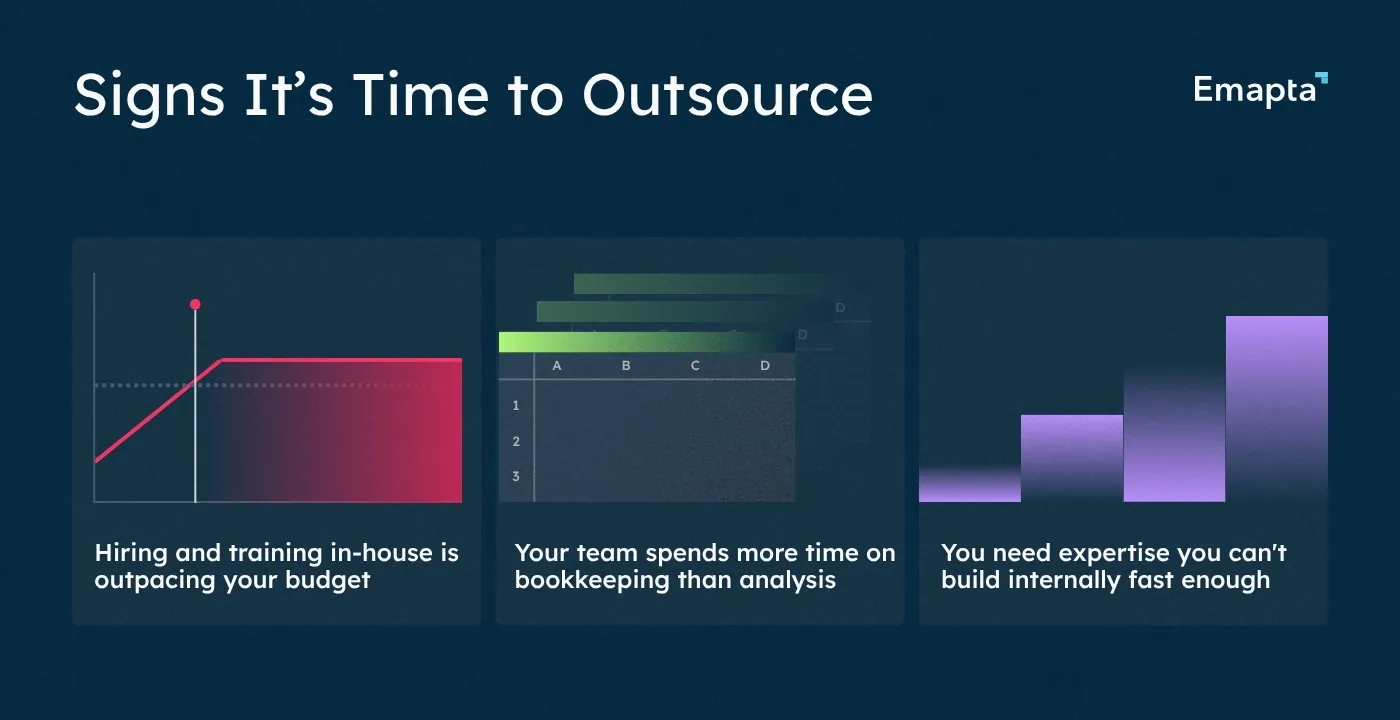
Outsourcing is not the right move for every business at every stage, but for many growing companies, it solves a specific problem: accounting complexity that has outpaced internal capacity. Businesses that outsource typically do so to free up time, reduce the overhead of hiring and training in-house staff, and gain access to specialized expertise they could not easily build internally.
Before deciding, it helps to understand what a reliable accounting outsourcing provider actually covers, since the scope can range from basic bookkeeping to full financial strategy support. Reviewing what finance and accounting outsourcing looks like in practice can clarify whether your business needs a narrow engagement or a broader partnership.
It also helps to look at where the market is heading as 80% of executives plan to maintain or increase investment in third-party outsourcing, a sign that these arrangements are becoming standard practice rather than a stopgap. Keeping an eye on finance and accounting outsourcing trends can clarify which capabilities are worth prioritizing in a provider search.
If your team is spending more time on routine bookkeeping than on the financial analysis that drives decisions, that is usually a sign outsourcing is worth exploring.
How to Outsource Finance and Accounting to a Third-Party Provider
Once you have decided outsourcing makes sense, the process itself follows a fairly consistent path.
1. Define Your Goals
Start by identifying what you want outsourcing to accomplish, whether that is more free time for your existing team, improved accuracy, or support for a specific growth goal. From there, list the services you want to outsource and rank them by priority.
Businesses exploring a dedicated finance and accounting outsourcing provider often find it useful to first understand how a fully built out finance team could be structured to support their goals.
2. Select the Right Provider
Interview a shortlist of providers rather than defaulting to the lowest quote. The goal is the best balance of expertise, reliability, and cost, not simply the cheapest option.
A reliable accounting outsourcing provider is built around specific sectors, such as those offering accounting outsourcing solutions tailored to particular industries, can be worth prioritizing if your business has specialized reporting or compliance needs.
3. Create an Onboarding Plan
Set clear expectations for onboarding, including timelines, reporting deadlines, and what your internal team needs to prepare on their end. Outsourcing works best when both sides understand their responsibilities from day one.
For businesses building a more extensive remote finance function, it can help to look at how to build a remote accounting and finance team, since many of the same onboarding principles apply.
4. Inform Your Team
Let your existing staff know what is changing and why. Address concerns directly, and be clear about which responsibilities are shifting so nothing falls through the cracks during the transition.
5. Review and Adjust
After the outsourced team is integrated, check in regularly. Confirm they have what they need to meet expectations, and look for additional tasks that could benefit from outsourcing as your business continues to grow.
Conclusion
Selecting the right finance and accounting outsourcing provider comes down to matching technical expertise, communication style, security standards, and scalability to your business needs. A provider that fits well will free up internal capacity, reduce the risk of costly errors, and grow alongside your business rather than becoming something you outgrow.