

When to Outsource Accounting – 7 Signs It’s Time to Act
Knowing when to outsource accounting is less about reaching a specific company size and more about recognizing when your finance function is no longer keeping up.
You may notice it when month-ends take longer, senior staff get increasingly pulled into routine accounting work, or reports arrive too late to guide decisions. These issues can signal that your current setup is overwhelmed.
The goal is to decide where external support can make a significant operational impact. In this article, we will show you how to identify when to outsource F&A and why it is the right move for your business.
How do I Know When to Outsource Accounting – Key Takeaways
- Act before finance becomes a bottleneck – late closes, delayed reports, and stalled projects often signal limited capacity
- Protect senior-level time – outsourcing repetitive work helps leaders focus on strategy, forecasting, and growth
- Fill skill gaps, not just roles – external talent can add expertise across reporting, controls, analysis, and accounting operations
- Choose the right outsourcing partner – prioritize expertise, security, controls, scalability, and cost transparency over location alone
What Does it Mean to Outsource Finance & Accounting?
Finance and accounting outsourcing means using an external team to handle selected tasks that would otherwise sit with your in-house employees.
You might outsource:
- Bookkeeping and reconciliations
- Accounts payable and receivable
- Payroll support
- Month-end close activities
- Management reporting
- Budgeting and forecasting
- Financial analysis
- Controller-level support
- Audit preparation
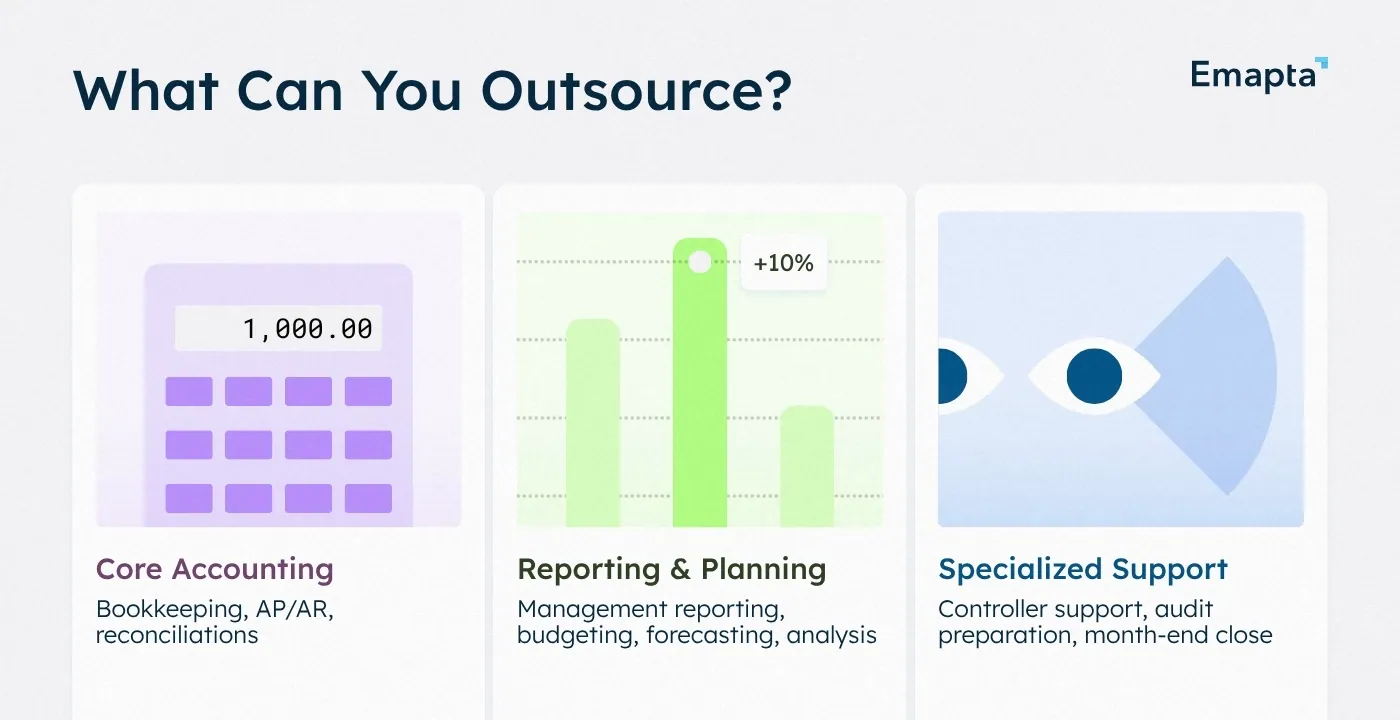
This model allows you to keep your F&A leadership members in-house while adding people around them to handle recurring work.
For a small business, outsourcing may begin with bookkeeping. For a large company, it may fill gaps in reporting, accounting operations, or financial analysis.
The key question is not “Should I outsource finance and accounting roles?” but “Which parts of finance are taking more time or expertise than my current team can provide?”
7 Key Signs It Is Time to Outsource Finance & Accounting
The best way to understand when to outsource accounting roles is to identify hurdles that are becoming increasingly common in your business. If any of the following situations sound familiar, it may be time to start outsourcing F&A talent.
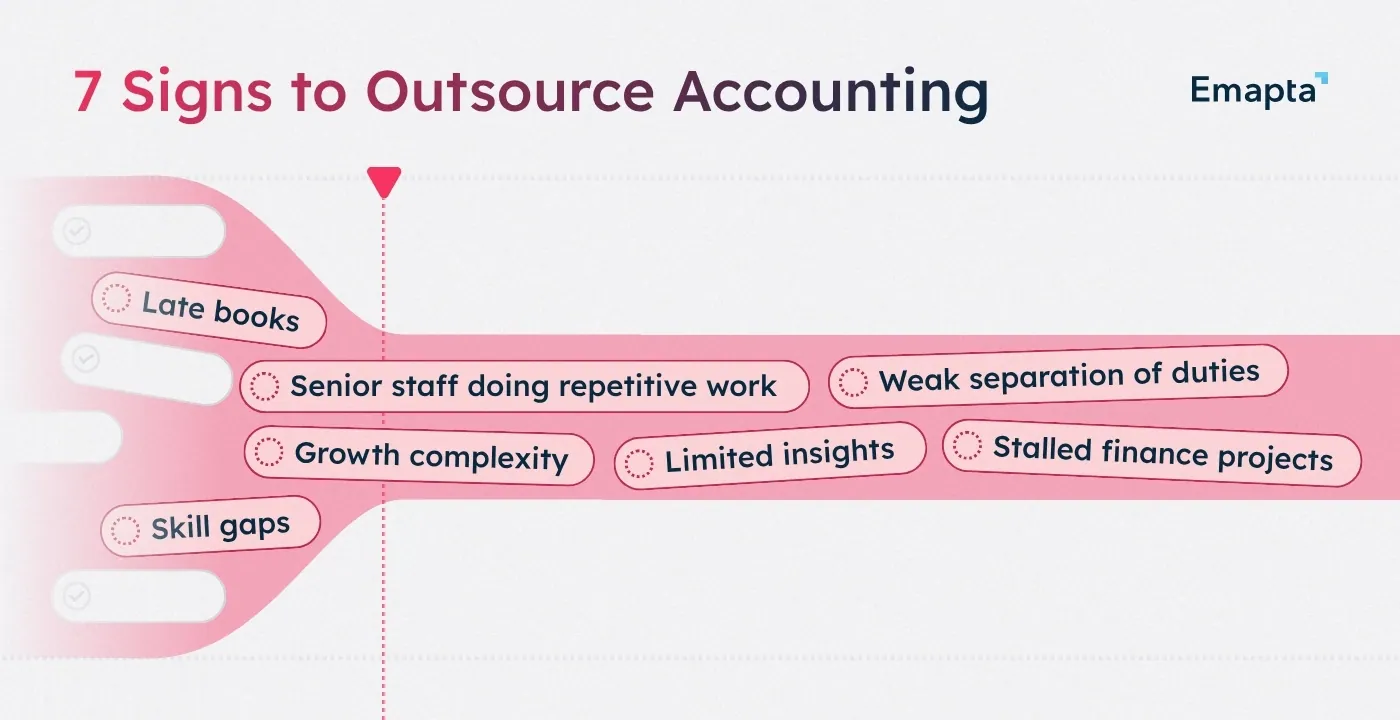
1. Your Books Are Regularly Late
If your close keeps slipping, your financial information becomes less useful.
Delayed reconciliations and reporting can leave you making decisions without a clear picture of cash flow, expenses, or recent performance.
A late close that becomes routine usually points to a capacity or process issue.
2. Senior People Are Handling Repetitive Tasks
A founder reviewing transactions or a CFO checking invoices may solve an immediate problem, but it also means expensive time is being used on repeatable work.
Pay attention when finance tasks begin taking time away from forecasting, strategy, operations, or growth planning. For many companies, this is a clear sign of when to outsource accounting for a growing business. The work is still being completed, but your current structure may be using the wrong resources to do it.
3. Adding One Headcount Will Not Suffice Your Needs
Sometimes the problem is not resources. It’s the number of different skills your finance function now requires.
Instead of relying on one person to fill every gap, you can combine internal leadership with specialized external talent. Understanding how to build a remote accounting and finance team can help you define the roles you actually need.
4. Growth Is Adding Complexity Faster Than Capacity
New entities, employees, customers, suppliers, or markets can create more work across payroll, reporting, controls, reconciliations, and compliance. When your business reaches a growth stage, review your finance capacity before:
- Entering a new market
- Preparing for an audit
- Raising capital
- Adding another entity
- Making an acquisition
- Implementing new finance technology
- Increasing transaction volume significantly
The ideal time to add support is before those changes overwhelm the team.
If your structure is already being stretched, different accounting outsourcing solutions can help you identify which functions are practical to move outside your core team.
5. Your Numbers Aren’t Driving Decisions
Accurate reporting matters, but you also need people who can explain what the numbers mean and what deserves attention next.
If your team spends most of their time processing transactions or fixing errors, analysis and forecasting can keep getting pushed aside.
Industry data shows concern about this recurrent issue. A 2025 Deloitte Survey found that 78% of respondents planned to increase automation in finance operations, while one-third expected to use outsourcing to address skills gaps.
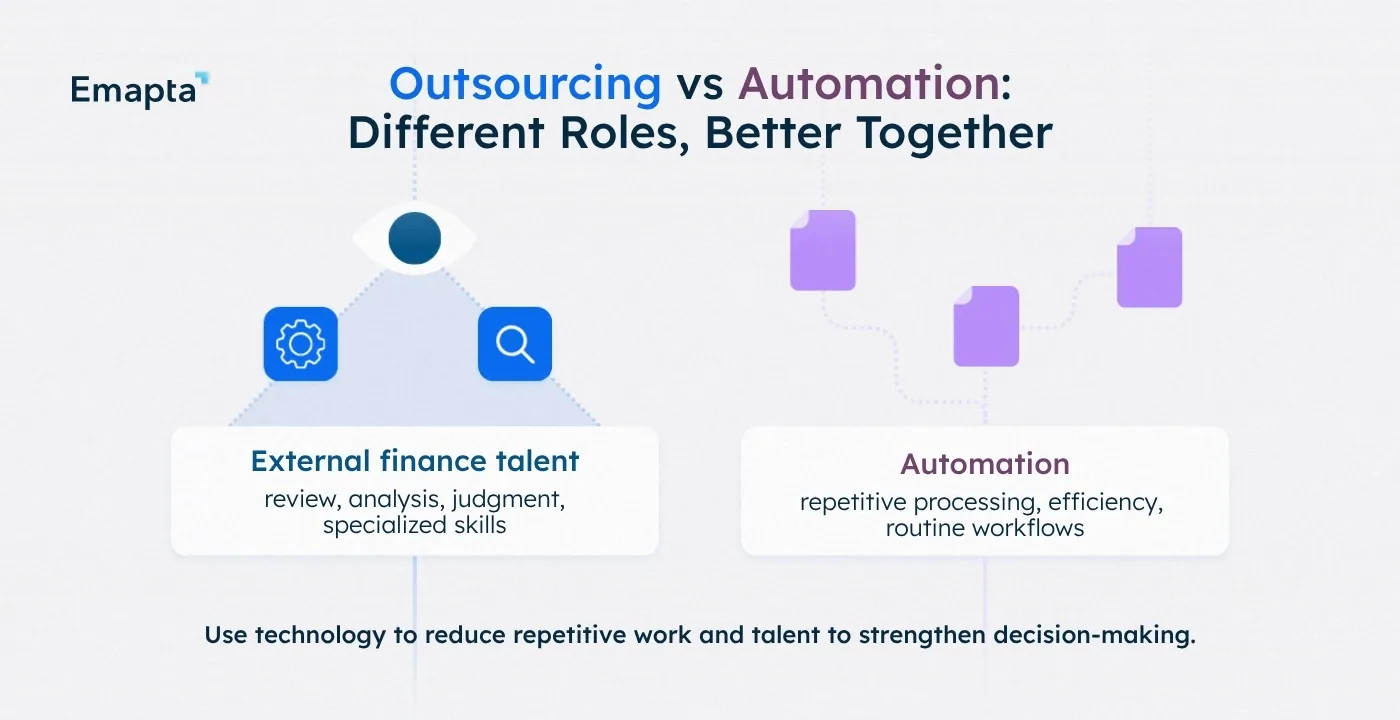
For you, these approaches can work together. Automation can reduce repetitive work, while additional finance talent can provide the review, analysis, and judgment technology cannot replace on its own.
If you are still defining which activities make sense to move outside your team, understanding how finance and accounting outsourcing works can help you separate routine processes from the responsibilities you want to keep internally.
6. Your Team Is Too Small for Strong Controls
Small finance teams can create risk when the same employee prepares, processes, and reviews important transactions.
Additional capacity can help separate responsibilities such as:
- Preparing and approving payments
- Completing and reviewing reconciliations
- Posting and checking journal entries
- Reviewing expenses
- Preparing financial reports
Outsourcing does not automatically create stronger controls but outsourced finance and accounting teams can give you more flexibility to structure responsibilities without hiring every role locally.
7. Key Finance Projects Keep Stalling
If you have been trying to improve dashboards, automate accounts payable, document processes, clean up accounts, or shorten close times for months, your team may simply have no capacity left for improvement.
External support can take recurring work off their plate or bring in skills you do not have internally.
That is where outsourcing can create its greatest value: helping you handle today’s work while giving your finance team room to improve how they operate.
When Should You Consider Outsourcing Accounting?
You should consider outsourcing before finance starts limiting your ability to operate or grow.
For a startup, the signs that you’re ready to outsource bookkeeping often appear when transaction volumes increase, reconciliations start falling behind, financial records become harder to keep current, or founders and senior employees are spending meaningful time on routine bookkeeping.
If basic financial tasks are taking attention away from customers, operations, fundraising, or growth, outsourcing can help restore that time while keeping the books accurate and up to date.
For an established company, the warning signs may be less obvious. Ask yourself:
- Are your books current each month?
- Do you receive reports in time to act on them?
- Is workload increasing faster than capacity?
- Are finance projects repeatedly delayed?
- Do you need skills your current team lacks?
- Are senior people doing transactional work?
- Are key duties properly separated?
If several answers raise concerns, it may be time to reconsider your model.
At that point, the question often shifts from whether to outsource to where and with whom. You might, for example, be researching when to outsource accounting to the Philippines or considering other established outsourcing locations.
Location matters, but it should be only one part of the decision. More importantly, evaluate a potential provider based on its:
- Accounting expertise
- Industry experience
- Data security
- Process controls
- Technology
- Communication
- Scalability
- Cost transparency
It can also help to review current finance and accounting outsourcing trends to see how automation, global talent, and evolving finance roles are changing the way companies structure their teams.
Wrapping Up
There is no universal company size or revenue threshold that tells you when to outsource accounting.
Instead, look at how your finance function is performing. If work is falling behind, senior employees are spending too much time on transactions, growth is adding complexity, or your team lacks the capacity to improve, your current model may no longer be enough.
The right approach should give you reliable financial operations, access to the skills you need, and more room for your internal team to focus on decisions that move the business forward.