

How to Outsource Finance and Accounting Services
To outsource finance and accounting services effectively, you need to match the right external support to your organization’s needs. Understanding how it works can help you make that choice and prepare for the time, resources, and internal involvement required.
Let’s take a look at the key steps that can make the process easier to manage and position your organization to gain greater value from external support.
What is Finance and Accounting Outsourcing?
Finance and accounting outsourcing (FAO) is the practice of bringing in external specialists to manage selected responsibilities or expand an internal team’s capabilities. It can cover services ranging from bookkeeping, payroll, and accounts payable to reporting, tax, and controllership.
Why Companies Outsource Finance and Accounting Services
Many organizations rely on external support to keep pace with the growing operational and strategic demands placed on the finance and accounting function.
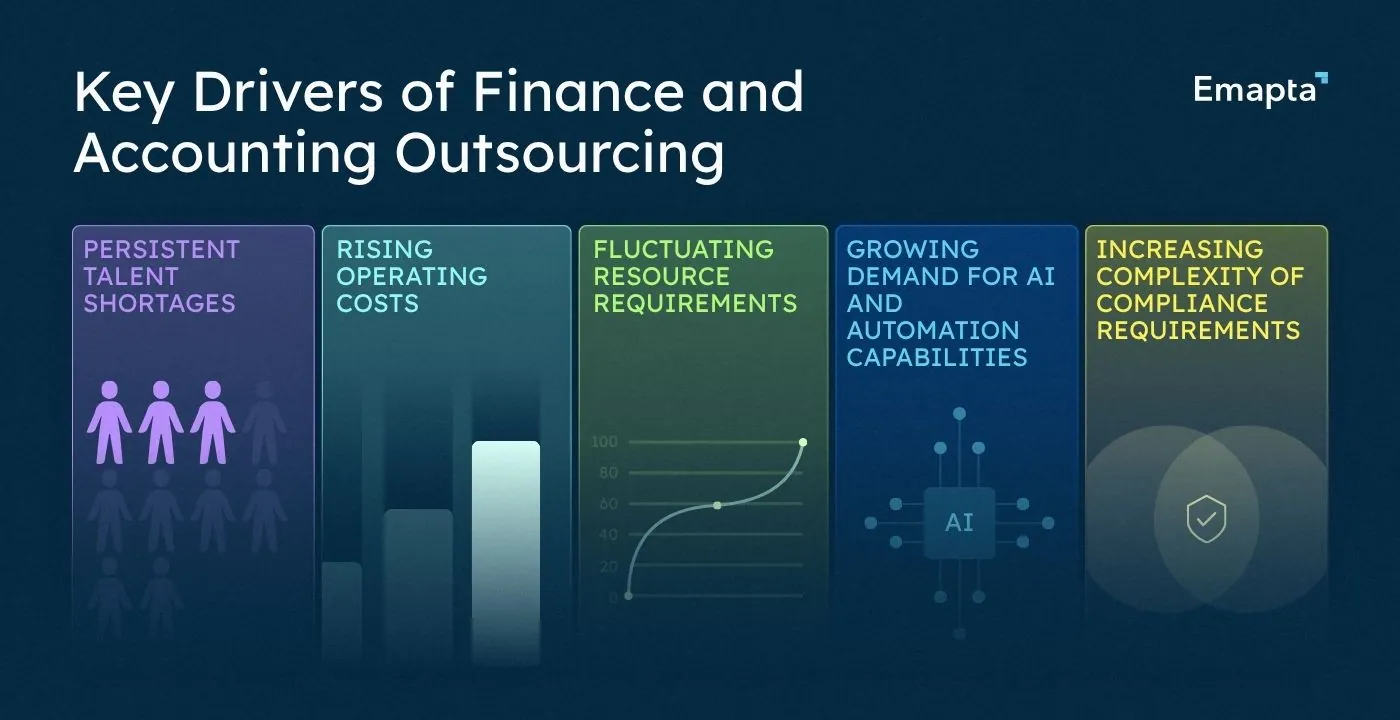
The most common reasons outlined below can help you identify similar pressures and opportunities within your own organization. You can then assess where external support could have the greatest impact.
1. Persistent Talent Shortages
Talent shortages across the finance and accounting industry can leave critical roles unfilled for longer, placing more pressure on in-house teams and limiting the function’s ability to support wider business priorities.
When specialized expertise is difficult to find locally, outsourcing allows companies to draw from talent pools across different regions. This enables them to close capability gaps more quickly and maintain continuity across essential processes.
2. Rising Operating Costs
The cost of building and maintaining sufficient finance capabilities in-house can lead companies to consider outsourcing. After all, it can reduce expenses associated with:
- Recruitment and onboarding
- Salaries and employee benefits
- Training and development
- Technology and infrastructure
Outsourced accounting services can also make spending more predictable while allowing companies to direct resources toward more pressing business needs.
3. Fluctuating Resource Requirements
Outsourcing gives leaders the flexibility to adjust capacity as business needs change. This demand for greater adaptability is also shaping broader trends as companies seek arrangements that can scale with their requirements. They can add support during busy periods, bring in specialists for specific projects, or expand a dedicated team without repeatedly hiring or restructuring in-house.
4. Growing Demand for AI and Automation Capabilities
Some companies turn to external support when they lack the technology or expertise to implement AI effectively across finance and accounting processes. Outsourcing providers with established capabilities can help strengthen key areas of the function without requiring companies to build everything from the ground up, including:
- Workflow efficiency
- Data analysis
- Financial visibility
5. Increasing Complexity of Compliance Requirements
Increasingly complex compliance obligations and financial risks can create a need for additional expertise and oversight. Through outsourcing, companies can bring experienced professionals to help maintain reliable controls, prepare for audits, and respond to changing requirements.
Outsourced Finance and Accounting Pros & Cons
Deciding to outsource finance and accounting, and how to go about it, should support both your immediate requirements and the future direction of your function. A model that addresses today’s workload may not provide the control or capabilities your organization will need as it evolves.
Weighing the pros and cons can help you identify gaps that need to be addressed and assess whether building a global finance and accounting team can support your priorities over time.
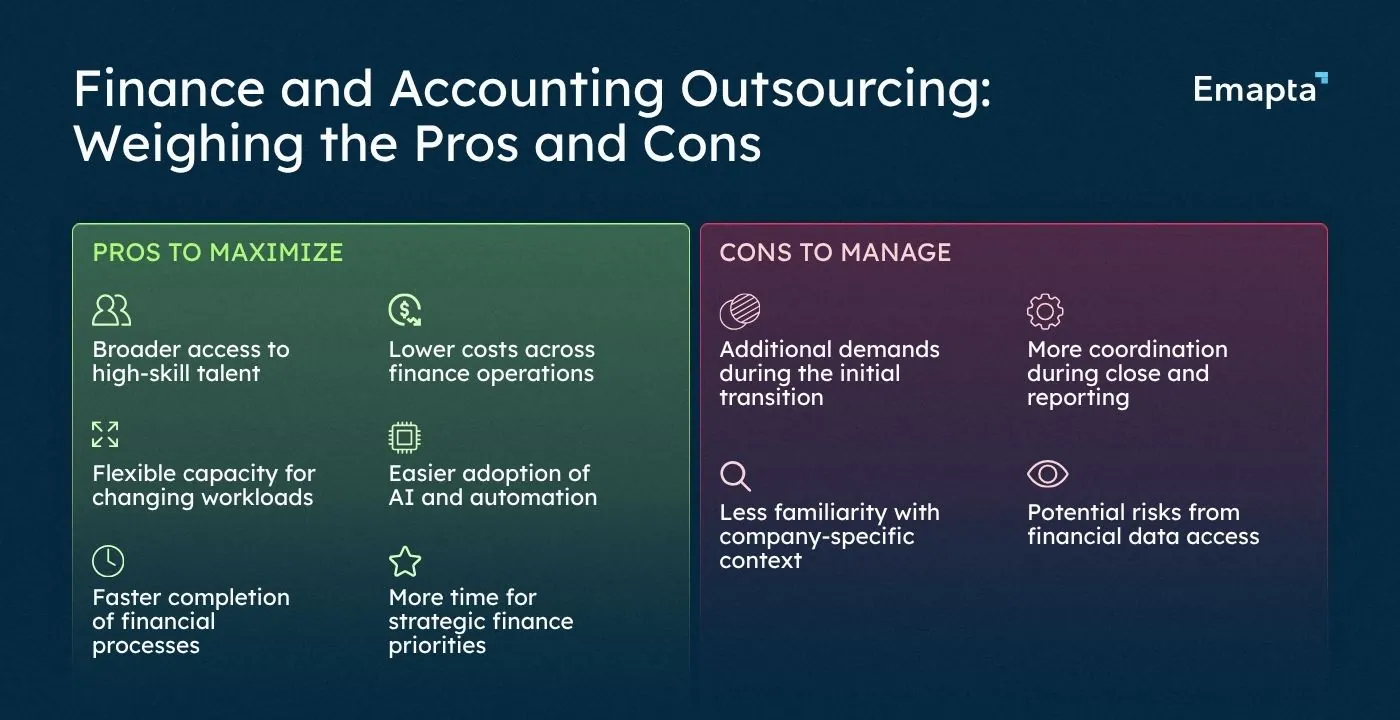
What Are the Benefits of Outsourced Finance and Accounting?
Access to highly skilled global professionals can help organizations manage essential processes more efficiently, accurately, and reliably. These advantages help explain why the global FAO market is projected to reach USD 85.92 billion by 2031.
a) Access to a Broader Global Talent Pool
Recruiting across markets gives you a wider selection of qualified finance and accounting professionals than local hiring alone.
b) Lower Operating Costs
A more cost-efficient delivery model can create room in your budget for other operational priorities.
c) Greater Operational Flexibility
The best providers allow you to adjust the scope and level of support as your needs change. This could mean scaling capacity during busy periods or structuring a remote setup around your preferred hours of coverage.
d) Faster Turnaround Times
Dedicated support and extended time-zone coverage can keep reconciliations and transaction processing moving beyond local business hours, helping you complete the month-end close sooner.
e) Stronger AI and Automation Capabilities
Working with a provider that has established automation capabilities gives you access to the technology and expertise needed to accelerate AI adoption.
f) Greater Focus on Strategic Priorities
Delegating selected operational responsibilities gives internal leaders more time for other work that depends on institutional knowledge and close stakeholder involvement.
What Are the Potential Drawbacks of Outsourced Finance and Accounting Services?
Potential drawbacks can be managed through careful planning and clear oversight. Understanding them early can help you establish appropriate safeguards and set clear expectations when outsourcing.
a) Initial Transition Demands
Transferring reconciliations, reporting tasks, and approval workflows requires detailed documentation and training, which can temporarily add to your internal workload.
b) Limited Institutional Context
External professionals may need time to understand your accounting policies, transaction patterns, and business context before handling judgment-heavy work effectively.
c) Close and Reporting Coordination
Month-end close often depends on timely inputs and approvals, so unclear handoffs between internal and outsourced professionals can cause delays.
d) Financial Data Access Risks
Providing access to financial systems and confidential records requires carefully managed permissions, security controls, and confidentiality requirements.
How to Outsource Finance and Accounting Functions?
The outsourcing process involves a series of connected decisions, from assessing your needs to refining how the setup works. Taking a structured approach helps you establish clear responsibilities and expectations with your provider.
The following steps provide a practical framework you can adapt to the scope and complexity of the services you plan to outsource.
Step 1: Assess Your Needs and Readiness
Start by diagnosing what’s placing pressure on your finance and accounting function and what needs to change as a result. Clarify:
- The underlying problem and its effect on the business
- The outcome you want the function to achieve
- Why external support is an appropriate response
Your desired outcomes can remain directional until you define success metrics later. You’ll also need to assess whether your organization can provide the internal support required for setup.
The Result
By the end of this step, you’ll have:
- A clearly defined business need
- Documented readiness gaps and next actions
- A decision to proceed or prepare further before outsourcing
Step 2: Identify Which Roles to Outsource
List the finance and accounting responsibilities you want professionals to cover, then organize them by the type of expertise required. You can keep these initial requirements high-level at this stage. Commonly outsourced roles include:
- Bookkeepers
- AP/AR Specialists
- Staff Accountants
- Payroll Specialists
- Tax Accountants
- Controllers
Location-specific knowledge should also shape your initial requirements. For example, US accounting outsourcing may require GAAP experience, while work for EU-listed companies may call for knowledge of EU-adopted IFRS.
The Result
By the end of this step, you’ll have:
- A prioritized list of roles to outsource
- A high-level scope and required expertise for each
- A clear view of which responsibilities will remain in-house
Step 3: Choose the Right Provider
Research providers that can support the initial requirements in step two. Build a shortlist, then evaluate each option using the same criteria so your decision is based on more than cost or availability. Key considerations may include:
- Relevant F&A experience and accounting framework expertise
- Recruitment, assessment, and retention practices
- Compatibility with your ERP and accounting systems
- Documented security controls for financial data
- Pricing model and clarity of included services
- Standard contract terms and negotiation flexibility
Validate each provider’s claims through references and supporting documentation before making your selection.
The Result:
By the end of this step, you’ll have:
- A selected provider aligned with your F&A requirements
- A documented rationale for your decision
Step 4: Develop Your Workforce Strategy
Once you select a provider, work with them to develop a workforce strategy that reflects your requirements and business context. They should lead the process while you contribute internal knowledge, review their recommendations, and confirm the final direction.
This may include:
- Final role scopes and skill requirements
- Team structure and governance frameworks
- Location strategy – including offshore, nearshore, or hybrid delivery
- Future-state operating models
The Result
By the end of this step, you’ll have:
- An approved workforce strategy
- A shared understanding of the proposed team and delivery approach
- Agreed next steps for putting the strategy into action
Step 5: Define Success Metrics
Work with your provider to define success at two levels for the services you want to outsource: the performance of the team and the business impact of the engagement. This prevents activity metrics from being mistaken for meaningful outcomes.
Measures may include:
- Team performance: Accuracy, turnaround times, productivity, and service-level adherence
- Business impact: Faster month-end close, lower operating costs, reduced backlogs, and more internal capacity for strategic work
Decide which team-performance measures should be formalized as service-level agreements (SLAs). These should focus on results the provider can directly control and be documented before implementation begins.
The Result
By the end of this step, you’ll have:
- An agreed performance scorecard
- Metrics covering team performance and business impact
- Defined baselines, targets, and reporting schedules
Step 6: Collaborate on the Implementation Process
At this point, all major details and contract terms should be finalized. Your provider should lead implementation while you coordinate internal requirements and keep affected stakeholders informed.
Implementation activities may include:
- Recruiting and onboarding your global F&A team
- Documenting processes and transferring knowledge
- Setting up system access and security permissions
- Scheduling the launch around close and reporting deadlines
Use the agreed governance structure to track progress, resolve issues, and confirm readiness before work begins. A phased launch may be best for complex or high-risk processes.
The Result
By the end of this step, you’ll know how to outsource finance and accounting and have the following:
- An onboarded workforce ready for service delivery
- Validated workflows, controls, and system access
- A confirmed launch plan and start date
Step 7: Continuously Review and Refine
Your outsourcing arrangement should evolve with your organization rather than remain fixed after launch. Review results with your provider regularly, then adjust processes, responsibilities, or staffing as priorities change.
Wrapping Up
Global teams can help organizations fill capacity gaps, access specialized talent, and adapt to changing demands. Realizing these benefits requires a clear scope, the right provider, and close collaboration throughout the engagement.
When you treat outsourcing as an opportunity to design your finance and accounting function more intentionally, its value extends beyond relieving immediate pressure. The choices you make around ownership, expertise, and accountability can shape how you outsource finance and accounting functions that support the business long after launch.