

Which Finance and Accounting Functions Should You Outsource
Choosing the right finance functions to outsource can determine whether your outsourcing partnership saves time or creates more work. Many businesses default to outsourcing bookkeeping and payroll alone, missing opportunities in tax compliance, financial analysis, and reporting. Knowing which accounting functions to outsource, and which to keep in-house, helps you build a leaner finance operation without losing strategic control.
This guide breaks down the finance and accounting functions worth delegating to a trusted outsourcing partner, why they matter, and how we support you through global talent and the Emapta Talent Marketplace.
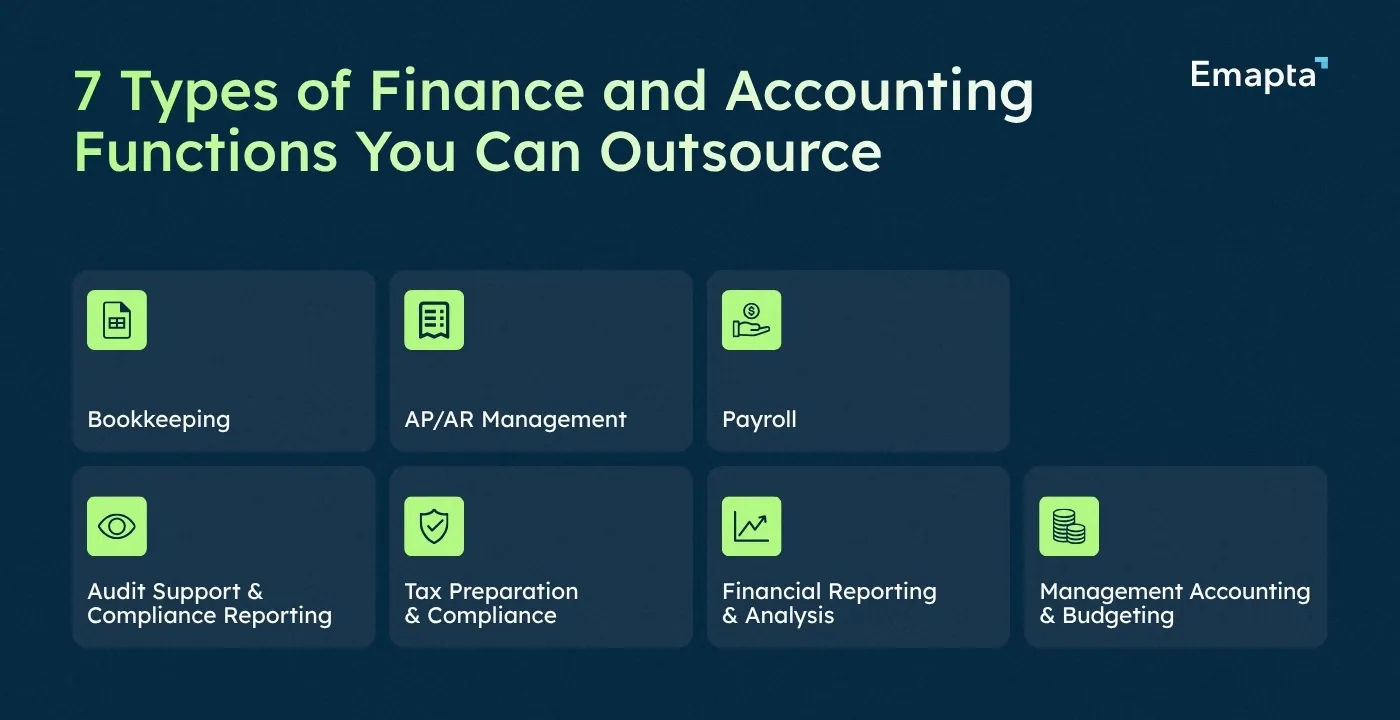
7 Types of Finance and Accounting Functions You Can Outsource
Finance and accounting cover a wide range of tasks, and not every function needs to stay in-house. The types of finance and accounting functions you can outsource span from routine tasks to strategic ones, and the seven below are where most businesses start, roughly in order of how quickly they typically delegate them.
1. Bookkeeping and Transaction Processing
Bookkeeping remains the foundation of outsourced finance work, covering daily transaction recording, account reconciliations, and general ledger maintenance. Handing this off frees your in-house team from repetitive data entry so they can focus on decisions rather than data. It also gives you cleaner books to build every other financial function on top of, which matters once you start layering on analysis or forecasting.
2. Accounts Payable and Accounts Receivable Management
Outsourcing accounts payable and receivable are the pillar accounting functions to outsource as both roles keep cash flowing in both directions without delays. A dedicated team manages vendor payments, invoice processing, and collections, while also tracking outstanding balances so nothing slips through the cracks.
The importance of effective receivables management is clear: PwC’s 2024 Working Capital Study found that days sales outstanding (DSO) had increased 6.6% over the previous five years, while identifying €1.56 trillion in excess working capital globally.
3. Payroll Processing and Administration
Payroll is one of the accounting functions to outsource first since it combines strict deadlines with constant regulatory change. An outsourced payroll team manages salary computations, statutory contributions, and payslip distribution, reducing the risk of compliance errors. This keeps employees paid accurately and on time every cycle, regardless of headcount growth or shifting local requirements.
4. Tax Preparation and Compliance
Tax preparation covers far more than annual filings. Outsourced tax teams handle quarterly estimates, jurisdiction-specific compliance, and documentation for audits, catching deductions your in-house team might miss. Partnering here also reduces the risk of penalties tied to late or inaccurate filings, particularly for businesses operating across more than one tax jurisdiction.
5. Financial Reporting and Analysis
Beyond compiling balance sheets and income statements, outsourced finance functions can extend into full financial analysis, profitability tracking, and trend reporting. These insights help leadership make faster, better-informed decisions about spending, investment, and growth.
Structuring this function well often determines how much strategic value an outsourcing partnership delivers, since raw numbers only become useful once someone interprets them, which is part of the reason finance and accounting outsourcing tends to work best as a broader strategy rather than a single hire.
6. Management Accounting and Budgeting
Management accounting functions, like budgeting, variance analysis, and cash flow forecasting, give leadership an ongoing view of financial health rather than a once-a-year snapshot. Outsourcing this work turns one of the more advanced finance functions to outsource into forward-looking guidance, not just historical reporting. Many businesses pair this with a dedicated remote accounting and finance team built specifically to support that kind of ongoing analysis.
7. Audit Support and Compliance Reporting
Audit preparation and statutory compliance reporting round out the list of finance functions to outsource, since both require meticulous documentation and up-to-date knowledge of changing regulations. An outsourced team organizes records, prepares schedules, and coordinates with auditors so internal staff are not pulled away from daily operations. This reduces audit stress while keeping your business audit-ready year-round, instead of scrambling in the weeks before a filing deadline.
Why You Should Outsource Finance and Accounting Roles
Outsourcing finance and accounting roles is increasingly about more than reducing costs, though the savings are still real. Deloitte’s 2025 Global Business Services Survey found that roughly half of organizations achieved more than 20% savings through their GBS operations. Many are also prioritizing next-generation capabilities and customer experience alongside cost efficiency.
A dedicated outsourced team brings something cost savings alone can’t: continuity. Instead of losing institutional knowledge every time an in-house hire leaves or moves teams, businesses gain a stable, scalable function. It grows alongside demand rather than resetting with every hire.
That stability matters more as AI reshapes the profession. In a separate 2025 Deloitte survey of more than 3,300 finance and accounting professionals, 80.5% said they expect AI-powered tools to become standard in the profession within five years.
Hiring the top 1% of highly-skilled talent, trained to work with industry-leading AI tools for greater productivity and efficiency, gives you a head start on that shift instead of a separate investment to catch up later.
Industry trends also support the shift. Data shows that 83% of executives leverage AI as part of outsourced services. More companies are moving beyond transactional bookkeeping toward strategic finance partnerships that combine automation, data security, and specialized expertise.
Which Accounting Functions Should You Outsource by Working With Emapta
We start by matching you with vetted finance and accounting professionals through the Emapta Talent Marketplace (ETM).
We handle the backend, HR, compliance, IT, and facilities, so you can direct the actual work your outsourced finance team performs, without carrying the administrative load of managing a remote office yourself. With eight talent hubs across the globe, including 16 offices across the Philippines, we give you flexibility in where and how you build your finance function.
Whether you’re outsourcing a single accounting role or building a full department, our accounting outsourcing solutions are designed around your structure, not a fixed package. Most partners start with one or two roles and scale from there, which is typically how we outsource for growing teams.
Wrapping Up
Deciding which finance functions to outsource is not about handing off everything at once. Start with the tasks that drain the most time, like bookkeeping, payroll, or accounts payable, then expand into higher-value functions such as financial analysis and management accounting as the partnership matures.
The right outsourcing partner should grow with the business, expanding its support across compliance, reporting, and strategic finance as needs evolve.