

Outsourcing in Healthcare – Key Services & Best Practices
From administrative functions to specialized support, outsourcing in healthcare lets providers extend their capabilities beyond their internal teams. This can improve efficiency, broaden access to expertise, and free up resources for patient-facing priorities.
With a clear understanding of how the practice works, you can make informed decisions on which roles to outsource and how external expertise can best support your organization. Let’s dive into the most common services, the challenges it can help solve, and what to consider when building the right approach.
Outsourcing in the Healthcare Industry – Key Takeaways
- Outsourcing can help your healthcare organization add capacity, expertise, and flexibility in areas where internal resources fall short
- Common drivers include talent gaps, burnout, cost pressure, patient experience, service coverage, and compliance needs
- Frequently outsourced services span administrative, technical, financial, and patient support functions
- Success depends on clear needs, the right partner, thoughtful implementation, and continuous improvement over time
What is Outsourcing in Healthcare?
Hospitals, clinics, health systems, and insurers use outsourcing to move selected responsibilities to an external provider instead of handling them all internally. These arrangements can span administrative support, revenue cycle management, and specialized clinical or technical services, depending on the organization’s needs.
The scope for outsourcing in healthcare can also differ significantly from one arrangement to another. Companies may use external support for:
- Individual roles
- Specific processes
- Ongoing functional support
- End-to-end service delivery
- Specialized expertise
The setup can vary based on how and where support is delivered. Organizations may work with providers in the same market or build distributed teams across different locations, depending on factors such as talent availability, cost, coverage, and operational requirements.
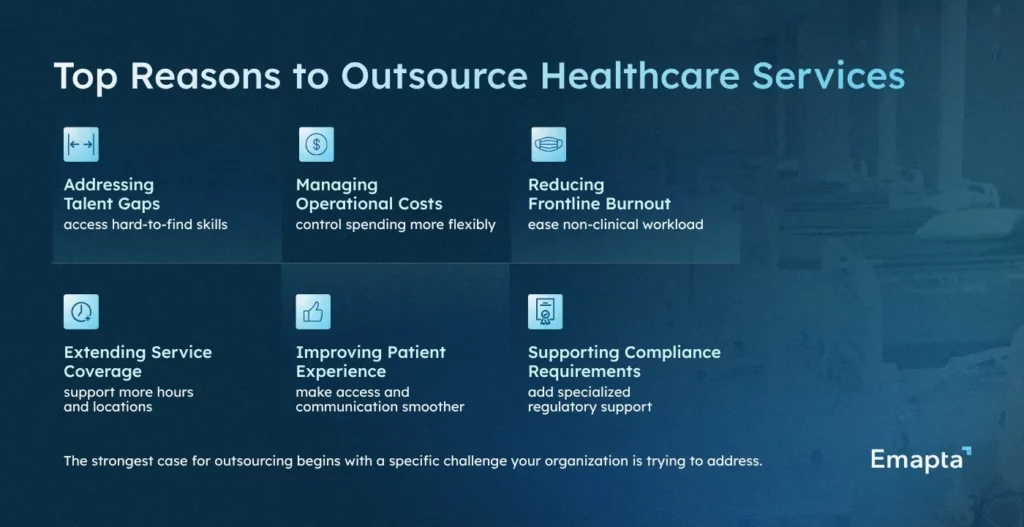
6 Reasons Why Should You Outsource Healthcare Services
Outsourcing can help you strengthen care delivery and operations when internal resources, expertise, or capacity are not enough to meet every demand. These are some of the key challenges that can make external support a practical option for your organization:
1. Addressing Talent Gaps
When hiring cannot keep pace with workforce demand, outsourcing in healthcare can open access to qualified support professionals beyond your immediate talent market. That added reach can help you address vacancies and keep essential services running.
Current workforce data shows how wide that gap can be. In the U.S., 2.2 million healthcare and healthcare support jobs are open, compared with fewer than 420,000 unemployed workers seeking these roles. That’s roughly five openings for every available job seeker.
2. Managing Operational Costs
Staffing, systems, regulatory requirements, and extended service hours can quickly drive up operating costs. Outsourcing can help you control that spend without building every healthcare capability in-house.
3. Reducing Frontline Burnout
Burnout remains a major concern among frontline professionals, with 54% of U.S. physicians surveyed reporting that they often experience it. This can worsen when administrative responsibilities add another layer of demand to already heavy clinical workloads.
Outsourcing can take some of that pressure off by shifting suitable non-clinical tasks to external teams. This gives frontline staff more room to focus on patient care and the responsibilities that require their expertise.
4. Extending Service Coverage
Outsourced offshore or nearshore professionals can help you extend healthcare service coverage when internal teams cannot easily support every shift, location, or area of demand. This is especially useful for after-hours needs, seasonal surges, or broader service requirements.
5. Improving Patient Experience
Better patient care often depends on what happens around the clinical interaction, not just during it. Outsourced support can help keep scheduling, documentation, billing, and other essential processes moving so patients receive more timely and coordinated service.
7. Supporting Compliance Requirements
Compliance requirements can be difficult to manage as regulations, documentation standards, and data privacy rules evolve. Outsourcing providers with healthcare expertise can help support adherence to requirements such as HIPAA, especially in functions that handle protected health information, billing, records, or other regulated processes.
6 Most Common Outsourced Healthcare Services
Healthcare services that organizations often entrust to external providers tend to sit around the clinical core of care delivery, supporting the processes that keep day-to-day operations running smoothly. These can range from administrative and patient support to technology and revenue cycle functions.
a) Medical Billing and Coding
Outsourced medical billing and coding helps healthcare providers turn patient care into accurate claims and payments. It includes assigning standardized codes to diagnoses and procedures, preparing and submitting claims, following up on denials, and helping make sure reimbursements are processed correctly.
Business Impact
- Improved claim accuracy and fewer preventable billing denials
- Faster reimbursement and steadier organizational cash flow
- Reduced billing workload and greater internal team efficiency
b) Appointment Scheduling
Appointment scheduling covers patient bookings, rescheduling, cancellations, reminders, and calendar coordination across providers or locations. External support can help reduce booking friction and make it easier for patients to secure the right appointment at the right time.
Business Impact
- Shorter wait times and smoother patient access
- Fewer scheduling errors, missed appointments, and calendar gaps
- More efficient use of provider time and available slots
c) Patient Communications
Communication services outsourcing in healthcare can give you added support for handling inquiries, appointment reminders, follow-ups, care instructions, and other routine interactions. With the right support, patients can get clearer answers and more consistent communication throughout their care journey.
Business Impact
- Faster response times across patient communication channels
- More consistent follow-ups and fewer missed touchpoints
- Better patient access to timely information and support
d) IT Help Desk
IT help desk support helps you resolve everyday technology issues that can disrupt staff workflows and patient services. Outsourced teams can handle troubleshooting, access requests, and system support, and even work with AI-assisted tools that speed up ticket routing and surface common fixes. These are the biggest reasons why healthcare companies are outsourcing IT.
Business Impact
- Faster resolution of routine technical support issues
- Less downtime across critical systems and workflows
- Support that works with your existing tools and systems
e) Insurance and Eligibility Support
Before care can move forward, providers often need to confirm coverage, benefits, and eligibility. Outsourcing these checks to experienced support teams can help healthcare organizations avoid administrative delays and catch coverage issues earlier.
Business Impact
- Fewer coverage-related delays and billing complications
- Lower risk of denied or delayed reimbursements
- More efficient use of administrative resources
f) Medical Transcription
Outsourcing in the healthcare industry often extends to documentation support, including medical transcription. The service turns dictated clinical notes into accurate written records while helping clinical staff spend less time on manual documentation.
Business Impact
- Faster turnaround for clinical documentation and records
- More consistent documentation across patient files
- Less administrative work for clinicians and support staff
See how a U.S. healthcare network built a 74-person HIPAA-compliant offshore team.

How to Effectively Outsource Healthcare Roles
A successful outsourcing arrangement comes down to building support that fits your organization without disrupting care delivery. The goal is to add capability in a way that feels integrated, reliable, and sustainable. A few key practices can help you put that foundation in place:
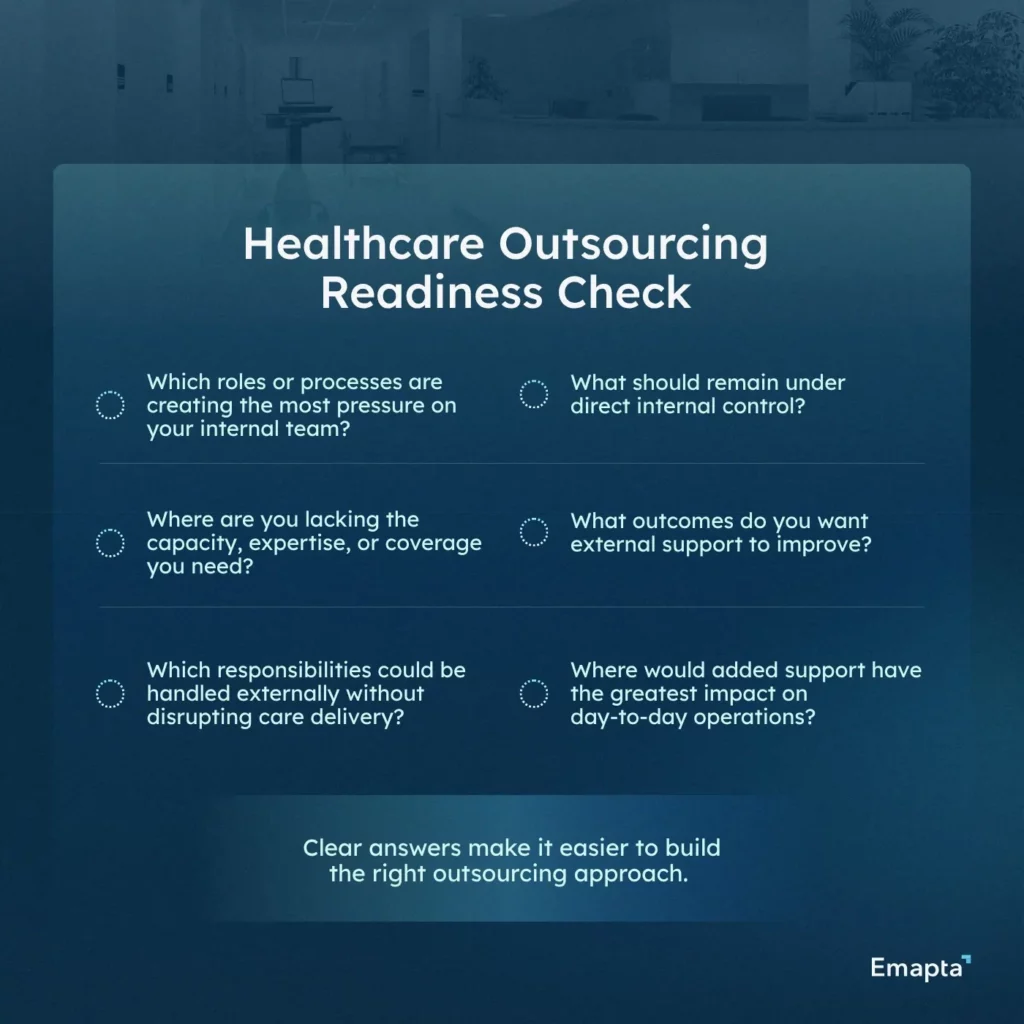
1. Assess Your Needs
Start by identifying where internal capacity, expertise, or coverage is falling short. Look at the roles and processes creating the most pressure, then determine whether the gap calls for additional people, specialized skills, or broader outsourced support for your healthcare workforce.
2. Choose the Right Partner
Look for an outsourcing provider with proven experience supporting organizations like yours and the expertise needed for the roles you plan to outsource. Review their compliance practices, security standards, talent quality, technology capabilities, and track record before deciding whether they are the right fit.
3. Define Roles and Responsibilities
Your provider should take the lead in building a workforce strategy around the gaps and priorities you identified, with your leadership closely involved in shaping the final setup.
For outsourcing in healthcare to work well, both sides should agree on which roles sit with the external team, how responsibilities connect with internal staff, and where accountability ultimately rests.
4. Plan the Implementation
Your provider should translate the agreed strategy into a practical rollout plan, while you provide the internal context, access, and input needed to make it work. Together, you can coordinate timelines, onboarding, knowledge transfer, systems access, and workflow integration to keep the rollout smooth.
5. Establish Communication and Governance
Set clear ways for your internal and external teams to share updates, raise issues, and make decisions as the partnership gets underway. In healthcare, strong governance can make outsourcing easier to manage by keeping responsibilities visible, communication consistent, and issues addressed quickly.
6. Enable Continuous Improvement
Track results against the goals you set and review how well the arrangement is working overtime. Regular check-ins can help you spot gaps early, make adjustments, and keep performance aligned with changing needs.
Wrapping Up
External healthcare support is becoming more strategic. As providers face growing pressure around talent, cost, access, and compliance, the strongest arrangements will be the ones that extend capability in ways that feel integrated with how care is actually delivered.
Understanding where outsourcing in healthcare fits in your operations can help you make more deliberate decisions about the roles and services your organization needs. The right approach should strengthen your capabilities while still reflecting how your teams work and how you support the people you serve.