

6 Benefits of Outsourcing in Healthcare for Better Operations
Your healthcare team may be doing everything right and still feel stretched.
Patient needs keep growing. Billing requires constant attention. Customer support can’t stop. Meanwhile, every hour your in-house team spends handling administrative work is time they can’t spend on higher-value tasks, including patient care.
That’s where the benefits of outsourcing in healthcare come in. The right outsourcing strategy can give you extra capacity, access to specialized talent, and a more flexible way to manage essential functions without overloading your internal team.
Here is what a successful healthcare outsourcing operation looks like.
Benefits of Healthcare Outsourcing – Key Takeaways
- Outsourcing can reduce admin pressure, improve billing support, and expand access to specialized talent
- Healthcare staffing outsourcing adds flexibility as demand and workloads change
- Strong results depend on clear KPIs, data protection, and internal oversight
- The biggest impact: more time for patients and higher-value work
What Are the Main Benefits of Outsourcing in Healthcare?
The main value of healthcare outsourcing is not simply doing the same work for less. It’s creating more capacity for the work your organization needs to keep in-house.
That may mean freeing clinicians from administrative tasks, supporting an overburdened revenue cycle team, or accessing specialists who are difficult to recruit locally.
Let’s take a closer look at the main healthcare outsourcing benefits of building an outsourced operation for your healthcare business.
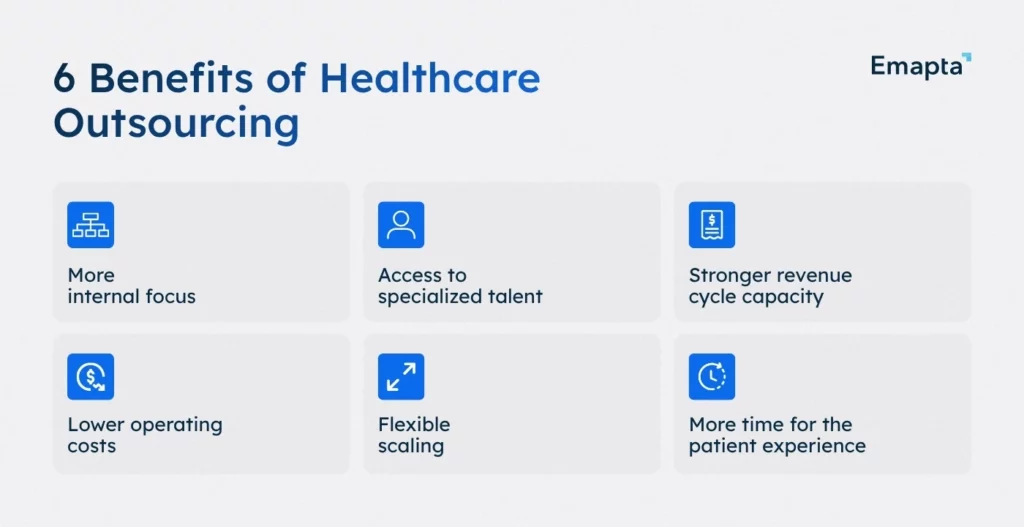
1. Give your internal teams more time to focus
As patient volumes grow, so do appointments, authorizations, calls, claims, follow-ups, and records. Each task may look manageable on its own, but together they can pull skilled employees away from higher-value work.
Outsourcing support processes lets dedicated teams handle recurring administrative tasks while your people stay focused on patient care, core business strategies, and other responsibilities that require their direct involvement.
2. Access specialized healthcare talent
Not every capability needs to be built in-house.
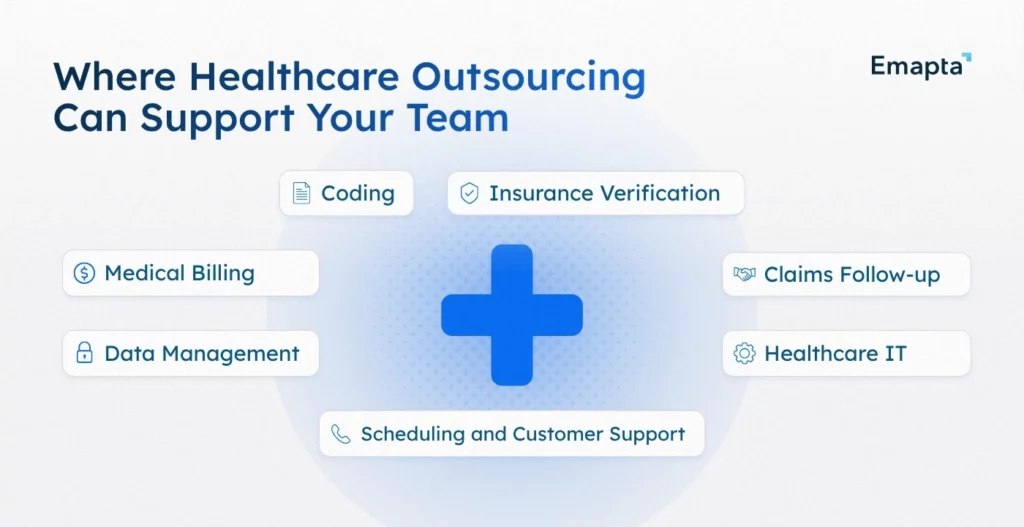
Medical billing, coding, claims follow-up, insurance verification, healthcare IT, and data management all require specialized expertise. Hiring for those skills internally can take time, especially when you need to grow quickly.
This is one of the biggest benefits of outsourcing in healthcare, as it gives you access to a broader pool of specialized talent, so you can build support around the experience, systems knowledge, and coverage your operation needs.
3. Improve billing and revenue cycle capacity
Medical billing problems usually build gradually. Missing information, coding errors, delayed follow-up, incomplete authorizations, and growing claim volumes can all put pressure on an already pressured revenue cycle team.
That’s one of the clearest benefits of outsourcing healthcare billing: adding dedicated, specialized support across key revenue cycle tasks, including:
- Eligibility and insurance verification
- Claims preparation and submission
- Denial management
- Claims follow-up and resubmission
The goal is not simply to move billing elsewhere. It’s to keep unresolved work from accumulating and affecting the rest of your revenue cycle.
4. Reduce selected operating costs
Building every capability in-house costs more than salaries. Recruitment, onboarding, management, equipment, technology, training, and infrastructure all add to the total cost of running a function.
When a specialized provider already has those capabilities in place, selected processes can often operate through a leaner model. In some cases, that can translate into total operational cost savings of up to 50%.
In a highly competitive healthcare market, those savings can make a meaningful difference. The goal is not simply to cut costs, but to improve the economics of a process without compromising its quality.
5. Scale capacity as demand changes
Healthcare workloads rarely grow in a predictable way. You might open a new location, see a sudden increase in patient volumes, face a growing backlog, or add a new specialty, payer, or service line.
Hiring permanent employees to cover every peak can leave you overstaffed later. But waiting until demand rises can put too much pressure on the team you already have.
One practical benefit of outsourcing healthcare staffing is the flexibility to add support as needs change, without rebuilding your recruiting, onboarding, and infrastructure processes each time.
The key is knowing where that extra capacity will have the most impact.
Understanding how outsourcing works across different healthcare processes can help you identify which functions are best suited for external support, and which ones should remain in-house.
6. Protect more time for the patient experience
Patients may never see your revenue cycle or administrative workflows, but they often feel the impact when those processes take too much time away from care.
That is a significant amount of time spent away from patients and other higher-value responsibilities.
By shifting suitable administrative and support tasks to external teams, you can give your in-house staff more room to focus on the interactions that matter most: delivering timely, attentive, and high-quality patient care.
How to Implement and Optimize Outsourcing in Healthcare
Successful healthcare outsourcing starts with the problem you want to solve, not with a list of tasks you want to move elsewhere.
Identify where your team is feeling the most pressure: backlogs, overtime, errors, hiring challenges, slow turnaround times, patient complaints, or repetitive administrative work.
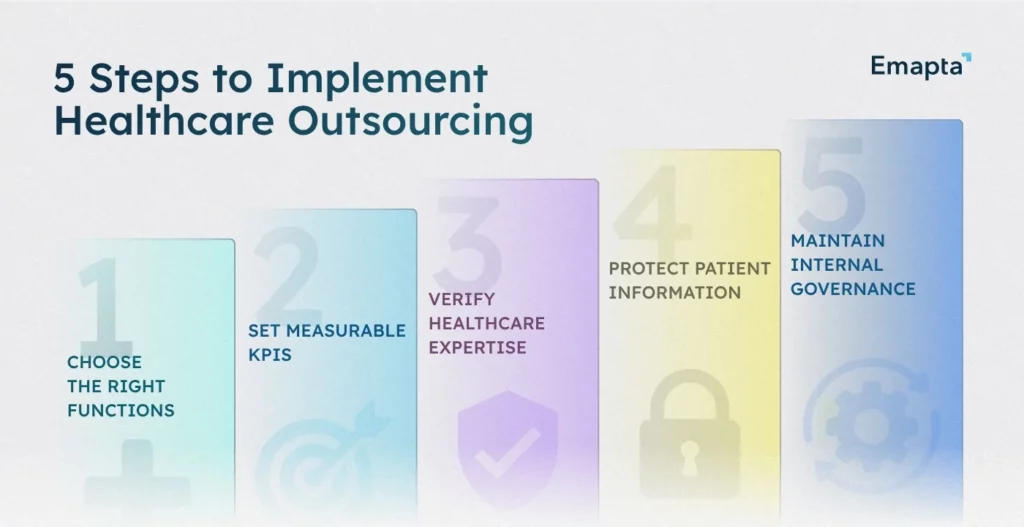
From there, determine the processes that can be documented clearly, transferred smoothly, and measured consistently. If you are not sure where to begin, these guidelines can help:
- Choose the right functions: Prioritize repeatable processes that don’t require you to give up essential clinical or strategic control.
- Set measurable expectations: Define KPIs such as claim accuracy, turnaround time, response time, backlog, denial rates, or service-level achievement.
- Check healthcare expertise: Your provider should understand the systems, terminology, regulations, and workflows associated with the work.
- Protect patient information: Providers handling protected health information may qualify as HIPAA business associates and require appropriate contractual safeguards, including a Business Associate Agreement where applicable.
- Keep governance internal: Maintain regular performance reviews, escalation procedures, quality checks, and clear accountability on both sides.
Ultimately, the right outsourcing partner should feel like an extension of your operation, not another vendor that creates more work for your team.
One way to achieve that is by building dedicated healthcare outsourcing teams that are aligned with your workflows, performance standards, and day-to-day priorities from the start.
Discover how leading healthcare organizations are redesigning work across people, process, technology, AI, and specialized global talent.

Wrapping Up
Healthcare organizations are under constant pressure to manage rising patient demand, administrative workloads, staffing gaps, billing complexity, and the need to protect the patient experience.
The benefits of outsourcing in healthcare can help address those challenges by adding specialized support, improving flexibility, expanding capacity, and reducing pressure on internal teams.
The biggest impact is not simply lower costs. It is creating a more resilient operation where your people can focus on higher-value work, patients receive more consistent support, and your business is better equipped to grow.