
10 Benefits of Outsourcing to India for Global Companies
The benefits of outsourcing to India go far beyond lower labor costs. For many global companies, India has become the go-to destination for building offshore teams that handle complex technical, analytical, and business support work at scale. A deep talent pool, strong English proficiency, and growing expertise in artificial intelligence (AI) make the country a strategic choice rather than a cost-cutting shortcut.
Today, we will break down 10 key advantages what savings to expect, and how to tell if India is the right fit for your business.
Key Advantages of Outsourcing to India
- India offers one of the world’s largest pools of tech, AI, and business services talent
- Companies can significantly reduce workforce costs while maintaining quality and control
- Time zone differences enable round-the-clock productivity for U.S. and European businesses
- India is a strong fit for technical, data, and AI-driven roles that need to scale quickly
Why Are Global Companies Outsourcing Talent to India?
Global companies outsource talent to India to access skilled professionals at lower costs, fill roles that are difficult to staff at home, and extend working hours across time zones. India’s large tech workforce and growing AI expertise also make it a practical way to scale teams and keep pace with innovation.
India was once known mainly for IT services and back-office support. Today, offshore outsourcing to India spans software engineering, data analytics, finance, and AI-enabled workflows.
This shift is driven by hiring shortages in the U.S., UK, and Australia, along with pressure to modernize operations without inflating payroll. That is why understanding the benefits of outsourcing to India has become essential for leaders planning a global workforce strategy.

10 Benefits of Outsourcing to India
Each of the benefits below addresses a different business need, from controlling costs to closing skill gaps and extending operating hours. Together, they explain why many companies now treat India as part of their long-term workforce strategy rather than a one-off cost decision.
1. Significant Cost Savings
Lower salary benchmarks in India allow companies to hire skilled professionals at a fraction of onshore costs. These savings can be reinvested into growth initiatives, product development, or expanding the team itself. We break down what companies can realistically save in a later section.
2. Round-the-Clock Productivity
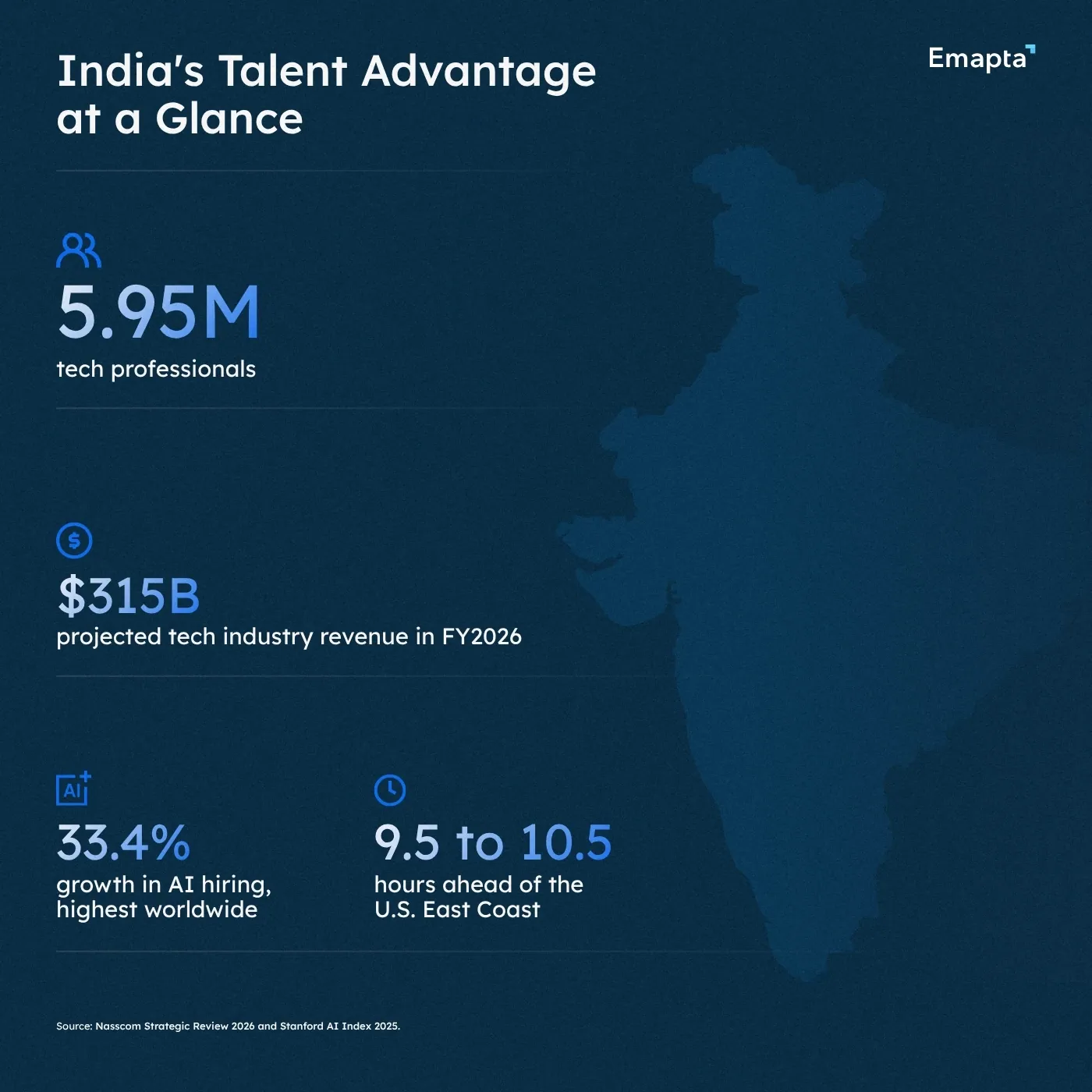
India is roughly 9.5 to 10.5 hours ahead of the U.S. East Coast, depending on daylight saving time. This allows work to continue overnight, so projects move forward while onshore teams are offline. For customer support and IT operations, it also makes extended or 24/7 coverage easier to achieve.
3. A Massive, Skilled Talent Pool
India’s outsourcing talent pool is among the largest in the world. According to the National Association of Software and Service Companies (Nasscom) Strategic Review 2026, the country’s tech sector employs nearly 5.95 million professionals and is projected to reach $315 billion in revenue in FY2026. This scale means companies can find experienced, senior specialists, not just entry-level hires, even for niche technical roles.
4. Strong English Proficiency
English is widely used in Indian business, higher education, and the tech sector. This makes day-to-day collaboration, documentation, and reporting smoother, especially for teams working closely with U.S., UK, and Australian stakeholders.
5. Growing AI and Emerging Tech Expertise
According to Stanford’s AI Index 2025, India recorded the highest year-over-year growth in AI hiring worldwide at 33.4% in 2024. This growing concentration of AI talent gives companies access to professionals with skills in areas such as machine learning, data science, and generative AI, making India increasingly viable for teams that need to add specialized capabilities without building an entire AI function from scratch.
6. Easy Scalability
With a deep talent supply, companies can grow from a small pilot team to a larger operation without the long hiring cycles common in tight onshore markets. This flexibility helps businesses respond quickly to new projects, seasonal demand, or expansion plans.
7. A Mature Outsourcing Ecosystem
India’s outsourcing industry has decades of experience supporting global businesses, giving companies access to an established ecosystem of talent, delivery expertise, and technology capabilities. According to Deloitte, India is poised to become the third-largest economy by 2027, strengthening its position as a key hub for outsourcing, evolving beyond traditional cost-focused models toward AI, innovation, and more strategic value creation.
8. Talent Across a Wide Range of Roles
One of the often-overlooked benefits of hiring talent in India is the variety of roles available. Beyond IT, companies commonly fill positions such as data analysts, accountants, customer support specialists, and digital marketers, giving them the flexibility to cover multiple functions through a single operation.
9. More Focus on Core Business Priorities
Companies that build an offshore team in India free up onshore employees to concentrate on strategy, innovation, and client relationships. Instead of stretching in-house resources thin, leaders can assign execution-heavy work to dedicated professionals who operate as a true extension of the business.
10. Strong Security and Compliance Standards
India’s data protection framework is maturing, with the government notifying the Digital Personal Data Protection Rules, 2025 in November 2025. Combined with international certifications like ISO 27001 that many established providers already hold, this gives companies a stronger foundation for outsourcing work involving personal or sensitive information. Before signing on, confirm that a partner’s security controls and contractual safeguards meet your industry and home-market requirements.
Discover why India is becoming the world’s go-to hub for AI-ready talent.

How Much Can Companies Save by Outsourcing to India?
Cost savings from outsourcing to India vary by role, seniority, and location, but the gap between onshore and Indian salary benchmarks is substantial. Emapta’s data shows that companies can reduce workforce costs by 30% to 70% compared with local hiring in markets like the U.S.
The difference also goes beyond wages. Companies avoid much of the expense and time tied to onshore recruitment, office space, and equipment. With a dedicated staffing model, clients pay their team’s salaries plus a transparent service fee, which keeps spending predictable.
Keep in mind that the lowest rate is not always the best value. Factor in onboarding time, management involvement, and retention when calculating your true return on investment.
When Is India the Right Outsourcing Destination for Your Business?
India is an especially strong fit if your business needs:
- Technical, data, or AI-focused roles that require specialized skills
- The ability to scale teams quickly across multiple functions
- Extended or overnight coverage to keep work moving 24/7
- Cost efficiency without compromising on quality
Every destination involves trade-offs. Limited working-hour overlap with the U.S. can be a challenge for roles that need constant real-time collaboration, and attrition in competitive tech markets requires active management. The right partner helps address both through structured onboarding, retention programs, and flexible shift arrangements.
With Emapta, companies can start building a dedicated team in India with the top 1% of highly-skilled talent, trained to work with industry-leading AI tools for greater productivity and efficiency. Emapta manages HR, compliance, IT, and facilities, while you direct your team’s day-to-day work and priorities.
Conclusion
India has earned its place as one of the world’s leading outsourcing destinations, and its role continues to expand as businesses invest in AI and digital transformation. Whether the goal is to lower costs, access specialized skills, or keep operations running across time zones, the country offers a compelling case for building offshore teams. For companies ready to grow smarter and compete globally, now is the time to explore the full benefits of outsourcing to India.
Frequently Asked Questions (FAQ)
The main benefits include significant cost savings, access to a large pool of skilled tech and business professionals, strong English proficiency, growing AI expertise, and time zone advantages that support round-the-clock productivity. India also offers a mature outsourcing ecosystem that makes it easier to scale teams quickly.
Data indicates that companies can typically reduce workforce costs by 30% to 70% compared with hiring locally in markets like the U.S. Actual savings depend on the role, seniority, and engagement model, as well as factors like onboarding and retention.
Companies commonly outsource software engineers, web developers, data analysts, IT help desk staff, accountants, customer support representatives, and digital marketing specialists to India. The talent pool also supports specialized AI, machine learning, and automation roles.
Outsourcing to India for U.S. companies offers access to skilled talent that is scarce or expensive locally, lower costs, and extended working hours through time zone differences. India’s strength in technology and AI also makes it a strategic choice for digital transformation.
The most common challenges are fewer shared working hours with U.S. teams, occasional communication gaps, employee turnover, and data protection concerns. An experienced partner can reduce these through strong security standards, a well-planned transition, and programs that keep talent engaged long term.