

A Quick Guide to Finance and Accounting Outsourcing Models
Behind every finance and accounting outsourcing arrangement is a model that determines how, where, and under what terms the work is delivered. Your choice ultimately affects the value your business receives, and the effort required to realize it.
By understanding how each option works and where it fits best, you can build an outsourced function that supports reliable performance over the long term. Let’s take a closer look at each one, so you can find an approach that turns added capacity into lasting capability.
What are the Different Types of Models in Accounting Outsourcing?
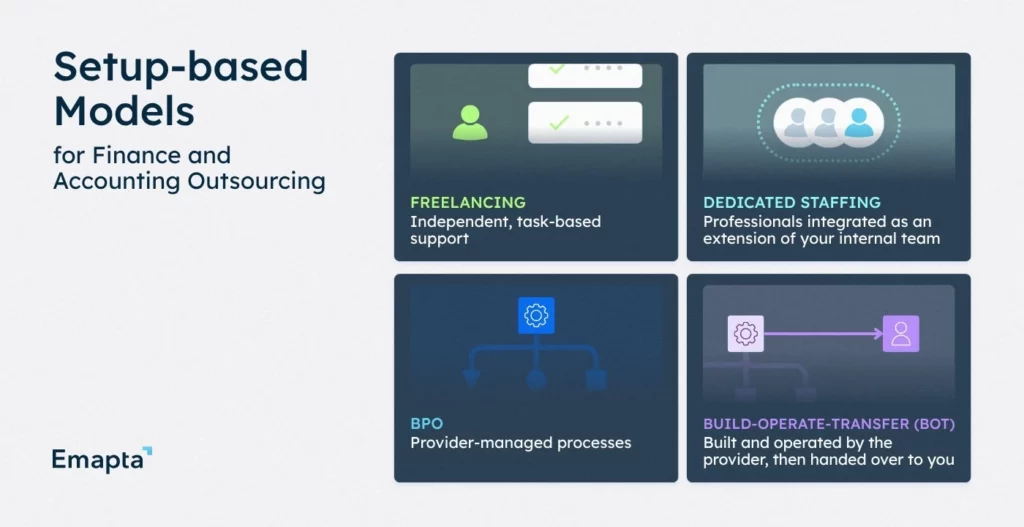
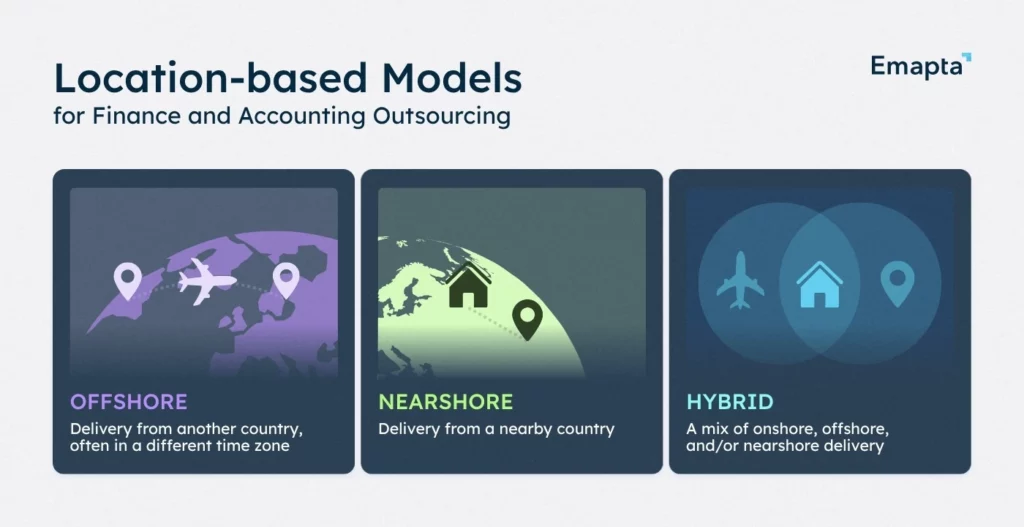
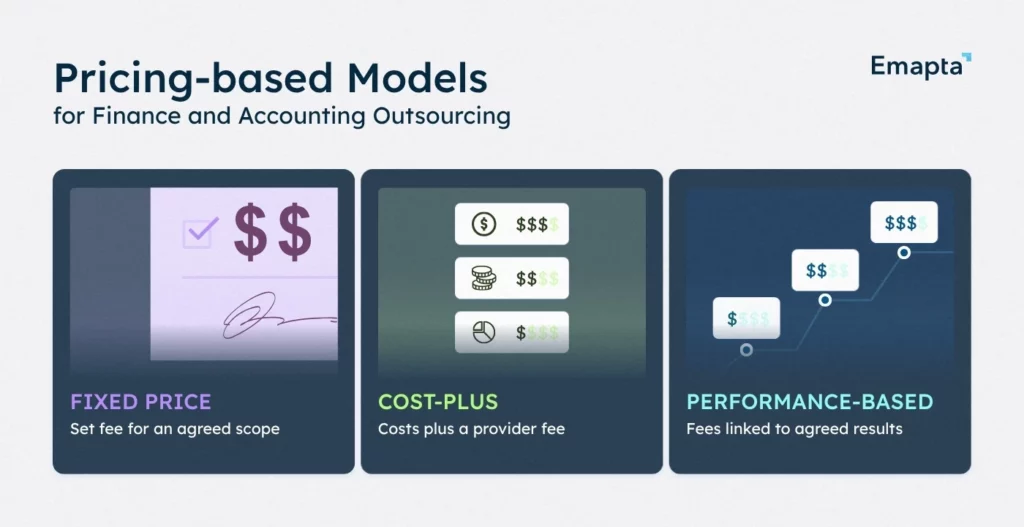
The types of finance and accounting outsourcing models are generally classified according to three main categories: engagement setup, location, and pricing. These categories are not mutually exclusive. Instead, they describe different parts of the arrangement and can be combined based on how your business wants the work delivered.
- Engagement Setup – How the external team works with your business, including its level of integration, your degree of control, and the provider’s responsibilities
- Location – Where the outsourced work is performed, which can affect talent access, time-zone coverage, and labor costs
- Pricing – How fees are calculated and how costs change based on staffing levels, workload, or agreed deliverables
For example, a business might use an offshore dedicated finance and accounting team under a monthly fee structure. The combination you choose shapes the overall cost, flexibility, and level of involvement required from your internal team.
10 Finance & Accounting Outsourcing Models for Your Business Needs
In finance and accounting outsourcing, a model serves as a blueprint that puts provider capabilities to work and turns a broad requirement into a defined service. These models may vary in complexity and scope, but each shapes how resources and responsibilities come together to support your organization’s needs.
1. Freelancer Model
Freelancing is an outsourcing model involves hiring an independent finance and accounting professional on a project-based or contractual basis. The freelancer works directly with your organization rather than through a provider-managed team, with responsibilities and deliverables typically defined by the agreed scope of work.
Best Use Cases
- Short-term or clearly defined project requirements
- Smaller or occasional workloads that do not require full-time support
- Temporary capacity needs during busy periods or workload spikes
2. BPO Model
One of the most widely recognized models, business process outsourcing (BPO) enables organizations to work with an external provider to handle work that would otherwise sit in-house. Depending on the arrangement, the provider may supply individual professionals, a dedicated team, or take responsibility for an agreed process or function.
The BPO model can include different delivery approaches for outsourced finance and accounting, such as staff augmentation and managed services. The provider’s role can also range from adding capacity that you manage directly to overseeing the people, processes, and outcomes behind the service.
Best Use Cases
- Ongoing finance and accounting requirements across one or more processes
- Functions that can be partially or fully supported by an external provider
- Businesses looking for a scalable outsourcing arrangement
3. Dedicated Staffing Model
The dedicated staffing model involves outsourcing finance and accounting professionals who work exclusively for your organization. They typically follow your processes, tools, and day-to-day direction, functioning as an extension of your in-house team while remaining employed through the provider. Although considered a form of BPO, the distinction of this model is significant enough to consider it separately.
Best Use Cases
- Functions that need dedicated, full-time support and consistent ownership
- Organizations that want more direct control over outsourced professionals
- Growing workloads that require additional long-term capacity
4. BOT Model
Build-operate-transfer (BOT) is an outsourcing model where a provider builds and initially operates a finance and accounting team or function on your behalf before transferring ownership and management to your organization. The provider handles the setup and early operations, giving you time to establish the required people, processes, and infrastructure before bringing the function in-house.
Best Use Cases
- New functions that need provider support during setup and early operations
- Businesses that want provider support before transitioning the operation in-house
- Companies that want eventual ownership of the team, processes, and infrastructure
5. Offshore Model
In this type of outsourcing setup, finance and accounting work is handled offshore by professionals based in another country, often in a region with lower labor costs or a larger talent pool. This arrangement commonly relies on remote work, allowing professionals or teams to support your organization from abroad.
Best Use Cases
- Roles that are difficult or expensive to fill in your local market
- Larger workloads that require access to a broader talent pool
- Organizations looking to reduce labor costs while maintaining dedicated support
6. Nearshore Model
Rather than sourcing talent from farther locations, nearshoring connects your company with professionals in a nearby country or region. With this model, the shorter geographic distance can make time-zone alignment and collaboration easier while still giving your organization access to talent beyond the local market.
Best Use Cases
- Work requiring frequent collaboration during overlapping business hours
- Functions where closer cultural or regional familiarity supports collaboration
- Market-facing work with specific language requirements
7. Hybrid Model
This model combines two or more location strategies (onshore, offshore, nearshore) within the same arrangement. Many companies across the finance and accounting industry use this type of outsourcing to balance cost, talent availability, time-zone coverage, and collaboration based on the needs of different roles or processes.
Best Use Cases
- Functions with different location needs across roles or processes
- Operations requiring broader time-zone coverage across regions
- Businesses that want flexibility to source talent from multiple markets
8. Fixed-Price Model
Fixed pricing gives organizations an agreed cost for a specific scope of work before the engagement starts. The price is usually based on agreed requirements, deliverables, and timelines, giving you greater cost predictability when the scope remains relatively stable.
Best Use Cases
- Organizations that need stronger budget certainty upfront
- Work with predictable scope, timelines, and resource needs
- Short-term engagements where requirements are unlikely to change significantly
9. Cost-Plus Model
Cost-plus pricing separates the actual cost of delivering the service from the provider’s agreed markup or management fee. Your organization pays the underlying expenses associated with the finance and accounting resources, plus an additional amount for the outsourcing provider’s services, creating a more transparent view of how the total cost is structured compared to other models.
Best Use Cases
- Arrangements that benefit from greater cost transparency
- Organizations comfortable with variable monthly expenses
- Services where the final resource requirements are difficult to define upfront
10. Performance-Based Model
Performance-based pricing links some or all of the provider’s fees to agreed results rather than only the resources or time used to deliver the work. Depending on the arrangement, this may include KPI-based incentives, value-based pricing, shared savings, or profit-sharing structures, reflecting wider trends toward outcome-based pricing.
Best Use Cases
- Engagements with clearly measurable performance targets
- Work where provider incentives can be tied to business outcomes
- Organizations comfortable sharing upside when agreed results are achieved
What is the Ideal Finance & Accounting Outsourcing Business Model?
What makes an outsourcing model ideal is not whether it is considered the best overall, but whether it fits the specific requirements of the function and the wider business. Rather than comparing models by reputation or popularity, consider how well each one aligns with your priorities, preferred level of control, resource needs, and the amount of responsibility you want the provider to take on.
Discover how HLB Mann Judd’s found sustainable growth in finance and accounting with offshoring.

Wrapping Up
Outsourcing models are becoming less like fixed templates and more like building blocks for how organizations shape their finance capabilities. The advantage will increasingly come from knowing how to combine, adapt, and refine these structures as the business changes.
Ultimately, the right choice comes from matching how the engagement is designed to the way the function needs to operate today, while leaving room for future change. That perspective can help you move beyond labels and make better decisions across finance and accounting outsourcing models.