

Healthcare Outsourcing vs In-House – Which Model to Choose?
Healthcare outsourcing vs in-house operations is one of the toughest calls a healthcare organization has to make, and the stakes keep rising. Staffing shortages, climbing labor costs, and tighter compliance demands are pushing hospitals, clinics, and payers to rethink how they manage billing, coding, and patient support.
Some organizations lean toward outsourcing for scalability and predictable costs, while others hold onto in-house teams for direct control.
This guide breaks down the differences, the pros and cons, and the cost factors so you can choose the model that actually fits your operation.
Healthcare Outsourcing vs In-House Operations – Key Takeaways
- In-house teams offer direct oversight of patient data and billing, but they require heavy investment in staffing, training, and technology
- Outsourcing gives healthcare organizations access to specialized expertise and scalability without the burden of internal recruitment
- Cost comparisons should account for hidden expenses like turnover, training cycles, and technology maintenance, not just base wages
- Many healthcare organizations land on a hybrid model, keeping sensitive functions in-house while outsourcing high-volume, time-intensive processes
- The right choice depends on operational bottlenecks, compliance requirements, and how quickly the organization needs to scale
Outsourced vs In-House Healthcare – 6 Main Differences
Choosing between outsourcing vs in-house healthcare operations rarely comes down to one factor. Most healthcare organizations are weighing cost, speed, and control all at once, and the right call depends on which of those matters most right now.
Before comparing the two models side by side, it helps to be clear on what outsourcing in healthcare actually involves, since the term covers a wide range of functions beyond just call handling. With that in mind, here are the six areas where the two models diverge most.
- Cost structure – in-house operations carry higher fixed costs across staffing, training, and technology. Outsourcing shifts more of that spend into predictable, usage-based fees
- Scalability – outsourced teams can flex up or down as patient volume changes. In-house teams are limited by how fast HR can hire and onboard
- Access to expertise – outsourcing partners bring specialized knowledge in billing, coding, and compliance that’s expensive to build internally for a narrow need
- Technology and infrastructure – outsourcing providers often maintain their own billing systems and tools, while in-house teams have to buy, integrate, and maintain their own
- Operational efficiency – dedicated outsourced workflows tend to stay consistent, while in-house performance can dip when internal teams are short-staffed
- Compliance and data security – both models can meet regulatory standards, but the resourcing looks different. In-house teams build compliance into daily operations, while outsourcing partners typically have dedicated compliance functions built for scale
Healthcare Process Outsourcing vs In-House – Pros and Cons
In-house operations give organizations tighter alignment between administrative work and patient care. Teams are close to the mission, and there’s less coordination overhead with an external partner. The trade-off is overhead. Staffing, training, floor space, and software all add up, and a single unexpected departure can strain the whole team.
Outsourced operations remove much of that hiring and training burden. A dedicated outsourced team can typically ramp up faster than an internal hire, since the provider handles recruitment and initial training. The main concern organizations raise is control. That’s usually resolved by choosing an established partner with clear service level agreements and transparent reporting, rather than assuming loss of control is inevitable.
See how a U.S. healthcare network built a 74-person HIPAA-compliant offshore team.

Healthcare Process Outsourcing vs In-House Costs
Once you know where the two models differ operationally, the next question is usually which one costs more, and the answer depends on what you count.
In-House Costs
In-house costs include base pay and benefits, but also recruitment, onboarding, software licensing, equipment, and the productivity dip that comes with turnover.
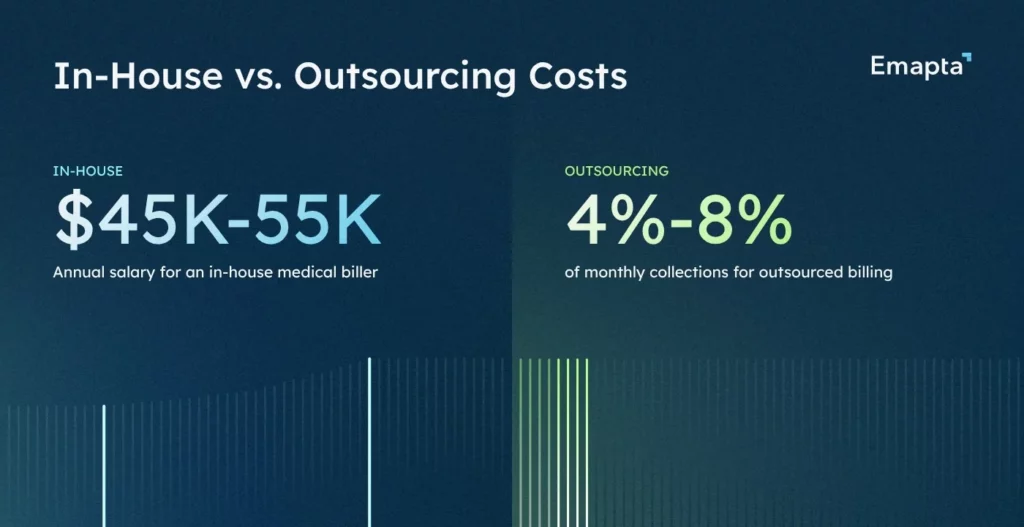
A U.S. medical biller can earn roughly $45,000 to $55,000 per year in salary alone, before benefits, software, training, equipment, and other overhead are added. Once those expenses are included, one 2026 industry estimate puts the fully loaded cost of an in-house biller at approximately $72,000 to $92,000 per year.
That means a practice comparing a $50,000 salary with an outsourcing quote is not necessarily comparing equivalent costs. The in-house figure can rise significantly once the supporting infrastructure and employee overhead are included.
Outsourced Costs
Outsourced billing is typically priced as a percentage of collections, a per-claim fee, or a fixed monthly rate. For full-service medical billing, current industry pricing commonly falls around 4% to 8% of monthly collections. For example, a practice collecting $100,000 per month could pay approximately $4,000 to $8,000 per month for outsourced billing, depending on its specialty, claim volume, and the services included.
For practices that need dedicated staff rather than a full-service billing operation, 2026 market estimates put outsourced RCM staffing at roughly $1,400 to $3,500 per month per full-time employee, depending on the role, experience, and level of support provided.
These models make outsourcing costs easier to forecast, but the lowest quote is not automatically the best value. Practices should compare what is included, such as coding, claims submission, denial management, payment posting, reporting, and software access.
Takeaway – Comparing the Total Cost
The real cost comparison isn’t just dollars per hour. It’s total cost of ownership against the value delivered, including faster reimbursement cycles, fewer billing errors, and reduced administrative drag on clinical staff. In fact, the 2024 CAQH Index estimated that fully electronic administrative workflows could unlock $20 billion in additional annual savings, illustrating how much efficiency can be lost when administrative processes remain manual.
When Should You Outsource Healthcare?
Outsourcing tends to make the most sense when internal limitations start affecting performance. Organizations facing persistent staffing gaps, rising overhead, or inconsistent collection rates are often good candidates, particularly smaller practices without the resources to run a full billing department.
It also helps organizations that need to scale quickly without adding headcount, such as during open enrollment periods or rapid patient volume growth. A healthcare outsourcing solution can absorb that demand without the lead time of a traditional hiring cycle.
In-house operations still make sense for organizations with mature internal processes, stable staffing, and functions that require tight integration with clinical teams, such as executive escalations or highly specialized care coordination.
Conclusion
There’s no single right answer to healthcare outsourcing vs in-house operations. The decision comes down to your organization’s current bottlenecks, budget structure, and how much control you need over specific functions. Many healthcare organizations find that a hybrid approach, keeping sensitive work in-house while outsourcing high-volume or specialized processes, delivers the best balance.
Whichever direction you take, the goal stays the same: build an operating model that supports patient care without buckling under administrative pressure and revisit the healthcare outsourcing vs in-house question as your organization’s needs evolve.