

15+ Employer Branding Trends in 2026
Employer branding trends continue to show intriguing numbers and are evolving as candidates place greater value on authenticity, workplace culture, and the overall employee experience.
Building a strong employer brand is all about creating a workplace that employees want to join and stay with.
Let’s see what the data suggests, how candidates see this, and what that means for employers:
6 Key Employer Branding Statistics for 2026
- 78% of surveyed organizations invest in employer branding, but only 18% can clearly communicate its ROI
- 70% of employers think they understand what workers want, while only 18% of job seekers agree
- Pay is the top employer attractor for 81% of talent, but work-life balance is the main retention factor for 46%
- 73% of surveyed European job seekers would trust a careers page more if it included employee testimonials
- 55% of B2B organizations already have active employee advocacy programs
- 56% of companies say employer branding improved their public image
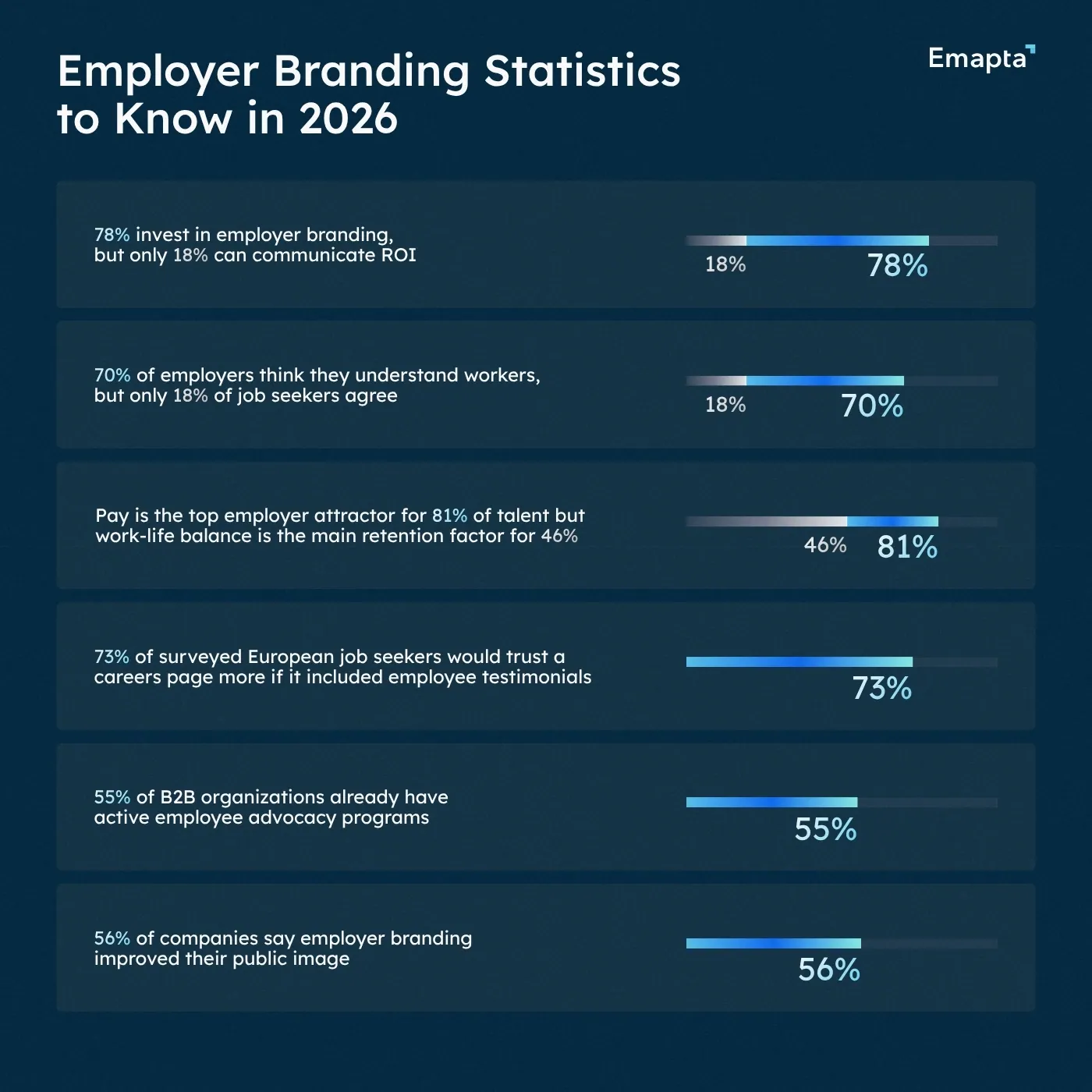
These statistics reveal a broader pattern. Judging by this data, we can see where employer branding efforts are succeeding and where organizations continue to struggle.
What Do Employer Branding Statistics Show Worldwide?
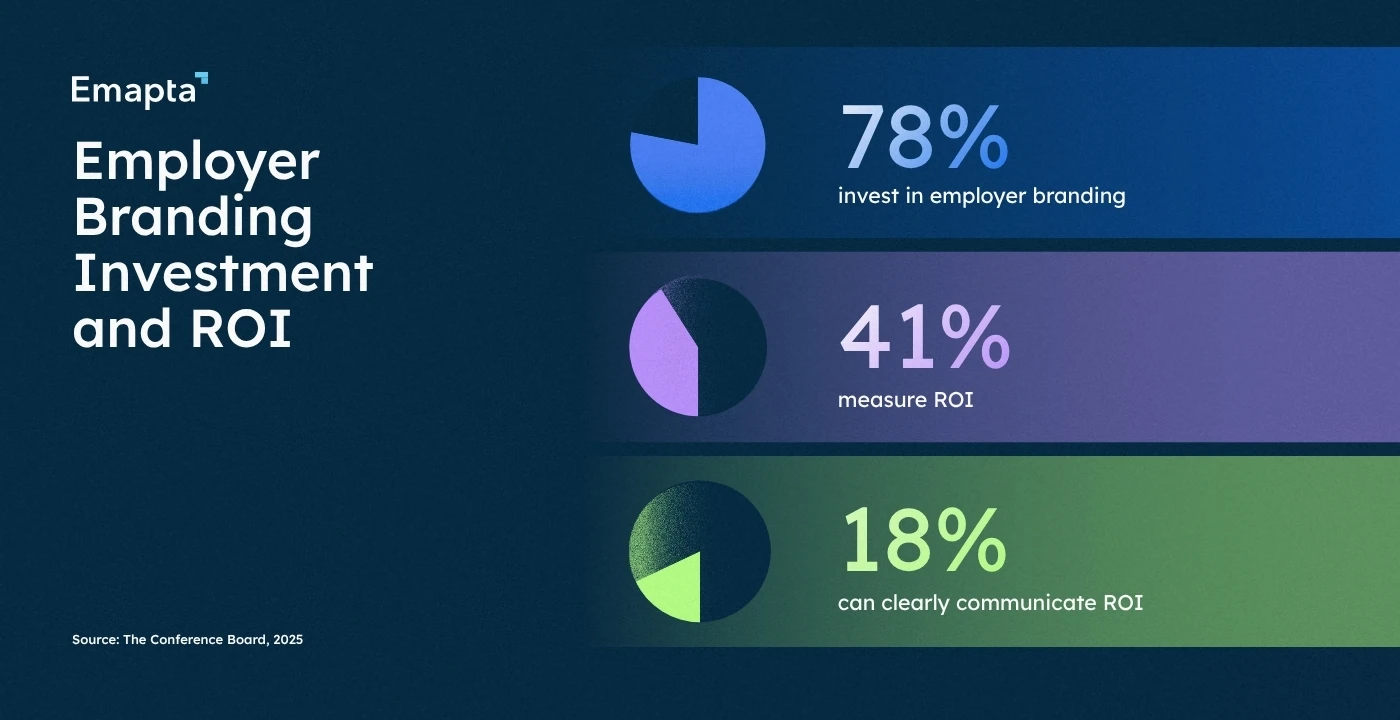
The data suggest a gap between investment and credibility. Around 78% of surveyed organizations invest in employer branding, yet only 18% can clearly explain the return.
Another 2026 survey found an even wider perception gap: 70% of employers think they understand workers, but only 18% of job seekers agree.
1. 78% Invest in Employer Branding, but Only 18% Can Communicate ROI.
The harder part is proving what that spending delivers. Only 41% of surveyed organizations measure ROI, while most teams still rely on easier-to-track signals such as social engagement.
Sources: The Conference Board, The ROI of Employer Branding
Employer branding is easy to measure at the surface. Likes, visits, and applications are visible. The harder metrics tell you whether it’s actually working:
- Are roles filling faster?
- Are new hires staying?
- Are candidates accepting offers?
- Is the right audience engaging?
- Is the EVP being delivered internally?
Tracking this requires several teams to share data and adjust in real time. Even data from a few months ago can already be stale.
When that feedback loop breaks, there is a cost.
2. 70% of Employers Think They Understand Workers, but Only 18% of Job Seekers Agree.
A 2026 survey shows that employers and candidates don’t see the market in the same way. That matters before any EVP or campaign is built.
If the starting assumption is wrong, better creative can simply make the wrong message more visible.
Sources: Indeed, 2026 U.S. Sentiment Survey with YouGov
3. Pay Attracts 81% of Talent, But That’s Not What Keeps It In The Company.
One of the clearest employer branding insights is that attraction and retention are not the same thing. Work-life balance led retention at 46%, while only 23% named pay as the main reason to stay.
The EVP needs both, in the right order: compensation first, then the wider work experience. Yet salary appears in just 4% of European and North American EVPs and 6% in APAC.
Sources: Randstad, Workmonitor 2026 | Universum, Employer Branding NOW 2026 regional analysis
4. 73% of Candidates Trust Careers Pages More When Employees Speak for Themselves.
Employee voices build trust. In a 2025 survey, 73% said employee testimonials would make a careers page more credible, while 58% still saw the corporate website as the most reliable starting point.
Sources: Comprend, Careers Survey 2025
So, candidates are not ignoring company-owned content. But when the language feels vague, overproduced, or too obviously promotional, employee reviews serve as a reality check.
Candidate expectations are broadly similar, but local priorities still influence what makes an employer attractive. Regional data highlights where those differences become most apparent.
How Do Employer Branding Trends Differ by Country and Region?
Local priorities overlap, but they do not line up perfectly. Work-life balance ranks as a priority for 64% of UK workers and 61% of Australian talent, while 76% of respondents in the Netherlands prioritize workplace atmosphere.
5. 52% of U.S. Job Seekers Rejected an Offer After a Poor Candidate Experience.
Employer branding statistics from 2024 also put candidate experience in focus. In one U.S. survey, 52% had rejected an offer because of how the hiring process was handled. Furthermore, 35% of candidates reported leaving a negative review online after it.
Source: CareerPlug, 2024 Candidate Experience Report
6. 76% in the Netherlands Prioritize a Pleasant Work Environment.
In the Netherlands, the day-to-day feel of work outranked every other employer attribute in 2026. A pleasant work atmosphere was followed by:
- Work-life balance: 68%
- Interesting work: 57%
- Salary and benefits: 54%
That makes ‘culture’ less abstract. It shows up in the manager, the team, the workload, and what a normal Tuesday at work actually feels like.
Source: Randstad Netherlands, Employer Brand Research 2026
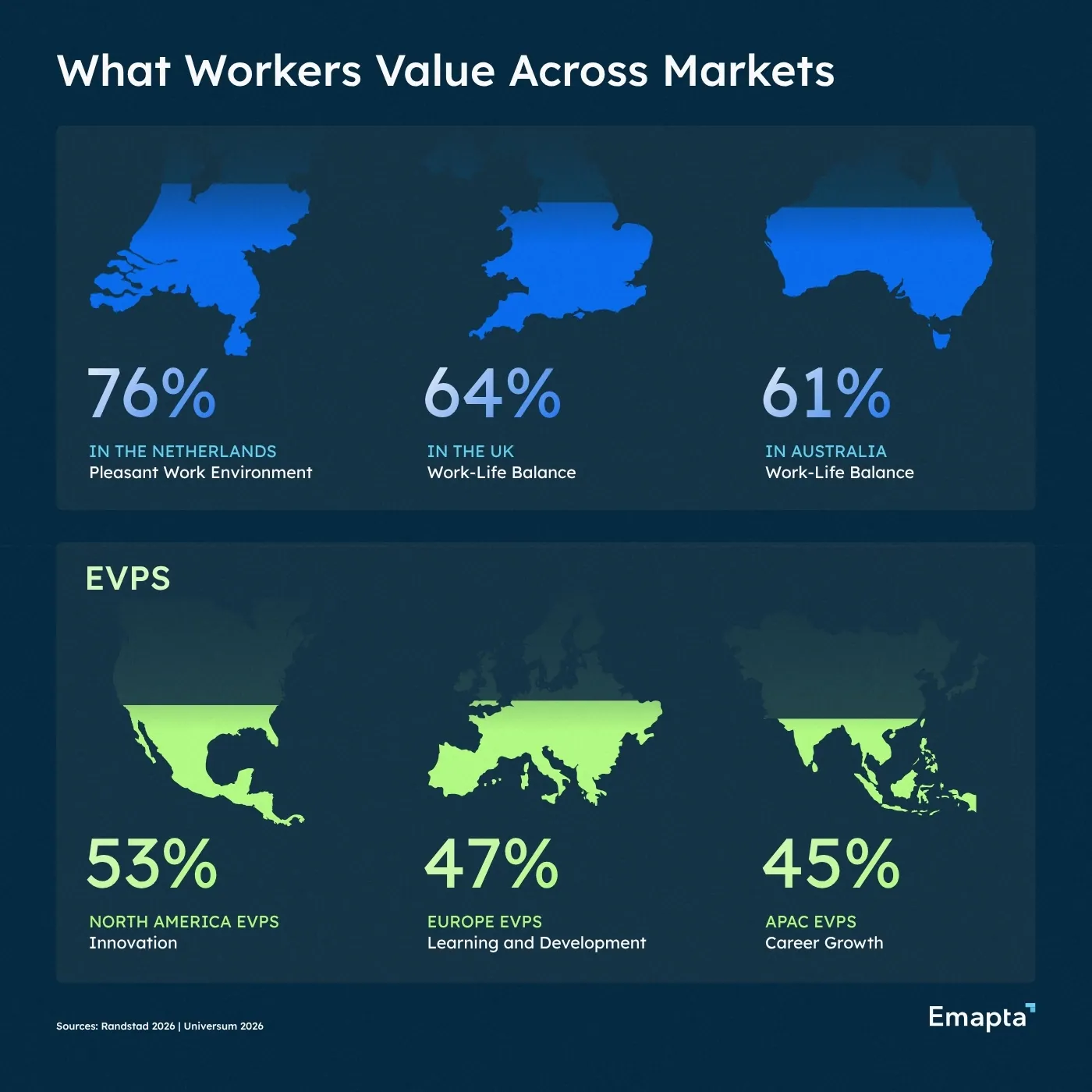
7. 64% of UK Workers and 61% of Australian Talent Put Work-Life Balance First.
The UK and Australia tell a similar story when it comes to work-life balance. Based on the latest employer branding statistics, in the UK, 43% also cited poor balance as the main reason for leaving. What’s interesting is that in Australia, its importance varies:
- 53% among Gen Z
- 70% among Gen X
- 72% among Baby Boomers
Sources: Randstad UK, Employer Brand Research 2026 | Randstad Australia, Employer Brand Research 2026
Gen Z is often portrayed as the generation most focused on boundaries, while older workers are expected to put work first. These numbers suggest otherwise: work-life balance matters across generations and becomes even more important with age.
What else is important for candidates?
8. 53% of North American EVPs Emphasize Innovation.
Employer positioning already looks quite different by region. Innovation appeared in 53% of North American EVPs in 2026. Learning and development led in Europe at 47%, while career growth was the most common theme in APAC at 45%.
Sources: Universum, Employer Branding NOW 2026 regional analysis
Current preferences tell only part of the story. Looking at how employer branding has changed over the past few years helps explain why these priorities continue to evolve.
How Have Employer Branding Trends Changed?
Employer branding investment continues to grow. In 2025, 42% of employers increased spending on social networks, and 56% said employer branding improved market perception. But employee-review mentions of “misalignment” rose by 95% in 2026.
9. 48% of Leading Employers Increased Employer Branding Budgets in 2023.
Employer branding trends from 2023 were backed by real spending: 78% also called employer branding a top priority.
Sources: Universum, Employer Branding NOW 2023
10. 42% of companies Increased Investment in Social Networks in 2025.
Physical and in-person events saw the biggest planned pullback. That shift moves more employer-brand activity into public channels, where company posts sit alongside employee voices, comments, and reviews.
Sources: Universum, Employer Branding NOW 2025
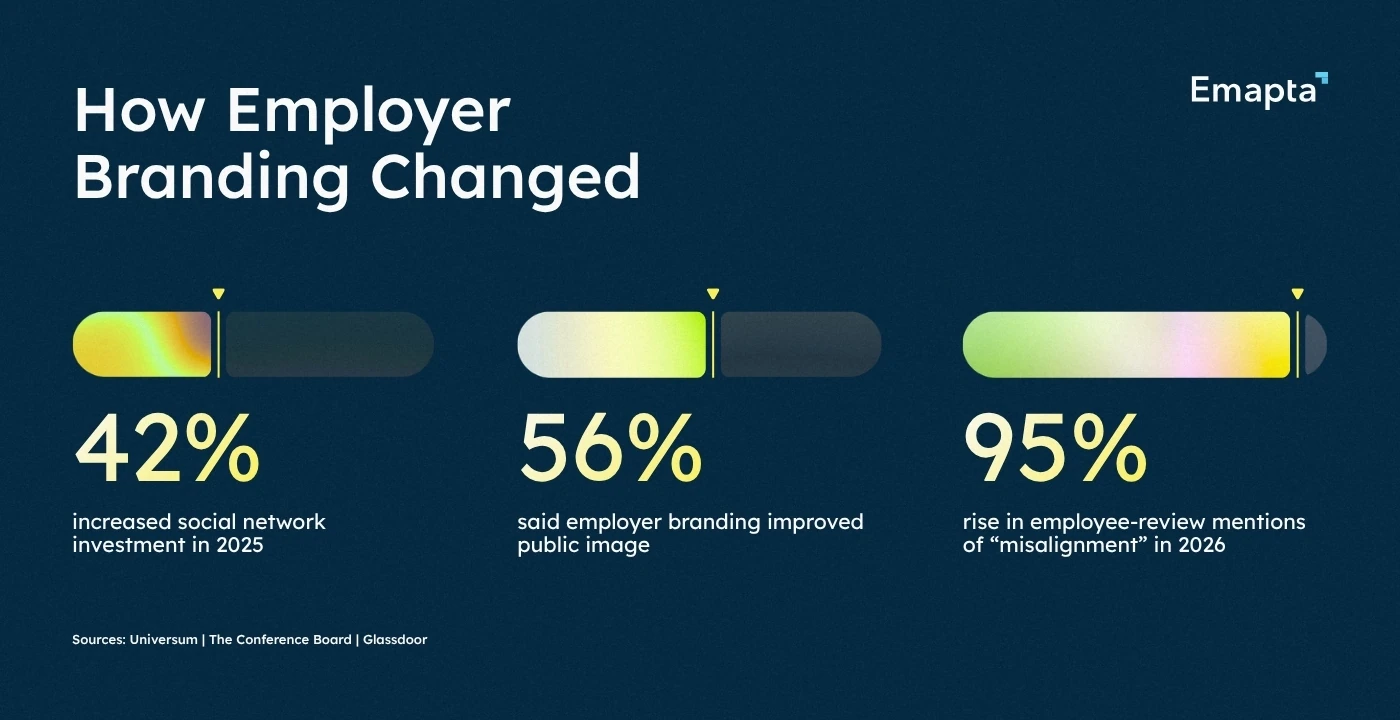
11. 56% of Leaders Said Employer Branding Improved Their Public Image.
According to employer branding statistics from 2025, another 19% of employers said their efforts strengthened an already positive image.
Sources: The Conference Board, The ROI of Employer Branding
What a company projects externally can still be very different from what employees experience internally.
12. Employee Review Mentions of ‘Misalignment’ Rose 95% in 2026.
Other management-related language moved in the same direction:
- Disconnect: +52%
- Distrust: +18%
- Hypocrisy: + 4%
All figures refer to U.S. employee reviews discussing management or senior leadership.
Sources:(Glassdoor Economic Research, Worklife Trends 2026 Midyear Check-in)
13. Trust in Leadership Fell to 72%, While Manager Relationships Improved.
At the same time, the share of talent reporting a strong relationship with their direct manager rose from 64% in 2024 to 72%.
For employees, the employer brand is often experienced through a direct manager long before it is experienced through corporate messaging.
Sources: Randstad, Workmonitor 2026
Where Are Trends in Employer Branding Heading Next?
Employer branding is becoming more employee-led and AI-influenced. Some 55% of surveyed B2B organizations already run advocacy programs, 41% of internal communicators want to explore employee influencers in 2026, and 87% of established programs provide training.
14. 55% of B2B Organizations Already Have Employee Advocacy Programs.
Employee advocacy was already emerging as one of the employer branding trends from 2025. In one B2B survey, 55% said their organization had an active program, rising to 62% in the UK.
Source: Oktopost
It will be interesting to see how far companies are willing to take employee-led content. Being an active creator could eventually become a real CV advantage, regardless of role or location.
However, encouraging employees to create is one thing. Deciding how much guidance to give them is another.
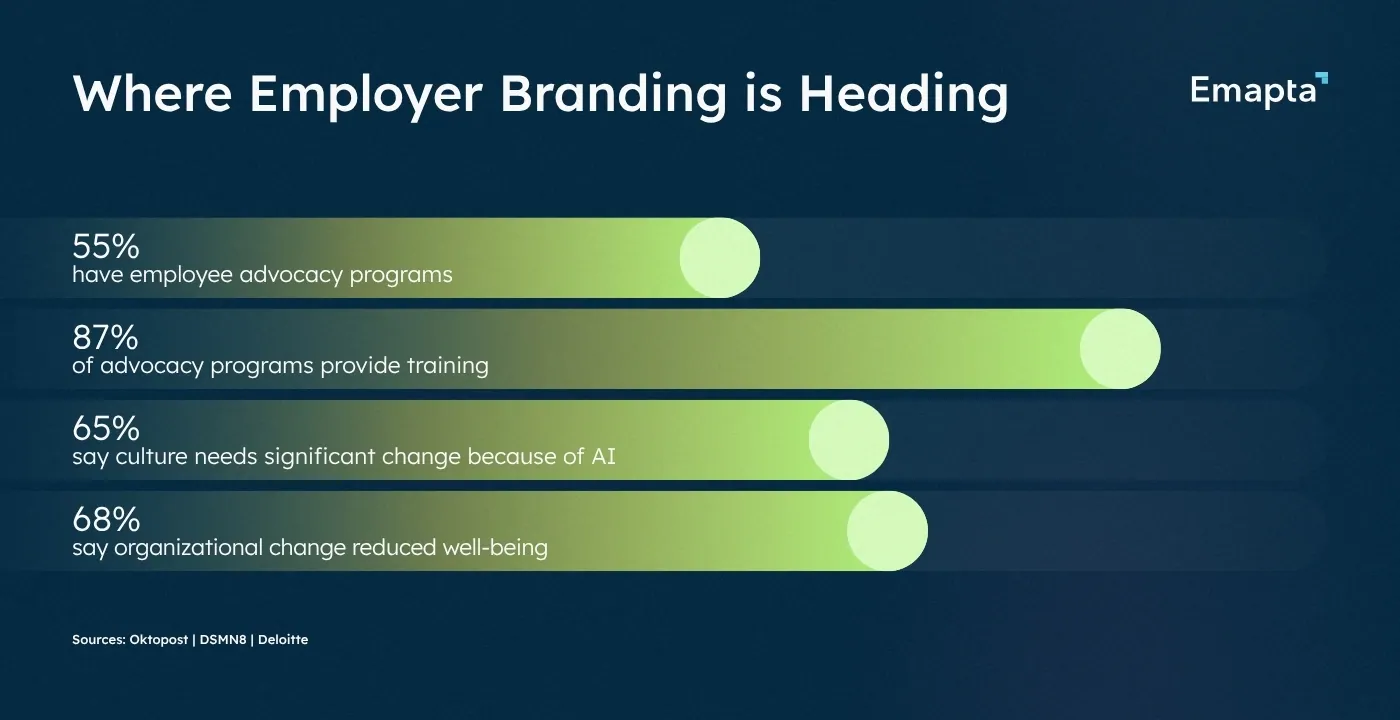
15. 87% of Employee Advocacy Programs Now Provide Training.
More employee visibility brings more structure, but also more risk. Too little guidance creates liability; too much scripting can strip away the authenticity that makes employee content valuable.
Sources: DSMN8, Employee Advocacy Benchmark Report 2026
16. 65% Say Their Culture Needs Significant Change Because of AI.
According to these employer branding stats, AI adoption is forcing a culture reset in many organizations, but only 5% report making major progress in addressing AI’s cultural effects.
Calling a company ‘AI-first’ or ‘future-ready’ is easy. The harder part is ensuring that management, communication, and employee support evolve at the same pace.
Sources: Deloitte, 2026 Global Human Capital Trends: AI and Cultural Debt
17. Organizational Change Reduced Well-Being for 68% of Workers.
The strain of repeated change is already visible in worker experience.
- 60% of employees report heavier workloads
- 58% feel less relevant or left behind
- One-third had gone through 15 major changes in the previous year
A fast-moving workplace can be attractive. However, fifteen major changes in a year can feel different from the inside.
Sources: Deloitte, 2026 Global Human Capital Trends: Creating an Adaptable Workforce
Wrapping Up
Employer branding has become a business priority, but standing out requires more than a larger budget or a stronger social media presence. Candidates expect transparency, employees want genuine workplace experiences, and company claims are easier than ever to verify.
Organizations that succeed will focus on building a workplace people genuinely want to be part of before promoting it externally. A positive employee experience, authentic communication, and consistent actions will always have a greater impact than polished marketing campaigns.
The employer branding trends we just presented show that the strongest employer brands are built on credibility, not campaigns. Companies that align their culture, employee experience, and messaging will be in the best position to attract and retain top talent in 2026 and beyond.
Frequently Asked Questions (FAQ)
Current trends in employer branding include greater pressure to prove ROI, AI-driven changes to work and culture, more localized EVP messaging, and heavier reliance on employee voices and third-party reputation signals.
A strong employer brand starts with a competitive offer and a credible day-to-day experience. Compensation, management, flexibility, workload, development, culture, and the hiring process all shape how people judge an employer.
Candidates still use official company sources, but they rarely rely on them alone. In a 2025 European survey, 58% saw corporate websites as the most reliable source of employer information, while 73% said employee testimonials would make a careers page more trustworthy.
Reach, engagement, career-site traffic, and applications show whether the message is being seen. A fuller view of employer-brand performance also needs outcomes such as offer acceptance, retention, early attrition, quality of hire, and changes in employer reputation.