

What Is Sales Outsourcing? Benefits, Success Stories & Examples
Sales outsourcing involves transferring some sales tasks and responsibilities to an external team, which in turn allows your company to focus on its core objectives.
No matter how strong your sales team is, there comes a point when growth becomes overwhelming. As pressure builds to maintain momentum, teams can quickly become stretched, disconnected, and overloaded. This is often the moment when companies turn to sales outsourcing.
With that in mind, let’s take a look the definition, types, benefits, and success stories that show why sales outsourcing is a strategic move to extend your team’s capacity and help your business scale.
What is Sales Outsourcing?
Sales outsourcing means delegating part of your sales process to a third-party provider while retaining control of your brand and customer relationships. It gives your business additional sales capacity without the need to recruit, onboard, or manage every role internally. Companies often use it to expand into new regions through SDRs, appointment setters, or sales ops specialists working as an extension of their team.
6 Types of Sales Functions That Can be Outsourced
Not every part of sales should be outsourced. The best candidates are functions that are repeatable, measurable, and easy to integrate into your existing process.
With outsourcing being a strategic decision, here are the most common sales functions companies choose to outsource:
1. Lead Generation and Prospecting
Lead generation is one of the most commonly outsourced sales functions. Recent industry reports indicate that approximately 72% of B2B companies globally rely on outsourced sales providers to improve lead generation efficiency.
| Pros | Cons |
|---|---|
| Consistent pipeline generation | Results depend heavily on targeting and messaging quality |
| Access to specialized prospecting tools and workflows | Requires clear ICP and alignment to avoid low-quality leads |
| Scalable outreach without increasing internal workload |
Best use:
Companies that need to build new pipeline quickly or test outbound strategies without overloading their internal team. It’s particularly effective for cold outreach campaigns and early-stage market research.
2. Appointment Setting
Appointment setting bridges the gap between prospecting and closing. External teams qualify leads and book meetings, allowing internal sales reps to focus on high-value conversations.
| Pros | Cons |
|---|---|
| Keeps the sales calendar consistently full | Poor qualification criteria can lead to low-quality meetings |
| Reduces time spent on early-stage qualification | Requires structured handoff processes between teams |
| Improves efficiency of internal sales teams |
Best use
Companies that already generate leads but struggle to convert them into qualified meetings. Commonly used for demo booking, inbound lead qualification, and campaign follow-ups.
3. Inside Sales
Inside sales teams handle the full sales cycle remotely, making them ideal for high-volume or transactional sales environments.
| Pros | Cons |
|---|---|
| Expands sales coverage without geographic constraints | Less effective for complex, enterprise-level deals |
| Lower operational costs compared to field sales | Requires strong onboarding to align with product and messaging |
| Faster response times across channels |
Best use
Businesses managing a large volume of smaller deals or operating across multiple regions. It supports SMB and mid-market sales, subscription models, and distributed customer bases.
4. Sales Operations Support
Sales operations keep the entire revenue engine running smoothly. When outsourced, it removes administrative friction from internal teams.
| Pros | Cons |
|---|---|
| Improves CRM accuracy and reporting visibility | Requires secure data access and system integration |
| Frees up sales reps to focus on selling | Needs clear process documentation to avoid inconsistencies |
| Enhances overall process efficiency |
Best use
Companies whose sales teams are spending too much time on administrative work. It’s commonly used to manage CRM systems, maintain data quality, generate reports, and support proposal workflows.
5. Market Expansion Sales
Expanding into new markets requires speed and local insight. Outsourced teams can help companies test demand and build early traction without heavy upfront investment.
| Pros | Cons |
|---|---|
| Faster entry into new regions | Requires strong alignment with brand positioning |
| Lower risk compared to building local teams | Market nuances may take time to fully understand |
| Access to multilingual and culturally aligned talent |
Best use
Companies exploring new geographies or verticals where demand is still uncertain. It allows businesses to validate messaging, identify target segments, and generate early pipeline before committing to building a full in-market team.
6. Partner and Channel Sales Support
As partner ecosystems grow, managing them effectively becomes critical. Outsourced teams can support partner engagement and channel execution.
| Pros | Cons |
|---|---|
| Expands reach through partner networks | Risk of channel conflict without clear ownership |
| Improves follow-up and partner coordination | Requires strong communication between internal and external teams |
| Increases pipeline from indirect channels |
Best use
Companies that rely on distributors, resellers, or referral partners to drive growth. It maintains consistent communication, ensures partner leads are followed up, and supports co-selling efforts across different regions or markets.
Sales Outsourcing Examples
The easiest way to understand what sales outsourcing looks like in practice is to see how companies apply it in real scenarios.
Let’s take a look at some recent cases of companies that used sales outsourcing solutions and the impact it had on their operations:
1. Ting Internet
Ting Internet, a 100M dollar internet service provider, outsourced field sales support to expand their presence in key local markets without building a large internal team from scratch.
As a result, Ting reached 55% market share in South Denver and Raleigh-Durham and achieved more than 95% customer retention in the first year.
2. LATAM Retailer
A leading retailer in Latin America struggled to handle spikes in demand during promotions, losing revenue because internal staff could not keep up with inbound sales inquiries.
The solution? Outsourcing inbound sales to a contact-center partner that staffed a multilingual team and implemented a modern CCaaS platform. As a result, inbound conversion rates increased by 30% and operational costs fell by 20%.
3. New York, U.S.-Based Software Company
A New York–based company providing software for personal injury lien and letter‑of‑protection holders, outsourced inside sales support to increase outbound capacity and improve growth execution.
Outsourcing’s positive impact enabled them to double their sales team within nine months, increase the meeting rate by 25% in three months and shorten the sales cycle.
4. Global Credit Card Company
One of the world’s largest credit card companies worldwide hired sales outsourcing solutions to re-activate more than 500,000 merchants who were discouraging card usage.
The strategy converted over 65% of engaged merchants, generating more than 100 million dollars in additional revenue while maintaining a 99% customer satisfaction rate in the first year.
6 Benefits of Outsourcing Sales
Sales outsourcing works best when it solves a specific problem. It should not be used simply because a team is busy or because hiring feels expensive.
When done for the right reasons, sales outsourcing will become a strategic move to grow your business.
Faster Access to Sales Talent
Hiring sales talent can take time and training them takes even longer.
Outsourcing helps companies hiring skilled sales professionals faster, especially for roles like SDRs, appointment setters, inside sales reps, and sales support specialists.
Having access to specialized talent that can integrate seamlessly into your workflows from day one is beneficial, especially when you’re dealing with a stalled sales pipeline or an overwhelmed in-house sales team.
Lower Operational Pressure
Building an in-house sales team comes with fixed costs:
- Salaries
- Office space
- Recruiting
- Onboarding
- Training
Outsourcing does not remove the need for investment, but it can make growth more flexible.
More Time for Internal Teams to Focus on High-Value Work
Salespeople are often pulled into tasks that do not require their highest skill set.
Research, admin, follow-up, database updates, and early-stage qualification all matter. But when senior sellers spend too much time on those tasks, bigger deals slow down.
When a company outsources support, internal teams can dedicate their time to higher-value, revenue-generating tasks. This shows that sales outsourcing is a key driver of productivity.
Stronger Market Coverage
Companies often struggle to cover every geography, segment, or time zone with one internal team.
An outsourced sales team can help extend coverage without forcing the business to open new offices or hire full-time employees in every location.
This is especially useful for companies expanding across the U.S., Canada, Australia, Europe, or Latin America.
Access to Better Tools and Processes
Many sales outsourcing providers bring structured workflows, reporting dashboards, outreach tools, QA processes, and performance management systems.
That can help companies move faster, especially when their internal sales process is still maturing.
Better Scalability Without Losing Control
The best outsourced sales teams do not operate separately from the business. They work inside the company’s systems, follow its messaging, and report against shared goals. The right model gives companies:
- Team integration
- Clear visibility
- Defined KPIs
- Shared reporting
- Flexible scaling
- Stronger accountability
Bonus Point – Challenges of Sales Outsourcing
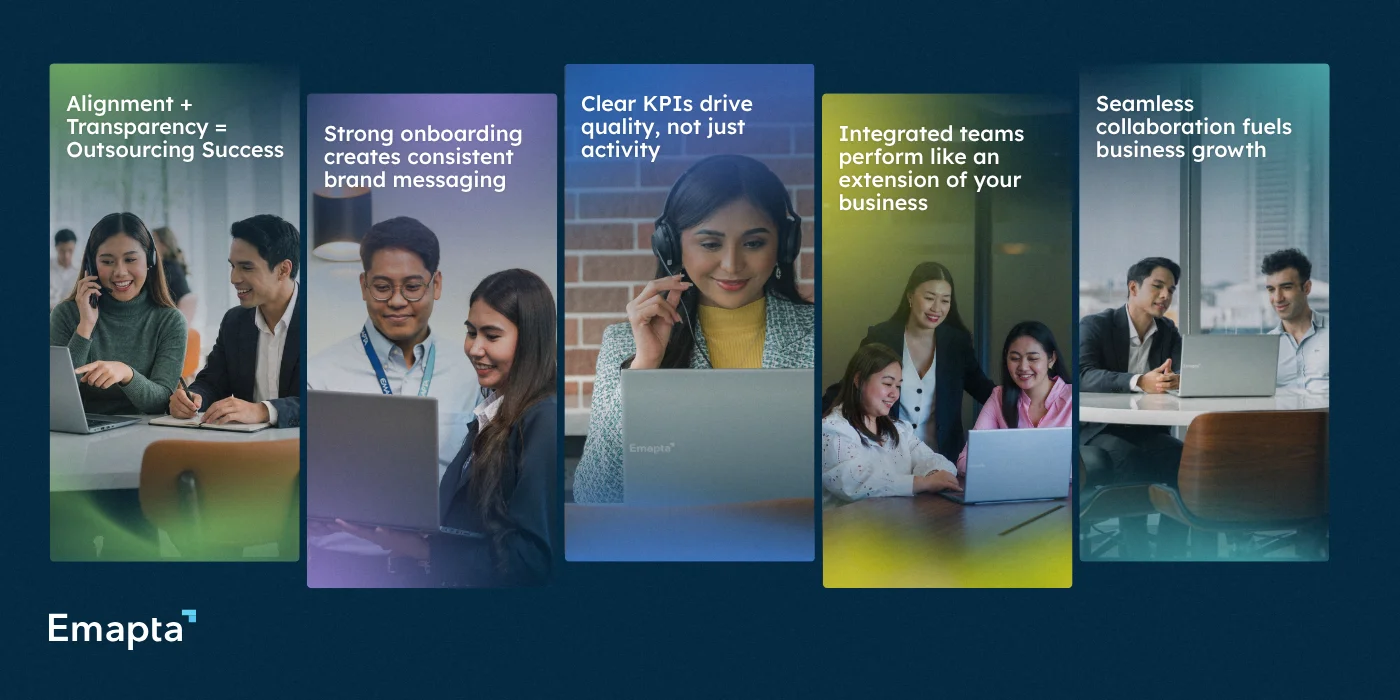
One common challenge is maintaining consistent messaging and brand voice, which can feel misaligned without proper onboarding. Additionally, weak handoffs between teams can also disrupt the buyer experience.
From an operational standpoint, unclear KPIs can lead to high activity but low-quality outcomes, while limited visibility makes performance harder to track.
Finally, managing data access, compliance, and system integration also require careful management, particularly when working across multiple tools or regions.
Fortunately, these challenges can be easily overcome with a model focused on integration and transparency.
When external teams work within your systems, follow defined processes, and align with your KPIs, they operate as an extension of your business. This seamless partnership model turns outsourcing into a high-performing growth strategy.
Wrapping Up
Sales outsourcing helps companies to generate pipeline, enter new markets, improve coverage, and give internal sellers more time for high-value work.
This model works when it is applied intentionally and the right functions are being outsourced. Essentially, sales outsourcing is all about hiring third-party specialists to handle sales tasks, such as customer relationship management, lead generation, or closing deals.
When this is done successfully, sales outsourcing becomes a scalable way to grow revenue with more speed, focus, and control.