

What Are an Employer of Record’s (EOR) Legal Responsibilities?
An Employer of Record’s (EOR) legal responsibilities involve several risk factors that must be managed to avoid serious financial and compliance consequences. An EOR is responsible for key employment obligations such as payroll, taxes, statutory benefits, compliance, and lawful termination. This allows you to retain control over your offshore or nearshore team’s day-to-day work and performance without having to manage the legal and administrative requirements of employment.
Let’s take a look at the extent of these responsibilities, so you know what to expect from an EOR partnership as you build your global workforce.
Which Legal Aspects Does an Employer of Record (EOR) Cover?
An Employer of Record (EOR) serves as the legal employer, and their duties cover the full employment lifecycle, including employment contracts, payroll and tax compliance, statutory benefits, working conditions, employee records, and lawful termination. These obligations vary by country, so the EOR must manage each area in accordance with applicable local labor laws.
Key Employer of Record Responsibilities:
- Drafting compliant employment contracts
- Payroll administration
- Tax withholding and reporting
- Statutory benefits administration
- Social security contributions
- Compliance with working time and leave requirements
- Employee onboarding and offboarding
- Termination processes in accordance with local labor laws
- Employment record management
Although responsibilities vary by country, an EOR typically manages the legal aspects throughout the employee lifecycle, from onboarding to offboarding, keeping every stage compliant with local labor laws.
How Does an Employer of Record Agreement Work in Practice?
Let’s take this scenario as an example: a SaaS company based in Austin, Texas, wants to hire a software engineer in Medellín, Colombia. They’ve identified the right candidate, but they can’t legally employ the developer directly. Instead of spending months establishing a local entity, they partner with an EOR.
The EOR will:
- Legally employ the developer in Colombia
- Issue a locally compliant employment contract
- Process payroll and mandatory tax withholdings
- Administer statutory benefits and social contributions
- Ensure compliance with Colombian labor laws
The SaaS company will:
- Assign day-to-day work
- Set goals and priorities
- Manage performance
- Integrate the developer into their team
How Does an Employer of Record (EOR) Ensure Compliance with Labor Laws?
An Employer of Record (EOR) ensures compliance with labor laws by applying local legal expertise to employment decisions and updating their policies and processes as regulations change. Labor laws affect day-to-day employment practices, so the EOR must interpret how each requirement applies across the employee lifecycle.
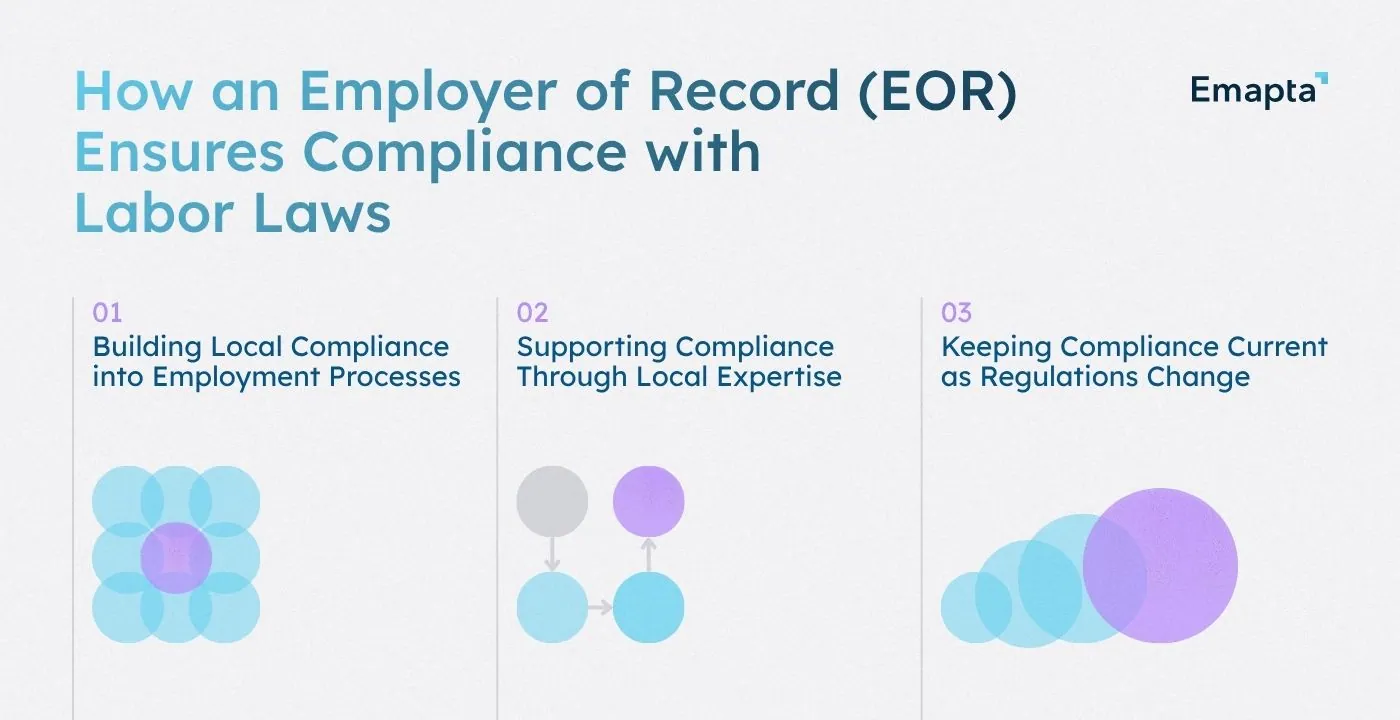
1. Building Local Compliance into Employment Processes
Building local compliance is one of the essential Employer of Record compliance responsibilities. Your EOR should embed local legal requirements into every stage of employment.
Employment contracts and policies
The EOR prepares employment documents based on the laws of the employee’s country. Depending on the jurisdiction, these may need to specify:
- Compensation and payment terms
- Working hours and overtime rules
- Mandatory benefits
- Termination conditions
Moving beyond employee-specific documents, the EOR reviews broader company policies to determine where global standards need to be adapted for the local workforce.
Payroll, taxes, and statutory contributions
Payroll requirements can include different tax rates, filing schedules, social security systems, and mandatory deductions. The EOR manages these obligations by:
- Calculating gross and net pay
- Withholding employee taxes
- Making required employer contributions
- Updating calculations when rates or thresholds change
Leave and employee entitlements
Local laws determine the minimum time off employees are entitled to receive, which may include:
- Annual leave
- Sick leave
- Parental leave
- Public holidays
- Other statutory absences
The EOR tracks each employee’s eligibility and coordinates approved absences with payroll to ensure accurate pay.
2. Supporting Compliance Through Local Expertise
Standardized processes can provide consistency across countries, but they cannot account for every local requirement on their own. An EOR’s in-country HR, payroll, and legal specialists ensure those processes are applied correctly within each jurisdiction.
In-country employment expertise
An EOR understands how government agencies, filing systems, and administrative procedures operate in practice. This enables them to complete required registrations, submissions, and employment actions through the correct local channels.
Interpreting local labor laws
Labor laws don’t always provide simple yes-or-no answers. Requirements can vary depending on:
- Employment arrangements
- Tenure
- Collective agreements
- Regional regulations
An experienced EOR provider helps interpret these rules in context, allowing you to make employment decisions with greater confidence.
3. Keeping Compliance Current as Regulations Change
EOR compliance extends beyond setting up a lawful employment arrangement. It also requires ongoing oversight to keep that arrangement legally defensible over time.
Updating employment practices
When regulations change, your EOR determines what needs to be adjusted. This may involve revising contracts, changing payroll calculations, or informing the client and employee of new requirements.
Maintaining records and audit trails
You may need to retain contracts, payroll records, tax filings, and other employment documents for a defined period. Your provider preserves this documentation so the employment arrangement can be supported during regulatory reviews, audits, or employee disputes.
How Does an EOR Handle Employee Contracts/Agreements?
One of the key Employer of Record responsibilities is to handle contracts and agreements for its employees. The EOR drafts and issues the employment contract directly with the individual being hired, using a template that’s adapted for the hiring location. You are not the legal party to the contract, the EOR is.
That said, the contract still reflects the role you need filled. Job title, responsibilities, salary, and start date are typically agreed between you and the employee. The EOR ensures the remaining terms, such as probation periods, notice requirements, and termination clauses, comply with local labor laws.
Is EOR Recognized in International Employment?
EOR arrangements are recognized in many countries as a legitimate way to employ global talent.
Every country has its own requirements for Employer of Record agreements, which is why choosing a provider with established local expertise is important. The provider should understand the country-specific employment, tax, and regulatory requirements that apply in each market.
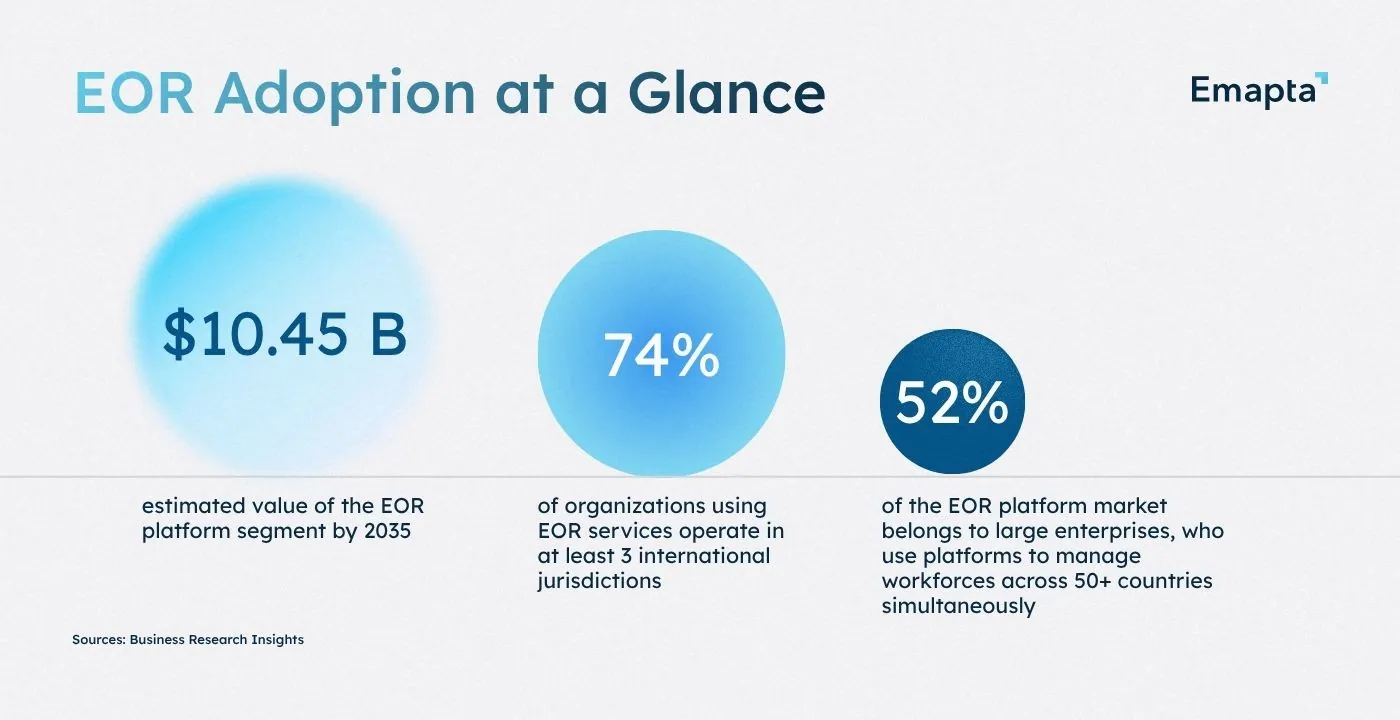
In fact, Business Research Insights projects that the global employer of record market will reach USD 10.45 billion by 2035.
Legal Risks for Companies without EOR Help
Hiring internationally without local employment expertise can expose you to legal and financial risks. Even small compliance mistakes can lead to penalties, disputes, or operational delays.
For these reasons, it is important to understand how an Employer of Record works, before seriously considering it as an option. While not every company needs an Employer of Record, businesses hiring without one should understand the legal responsibilities they’re taking on and make sure they have the expertise to manage them.
1. Employment Law Violations
Failing to comply with local employment laws can result in legal claims, financial penalties, or government enforcement actions.
How It Happens
- Employment contracts that don’t meet local requirements
- Incorrect probation or notice periods
- Mismanaged leave entitlements
- Non-compliant termination processes
Potential Business Impact
- Regulatory penalties
- Employment disputes
- Increased legal costs
- Disruptions to workforce operations
2. Payroll and Tax Compliance Issues
International payroll involves more than paying employees on time. Employers are also responsible for tax withholding, social contributions, and statutory reporting.
How It Happens
- Incorrect payroll tax calculations
- Missed tax filings or reporting deadlines
- Underpayment of mandatory employer contributions
- Incorrect statutory deductions
Potential Business Impact
- Financial penalties and interest
- Payroll corrections and administrative burden
- Delays in statutory reporting
- Compliance audits
3. Worker Misclassification
Incorrectly classifying workers can create significant legal and financial exposure, particularly when contractors should legally be treated as employees.
How It Happens
- Treating employees as independent contractors
- Using contractor agreements where employment relationships exist
- Misunderstanding local classification rules
- Relying on generic contractor templates
Potential Business Impact
- Back payment of wages and benefits
- Unpaid taxes and social contributions
- Employment claims
- Government investigations
4. Delays to International Hiring
Without an established legal entity or local employment infrastructure, expanding into a new country often takes longer than expected.
How It Happens
- Registering a local entity
- Setting up payroll and tax systems
- Establishing compliant HR processes
- Meeting country-specific employment requirements
Potential Business Impact
- Slower hiring timelines
- Delayed business expansion
- Missed market opportunities
- Lost competitive advantage
5. Reputational and Employee Relations Risks
Compliance issues don’t only affect regulators. They can also impact employee trust and your employer brand.
How It Happens
- Payroll or benefits errors
- Poor communication around employment obligations
- Mishandled workplace issues
- Inconsistent policies across regions
Potential Business Impact
- Reduced employee trust
- Higher turnover
- Damage to employer reputation
- Greater difficulty attracting talent
Wrapping Up
Expanding internationally helps businesses find talent in new markets, supports current employees, and allows for efficient scaling.
Learning what Employer of Record’s (EOR) legal responsibilities fully entail is an essential part of that process. An Employer of Record (EOR) helps turn complex legal and compliance requirements into a structured and fully manageable process.
The result is a faster, lower-risk path to building a global workforce, without the burden of navigating each country’s employment laws on your own.
Frequently Asked Questions (FAQ)
The duties of an Employer of Record (EOR) are to assume the legal and administrative responsibilities of employment for a company’s employees. This allows organizations to hire staff globally or in new regions without establishing a local legal entity, as the EOR handles payroll, taxes, mandatory benefits, and compliance with local labor laws.
Yes. An EOR is a recognized, legal way to hire in countries where you don’t have your own entity. The EOR takes on the legal employer role and ensures everything, from contracts to payroll, follows local labor law, so your company stays compliant without needing local legal expertise.
Even with an EOR in place, your company still manages daily tasks, performance, and direction of your team’s work. The EOR handles the legal employment side. Your responsibility is essentially the same as managing any other team member, minus the legal and administrative burden.
The EOR maintains legally required records, including contracts, payroll history, tax filings, and benefits documentation. They ensure these records meet local retention and reporting standards, so your company isn’t responsible for tracking or storing compliance-related paperwork in each country you hire in.
Risks of using an EOR are generally low but can include choosing an EOR unfamiliar with local laws, unclear division of responsibilities between you and the EOR, or added cost compared to direct hiring. Vetting the EOR’s track record and clarifying responsibilities upfront helps minimize these risks.