

19 Interesting Facts About Lawyers
Facts about lawyers often come down to the same image: status, responsibility, long hours, and an endless supply of jokes at your expense.
Behind that reputation is a profession going through real change. Recent data shows rising numbers, shifting demographics, AI adoption, and burnout that is much harder to laugh off.
We have prepared a selection of statistics that illustrate these changes and show what may come next.
7 Newest Lawyer Facts
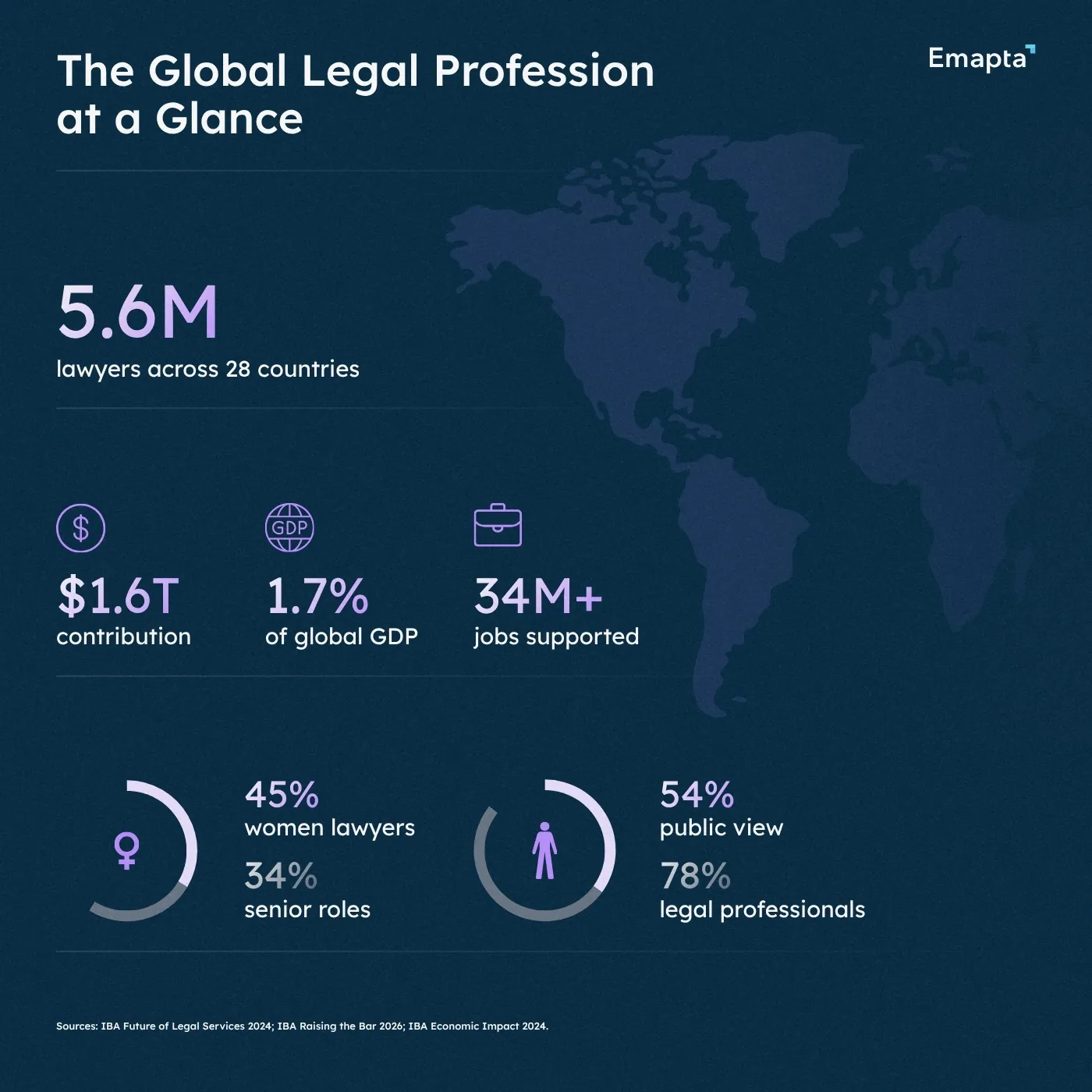
- Around 5.6 million lawyers work across 28 countries representing 51% of the global population
- Women make up 45% of lawyers globally, but only 34% of senior legal roles
- The legal profession contributes about $1.6 trillion, or 1.7% of global GDP, and supports more than 34 million jobs directly and through supplier sectors
- The Cayman Islands has 1,200+ attorneys on its Roll for a population of about 90,600, roughly one attorney for every 75 residents
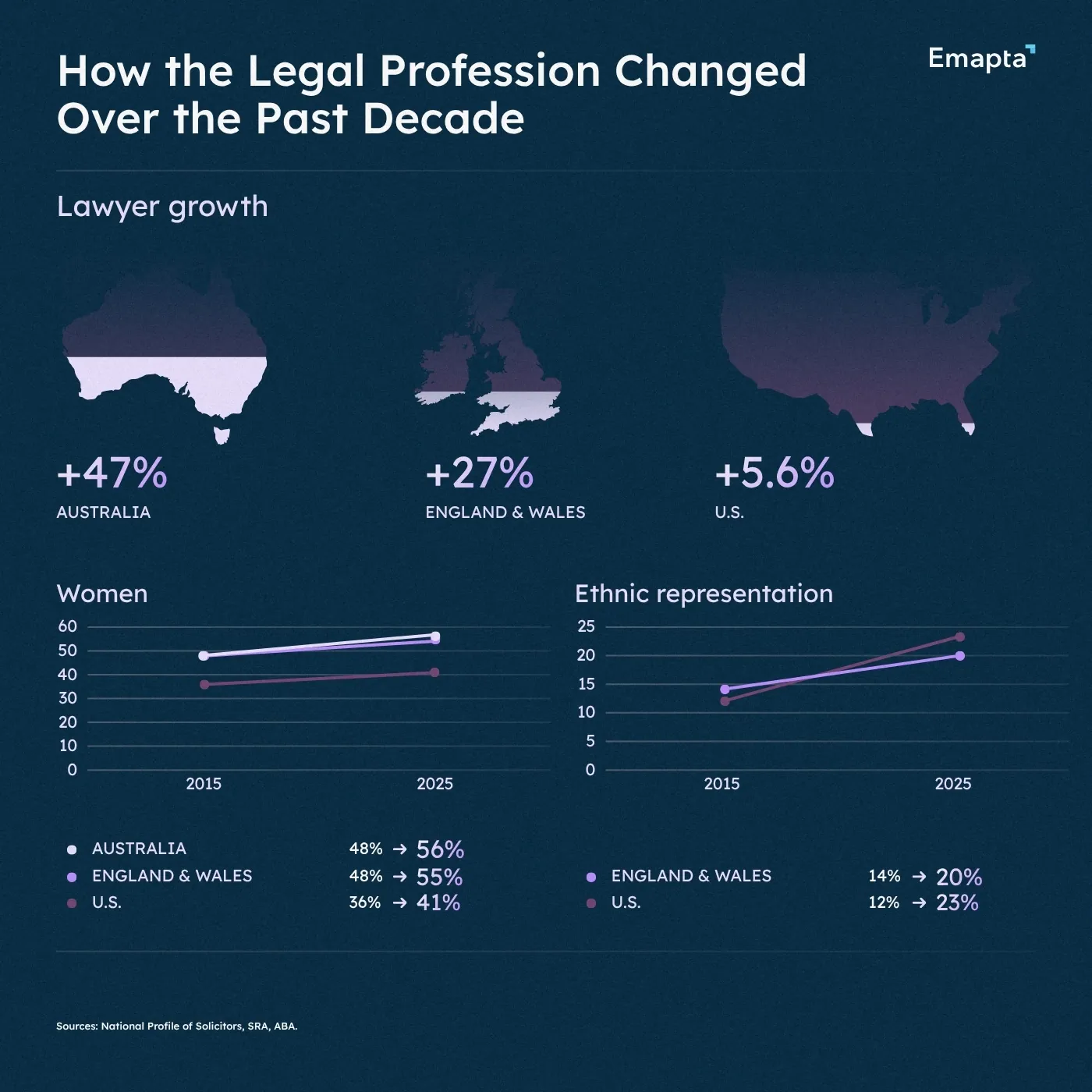
- Australia’s solicitor population grew 47% over a decade, compared with about 27% in England and Wales and 5.6% in the U.S
- 47.4% of U.S. lawyers screened positive for high burnout in 2026
- Becoming a lawyer can take just over four years in Australia, compared with 5.5 to 6 years in Singapore and about seven years of full-time study in the U.S.
Global Lawyer Statistics
There is no single authoritative number of lawyers in the world because countries count lawyers differently. But, across 28 countries representing 51% of the world’s population, there are about 5.6 million lawyers. Globally, 20+ million people work directly in the legal profession, while another 14 million works in its supplier sectors.
1. 5.6 Million Lawyers Work Across 28 Countries Representing 51% of the Global Population.
The group includes the U.S., India, China, Brazil, Japan, Canada, France, Germany, and the UK. The U.S. alone had 1,374,720 resident active lawyers in 2025, accounting for roughly one-quarter of the 5.6 million lawyers covered by the 28-country comparison.
Sources: International Bar Association
2. Women Make Up 45% of Lawyers but Only 34% of Senior Roles.
That is an 11-percentage-point gap between representation in the profession and representation at senior levels.
Career progression is also shaped by responsibilities outside work: 64% balance work with caregiving, while only 7% have formal career support.
Source: International Bar Association, 2026
3. The Legal Profession Contributes $1.6 Trillion and Supports 34 Million+ Jobs.
The profession’s direct economic contribution equals about 1.7% of global GDP. More than 20 million lawyers, paralegals, and support staff work directly in it, alongside another 14 million workers in supplier sectors such as notaries and translators.
That makes the legal profession much larger economically and operationally than lawyer headcount alone suggests.
Source: International Bar Association
4. Only 54% of the Public Think Lawyers Have a Positive Impact, Versus 78% of Legal Professionals.
One of the most interesting facts about lawyers is that their view of the profession’s positive impact is 24 percentage points higher than the public’s.
That fits the profession’s unusual position: lawyers generate significant economic value and remain essential to business and legal process systems, but public opinion is considerably less enthusiastic.
Source: International Bar Association
5. Lawyer Jokes Have Been Around for Centuries.
Some of the more unusual fun facts about lawyers go back much further than modern legal culture. Medieval English legal records from the 13th to 15th centuries contain examples of jokes, wordplay, laughter, and other humor involving lawyers and judges. So while the profession has changed dramatically, making jokes about legal work is hardly a modern habit.
Source: University of Bristol
Lawyer Statistics by Country
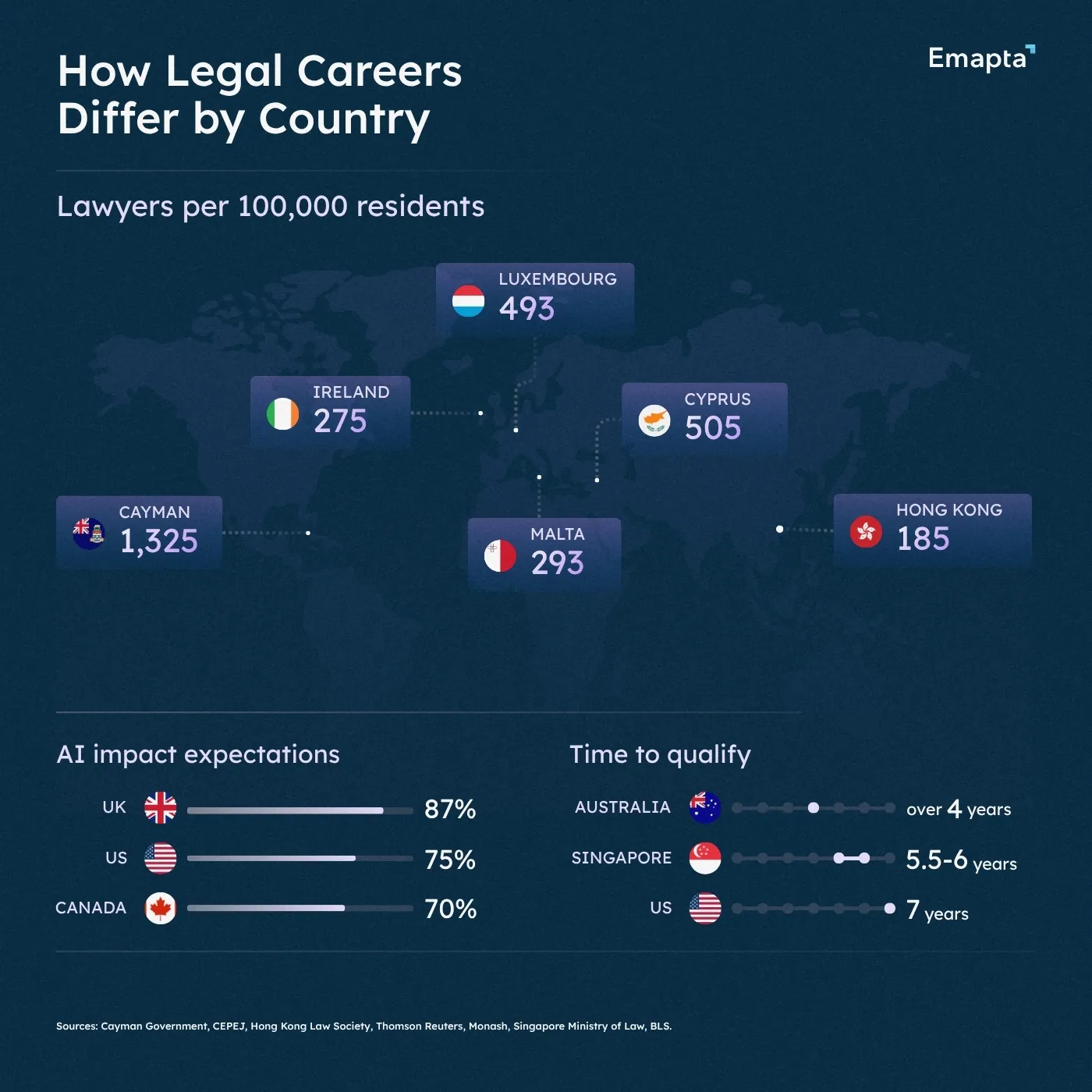
The Cayman Islands has 1,200+ attorneys on its Roll for a population of about 90,600, while 87% of UK lawyers expect AI to have a major impact on the profession, compared with 75% in the U.S. and 70% in Canada. Pay also varies by market, from a $76.76 hourly median in the U.S. to C$59.76 in Canada and A$56 in Australia.
6. Cayman Has 1,200+ Attorneys on Its Roll for a Population of About 90,600.
A small jurisdiction built around cross-border finance and corporate lawyer work can sustain a legal profession far larger than its local population might suggest. For a rough population comparison, 1,200 attorneys work out to about one for every 75 residents.
As lawyer fun facts go, Cayman is an extreme case, but a similar pattern appears among several European business and financial hubs:
- Cayman Islands:1,325 lawyers per 100,000 residents.
- Cyprus: 505.2 lawyers per 100,000 residents
- Luxembourg: 492.6
- Malta: 292.8
- Ireland: 275.3
- European average: 180
But being a global financial center does not automatically produce the same result. For instance, Hong Kong has 12,160 practicing solicitors and 1,785 registered foreign lawyers serving about 7.53 million people. That works out to roughly 185 lawyers per 100,000 residents, or one for every 540 people.
The reasons behind these differences are mostly familiar and go beyond the scope of this article, but the comparison makes one thing clear: financial-hub status alone does not explain lawyer density.
Sources: Cayman Islands Government, 2026, Cayman Islands Economics and Statistics Office, 2025, CEPEJ Evaluation Report, Law Society of Hong Kong, 2026, and Hong Kong Census and Statistics Department, 2025
7. 87% of UK Lawyers Expect Major AI Impact, Versus 75% in the US and 70% in Canada.
The question asked about the profession within the next five years, making this a measure of expected disruption rather than current AI use.
The comparison is interesting because UK lawyers expect the greatest impact despite operating in a more regulated AI environment than their U.S. peers. And the U.S. Is home to most of the largest AI companies.
Source: Thomson Reuters Institute
8. Lawyers Earn a Median $76.76 an Hour in the US, C$59.76 in Canada, and A$56 in Australia.
Lawyer stats show that pay varies substantially across major legal markets:
- Germany: €7,922 gross per month median for full-time lawyers
- United Kingdom: £30,000 starter to £80,000 experienced
- United States: $159,670 per year median
- Australia: A$2,070 per week median
The figures point to strong earning potential across several countries, although pay levels differ significantly by market and experience.
Sources: U.S. Bureau of Labor Statistics, 2025, Canada Job Bank, 2025, Jobs and Skills Australia, 2025, Germany Federal Employment Agency, 2025, and UK National Careers Service
9. Australia Offers One of the Shortest Routes to Becoming a Lawyer at Just Over 4 Years.
Australia has one of the shortest routes among the countries compared here. An accelerated LLB can take four years, followed by Practical Legal Training that can be completed in about 15 weeks. Singapore typically takes at least 5.5 to 6 years, while the U.S. usually requires seven years of full-time study after high school.
Sources: Monash University, College of Law Australia, Singapore Ministry of Law, U.S. Bureau of Labor Statistics
10. 47.4% of US Lawyers Report High Burnout.
The latest lawyer burnout statistics show that nearly half of U.S. lawyers screened positive for high burnout in 2026. Another 35.9% reported high or very high work-family conflict, showing that the pressure extends beyond working hours.
Source: American Bar Association
Lawyer Statistics by Year
Lawyer statistics by year show very different growth patterns. Australia’s solicitor population grew 47% in a decade, compared with about 27% in England and Wales and 5.6% in the U.S. Over a similar period, women’s share of the profession rose 8 percentage points in Australia, 7 in England and Wales, and 5 in the U.S.
11. Australia’s Lawyer Population Grew 47%, England and Wales 27%, and the US 5.6%.
Australia went from 66,211 practicing solicitors in 2014 to 97,500 in 2024. England and Wales rose from 135,294 in 2014/15 to 172,382 at the end of 2025.
The U.S. had 1,374,720 resident active lawyers in 2025. and added 73,363 resident active lawyers between 2015 and 2025. These facts about lawyers show that all three markets expanded, but at very different speeds.
Sources: 2024 National Profile of Solicitors, Solicitors Regulation Authority, and American Bar Association, 2025
12. Lawyer Density Rose 40% in Cyprus and 32% in Luxembourg, but Fell 7% in Malta.
The underlying shifts look like this:
Cyprus: from 362 to 505 lawyers per 100,000 residents
- Luxembourg: 387 to 510
- Poland: 137 to 168
- France: 93.5 to 106
- Malta: 337 to 314
Malta is the outlier in this group because density fell while the other four markets moved upward. Even within Europe, growth in lawyer supply is far from uniform.
Source: European Commission, 2025 EU Justice Scoreboard
We can see that the number of lawyers is rising, but what about the percentage of lawyers by race and gender?
Latest data shows that the past decade has witnessed substantial growth:
13. Racial and Ethnic Representation Rose 11 Percentage Points in the US and 6 in England and Wales.
In the U.S., lawyers of color went from 12% of the profession in 2014 to 23% in 2024. In England and Wales, Black, Asian, and minority ethnic lawyers moved from 14% in 2015 to 20% in 2025.
Sources: American Bar Association demographics and Solicitors Regulation Authority
14. Women Make Up 56% of Lawyers in Australia, 55% in England and Wales, and 41% in the US.
According to these lawyer facts, a decade earlier, women represented 48% of Australian solicitors, 48% of lawyers in SRA-regulated firms in England and Wales, and 36% of U.S. lawyers.
That means gains of eight, seven, and five percentage points, respectively.
Sources: National Profile of Solicitors, Solicitors Regulation Authority, and American Bar Association demographics
Future Trends & Facts About Lawyers
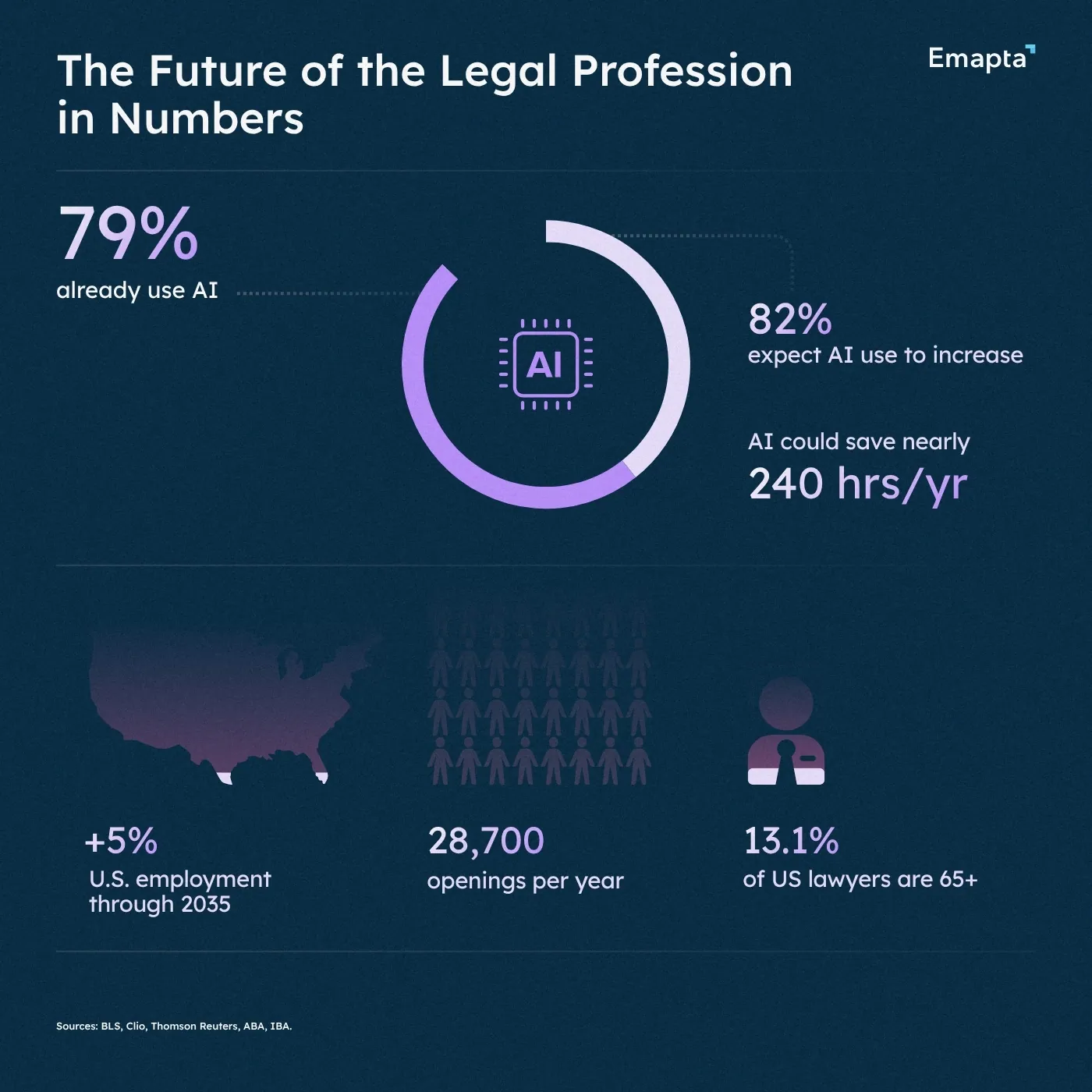
Data points to continued demand and faster technological change. U.S. lawyer employment is projected to grow 5% through 2035, while 79% of legal professionals already use AI and 82% expect to use it more. AI could also free up nearly 240 hours per legal professional each year, while 13.1% of U.S. lawyers are already 65 or older, creating additional replacement demand.
15. Law Still Attracts 0.5% to 2.5% of Young Adults Across 13 Countries.
Spain sits toward the top of the range, while Kenya tends toward the lower end. More importantly, the share has remained broadly stable over the past decade.
For Gen Z, there is no statistical evidence that they are broadly losing interest in law, but retention and work culture might pose a future challenge.
Source: International Bar Association
16. US Lawyer Employment Is Projected to Grow 5% Through 2035.
That would take lawyer employment from about 863,700 jobs in 2025 to 904,300 in 2035.
About 28,700 openings per year are expected on average, many created by workers leaving the occupation as well as new job growth. Some routine legal tasks may be automated without eliminating overall demand.
Source: U.S. Bureau of Labor Statistics, 2026
17. 79% of Legal Professionals Already Use AI.
Another 82% expect their AI use to increase over the next 12 months.
That makes AI less a future possibility and more an existing change still spreading through legal workflows.
Source: Clio 2025 Legal Trends Report
18. AI Could Free Up Nearly 240 Hours per Legal Professional Each Year.
The estimate is up from about 200 hours in 2024 and equals roughly six 40-hour workweeks – or an annual value of $19,000 per professional.
Source: Thomson Reuters Future of Professionals 2025
19. 13.1% of US Lawyers Are 65 or Older, Nearly Twice the Workforce Average.
One of the more interesting facts about lawyers is their age profile. 13.1% of U.S. lawyers are 65 or older, nearly twice the 6.8% share across the overall U.S. workforce. The median lawyer is also older, at 46, compared with 42.1 for all workers.
That age profile matters for future hiring. Some of the 28,700 projected annual lawyer openings will come from people leaving the profession, not only from new job creation.
Source: American Bar Association demographics
Conclusion
The jokes about lawyers may be centuries old, but the profession itself is changing fast. We see growing headcounts, shifting demographics, strong earning potential, rising AI use, and continued demand for legal work.
At the same time, these facts about lawyers show that high burnout and an aging workforce show another side of the profession. Law is still a strong career, but not an easy one.
Frequently Asked Questions (FAQ)
There is no single success rate because becoming a lawyer has several stages. In 2025, the U.S. law-school admission rate was 65%, while 63% of bar exam takers passed. First-time bar candidates had a 76% pass rate.
Five interesting facts about being a lawyer are that the path to qualification can take from just over four years in Australia to about seven years in the U.S., U.S. lawyers earn a median $159,670 a year, 47.4% report high burnout, 79% of legal professionals already use AI, and AI could eventually free up nearly 240 working hours per professional each year.
In the U.S., resident active lawyers represented about 0.4% of the population in 2025, or roughly one lawyer for every 249 people. The estimate compares 1,374,720 active lawyers with a U.S. population of roughly 342 million.
According to the American Bar Association, burnout appears to be one of the biggest challenges lawyers face. In 2026, 47.4% of U.S. lawyers screened positive for high burnout, and 35.9% reported high or very high work-family conflict.