

AI Won’t Fix Your Healthcare Operating Model
Healthcare providers can add AI, automate more tasks, hire more people, and still face the same capacity problem.
That was the starting point for Emapta’s recent webinar, “The Healthcare Operating Model Is Changing. Is Yours?” The session featured physician and healthcare strategist Dr. Barry Chaiken and April Price, Vice President of Business Development at Emapta.
The conversation kept returning to one question. It was not simply where AI can replace human work, but how the work should be divided in the first place. What requires clinical expertise? What can be automated? What can be handled by specialized external teams? And where does human judgment still need to remain central?
Dr. Chaiken’s central message was that AI adoption alone is not enough to transform healthcare operations. To get more value from the technology, healthcare organizations need to rethink the operating-model decisions around it, from workflow design and workforce structure to outsourcing, governance, and the role people continue to play in delivering care.
Here are the key takeaways from the session. To hear the full conversation, watch the webinar on demand.
7 Key Takeaways on How to Transform Your Healthcare Operating Model
Takeaway 1: AI Can Improve a Task Without Improving the Operation
Dr. Chaiken cautioned against assuming that making one task faster automatically improves the wider operation. If automation removes one step but creates more review somewhere else, the gain is limited. Technology can help, but its impact depends on how well it fits into the broader process.
“It doesn’t work where we layer the technology on top of what we have. We have to really start from the beginning.”
Takeaway 2: Start With the Work, Not the Tool
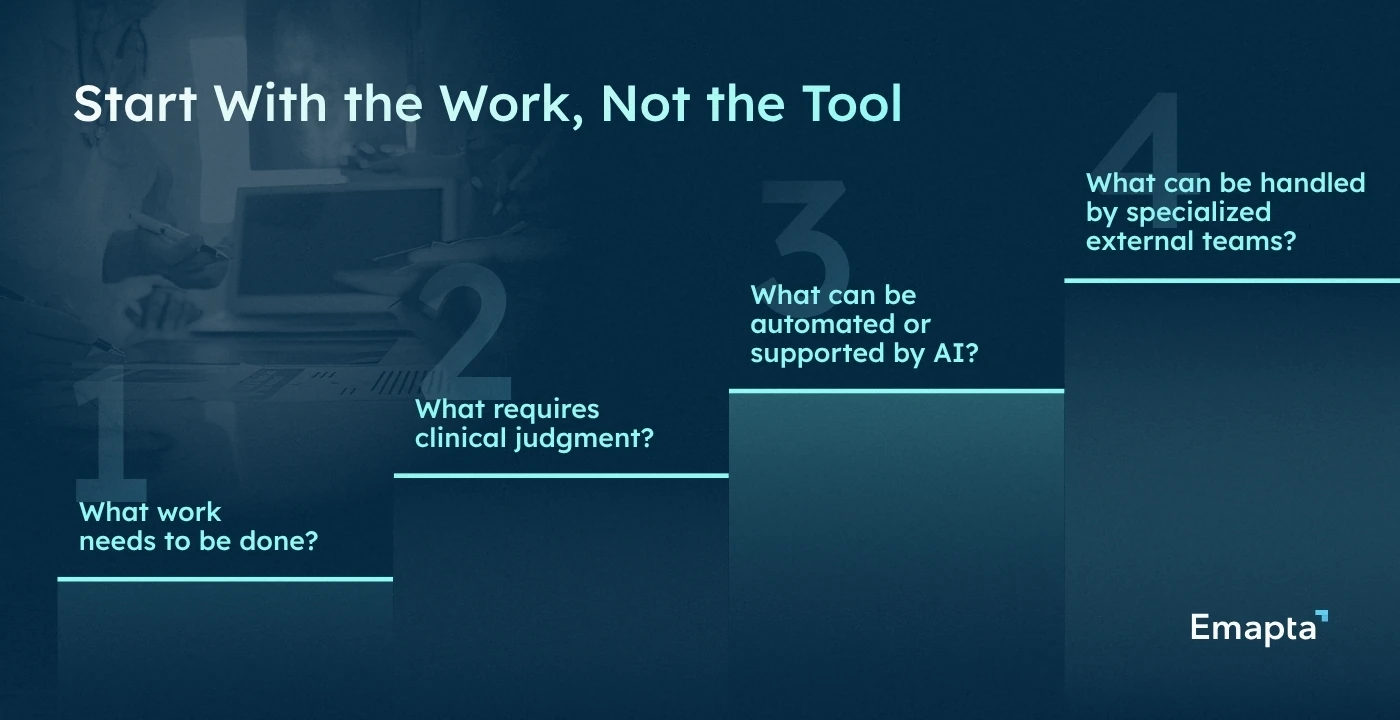
The practical starting point is relatively simple: break the work down before deciding whether to hire, automate, or move it elsewhere.
A healthcare workflow usually includes different types of tasks. Some require clinical judgment. Some need specialized non-clinical expertise. Others are administrative, repetitive, or rules-based.
When all of that work is treated the same way, it becomes harder to see where capacity can be created.
A stronger workforce-design process asks:
- What truly requires licensed clinical judgment?
- What needs human judgment, but not clinical expertise?
- What can technology automate reliably?
- Where can AI support people rather than replace the work entirely?
- What can be handled by another specialized team?
- Which tasks need to stay close to care delivery, and which do not?
- Where should human review or escalation remain essential?
This is where workforce transformation and AI strategy come together. AI doesn’t just change how many people are needed. It changes how people can spend their time.
The need to rethink the broader model is already on healthcare leaders’ agendas. In McKinsey’s 2025 Provider Operating Model Survey, 81% of health-system C-suite leaders said their current operating model was not effective or efficient, while 70% ranked operating-model redesign among their top five priorities.
The findings show that many health systems are already questioning how their current operating models work.
At the same time, McKinsey notes that AI is accelerating the need to rethink how work is structured, how decisions are made, and how talent is deployed.
That makes AI adoption part of a broader operating-model discussion, not a standalone technology decision.
Takeaway 3: The Goal Is to Return Capacity to People
Healthcare depends on skills that are already hard to find and difficult to scale. When highly trained people spend too much time on work that doesn’t require their full expertise, the operating model is using scarce capacity poorly.
Clinical documentation is a clear example.
AI-supported documentation can reduce the time clinicians spend recording encounters. But the real value is not a faster note. It is what that time can be redirected toward: more patient care, better coordination, higher throughput, or less administrative burden.
Dr. Chaiken described the opportunity this way:
“We can’t hire this away, so what we have to do is figure out how we can augment our workers with technology, augment our workers with AI to increase their productivity.”
Physicians seem to see much of AI’s value in those terms. Research from the American Medical Association (AMA) found that 57% of physicians see reducing administrative burden through automation as AI’s biggest opportunity, while 75% believe it can improve work efficiency.
That is a more useful way to think about AI in healthcare. The goal is not simply to remove human work, but to protect human capacity for the work where it creates the most value.
Takeaway 4: Global Talent Is One Design Decision Within the Workforce Conversation
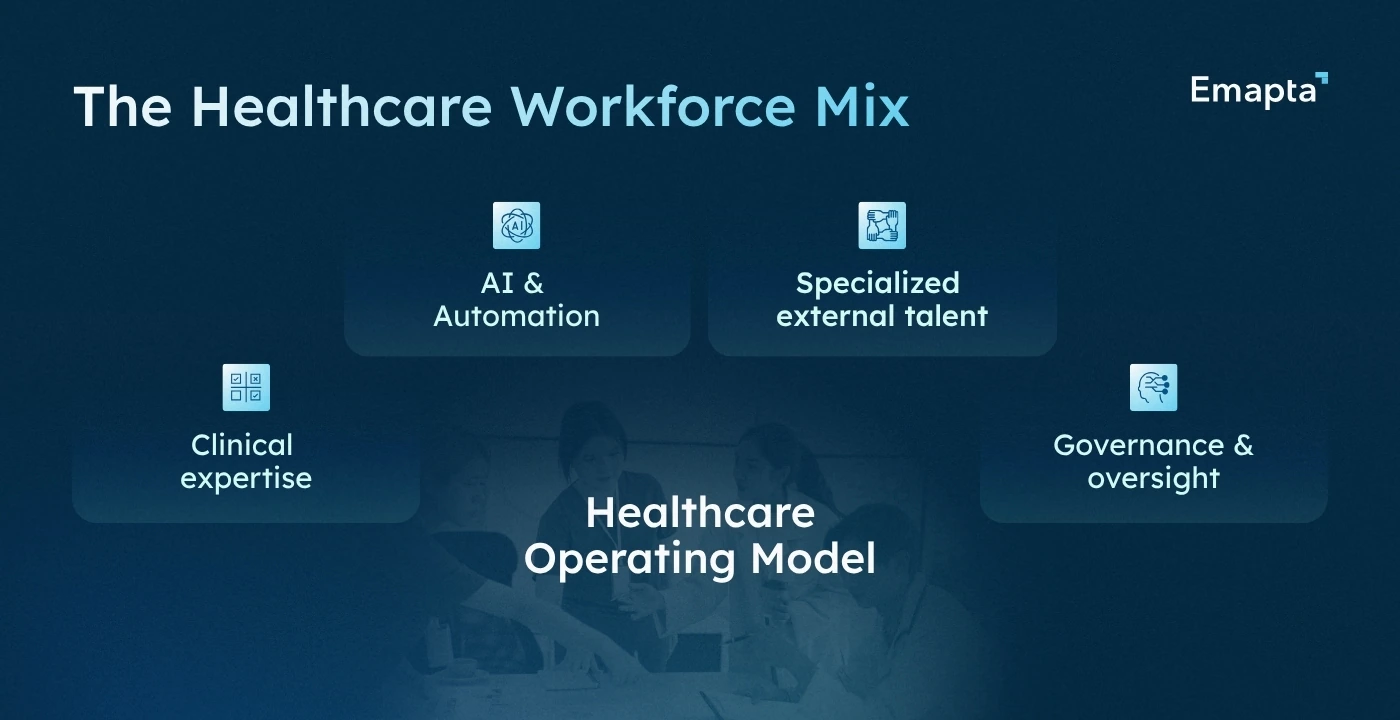
Once an organization understands the capabilities each type of work requires, another question becomes easier to answer: which work needs to stay close to care delivery, and which can be handled elsewhere?
Organizations sometimes approach outsourcing in healthcare from the opposite direction. Leaders choose a delivery model first—offshore, nearshore, or shared services—and then look for functions to move into it.
That puts geography ahead of the work. Some activities need to stay close to patients or local clinical operations. Others depend more on expertise, process discipline, coverage, or access to specialized skills than physical location.
This can open the workforce model to talent beyond the organization’s immediate labor market. Functions that can be supported by specialized external healthcare teams include:
- Revenue cycle
- Finance
- Supply chain
- Customer support
- Data operations
- Administrative work
Dr. Chaiken made a similar point during the discussion:
“There are talented people all around the world that can do work. You always want to keep your key competencies as close to you as you can, and your non-key competencies you can outsource in a way.”
The objective is not to move as much work as possible. It is to determine which capabilities the organization needs to keep close and where external expertise can strengthen the operation.
As April Price, Vice President of Business Development at Emapta, put it during the discussion:
“Global talent can be one design decision within a much broader strategy around capacity, expertise, resilience, and performance.”
The same principle applies to AI: understand the work first, then decide which combination of people, technology, and delivery model fits it best.
Takeaway 5: An AI-Enabled Workforce Needs Different Skills
Changing the work also changes what employees need to know. Giving people access to AI is not the same as preparing them to use it well. Employees need to understand where AI fits into the workflow, what outputs need to be checked, when to escalate an issue, and where human judgment still needs to lead.
“Wherever your workforce is, you have to educate them and train them in the use of AI tools.”
In practice, that means clinicians reviewing AI-generated documentation, operational teams spending more time on exceptions than routine processing, and managers overseeing work that combines employees, external specialists, and AI tools.
Takeaway 6: Governance Has to Follow the Workflow
AI also creates risks that cannot be delegated entirely to the technology provider. A tool can produce an output. The organization still has to decide who reviews it, who acts on it, who owns the outcome, and what happens when the tool is wrong.
Those controls are easier to establish when the workflow itself is clear. For each AI-enabled process, leaders should be able to identify:
- Where AI enters the workflow
- What information it can access
- Where human review is required
- What triggers an escalation
- Who remains accountable for the decision
- How performance and errors will be monitored
- What happens when the system produces an unexpected result
The same logic applies to distributed teams.
Building a dedicated healthcare team thousands of miles away does not automatically create more operating risk, just as an employee sitting inside the hospital does not automatically eliminate it.
What matters is whether the work has the right access controls, quality standards, training, accountability, security, oversight, and performance management.
Geography is only one part of the design. Governance determines how the work is controlled.
Takeaway 7: Measure the Operating Model, Not the AI Deployment
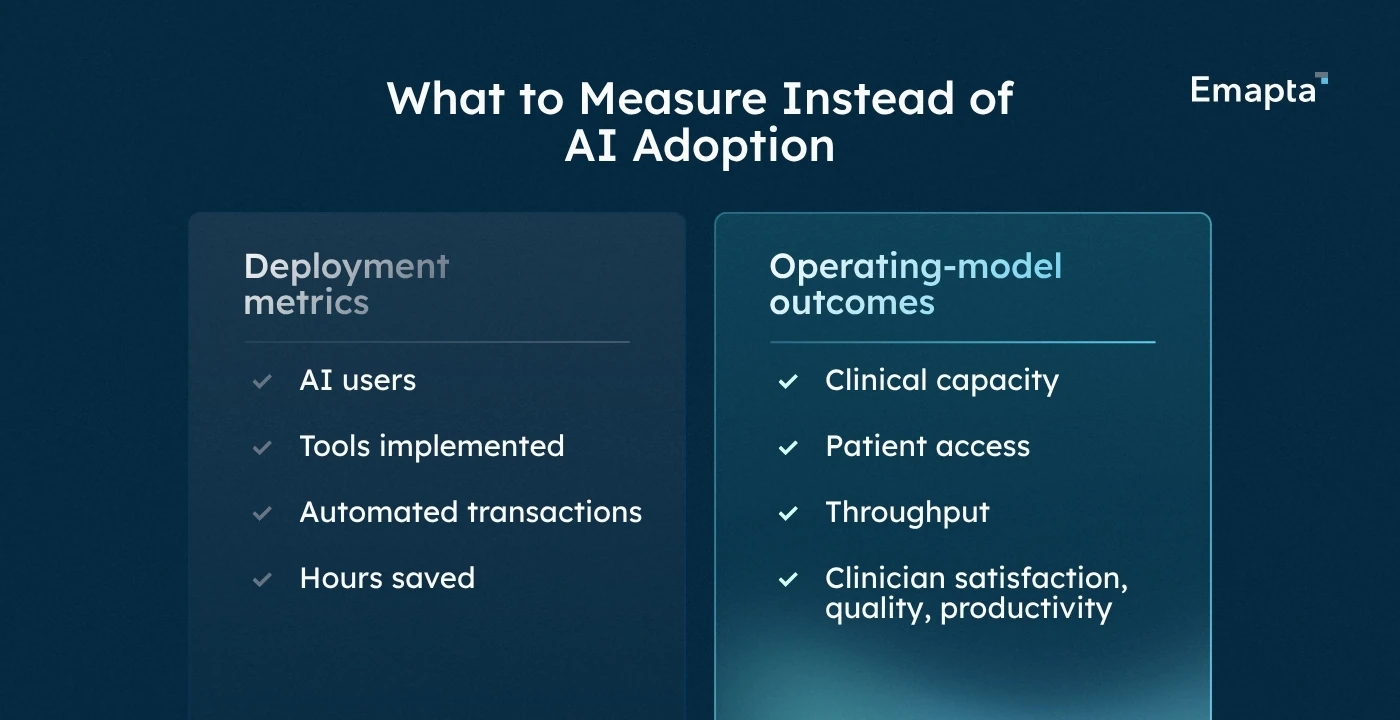
Another common mistake discussed was measuring transformation by how much technology was implemented. The number of AI users, automated transactions, implementation milestones, and hours saved can all be useful measures, but they do not necessarily show whether the operation improved. The stronger question is whether the changes produced the outcomes the organization needs. Depending on the workflow, those might include:
- Clinical capacity
- Patient access
- Throughput
- Administrative burden
- Clinician satisfaction
- Workforce retention
- Quality and patient safety
- Error and escalation rates
- Processing time
- Productivity
- Cost per transaction or process
The same applies to workforce transformation. A smaller workforce is not automatically more productive. A lower-cost global team is not successful if performance declines. And an AI tool that saves time on one task creates limited value if the overall process is still inefficient. Success should be measured by what the operating model produces, not simply by what was changed inside it.
Dr. Chaiken’s closing advice applies well beyond AI implementation:
“Focus on your outcomes. Start with the end in mind. Do not be strayed by that bright, shiny object.”
The Bottom Line: Building the Healthcare System of the Future
The webinar made one point clear: the future of healthcare will not be shaped by AI alone. It will depend on how well organizations redesign work around it, protect scarce clinical capacity, build the right mix of internal and global talent, develop new workforce skills, and put the right governance around every change.
As Dr. Chaiken stressed throughout the discussion, the starting point is always the outcome. The healthcare systems that move forward will not be the ones that adopt more technology, but the ones that use it deliberately to build stronger operations around the people, expertise, and care. The goal is a better system in which technology helps people deliver more of what healthcare is ultimately for: better care, better access, and better outcomes.
Watch the Full Session
Want the complete conversation with Dr. Chaiken and April Price?