

How AI Enhances the Value of Transformation-Led Outsourcing
The rise of AI has led some to question whether businesses will still need outsourcing at all. If technology can automate more work, it may seem logical that the need for external teams would shrink with it.
But that view overlooks how outsourcing is changing. Organizations are now looking beyond purely transactional work and toward the highly skilled professionals, technical capabilities, and workforce models needed to adopt AI effectively.
Outsourcing Is Here to Stay in the AI Era

While AI can take over many repetitive and routine tasks, it won’t eliminate the need for outsourced services. Organizations still rely on outsourcing to access specialized expertise, scale operations, and fill talent gaps that technology alone can’t solve.
Business investment decisions already point in this direction. According to Everest Group research, 44% of enterprises are now expanding their outsourcing scope to accelerate AI adoption, suggesting that AI is driving new priorities rather than making outsourcing obsolete.
After all, many business functions still rely on capabilities that AI can’t fully replicate, including:
- Critical thinking
- Real-world experience
- Domain expertise
- Collaboration
- Human judgment
Rather than replacing skilled professionals in outsourced roles, AI is helping them deliver better outcomes. In a Deloitte survey, 67% of organizations said they were adopting outcome-based outsourcing models focused on measurable results and innovation.
How AI Accelerates the Shift from Cost to Transformation
Historically, outsourcing has been viewed primarily as a cost-saving strategy, enabling organizations to scale operations while keeping overhead under control. While cost remains an important consideration, it is no longer the sole driver behind outsourcing decisions.
Organizations now evaluate outsourcing through a broader strategic lens, with greater emphasis on the capabilities and outcomes that support workforce transformation. According to Everest Group, access to specialized talent is already a key driver, cited by 60% of enterprises.
This broader role is set to expand further as continued innovation across the AI ecosystem increases what outsourcing can help businesses achieve across several key areas.
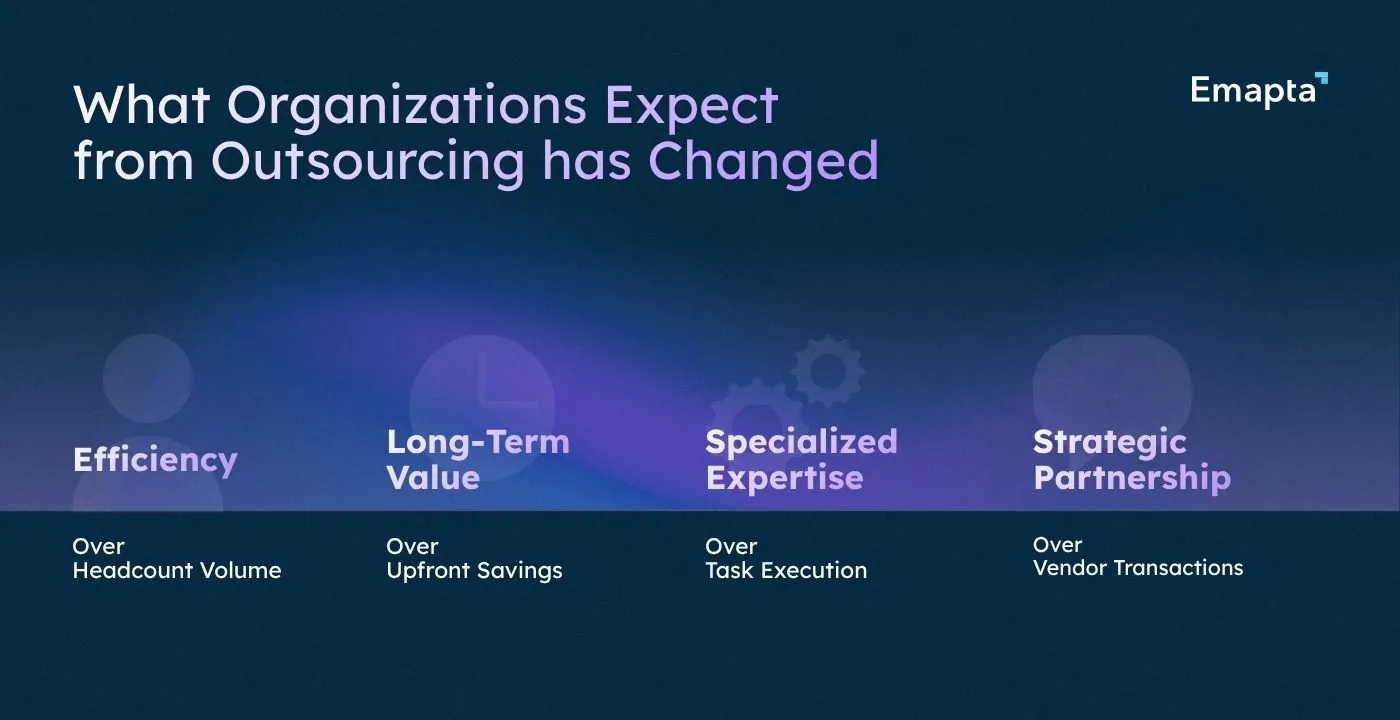
1. Efficiency Over Headcount Volume
As workforce needs evolve, leaders are increasingly questioning whether adding more people is the best solution. Instead, they’re prioritizing more efficient ways of delivering work before expanding headcount. Outsourcing is no longer measured by team size alone, but also by its ability to improve productivity and business performance.
How AI Supports This Shift
AI enables offshore and nearshore teams to deliver more with the same resources by:
- Equipping teams with AI-powered tools
- Reducing time spent on manual processes
- Increasing output per employee
2. Long-Term Value Over Upfront Savings
The lowest-cost outsourcing option doesn’t always deliver the strongest long-term outcomes. Organizations are increasingly evaluating providers based on their ability to continuously improve performance, scale with the business, and create value beyond the initial engagement.
How AI Supports This Shift
The long-term value of outsourcing grows when providers use AI to optimize how work is planned, delivered, and improved, including:
- Analyzing operational data to identify process improvement opportunities
- Forecasting demand and staffing needs through predictive analytics
- Monitoring workflows for anomalies and potential risks
3. Specialized Expertise Over Task Execution
Outsourcing has evolved beyond high-volume, process-driven functions. Today, organizations are increasingly outsourcing specialized areas such as technology, finance and accounting, engineering, and data, where deep functional expertise matters more than executing routine tasks at scale.
This shift is also increasing demand for highly skilled talent that can support more strategic business priorities. Research from the Everest Group shows that 48% percent of enterprises now outsource high-skill roles, and 57% plan to increase their use of outsourcing for these roles over the next 12 to 18 months.
How AI Supports This Shift
AI enhances the impact of specialized expertise by helping outsourced professionals work with greater speed, insight, and confidence, including:
- Synthesizing large volumes of data into actionable insights
- Identifying patterns and trends that may otherwise be overlooked
- Providing data-driven recommendations to support decision-making
- Generating ideas and alternative approaches to support innovation
4. Strategic Partnership Over Vendor Transactions
The deeper outsourcing becomes embedded in business strategy, the more the relationship shifts beyond traditional service delivery. Providers are expected to become strategic partners that help organizations adapt to change and achieve long-term business goals.
How AI Supports This Shift
AI helps organizations and their outsourcing partners work toward shared business outcomes by enabling:
- More informed strategic planning
- Better visibility into performance and progress
- Expanded capabilities for AI-fluent outsourced professionals
- Continuous workforce optimization through AI-driven insights
Where Human Expertise Makes the Difference
As AI becomes more widely available, it’s easy to assume the technology itself will become the primary competitive advantage. However, with 74% of enterprises prioritizing AI-driven automation, simply keeping pace is no longer enough. The real differentiator will be how effectively these capabilities are translated into better decisions and stronger business outcomes.
That distinction becomes clearer when you look at the role human expertise plays in how AI supports different types of work. Across functions, the technology can improve speed and efficiency, but the quality of the outcome still depends on the experience, judgment, and interpersonal skills of the person using it. Consider these examples:
- A corporate lawyer can use AI to draft a contract faster, but legal expertise is still needed to identify risks and negotiate terms.
- A supply chain specialist can use AI to analyze disruptions, but determining the right response still depends on operational judgment.
- A customer success manager can use AI to summarize client interactions, but recognizing unspoken concerns still depends on human insight.
For businesses, the implication is clear: access to AI alone will not create a lasting advantage. Real transformation happens when the technology is placed in the hands of highly skilled professionals who understand the work, apply it in context, and remain accountable for the outcome.
Transformation-Led Outsourcing as an AI Adoption Strategy
While companies across industries already recognize that effective adoption requires more than technology, they may not have all the specialized talent they need in-house. This leads them to look beyond their organization for the right expertise.
Outsourcing offers one way to access that, along with the AI tools and established capabilities providers have already developed. Traditional outsourcing, however, is often built around executing predefined tasks rather than changing how work gets done. Supporting AI initiatives takes a model designed for more than task delivery.
What businesses need from an outsourcing partner also goes beyond access to technical talent. With 53% of enterprises seeking AI workflow design expertise and 52% expecting seamless AI integration, they need partners that can help embed AI into how work gets done.
A Better Model for AI-Enabled Work
Unlike traditional outsourcing models that may rotate resources across accounts, dedicated staffing gives businesses access to global talent who work exclusively for them. As a seamless extension of internal teams, these professionals can apply new technologies in context, improve the processes around them, and support broader transformation.
Here’s how dedicated staffing can support organizations that turn to outsourcing for AI adoption:
1. Bring in the right expertise
Leaders can add the skills and capacity internal teams need across areas such as data, automation, machine learning, and process improvement, without building every capability in-house.
2. Apply AI in the right business context
Because dedicated professionals work closely with internal teams, they can understand existing workflows and use AI in ways that make sense for the business.
3. Improve how the work gets done
Adoption is rarely just about introducing a new tool. Dedicated teams can help refine workflows, clarify responsibilities, and build better processes around the technology.
4. Keep improving over time
Since the team works exclusively for one business, it can continue refining how AI is used as tools, priorities, and needs change.
5. Add capabilities as the strategy grows
Businesses can bring in new roles and expertise as their AI initiatives expand, rather than building the entire team from the start.
How This Changes Workforce Planning for Global Teams
If AI-enabled outsourcing is becoming part of your operating model, it will also reshape how you build your global team. As the technology, roles, and capabilities around it continue to change, workforce planning will need to become more flexible and more closely tied to how AI is used across your business.
The real transformation isn’t adding humans and machines together, it’s redesigning work with clear decision rights and trust thresholds to deliver exponential value as human and machine capabilities converge in the work itself.
— David Mallon, U.S. Human Capital head of research and chief futurist, Deloitte
This is already visible in the kind of work companies are outsourcing. With 24% moving outsourced work toward AI, analytics, and data specialists, global teams are playing a larger role in providing advanced capabilities, not just additional capacity.
As you think less about filling individual vacancies and more about building the right mix of capabilities across internal and external teams, consider these questions:
- Which capabilities should remain in-house?
- Which expertise should you add through global teams?
- How might roles change as AI becomes more embedded?
- How can you keep teams flexible as your needs develop?
Why You Need a Strategic Partner
Making these choices can be difficult when technology is changing faster than most workforce models can keep up with. This is why choosing a provider that goes beyond traditional outsourcing is essential.
You need one that will not just supply the right offshore or nearshore talent, but also help you build a long-term workforce strategy around the role AI will play in your business. This is the kind of partnership Emapta is built to provide.
Along with dedicated staffing solutions, we offer workforce transformation advisory to help you connect global talent decisions with your broader AI priorities. With Emapta, you can:
- Access the top 1% of global talent to build specialized AI, data, automation, and process capabilities faster, so you can accelerate AI initiatives without compromising on quality.
- Hire in as little as 9 days through the Emapta Talent Marketplace (ETM), helping you respond quickly to evolving AI priorities and reduce delays in critical projects.
- Maintain full control of your dedicated team, so you can align how AI is applied with your priorities, processes, and culture, ensuring AI adoption supports your business goals.
- Adjust your team as your AI needs develop through flexible engagement terms with no long-term contracts, giving you the agility to scale capabilities as your transformation evolves.
- Plan your AI workforce investment with complete pricing transparency, with no salary markups or hidden fees, so you can invest confidently and maximize the value of your AI initiatives.
AI Will Keep Expanding What Outsourcing Can Deliver
Over the next decade, the line between outsourcing and transformation will continue to blur. As AI changes the work itself, global teams will take on a bigger role in shaping new capabilities, new operating models, and entirely new ways of delivering value.
That gives you the chance to build for what comes next, not simply respond to it. With the right partner and the right foundation in place, transformation-led outsourcing can become a way to keep moving forward as AI opens up possibilities that are only beginning to emerge.
Power Your AI Initiatives with the Right Talent
Build the expertise behind your AI plans with a global team designed around where your business is headed.