

15+ Interesting Coworking Trends That Show Where the Industry Is Heading
Coworking trends show a continued growth of the industry, but the more interesting shift is happening in the customer base.
We are used to seeing this model used mostly by freelancers, digital nomads, and early-stage startups.
Today, larger, more established companies use coworking (flexible) workspaces to support hybrid teams, enter new markets, and avoid long-term office commitments.
These coworking space numbers show how the market changed in 2026 and where it could be heading next.
6 Key Coworking Statistics to Know by End of 2026
- The number of spaces worldwide reached 41,975 in 2024, up from 16,599 in 2018
- 55% of global occupiers use flexible office solutions, and 17% plan to increase their use
- 54% of coworking businesses were profitable in 2025
- India scored 100 on the Flexible Maturity Index, compared with 68 for Vietnam and 59 for Mexico
- U.S. coworking and flex locations increased by about 21% from Q2 2025 to Q2 2026
- 64% of European occupiers use flex space to avoid capital commitments
What Do Global Coworking Trends Show?
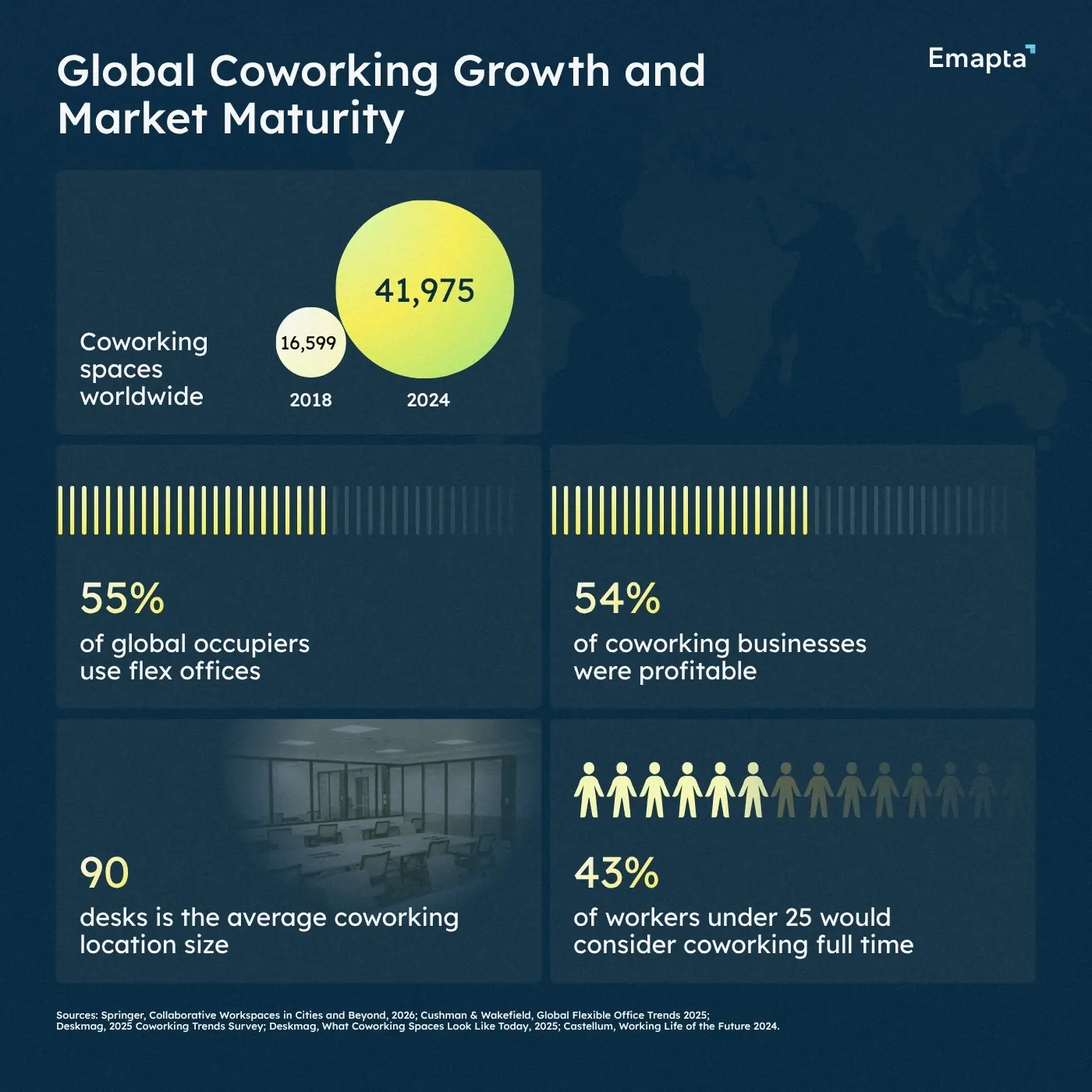
We see a market that’s expanding and maturing quickly. The number of coworking spaces worldwide rose from 16,599 in 2018 to 41,975 in 2024, while 55% of global occupiers now use flexible offices and 54% of coworking businesses are profitable.
The average location has about 90 desks, and age still matters: 43% of workers under 25 would consider working exclusively from a coworking space.
1. Coworking Spaces Worldwide Reached 41,975 in 2024.
According to coworking industry statistics, the number of coworking spaces worldwide reached 41,975 in 2024, up from 16,599 in 2018.
That’s roughly 2.5 times as many spaces in six years.
Source: Springer, Collaborative Workspaces in Cities and Beyond, 2026
The rise also reflects a different idea of what an office needs to do. The mahogany reception desk designed to impress visitors, or the sleek headquarters meant to signal that a company is cutting-edge, matters less when many client relationships start and continue online.
Coworking and flex spaces emphasize convenience, community, and how people actually use the workplace.
And the trend will continue to grow.
2. 55% of Global Occupiers Already Use Flexible Offices.
55% of global occupiers use flexible office solutions, while another 17% plan to increase their use.
Source: Cushman & Wakefield, Global Flexible Office Trends 2025
Demand now comes from project teams, satellite offices, temporary capacity, and distributed workforces, not only individuals and small businesses. That shift is one of the clearest coworking industry trends in the current market.
The last few years have not been kind to long-term planning. Many plans barely survive contact with reality – because it keeps changing.
Political uncertainty, global conflicts, economic shocks, and rapid AI development have made it harder for managers to manage remote teams or even know what their workforce or office needs will look like even a few quarters ahead.
It’s no surprise that companies are trying to reduce risk and avoid commitments they may regret later.
Flex and coworking spaces offer an alternative to the high upfront costs of traditional offices, while making it easier to add capacity when needed or scale back when plans change.
3. Global Coworking Occupancy Reached 68% in Early 2025, 54% of Businesses Were Profitable.
Coworking space industry analysis show that average occupancy across coworking spaces reached 68% in early 2025. In cities with more than one million residents, occupancy was above 70%.
54% of coworking businesses were profitable, while 18% reported losses. Nearly two-thirds of operators in cities with more than one million residents were profitable, compared with about 20% in towns with fewer than 20,000.
Sources: Deskmag, 2025 Coworking Trends Survey, Deskmag, 2025 Global Coworking Space Trends
That’s hardly a surprise, as larger cities have larger talent pools and attract more companies and freelancers.
4. Coworking Statistics Worldwide Show That The Average Coworking Location Has 90 Desks.
A typical coworking space has 90 desks across roughly 1,200 square meters. In towns with fewer than 20,000 residents, the average falls to only 22 desks.
Operators are also becoming less likely to stay single-location businesses. Only 53% now operate one location, down from more than 75% around a decade ago.
Source: Deskmag, What Coworking Spaces Look Like Today, 2025
5. 43% of Workers Under 25 Would Consider Coworking Full Time.
Coworking statistics by age show a clear decline in full-time interest as workers get older:
- Age under 25: 43%
- Age 25–34: 35%
- Age 35–44: 29%
- Age 45–54: 26%
- Age 55+: 15%
The same survey found that seven in ten Nordic office workers would consider working from a coworking space either fully or partly.
Source: Castellum, Working Life of the Future 2024
How Do Coworking Trends Differ by Country?
Coworking statistics by country show very different market patterns. In India, 44% of flex seat leasing comes from Global Capability Centers.
Surprisingly, Romania, despite having 1,000+ business service centers, has flex space that accounts for only 2.3% of Bucharest’s modern office stock. The U.S. counts 9,384 coworking and flex locations, versus 4,698 across the UK and Ireland.
6. The U.S. Has 9,384 Coworking and Flex Locations, Versus 4,698 Across the UK and Ireland.
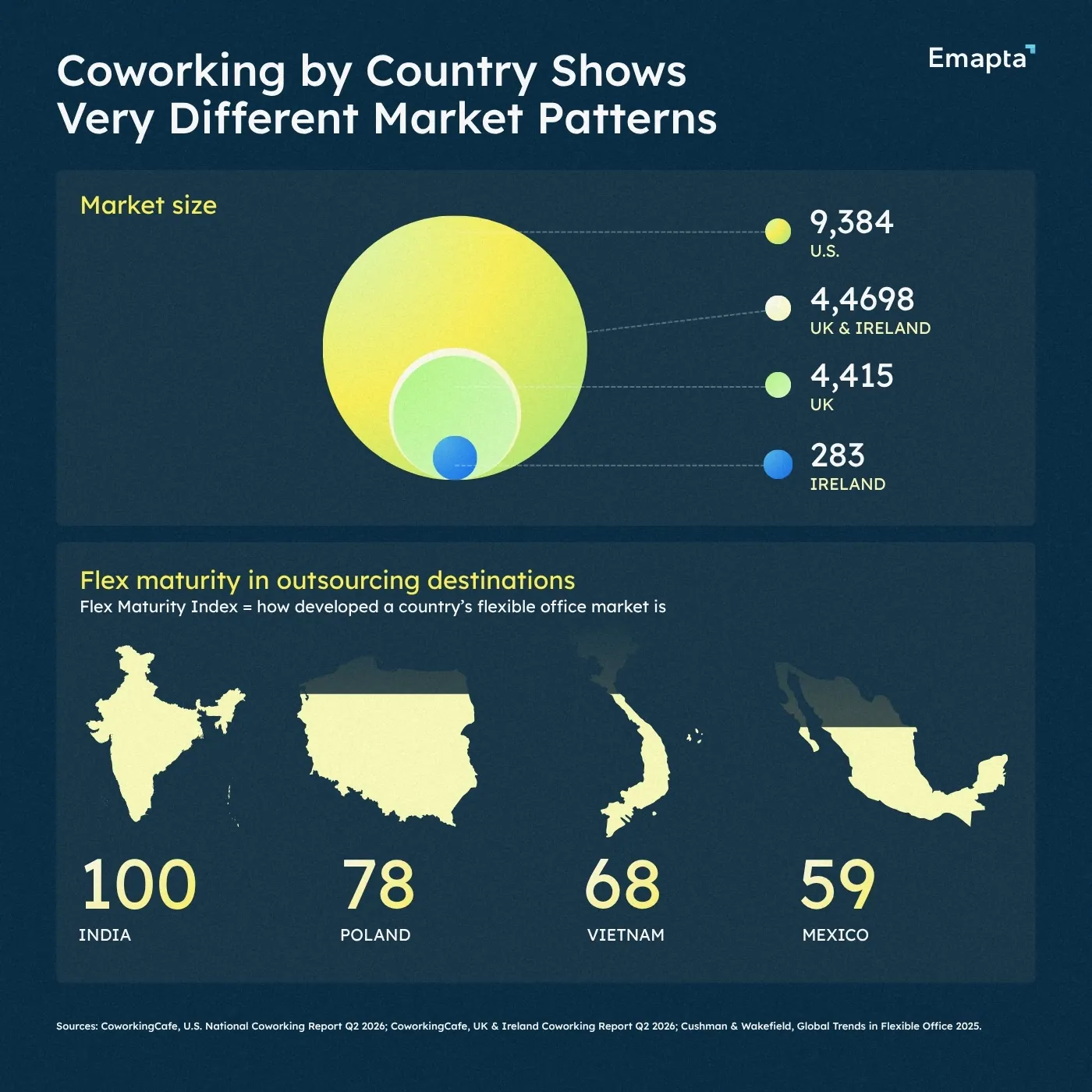
The U.S. had 9,384 coworking and flex locations in Q2 2026, roughly twice the locations across the UK and Ireland.
- UK: 4,415
- Ireland: 283
- Greater London: 1,275
Greater London alone accounted for more than a quarter of the UK and Ireland total, showing how concentrated supply remains in major business hubs.
Sources: CoworkingCafe, U.S. Q2 2026 and UK & Ireland Q2 2026
7. India Scores 100 for Flex Maturity, Compared With 68 for Vietnam and 59 for Mexico.
The Flex Maturity Index measures how developed a country’s flexible office market is, based on factors such as flex share of office inventory, operator competition, leasing activity, and contract maturity.
Among major outsourcing destinations, the scores vary widely:
- India: 100
- Poland: 78
- Vietnam: 68
- Mexico: 59
Sources: Cushman & Wakefield, Global Trends in Flexible Office 2025
8. Flex Represents About 10% of Office Stock in India, More Than in Warsaw or Bucharest.
Outsourcing strength alone does not explain how quickly flex space develops. For instance, India, Warsaw, and Bucharest are all popular outsourcing and business-service locations, but their flex-space penetration differs sharply: around 10% of Grade A office stock in India, 4% of modern office stock in Warsaw, and 2.3% in Bucharest.
Sources: Cushman & Wakefield India, 2026 and Colliers Romania, 2025
Coworking statistics show that the gap may depend less on outsourcing strength and more on who leases flex and coworking spaces, and why. In India, global companies account for a large share of demand, with GCCs using it for large teams that need to scale quickly.
In Poland, multinationals often use flex as an entry step before moving into conventional offices as they grow. And they save money, as traditional offices are usually cheaper there.
A strong outsourcing base creates demand, but the occupier mix helps determine whether that demand turns into flex.
9. 44% of India’s Flex Seat Leasing Came from Global Capability Centers.
In H1 2026, 44% of flex seats leased across India’s eight largest cities came from GCCs, up from about 37% in full-year 2025. Total flex seat leasing reached 191,306.
This directly links global service delivery with flex demand. Companies can expand teams without first committing to a conventional office fit-out and long lease.
Source: Cushman & Wakefield India, H1 2026
10. Romania Has 1,000+ Service Centers, but Flex Is Only 2.3% of Bucharest Office Stock.
One of the most interesting coworking facts is that Romania hosts more than 1,000 business service centers and over 280,000 employees in the sector. Yet flexible offices account for only 2.3% of Bucharest’s modern office stock.
The Philippines shows a different pattern. Its flex industry developed alongside the country’s outsourcing sector, and Metro Manila reached 49,500 flex seats by Q3 2025. Outsourcing can accelerate flexible and coworking workspace demand, but it does not determine it on its own.
Sources: Deloitte/ABSL Romania, 2026, Colliers Romania, 2025, and Colliers Philippines, 2025
Coworking Statistics by Year
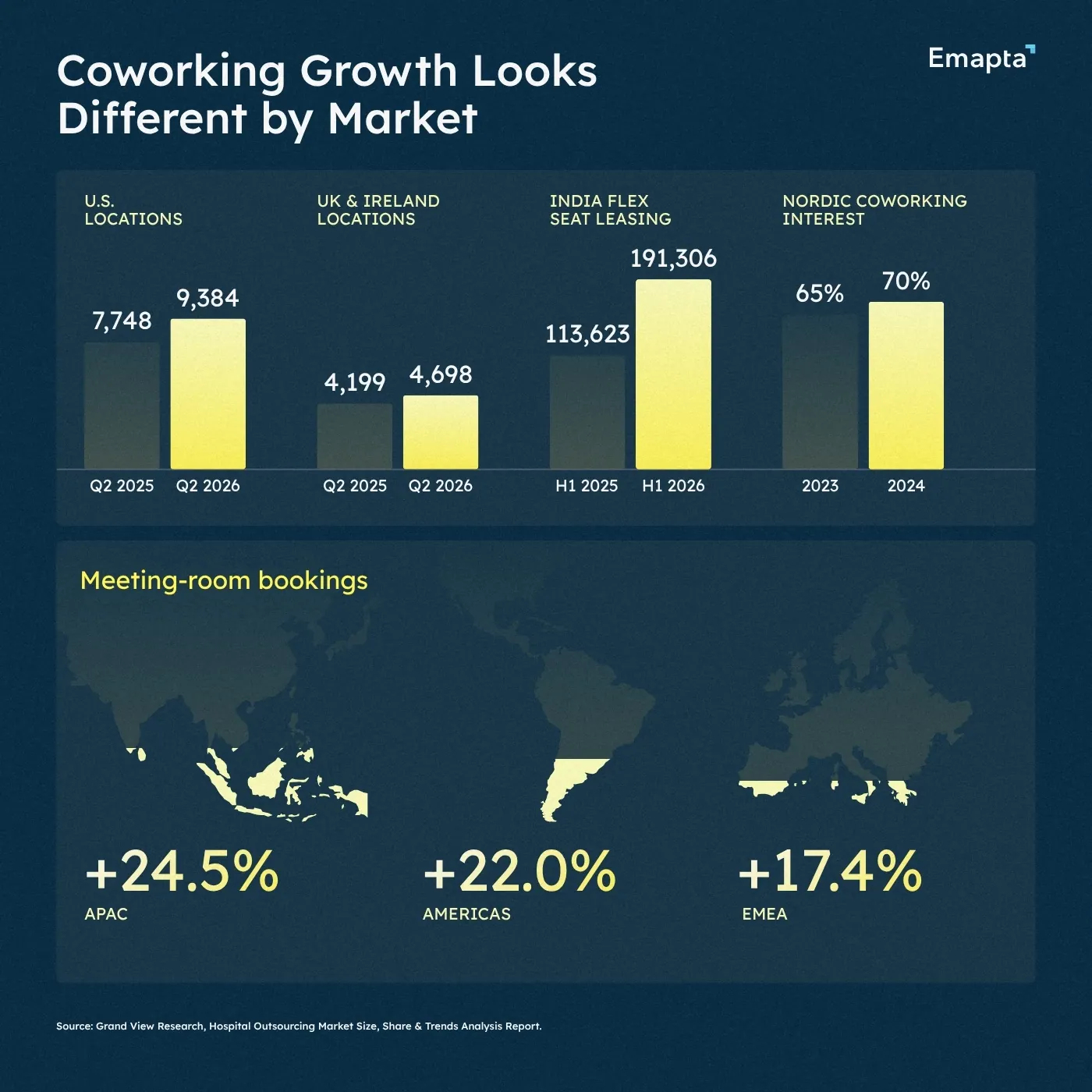
Statistics show continued expansion, but the pace differs sharply by market. U.S. locations grew about 21% from Q2 2025 to Q2 2026, compared with roughly 12% across the UK and Ireland, while India’s flex seat leasing jumped 68.4% year over year.
Usage is changing too: Nordic interest in coworking rose from 65% to 70%, while meeting-room bookings increased 17.4% to 24.5% across major regions as desk bookings declined.
11. Coworking Space Trends from 2025 and early 2026 Show That U.S. Coworking Locations Grew 21% in a Year, Compared With 12% in the UK and Ireland.
The U.S. increased from 7,748 locations in Q2 2025 to 9,384 in Q2 2026, or about 21%. The UK and Ireland increased from 4,199 to 4,698, or about 11.9%.
The same one-year comparison shows faster location growth in the U.S.
Sources: CoworkingCafe, U.S. Q2 2025, U.S. Q2 2026, UK & Ireland Q2 2025, and UK & Ireland Q2 2026
12. Nordic Interest in Coworking Rose From 65% to 70%.
In 2023, 65% of Nordic office workers said they would consider working fully or partly from a coworking space. In 2024, that increased to 70%.
Most of the gain came from respondents choosing coworking for part of their week. The share answering “partly” rose from 36% to 40%, while full-time interest moved from 29% to 30%.
Source: Castellum, Working Life of the Future 2024
13. Meeting Room Bookings Rose 17% to 25% While Desk Bookings Fell.
Flex usage is shifting toward collaboration:
- APAC: meeting rooms +24.5%, desks -5.2%
- Americas: meeting rooms +22.0%, desks -7.9%
- EMEA: meeting rooms +17.4%, desks -3.6%
Hybrid teams appear to be using flexible spaces more for meetings and team collaboration, rather than simply replacing an individual office desk.
Source: Cushman & Wakefield, Global Flexible Office Trends 2025
14. India’s Flex Seat Leasing Increased 68.4% Year Over Year.
India’s operators leased 191,306 flex seats in H1 2026, up 68.4% from 113,623 in H1 2025. Gross leasing volume also increased 55%, from 5.4 million to 8.4 million square feet.
Source: Cushman & Wakefield India, H1 2026
What Coworking Trends Will Shape the Future of Work?
Trends point toward more enterprise use, stronger pressure to control real-estate commitments, and heavier reliance on technology. Only 3% of large enterprises use coworking and flex for more than 10% of their portfolio, while European occupiers have targeted 29% flex by 2027.
Cost is a major driver: 64% of European occupiers use flex to avoid capital commitments, while 60% in the Americas use it to reduce capital expenditure. On the operator side, 97% of coworking founders say automation is important or very important.
15. Only 3% of Large Enterprises Put More Than 10% of Their Portfolio in Flex.
Only 3% of large enterprises globally use flexible space for more than 10% of their portfolio. At the same time, 42% of organizations allocate 1% or less of their headcount to flex solutions.
That leaves considerable room for enterprise adoption to grow.
Source: JLL, The Flexible Office Space Imperative, 2026
16. European Companies Targeted 29% of Their Portfolios in Flex by 2027.
Coworking industry trends from 2025 showed that European occupiers targeted 29% of their portfolios in flex by 2027, up from 21% in the previous year’s survey.
The target shows how much more flex companies expect to build into their office strategies.
Source: CBRE, European Office Occupier Sentiment Survey 2025
17. 64% of European Occupiers Use Flex to Avoid Capital Commitments.
Cost control is one of the strongest reasons companies give for using flexible space:
- Europe: 64% cite avoiding capital commitments
- Americas: 60% use flex to reduce capital expenditure
- Americas, companies with 10,000+ employees: 72% use it to reduce capital expenditure
The financial case is broader than a cheaper desk. Flex can reduce upfront fit-out spending and the risk of paying for excess space.
Sources: CBRE, European Office Occupier Sentiment Survey 2025 and CBRE, 2025 Americas Office Occupier Sentiment Survey
18. 97% of Coworking Founders Say Automation Is Important.
Coworking technology trends are changing the operator side too. 97% of owners and founders in Optix’s 2024 survey said automation was important or very important to their business.
Operators used an average of four technology tools. Nearly 70% used accounting systems and 61% used marketing platforms, alongside software for access, billing, onboarding, and bookings.
Source: Optix, 2024 Coworking Automation Survey
Wrapping Up the Latest Coworking Statistics
The biggest coworking trend in 2026 is not simply that more spaces are opening. The customer base is changing too.
Freelancers, startups, and remote workers remain part of the market, but larger companies are using flex for market entry, hybrid teams, collaboration, and scalable capacity, especially in India.
India shows how global business expansion can feed flex demand, while Romania, Vietnam, and Mexico show why the relationship should not be overstated. The data we gathered on coworking trends show that strong outsourcing sector can help, but it is only one factor shaping coworking growth.