

How to Build a Dedicated AI Team – A Step-by-Step Guide
A dedicated AI team gives your business the focused, specialized talent needed to move artificial intelligence (AI) initiatives from pilot to production. Instead of stretching a handful of generalists across every AI project, this kind of team brings together the data scientists, machine learning engineers, and AI strategists who can build, deploy, and manage AI solutions end to end.
This is different from a single dedicated AI assistant for your team that handles day-to-day tasks; a dedicated AI team builds and runs the AI systems behind the scenes.
Today, we will see what such a team looks like, the roles it should include, and a practical, step-by-step process for building one, whether you hire in-house, outsource traditionally, or use a dedicated staffing model.
What Is a Dedicated AI Team?
A dedicated AI team is a group of specialists assigned full-time to your organization’s AI projects, rather than a mix of freelancers or generalist staff working on AI part-time. AI-based dedicated tech teams differ from a standard IT department in one key way: this team focuses exclusively on designing, training, and maintaining AI models and systems. Members typically include data scientists, AI engineers, and other specialists who understand both the technology and the business problem it needs to solve.
When Does Your Business Need One?
Not every company needs a full AI team on day one. It usually makes sense once your organization moves past small pilots and starts asking AI to carry real operational weight, whether that is automating customer support, forecasting demand, or personalizing product recommendations.
A few common signals that it is time to build one:
- You are running multiple AI pilots and need consistent oversight instead of ad hoc effort
- Your data volume and complexity have outgrown what a generalist IT team can manage
- You want to reduce dependence on outside consultants for ongoing AI work
- Leadership has set AI as a strategic priority with a dedicated budget attached
- You need faster, more reliable AI delivery to stay competitive in your industry
If you recognize two or more of these signals, it is usually a sign that ad hoc effort has reached its limit and a structured team, rather than another one-off project, is the more sustainable next step.
Which Roles Should a Dedicated AI Team Include?
Getting your AI team structure right starts with knowing which roles to include, not just how many people to hire. The best setups combine core technical roles with supportive and strategic roles that connect the technology to business outcomes. Before you post a single job listing, map out AI team roles and responsibilities so each hire has a clear mandate from day one.
Core Technical Roles
- AI and machine learning engineers who build, train, and deploy models, then tune them as new data comes in
- Data scientists who define the problem, choose the right modeling approach, and interpret results well enough to explain the “why” behind a recommendation
- Data engineers who build and maintain the pipelines that feed clean, structured data into the models on a reliable schedule
- DevOps or MLOps engineers who deploy models into production, monitor them for drift, and roll back changes when something breaks
- Research scientists who test new algorithms and approaches before they get baked into the team’s standard toolkit, useful once you move past off-the-shelf models
Supportive and Strategic Roles
- A project manager or AI strategist who owns timelines, budget, and stakeholder alignment, and keeps the team’s roadmap tied to business priorities rather than technical curiosity alone
- A business analyst who translates business needs into technical requirements, so engineers aren’t left guessing what “improve customer experience” means in practice
- A domain expert, such as someone from finance or operations, who brings industry-specific context so the team’s models reflect how the business works
- An AI ethics and compliance advisor who reviews fairness, privacy, and regulatory risk before a model reaches production, not after a problem surfaces
Not every team needs all of these roles staffed separately. Smaller setups often combine responsibilities, for example a data scientist who also handles light MLOps work, while larger, more mature teams separate each function into its own hire.
How to Build a Dedicated AI Team in 7 Steps
The following seven steps will show you whether you hire in-house, outsource, or land somewhere in between. Once you understand the roles involved, building the team itself comes down to a repeatable process.
Step 1: Define Your AI Objectives First
Before any hiring, pin down the specific business problems you want your future team to solve, along with measurable targets using a framework such as SMART goals. According to McKinsey’s State of AI in 2025 survey, 88% of organizations now use AI in at least one business function, yet most remain stuck in the pilot phase without a team built to move past it. Vague ambitions like “use more AI” will not give a new hire a clear target to aim for.
Step 2: Map Roles to Responsibilities
Using the technical and strategic roles above, decide which specific positions you need for your objectives and how they will work together day to day.
Step 3: Choose In-House, Outsourced, or Hybrid
Decide whether you will recruit each role internally, partner with a staffing provider, or combine both. If a dedicated staffing model appeals to you, the section below on in-house versus outsourced teams walks through how it compares to building from scratch.
Step 4: Recruit or Partner for Talent
If hiring in-house, look for candidates with strong Python, TensorFlow, or PyTorch experience and genuine curiosity about AI, not just credentials. The competition for specialized talent is already significant: LinkedIn reported that AI engineering hiring grew more than 25% year over year in 2025, while AI engineering roles accounted for nearly 7% of all technical job postings despite AI talent representing less than 1% of LinkedIn members.
Step 5: Set Up the Technical Foundation
Before the team starts producing, make sure it has the infrastructure to work with, including a clear data management framework, defined security and compliance standards, and an agreed technology stack. A framework such as NIST’s AI Risk Management Framework can also help teams manage AI risks across the technology lifecycle, rather than addressing governance only after a system reaches production.
Step 6: Establish How the Team Works
Agree on a project management framework, typically Agile, along with documentation standards and communication channels so the team stays aligned with the rest of the business as it works.
Step 7: Launch, Measure, and Iterate
Set the team’s first milestones, track them against the KPIs from step one, and build in regular check-ins to adjust scope as the team’s understanding of the problem improves.
In-House vs Outsourced Dedicated AI Teams
In-house and outsourced teams work in fundamentally different ways, and it helps to understand both before looking at how dedicated staffing improves on the outsourced model specifically.
a) In-House Teams
With an in-house model, you recruit and employ each AI specialist directly. The team works within your existing systems, processes, and culture, with your organization responsible for recruitment, onboarding, employment, retention, and the infrastructure needed to support them.
For organizations with access to the AI skills they need locally, that can work well. But recruiting specialized AI talent can take time, and building the full range of skills required can become expensive as demand for AI expertise grows.
In exchange, you get a team that reports directly to you, works entirely within your existing systems and security policies, and builds institutional knowledge that stays with the company long-term.
b) Outsourced Teams
An outsourced team is typically faster to stand up and gives you access to specialists already trained on current AI tools, with lower fixed overhead. Since the provider handles recruitment and retention, you can usually scale the team up or down as project needs shift, without carrying the fixed cost of idle headcount between projects.
The trade-off can be less day-to-day visibility into how the team is managed, so it requires a partner you trust with your data and priorities.
How to Build an AI Team by Using a Dedicated Staffing Model
Dedicated staffing shouldn’t be confused with traditional outsourcing. In a traditional outsourced model, a vendor typically takes responsibility for delivering a defined service, process, or outcome and manages the people doing the work.
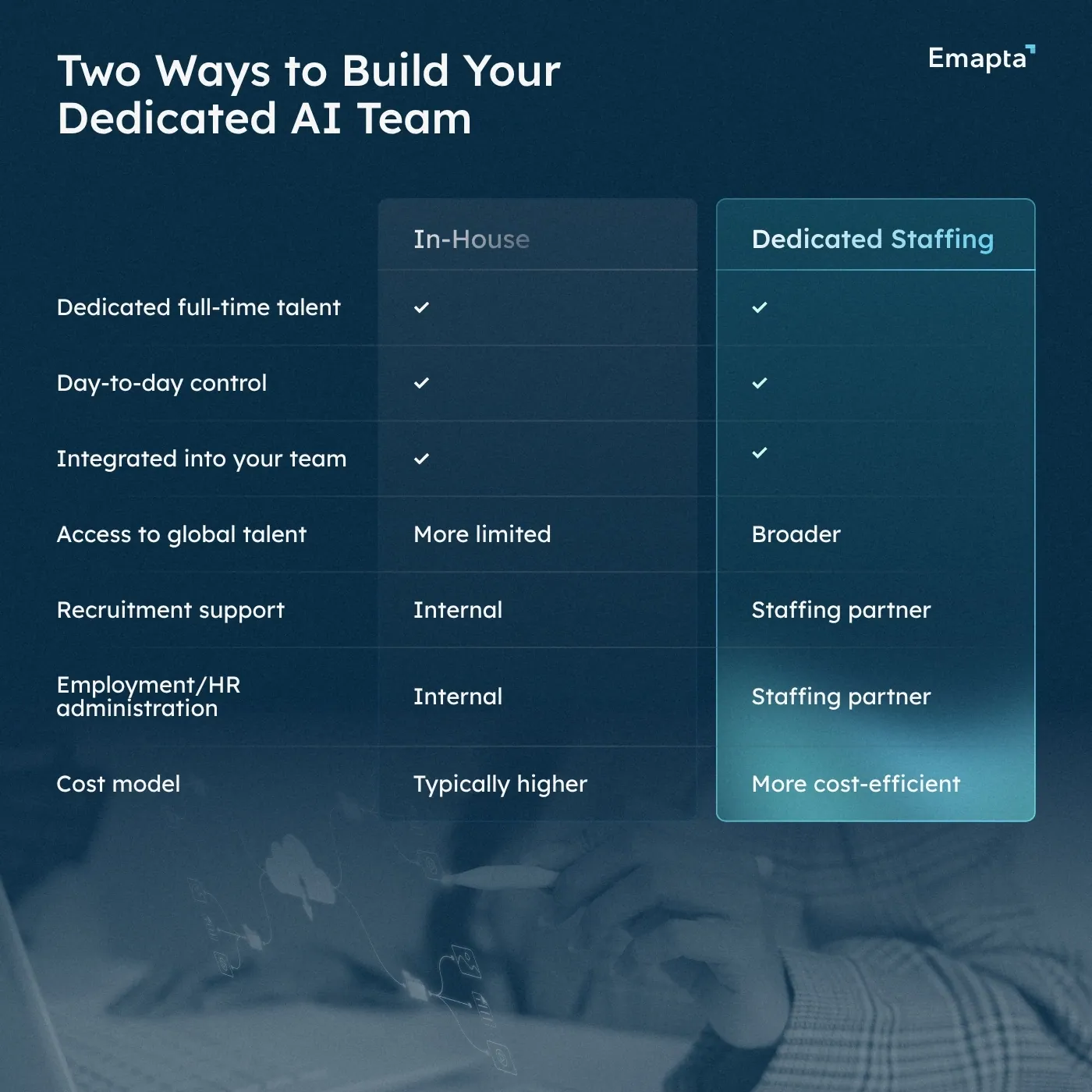
With Dedicated staffing, you retain control. The specialists are dedicated to your business, you direct their day-to-day work, and they integrate into your systems, processes, and culture. The staffing partner supports the employment side of the relationship, giving you access to a wider talent pool without requiring you to establish and employ a team in every market where the talent is located.
This is what separates dedicated staffing from traditional outsourcing, where a vendor manages the project on your behalf rather than you directing dedicated staff directly. With a dedicated staffing model, you keep day-to-day control over the work while your partner handles recruitment, payroll, and compliance behind the scenes.
How Much Does It Cost to Build a Dedicated AI Team?
Costs for a dedicated artificial intelligence team vary widely depending on team size, seniority, and location. A small in-house team of three to five specialists in a major tech hub can run well into six or seven figures annually once salaries, benefits, recruitment, and tooling are factored in.
Partnering with an offshore or nearshore staffing provider can significantly lower these costs while still giving you full-time, dedicated specialists, since salary benchmarks and operating costs vary considerably by location.
Whichever model you choose, budget beyond salaries alone. Ongoing training, cloud infrastructure, and the tools your team needs to stay current all factor into the true cost of building this kind of capability.
How to Manage and Scale Your Dedicated AI Team
Building the team is only half the work. It also needs clear KPIs tied to business outcomes, not just technical milestones, so progress is easy to communicate to leadership.
As the team grows, common friction points include time zone gaps, unclear ownership between departments, and knowledge that stays siloed with one or two people. Planning ahead for these offshoring challenges early keeps a growing team from stalling later.
Build in regular training time, a shared knowledge base, and a project management framework flexible enough to handle the iterative nature of AI work, so the team can scale without losing its footing.
It also helps to revisit your original objectives every quarter or two, since the problems worth solving with AI tend to shift as the technology, and your business, keeps moving.
Common Mistakes to Avoid When Building a Dedicated AI Team
Most of these mistakes come from moving too fast on hiring before the surrounding structure is ready.
- Hiring technical talent before defining the business problem it is meant to solve, which leaves engineers building impressive models nobody asked for
- Treating the team as a side project instead of giving it a real budget and mandate, so it competes for time with everyone’s “actual” job
- Skipping documentation, which makes onboarding and cross-team collaboration harder later, especially once the one person who understood a model moves on
- Ignoring change management, which can create quiet resistance from other departments who were never told how AI would change their workflow
- Underestimating ongoing costs like training, tooling, and infrastructure, which means explaining a budget overrun that a fuller estimate would have caught upfront
Conclusion
Building a dedicated AI team is less about hiring a handful of brilliant specialists and more about creating the structure, roles, and processes that let them do their best work. Start with a clear business objective, map out the roles that objective requires, then choose the hiring model, whether in-house, outsourced, or a dedicated staffing partnership, that fits your timeline and budget. With the right foundation in place, a dedicated AI team can move your organization from small AI pilots to a genuine, lasting competitive advantage.
Frequently Asked Questions (FAQ)
A dedicated AI team is a group of specialists, such as data scientists, AI engineers, and project managers, assigned full-time to an organization’s AI initiatives. Unlike generalist staff working on AI part-time, its members focus exclusively on building, deploying, and maintaining AI systems, whether they sit in-house or work through a staffing partner.
Most setups combine core technical roles, such as AI engineers, data scientists, and data engineers, with supportive roles like a project manager, business analyst, and domain expert. Smaller teams often combine responsibilities, while larger teams separate each function into a dedicated hire.
Costs depend heavily on team size, seniority, and location. An in-house team of three to five specialists in a major tech hub can cost six to seven figures annually, while partnering with an offshore or nearshore staffing provider can lower costs while keeping the team fully dedicated.
Timelines vary by hiring model. Recruiting a full in-house team can take several months per role, while partnering with an established staffing provider can shorten this to a matter of weeks, since the provider already has vetted talent in place.
It depends on your priorities. In-house and dedicated staffing both give you direct control and full integration into your team, the difference is that dedicated staffing gives you access to a broader talent pool at a more cost-efficient rate, since your staffing partner handles recruitment and HR. Traditional outsourcing trades some of that control for a vendor who manages the work on your behalf.