

Outsourcing to Mexico – Services, Benefits & Opportunities
You may start looking at outsourcing because domestic hiring is expensive or a role has been open for too long. But once collaboration, technical expertise, and speed enter the conversation, choosing the cheapest option is rarely enough.
That’s where outsourcing to Mexico becomes interesting. You get access to specialized talent close to your U.S. operation, with working hours that make real-time collaboration much easier.
So, where does Mexico fit into your outsourcing strategy?
Let’s look at what you can outsource, the benefits and costs to expect, the risks to consider, and how to choose the right partner for your team.
Outsourcing to Mexico Key Takeaways
- Specialized talent – Mexico offers strong talent across technology, engineering, data, finance, and operations
- Nearshore advantages – shared work hours, proximity, and competitive costs make collaboration easier
- Cost savings – hiring costs vary, but Mexico can offer significant savings over U.S. hiring
- Partner matters – strong compliance, transparent pricing, and the right talent expertise are essential
What Services Can U.S. Companies Outsource to Mexico?
U.S. companies can outsource technology, data and cybersecurity, engineering, supply chain, finance and operations, and customer or commercial functions to Mexico.
The country is particularly well suited to specialized work where technical skills and close collaboration with your in-house team matter. Common roles outsourced in each of these areas include:
- Technology and IT: Software engineering, full-stack development, QA automation, enterprise IT, ERP, cloud, and DevOps.
- Data and cybersecurity: Data analysis and engineering, AI and machine learning, business intelligence, automation, and cybersecurity.
- Engineering: Industrial and manufacturing engineering, CAD, quality and process roles, and technical support.
- Supply chain: Planning, procurement and sourcing, logistics, inventory analytics, and import/export support.
- Finance and operations: Accounts payable and receivable, payroll, financial analysis, project operations, and PMO roles.
- Customer and commercial operations: Customer success, sales operations, technical support, and selected customer service roles.
The advantages of outsourcing to Mexico become clearer when you look at where that talent is concentrated.
Guadalajara has a strong technology and engineering ecosystem; Mexico City offers deep talent across finance, operations, and corporate functions, while Monterrey combines industrial and shared-services capabilities.
This gives you options beyond simply moving lower-cost work offshore: you can build around the specific skills your team needs.
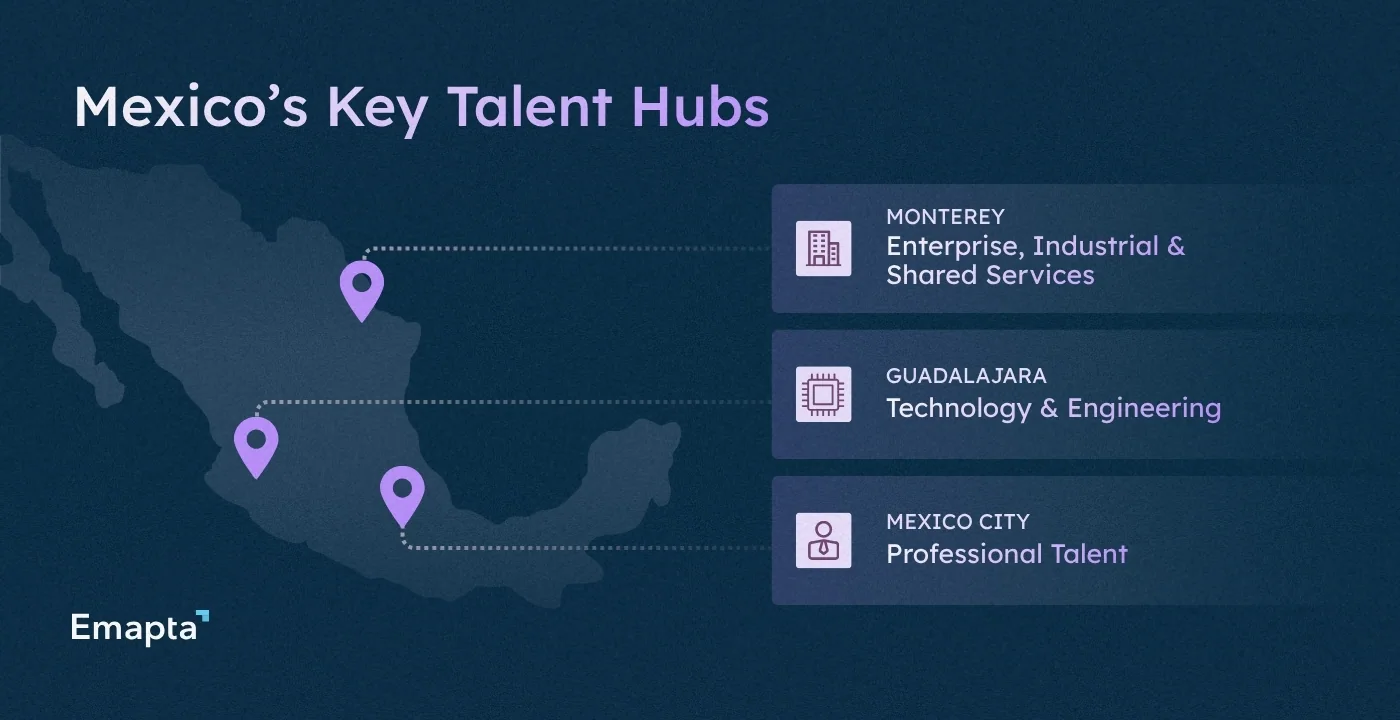
- Guadalajara: Technology & Engineering
- Mexico City: Professional Talent
- Monterrey: Enterprise, Industrial & Shared Services.
5 Benefits of Outsourcing to Mexico
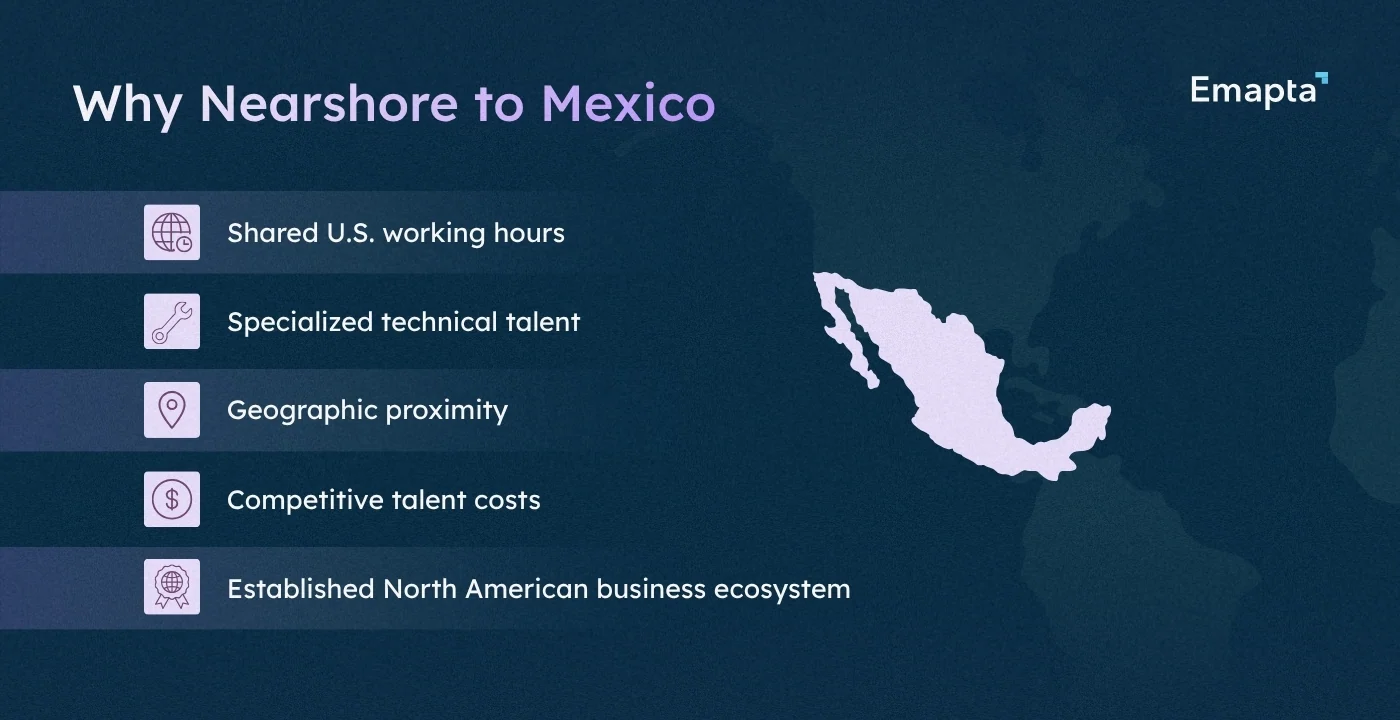
Mexico’s appeal isn’t built on a single advantage. It comes from the combination of four critical factors: proximity, talent, cost, and business ecosystem.
Let’s look at each factor in more detail.
1. Collaborate with your team in real time
Mexico’s major business hubs operate in North American-aligned time zones, giving outsourced teams substantial working-hour overlap with U.S. and Canadian teams. That makes meetings, approvals, and day-to-day communication easier to handle in real time.
For your team, fewer hours of separation can mean fewer delays. A developer waiting for a product decision or a supply-chain analyst flagging an urgent issue can reach the right people while they are still working, rather than waiting until the following day.
2. Access a large, increasingly technical workforce
According to the OECD, Mexico has the highest share of tertiary-level engineering graduates in the Americas, exceeding the OECD average. This gives companies a strong pipeline of engineering and technical talent for specialized roles.
For U.S. companies, that talent depth makes Mexico a strong option beyond transactional work, providing access to specialized skills across software, data, engineering, automation, and other technical functions.
3. Stay close to your U.S. operation
Mexico’s geographic proximity makes in-person collaboration considerably more practical than with distant outsourcing destinations.
Major business hubs such as Guadalajara, Mexico City, and Monterrey have direct air connections with major U.S. cities, making cross-border travel relatively straightforward.
That matters when remote collaboration isn’t enough. Executive visits, training, planning sessions, and face-to-face work with engineering, product, logistics, or supply-chain teams can become a practical part of your operating model rather than an occasional undertaking.

4. Lower talent costs without making cost the only decision
Mexico can offer substantial salary savings across specialized roles.
For example, 2026 data place the annual base salary for a senior DevOps engineer at about $81,600 in Mexico versus $168,000 in the U.S. For companies, the opportunity is to combine those savings with access to specialized talent and close collaboration.
Still, instead of comparing salaries alone, consider the fully loaded cost of the team to understand the actual value of the model:
- Compensation
- Statutory benefits
- Recruitment
- IT
- Facilities
- Compliance
- Provider fees
5. Build inside an established North American business ecosystem
Mexico’s value as an outsourcing destination goes beyond talent, cost, and proximity.
Its longstanding economic ties with the U.S. have created a mature cross-border business environment where technology, manufacturing, engineering, and professional services already operate across both markets.
That established business environment can make Mexico easier to integrate into your broader talent strategy. You can build specialized teams in a market that is geographically close, commercially connected, and accustomed to working with North American businesses.
How Much Does Nearshore Outsourcing to Mexico Cost?
There is no single rate for outsourcing to Mexico. Costs vary depending on the role, seniority, technical specialization, English proficiency, location, employment model, benefits, and provider fees.
For technology roles, a 2026 CodersLink report provides a useful benchmark based on more than 10,000 annual net salary responses across Mexico. The data shows how compensation changes significantly by both role and experience level.
| Role | Junior | Mid-level | Senior |
|---|---|---|---|
| Software Engineer | $1,551 | $2,717 | $3,600 |
| Full Stack Engineer | $1,715 | $2,732 | $3,311 |
| DevOps Engineer | $1,938 | $3,323 | $4,292 |
| Data Engineer | $1,772 | $3,102 | $4,154 |
The potential cost difference becomes even clearer when Mexico and the U.S. are compared directly. The report estimates that a senior software engineer in Mexico earns approximately $5,572 per month net, compared with about $14,400 for a comparable senior engineer in the U.S.
That difference helps explain Mexico’s nearshoring value, but cost shouldn’t be considered in isolation. Seniority, specialized skills, English proficiency, and competition for talent can all affect what you ultimately pay.
When comparing outsourcing companies in Mexico, look beyond the headline salary or monthly rate. Ask providers for a transparent breakdown that includes:
- Talent compensation and benefits
- Statutory employment costs
- Recruitment
- IT and workspace
- HR and operational support
- Provider or management fees
This gives you a clearer view of the fully loaded cost of your team and whether the model delivers meaningful savings while still giving you access to the skills your business needs.
Outsourcing to Mexico – Pros & Cons
Mexico offers a strong combination of skilled talent, proximity, and cost efficiency, but it may not be the right fit for every role or outsourcing strategy.
Pros:
- Shared working hours: Teams can collaborate with U.S. and Canadian colleagues during much of the same workday.
- Strong technical talent: Mexico has established talent pools across software, engineering, data, IT, finance, and other specialized functions.
- Easier travel: Geographic proximity makes in-person meetings, training, and team visits more practical.
- Competitive talent costs: Companies can reduce labor costs compared with equivalent U.S. hiring, particularly for specialized roles.
- Established business environment: Mexico’s close commercial ties with the U.S. can make cross-border operations easier to integrate.
Cons:
- Mexico isn’t always the lowest-cost LATAM option: Depending on the roles you need, other nearshore markets such as Colombia may offer a different combination of talent availability, specialization, and cost.
- Competition for talent can be high: Experienced bilingual professionals and specialized technology talent can attract significant demand.
- Talent availability varies by city: Guadalajara, Monterrey, and Mexico City have different talent strengths, so location should follow the roles you need.
- Compliance requires attention: Mexico has specific rules governing outsourcing and specialized services, making the provider’s employment and compliance model important.
- Security and infrastructure can vary by location: Companies should evaluate the specific city and operating environment rather than treating Mexico as a single market.
The right question, then, isn’t simply whether Mexico is a good outsourcing destination. It is whether its talent, cost, location, and operating environment match the team you need to build.
What Should U.S. Companies Know About Mexican Outsourcing Laws?
Outsourcing in Mexico is legal, but companies need to understand how the country’s rules affect the way outsourced teams are structured.
Mexico’s 2021 labor reform restricted traditional personnel subcontracting. Businesses can still contract specialized outsourcing services in Mexico, provided those services are not part of the client’s corporate purpose or predominant economic activity.
If your outsourcing arrangement falls under specialized services, there are several areas to check:
- REPSE registration: Providers of specialized services must be registered with Mexico’s Registry of Providers of Specialized Services or Works (REPSE), with registration renewed every three years.
- Scope of Mexico BPO services: The outsourced work should qualify as a specialized service rather than simply supplying personnel to perform the client’s core business activity.
- Written agreements: Contracts should clearly define the services being provided and the workers involved.
- Employer responsibilities: Your provider should have a clear legal employment structure and handle applicable payroll, benefits, social security, and labor obligations.
- Shared compliance risk: Clients can face joint liability for certain labor and social-security obligations if their provider fails to comply.
Mexico is also gradually reducing its statutory workweek from 48 to 40 hours by 2030, beginning in 2027. Companies building teams in Mexico should consider how future working-hour requirements could affect staffing and workforce planning.
The practical takeaway is simple: U.S. companies that outsource should evaluate providers on more than talent and price.
When evaluating providers in Mexico, consider how workers are employed, whether the provider possesses the necessary registrations, what services are legally permitted, and how they maintain ongoing labor compliance.
How to Choose an Outsourcing Partner in Mexico
Selecting the right outsourcing market begins with identifying where the skills your business requires are most abundant.
Whether you choose to nearshore to Mexico, establish teams in the Dominican Republic, or explore another LATAM hub, each country provides access to a diverse talent pool.
However, the effectiveness of that talent within your business largely depends on the partnership you choose. Before signing any agreement, check:
- Employment structure: Who legally employs the team, and does the arrangement comply with Mexican labor rules?
- REPSE status: If the services require REPSE registration, is the provider’s registration current and appropriate for the work?
- Talent specialization: Can the provider demonstrate recruiting depth for your actual roles and city?
- Hiring control: Can you interview and approve the people joining your team?
- Pricing: Are salary, statutory costs, benefits, facilities, and provider fees clearly separated?
- Security: How are access, IP, personal data, devices, and business continuity managed?
- Performance: What SLAs, KPIs, reporting, and escalation processes will you use?
- Retention and scalability: Can the provider retain specialist talent and grow from a few hires into a larger team without changing the model?
The goal is not simply to buy an outsourced service. You want people who can operate as an extension of your organization while the provider handles the local infrastructure that makes that possible.
Wrapping Up
Outsourcing can solve hiring challenges but choosing where and how to build a team requires balancing cost, talent availability, collaboration, and compliance.
Outsourcing to Mexico brings those priorities closer together. Its specialized talent, competitive costs, shared working hours, and proximity give U.S. companies an alternative to more distant outsourcing models.
With the right roles, location, and outsourcing partner, companies can build specialized teams in Mexico that collaborate more easily, integrate into existing operations, and support long-term growth.
Frequently Asked Questions (FAQ)
U.S. companies use Mexico for access to specialized talent, competitive labor costs, North American-aligned working hours, geographic proximity, and close commercial ties with the U.S.
Companies can outsource software development, cloud and DevOps, data, cybersecurity, engineering, supply-chain support, procurement, finance operations, customer success, technical support, and other professional functions.
Costs depend on the role, seniority, location, employment model, benefits, and provider fees. As a reference, current CodersLink benchmarks estimate approximately 61% savings for U.S. employers hiring in Mexico compared with local U.S. hiring.
Key risks include an incorrectly structured outsourcing arrangement, provider compliance failures, competition for specialist talent, infrastructure issues, and weak data or IP controls.