

EOR Global Compliance Management – Complete Guide
EOR compliance helps businesses hire abroad by putting an employer of record (EOR) in place to manage payroll, tax, and labor law obligations in every country, protecting companies from fines, back taxes, and legal disputes.
Today, we will break down the key elements of global EOR compliance, the best practices to follow, and how partnering with the right provider keeps international hiring secure and compliant.
Global EOR Compliance Key Takeaways
- EOR compliance depends on getting several things right in every country of operation: accurate worker classification, correct payroll and tax handling, appropriate benefits, and strong data privacy protections.
- A compliant EOR partner carries much of the legal risk tied to local employment law, shielding the business from costly penalties and wrongful termination claims.
- Regular audits, real-time legal monitoring, and accurate contracts are core best practices for maintaining EOR compliance at scale.
- Partnering with an experienced provider, especially one offering EOR alongside dedicated staffing, helps businesses expand internationally without setting up local entities.
Key Elements of Global EOR Compliance
Global compliance rests on a handful of core elements that protect both the business and its workforce. When any of these areas fall through the cracks, the risk of fines, audits, or reputational damage increases.
- Local labor law adherence: following country-specific rules on hiring, working hours, leave, and termination
- Worker classification: correctly distinguishing employees from independent contractors to avoid misclassification penalties
- Payroll and tax accuracy: calculating, withholding, and filing taxes correctly in every jurisdiction of operation
- Benefits administration: providing the statutory benefits required by local law, from health coverage to paid leave
- Data privacy: safeguarding employee information in line with regulations such as the General Data Protection Regulation (GDPR)
Employer of Record (EOR) Compliance Best Practices
Following EOR compliance best practices helps businesses avoid the penalties and disruptions that come with regulatory gaps. The practices below work together to keep international hiring accurate and audit-ready.
1. Conduct regular compliance audits
Routine audits catch small errors before they become costly problems. Rather than treating EOR compliance as something set up once and left alone, an EOR partner should be reviewing payroll records, confirming tax filings land on time in every jurisdiction, and rechecking worker classifications as roles evolve.
This ongoing review is really how a business knows its EOR partner is staying compliant as laws and headcount shift, not something either side can assume by default.
2. Classify workers correctly
Misclassifying an employee as an independent contractor can trigger fines, back taxes, and legal claims. A dependable EOR applies local classification rules consistently, weighing each role against country-specific criteria before onboarding and revisiting that classification whenever a worker’s responsibilities change.
Getting this right matters because classification is not just paperwork; it decides which tax obligations, benefits, and legal protections apply to a worker from their very first day.
3. Monitor local tax regulations
Tax rules shift often, and falling behind can mean underpayment or incorrect filings. A reliable EOR partner stays on top of statutory rates and thresholds in each country, handles withholding and remittance according to local deadlines, and keeps records that hold up under scrutiny.
What actually protects a business here is less about any single filing going smoothly and more about a partner’s track record of keeping pace with regulatory change year after year.
4. Customize benefits packages by country
Employee benefits are rarely one-size-fits-all. Because local law often mandates specific benefits, an EOR should be building packages around what each country actually requires rather than applying a single global template, then revisiting those packages as regulations shift.
A package that has full EOR compliance in one country can easily fall short in another, which is why localization tends to matter more here than standardization.
5. Track employment law changes in real time
Employment laws do not sit still: according to Littler’s Q1 2026 Global Guide Quarterly, more than 40 countries saw labor law activity in just the first three months of 2026, and missing even one of those updates can create a compliance gap overnight.
A provider that monitors these changes as they happen helps a business stay ahead of shifting regulations instead of reacting after the fact.
A partner with strong in-house legal and compliance specialists, rather than one relying solely on outside counsel, tends to catch these updates faster. This kind of monitoring is especially relevant when understanding how an employer of record operates day-to-day, since it is what turns compliance from an occasional check into something closer to a continuous safeguard.
How Does an Employer of Record (EOR) Help with Global Compliance?
An employer of record helps with global compliance by taking on legal responsibility for employment in every country where a business operates. This includes managing payroll, tax withholding, worker classification, and benefits according to local law, so the company hiring does not have to interpret unfamiliar labor codes on its own.
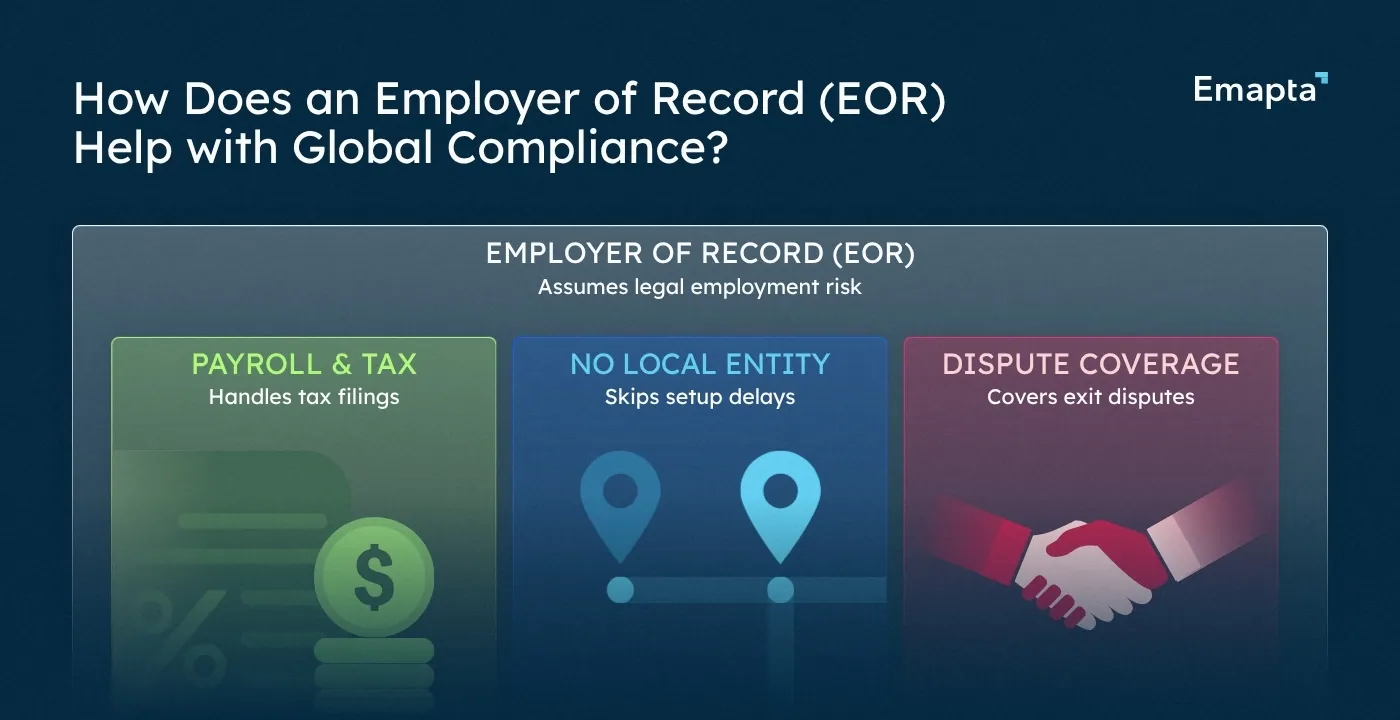
Because the EOR is the registered legal employer, it also handles the regulatory paperwork that would otherwise require setting up a local entity, which is often the slowest and most expensive part of entering a new market. This lets a business bring on talent quickly while staying within the bounds of local law from day one.
An EOR further reduces exposure to termination and worker dispute risks, managing severance calculations, notice periods, and workers’ compensation coverage according to local requirements.
For businesses planning a long-term presence, this kind of coverage becomes even more valuable over time, since it protects the company from disputes at exactly the point when a working relationship is most likely to break down.
How to Ensure EOR Compliance
Ensuring compliance takes more than choosing a provider and stepping back. Businesses need to stay involved in monitoring performance and understanding where risks might surface.
Partner with an experienced provider
The right EOR partner, particularly one that also offers dedicated staffing solutions, brings established processes for payroll, tax, and worker classification in each market. Look for a provider with a track record in the specific countries where a business plans to hire, and ask for references from similar markets before committing.
Use technology for compliance tracking
Manual tracking across multiple countries is difficult to sustain as a business grows. Automated systems that flag classification risks, tax deadlines, and policy changes reduce the chance of oversight, and centralized records make audits far less time-consuming.
Review contracts and agreements regularly
Contracts should be revisited whenever laws change or a worker’s role shifts. Outdated agreements are a common source of compliance gaps, so terms, data privacy clauses, and statutory requirements all need periodic review.
Understand the risks of getting it wrong
EOR legal compliance risks when hiring abroad include financial penalties, back-tax liabilities, and legal disputes stemming from misclassified or improperly managed workers. In some markets, non-compliance can also delay operations or damage a company’s standing with local authorities. Working with a compliant EOR partner lowers these risks considerably, but the business itself still carries responsibility for choosing and monitoring that partner.
Conclusion
Global expansion opens real opportunity, but it also introduces legal and operational complexity that most companies are not equipped to handle alone. A dependable EOR partner absorbs much of that complexity, covering payroll, tax, worker classification, and benefits according to local law.
Businesses that pair this with a long-term staffing strategy gain both compliance coverage and continuity in their teams. Staying informed, choosing an experienced partner, and reviewing agreements regularly all support strong EOR compliance over time.