
Data Security in Outsourcing: What to Look for in a Partner
Data can move faster than trust when companies outsource work. What starts as a smart way to scale can quickly raise harder questions about access, visibility, accountability, and control.
That risk does not mean outsourcing is unsafe. It means businesses need a clearer way to evaluate data security in outsourcing, especially when external teams handle sensitive information.
This guide breaks down what to look for in an outsourcing partner from a security standpoint, so leaders can ask better questions, spot red flags, and choose a partner that can protect the business as the team grows.
Key Takeaways
- Data security is a core outsourcing concern: More outsourced roles now handle sensitive business, customer, and financial data.
- Proof matters more than promises: A strong partner should show clear controls, not just say data is protected.
- Security must scale with the team: Access rules, monitoring, and offboarding need to grow as the outsourced team grows.
- Clear responsibility reduces risk: Both sides should know who owns access, devices, incidents, compliance, and training.
Why Data Security in Outsourcing Matters More Than Ever
Outsourcing gives companies more talent, speed, and flexibility. But it also means more people, systems, and locations may be connected to sensitive business data.
That is why data protection in outsourcing has become one of the biggest concerns when choosing a partner. A weak setup can expose customer records, financial data, internal processes, or confidential company information.
The risk is not outsourcing itself. The real risk is working with a partner that cannot show how it protects data every day.
Leaders should look for security controls that scale with the team, clear access rules, safe data handling, strong monitoring, and a proven way to respond when something goes wrong.
A practical outsourcing data security checklist should help answer three simple questions:
- Can this partner protect our data from the start?
- Can they keep it secure as the team grows?
- Can they prove their security works in daily operations?
What to Look for in a Secure Outsourcing Partner
Choosing an outsourcing partner is not just about hiring talent. It is about trusting another organization to support your business without weakening your controls.
The best way to evaluate the security level of an outsourcing partner is to assess their full compliance with the following precepts.
1. Security That Can Be Proven, Not Just Promised
Most providers will say they take security seriously. That is not enough.
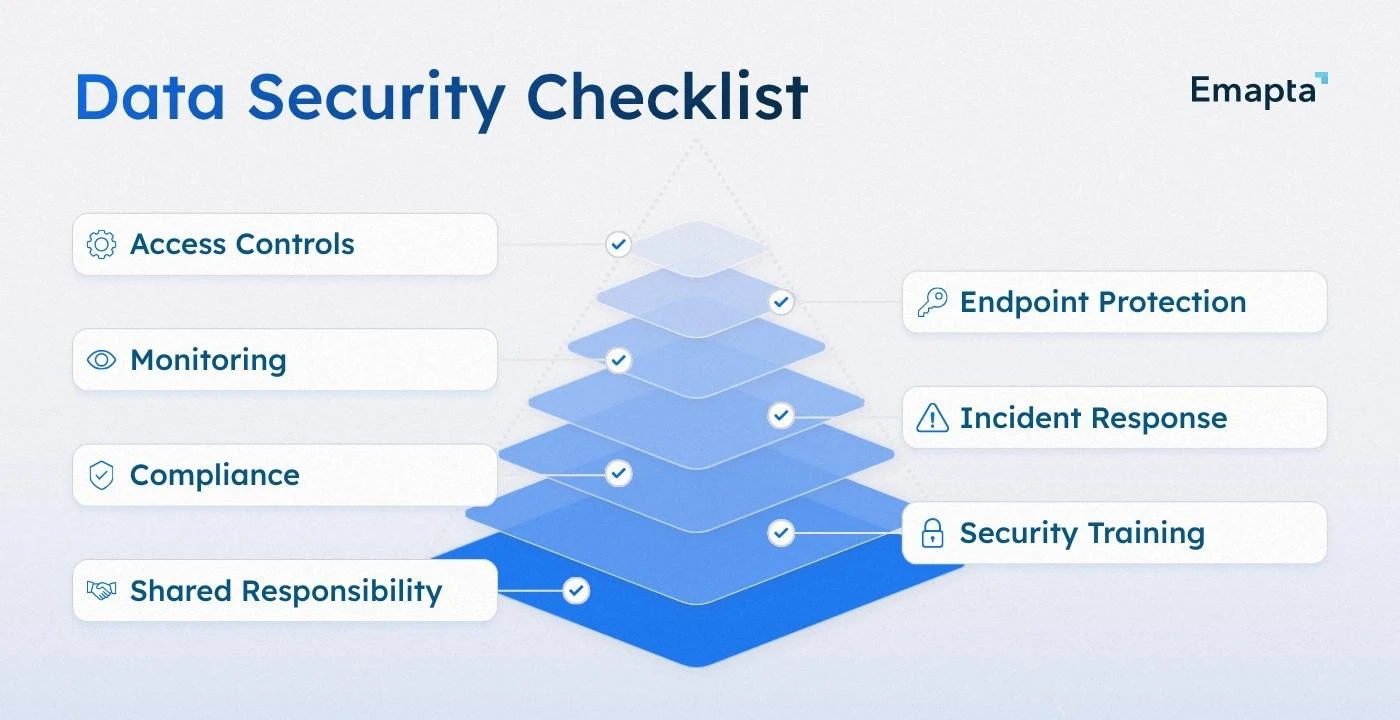
A strong partner should be able to show evidence of how security works. This may include documented policies, access approval workflows, incident response procedures, audit reports, compliance certifications, endpoint controls, and monitoring processes.
The key is to ask for proof, not promises. Look for evidence of:
- Role-based access controls
- Multi-factor authentication
- Device management
- Endpoint protection
- Data loss prevention
- Security awareness training
- Regular access reviews
- Incident response playbooks
- Business continuity and disaster recovery plans
- Security certifications and attestations
“A provider that can prove its security posture will show you the proof before you ask for it. That starts with internationally recognized certifications and attestations that are independently validated rather than self-declared. Emapta holds ISO 27001, ISO 27701, PCI-DSS and SOC 2, and delivers a secure data processing environment compliant with HIPAA, GDPR and APP standards. It extends to transparency through a public trust center that gives clients a live view of compliance posture and control status rather than a claim on a slide.” — Henry Vassall Jones, CIO at Emapta
2. Access Controls That Grow With the Team
Outsourced teams often start small. A company may begin with five support agents, two accountants, or one developer. But once that team grows to 30, 50, or 100 people, weak access controls can quickly turn into a serious risk.
A good partner should not manage access manually or casually. Access should be tied to roles, approved through a clear process, reviewed regularly, and removed quickly when someone changes roles or leaves.
Ask how the provider handles:
- New hire access
- Role changes
- Temporary access
- Privileged access
- Offboarding
- Permission reviews
- Access exceptions
This is where many outsourcing risks begin. Not because the team is offshore, but because access grows faster than governance.
As teams expand, companies need security controls that scale with the team, not manual workarounds that rely on a single manager or a single IT request.
“Look for security that scales by design rather than by headcount. The measure is defence in depth, layered and overlapping controls so that no single failure exposes data, applied consistently whether a team is five people or five hundred. Identity and access are governed by least privilege, multi-factor authentication and role-based access, provisioned automatically as teams expand so that growth never outpaces control.” — Henry Vassall Jones, CIO at Emapta
3. Strong Infrastructure and Endpoint Protection
A secure team needs more than secure intentions. It needs a safe working environment, protected devices, reliable networks, and clear rules for how data can be accessed, used, and shared.
This is especially important when outsourced teams work with customer records, financial information, company systems, or confidential files.
Before choosing a provider, companies should review whether the partner has enterprise-grade data security policies and protocols in place to protect both the team and the information they handle. These may include:
- Managed workstations
- Endpoint encryption
- Secure VPN access
- Network monitoring
- Data loss prevention tools
- Role-based access controls
- Backup connectivity
- Regular security checks
4. Monitoring and Incident Response
Cybersecurity in outsourcing is not only about preventing problems. It is also about how quickly a partner can detect, escalate, and respond when something looks wrong.
A provider may have strong access controls, secure devices, and clear policies. But companies still need to know what happens if there is suspicious activity, a system issue, an endpoint alert, or a possible data exposure.
This is where 24/7 visibility becomes important. Emapta’s IT Command Center supports this by bringing cybersecurity monitoring, network operations, and end-user support into one centralized hub.
That matters because security issues rarely happen in isolation. A network disruption, access problem, endpoint alert, or user support request can all affect how safely an outsourced team works.
With a connected 24/7/365 operation, risks can be monitored and escalated through a clearer process. For clients, this adds another layer of confidence that the team is protected, productive, and supported when technical or security issues arise.
“Correlating network anomalies, security alerts and service tickets in the same room cuts detection-to-response times to minutes, and governance tightens because oversight of infrastructure, security and support sits under one command structure instead of three reporting lines.” — Henry Vassall Jones, CIO at Emapta
5. Clear Shared Responsibility
In outsourcing, security is shared. But “shared” should never mean unclear.
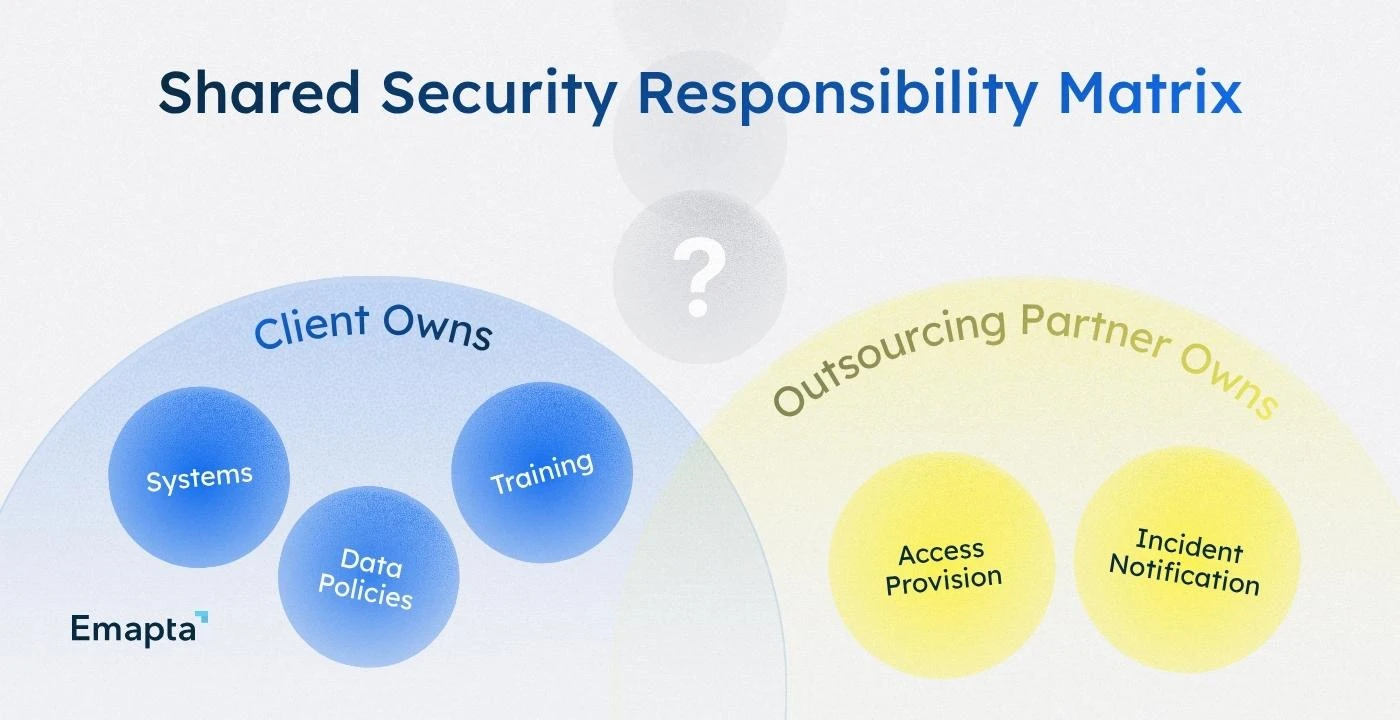
The client usually owns its systems, applications, data, and internal policies. The outsourcing partner may own the work environment, endpoints, connectivity, workforce onboarding, physical security, and first-level IT support.
Problems happen when both sides assume the other is responsible. Before choosing a partner, companies should look for secure, scalable offshore team environments where responsibilities are defined from the start.
Clarify who owns:
- Endpoint security
- Access provisioning
- Password and MFA policies
- User offboarding
- Device monitoring
- Data storage rules
- Incident notification
- Backup and recovery
- Compliance evidence
- Security training
- AI tool usage
6. Compliance, Certifications, and Audit Readiness
Compliance does not guarantee strong security on its own. But it can show whether a provider follows recognized standards and allows its controls to be reviewed.
Depending on your industry, you may need a partner familiar with standards or regulations such as:
- ISO27001 and ISO27701
- SOC 2
- PCI DSS
- HIPAA
- GDPR
- Local data privacy laws
- Industry-specific security requirements
Still, buyers should look beyond the certificate. A provider may have strong documentation, but companies also need to know how those controls work for their specific team, tools, data, and daily operations.
Before choosing a partner, review their enterprise-grade data security policies and protocols and ask for clear details such as:
- Scope of certification
- Date of latest audit
- Covered locations
- Covered systems
- Exceptions or findings
- Remediation status
- How evidence is maintained
- How audits are supported
7. Security Awareness Across the Team
Security is not only about systems. It also depends on how people work every day.
Even with strong tools in place, employees need to know how to handle data, spot suspicious activity, avoid phishing attempts, use approved platforms, and report issues quickly.
This becomes even more important when teams work across different locations. Companies should look for partners that support security awareness and remote workforce protection through training, clear policies and secure tools.
Look for training and controls around:
- Phishing awareness
- Password hygiene
- Data handling
- Clean desk policies
- Remote work security
- AI tool usage
- Incident reporting
- Confidentiality
- Client-specific security rules
10 Security Questions to Ask an Outsourcing Provider
A strong vendor conversation should feel practical. If the answers are vague, generic, or overly polished, keep asking.
Before making a decision, leaders should understand the essentials of data security in outsourcing, especially when the outsourced team may handle customer records, financial details, internal systems, or regulated information.
“Ask whether the provider holds certifications or attestations, and ask to see them. ISO, SOC and PCI-DSS signal that a provider has understood the security risks inherent in its business model and taken deliberate action to reduce them to a managed level. Ask what security policies and controls deliver a secure data processing environment for your team, and how those controls are enforced rather than documented. Establish where your data resides, who can access it, and how that access is governed and logged.” — Henry Vassall Jones, CIO at Emapta
Use these questions to review the partner’s security setup:
1. Who controls and secures the devices used by our outsourced team?
You need to know whether devices are managed, monitored, updated, and protected.
2. How do you approve and remove access?
Access should be based on roles, not convenience. Offboarding should be fast and consistent.
3. How do you prevent sensitive data from being copied, downloaded, or shared?
Look for DLP, endpoint controls, restricted permissions, secure workstations, and clear rules.
4. What visibility will we have into security events and incidents?
A partner should explain what you can see, when you will be notified, and who owns escalation.
5. Which certifications apply to our team and work environment?
Ask for scope, dates, locations, systems, and audit coverage.
6. How do you handle remote, hybrid, or office-based work securely?
The answer should change depending on the sensitivity of the work.
7. How do you manage AI tool usage?
The partner should have clear rules for approved tools, restricted data, and monitoring.
8. What happens during a security incident?
Ask who detects, who notifies, who decides, and how quickly the process starts.
9. How does your security model scale as the team grows?
A good answer should mention access reviews, role-based permissions, monitoring, onboarding, offboarding, and governance.
10. What security responsibilities stay with us as the client?
A mature partner will not pretend to own everything. They will define the shared model clearly.
Red Flags to Watch for in Outsourcing Partner Security
The biggest warning signs usually appear in how a provider answers questions related to data protection.
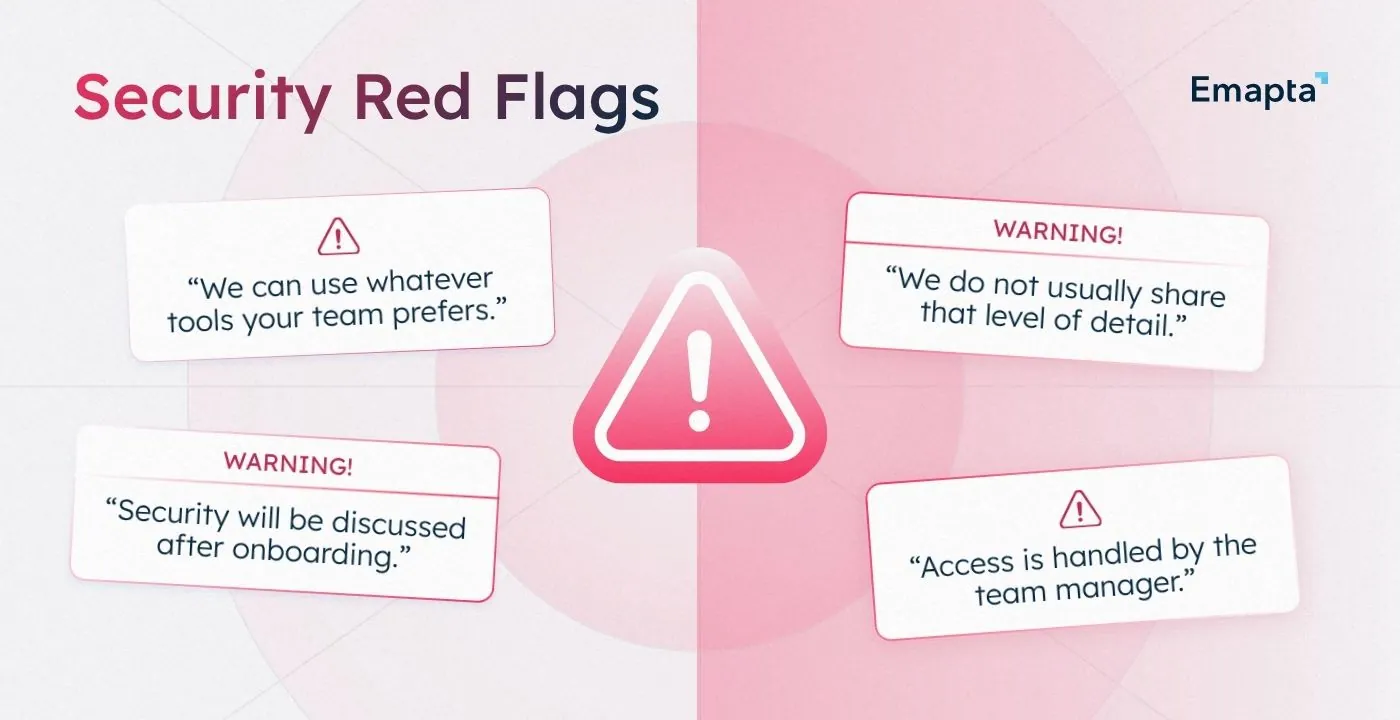
A weak provider may speak confidently but avoid specifics. A strong provider can explain how controls work in real life. Watch out for these red flags:
- “We are certified, so everything is covered.”
- “We do not usually share that level of detail.”
- “Access is handled by the team manager.”
- “Offboarding happens within a reasonable time.”
- “We allow flexibility depending on the employee.”
- “We have not had any major incidents.”
- “Our people know what to do.”
- “Security will be discussed after onboarding.”
- “We can use whatever tools your team prefers.”
- “We do not need formal escalation paths.”
These answers are risky because they rely too heavily on trust and not enough on proof.
“The clearest warning sign is a provider that describes its security but cannot back it up with evidence and artifacts, whether that means certifications it cannot produce or controls it cannot demonstrate. Be wary when security sits inside IT with no independent function or clear line of accountability, because it usually means no one owns it fully. Vague answers on incident response, or the absence of a committed breach notification timeline, tell you the provider has not rehearsed the moment that matters most.” — Henry Vassall Jones, CIO at Emapta
A provider does not need to expose confidential internal details to show maturity. But it should be able to explain its processes, responsibilities, controls, and escalation paths in a way that gives the buyer confidence.
Wrapping Up
Outsourcing can help companies grow faster, but it also creates new questions around access, visibility, compliance, and control.
That is why choosing the right partner means looking beyond cost and talent. Companies need clear security controls, protected devices, strong monitoring, defined responsibilities, and proof that these safeguards work in daily operations.
Strong data security in outsourcing helps businesses protect sensitive information, reduce risk, and scale their teams without losing control.