
5 Signs Your Finance Team Has Reached Its Capacity
A busy finance team isn’t necessarily an understaffed one. Month-end deadlines, reporting requests, reconciliations, forecasts, audits, and unexpected challenges are all part of running a business.
The problem starts when constantly being busy becomes the norm. At that point, the question is no longer simply whether the team can get the work done, but whether limited finance capacity is beginning to hold back business growth.
Recognizing the warning signs can help finance leaders identify where additional support is needed and what type of talent can make the biggest difference.
How to Tell If Your Finance Team Is at Capacity
Capacity constraints aren’t always obvious. Here are five signs that your finance team may be struggling to keep up with business demands.
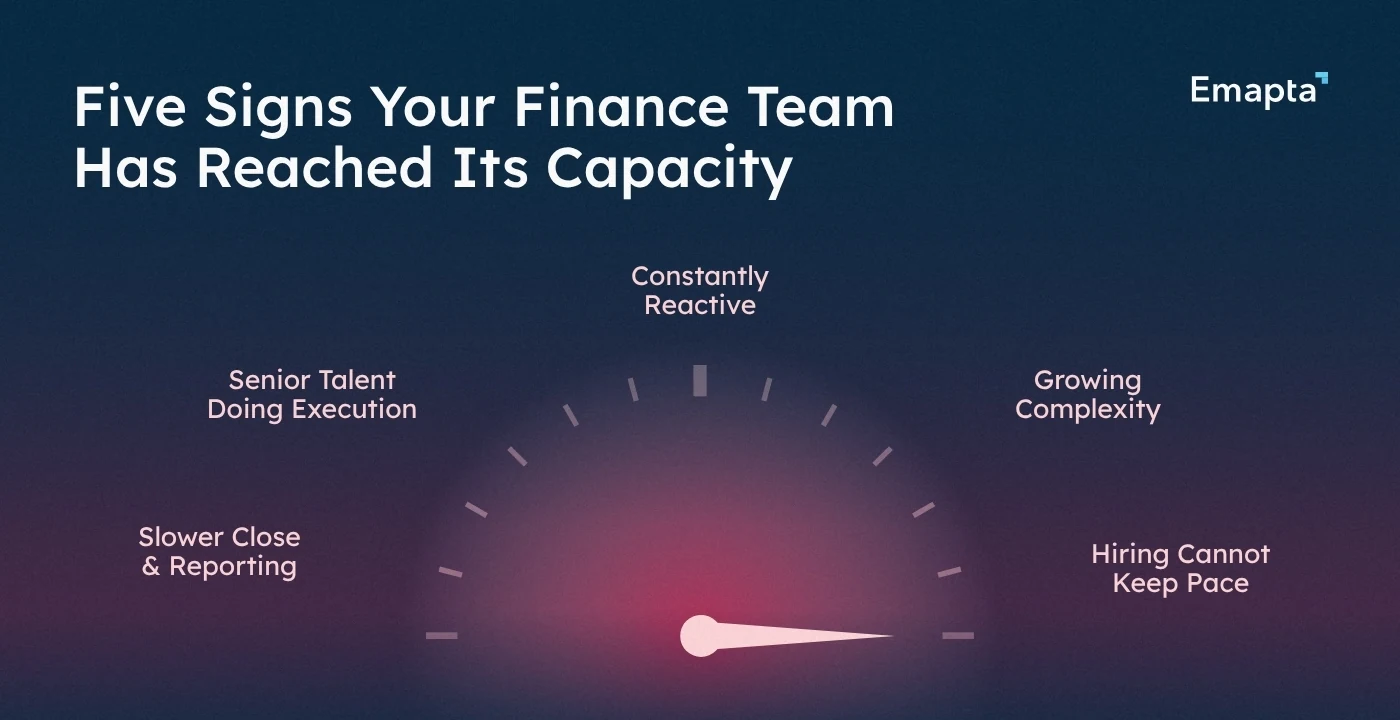
1. Your Close and Reporting Are Falling Behind
Close and reporting happen regularly. Because of this, they are good ways to check if the team’s workload and capacity are still in balance.
A tough close once in a while might just mean the month was unusual. However, if regular tasks often need overtime, last-minute fixes, or workarounds to meet deadlines, it could be a sign that capacity is becoming a problem.
That pressure can show up through:
- Reconciliations taking longer to complete
- Reporting packages being delivered later
- Reviews becoming compressed at the end of the process
- Increasing reliance on overtime during every close
- Outstanding items regularly carrying into the next cycle
The immediate problem is the missed or stretched deadline. But there’s a more significant issue over the long term.
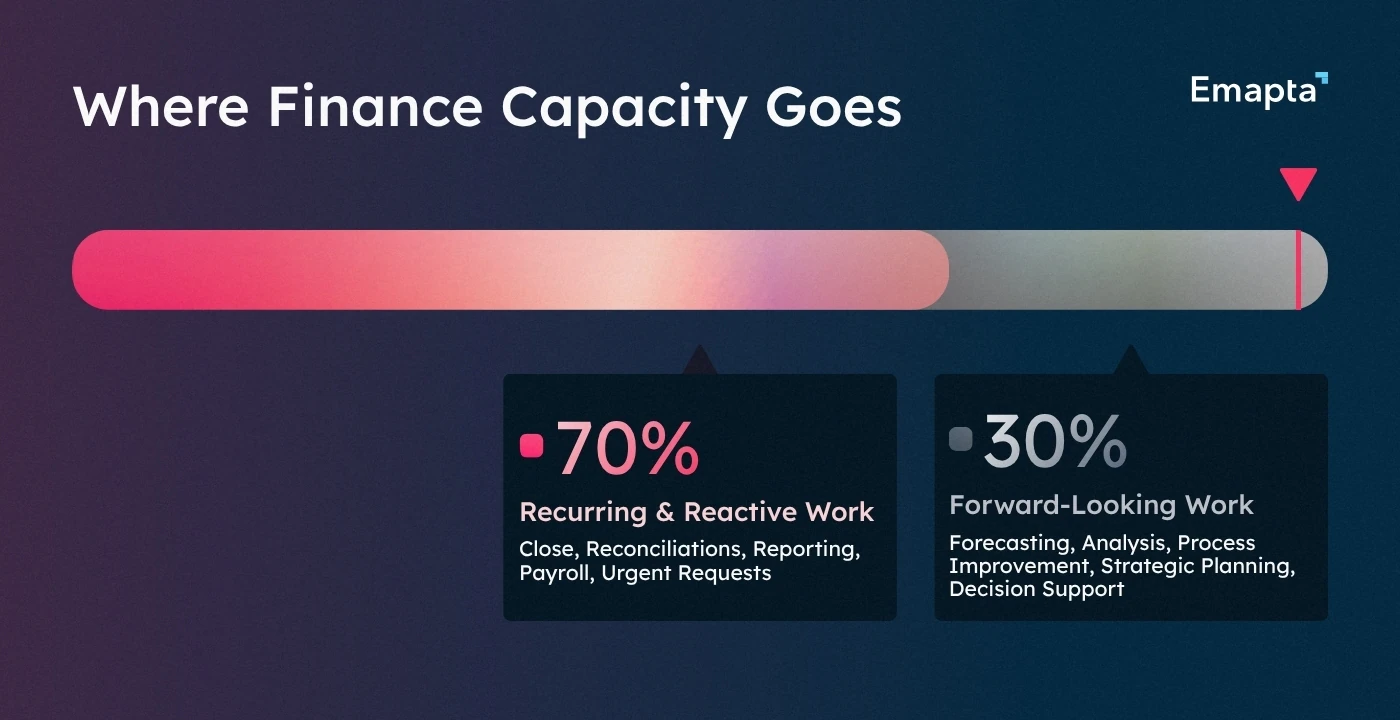
When the team is mainly dedicated to completing recurring work, there is less time available to investigate variances, improve reporting, support decision-making, or address the underlying processes creating the pressure.
A process that repeatedly requires extraordinary effort may be telling you something important: the workload has changed, but the capacity supporting it hasn’t.
2. Senior Finance Leaders Are Buried in Execution
Controllers, Finance Directors, FP&A leaders, and other senior finance professionals should naturally remain connected to the operational details of the function.
But there is a difference between maintaining oversight and constantly doing work that could sit at another level of the organization. When finance leaders spend too much time on routine execution, priorities can take a back seat.
Is Your Finance Team Operating as Efficiently as It Could?
Take our 3-minute CFO Efficiency Audit to benchmark your finance operations, identify performance gaps, and uncover opportunities for improvement.

For finance leaders, time spent absorbing work elsewhere in the finance function can mean less capacity for:
- Forecasting and scenario planning
- Financial analysis
- Business partnering
- Process improvement
- Internal controls and risk management
- Strategic planning and decision support
Adding capacity does not always mean adding another senior person. Sometimes the better answer is strengthening accounting, reporting, finance operations, or specialist support so that work can sit at the appropriate level of the organization.
For example, additional capacity could come from a Senior Accountant supporting close and reporting, an FP&A Analyst expanding analytical capacity, or an Accounts Payable specialist taking ownership of recurring operational work.
The goal is not simply to add headcount. It is to put the right work with the right level of talent.
3. Your Finance Team Is Always Reacting
Finance teams will always deal with urgent requests.
You may need to investigate a customer’s payment. Payroll or reporting always needs immediate attention. But when urgent work continually displaces planned work, the function can become permanently reactive.
That often means activities such as forecasting, automation, process redesign, documentation, system improvements, and deeper financial analysis are continually deferred.
Nothing necessarily stops functioning. The team keeps delivering. But it becomes increasingly difficult to improve how the function operates or give the business more forward-looking support.
Finance capacity should support both the work required to keep the business operating today and the analysis, planning, and improvements that help it operate better tomorrow.
If the team can consistently accomplish only the first, the capacity constraint may already be affecting the value finance can provide to the wider organization.
4. Business Growth Is Outpacing Finance Capacity
Growth is not always reflected into finance headcount.
A company may add customers without adding accountants. Introduce a new entity, system, product line, or payroll population while the same finance team continues managing the underlying processes.
Over time, each change adds another layer of work. Growth can mean:
- More transactions to process and reconcile
- Additional entities or reporting requirements
- Higher accounts payable and receivable volume
- More complex forecasting and planning
- Additional payroll requirements
- Greater tax, audit, or compliance demands
- More data for leadership to understand
That complexity can accumulate gradually, which makes the capacity threshold easy to miss.
The finance team may still have the same number of people and broadly the same responsibilities on paper, while the volume and complexity underneath those duties have changed significantly. That’s why finance capacity should not be assessed only by headcount.
Look at the work and determine:
- Which processes are taking longer?
- Where are backlogs growing?
- Which responsibilities have expanded?
- Where is specialist knowledge becoming increasingly important?
- Which work is being performed by people whose time would create more value elsewhere?
These questions help identify not only whether you need additional capacity, but also where it should sit.
Still find it difficult to assess whether to expand your team or not? Emapta’s CFO Workforce ROI Calculator can help you understand the potential financial trade-offs, so you can assess different workforce scenarios and their potential impact on your business.

5. Hiring Can’t Keep Up with Business Needs
Sometimes the capacity gap is already clear: you know another accountant is needed, FP&A needs support, a new specialist is required for tax, payroll, audit, or compliance. But identifying the need and filling it are two different things.
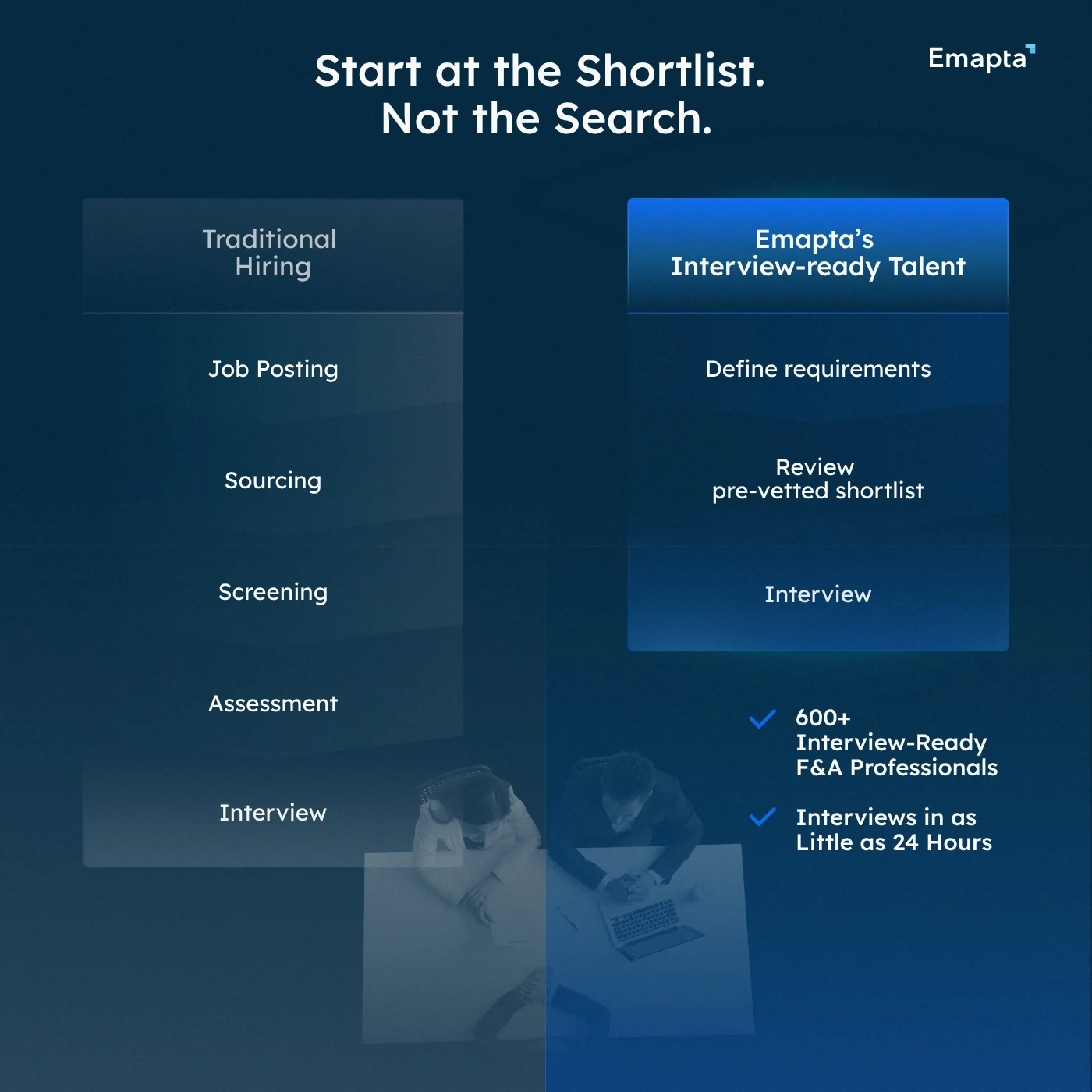
A traditional recruitment process may still require job postings, sourcing, application review, screening, assessments, experience verification, and preliminary interviews before a finance leader meets a candidate worth considering.
When the team is already under pressure, that creates another problem: the business may need additional capacity faster than the hiring process can deliver it.
That doesn’t mean the answer is to lower the hiring bar. What if you could start the hiring process with qualified professionals who are already ready to interview?
That’s the idea behind Emapta’s interview-ready Finance & Accounting talent. Instead of starting every search from scratch, Emapta connects businesses with a vast pool of finance professionals who have already completed key recruitment stages, including:
- Sourcing and screening
- Technical assessment
- English and communication evaluation
- Experience verification
- An interview with Emapta’s recruitment team
With that groundwork already completed, finance leaders can focus on evaluating candidates who match their specific requirements. The goal isn’t to skip the steps that make a good hire, it’s to remove unnecessary hiring delays so businesses can build capacity faster.
Add Capacity Where the Work Actually Needs It
Once a capacity issue has been identified, the next question should not automatically be, “How many people do we need?” A better starting point is, “Where is the work getting stuck?”
Different constraints require different types of support.
If senior finance leaders are consumed by recurring accounting work, additional accounting capacity may help redistribute execution.
If forecasting and reporting demands have grown, FP&A support may create more room for analysis.
If transaction volume is increasing, Accounts Payable, Accounts Receivable, payroll, or bookkeeping talent may strengthen everyday finance operations.
And where technical requirements are becoming more complex, specialist tax, compliance, audit, or controls expertise may be the more appropriate addition.
Emapta’s interview-ready pool includes 600+ Finance & Accounting professionals across areas such as:
- Finance Leadership
- Financial Planning and Reporting
- Accounting and Bookkeeping
- Accounts Payable and Receivable
- Tax and Compliance
- Payroll
- Audit Support
The objective is not to add resources everywhere—it’s to add the right capacity at the point where limited capacity is creating the greatest business impact.
What Changes When You Start with Interview-Ready Talent?
Your hiring process starts weeks ahead. Instead of opening a position and beginning with sourcing, teams can begin by defining the capacity they need and reviewing pre-vetted professionals, ready for the interview stage.
The process is deliberately simple.
1. Tell us where you need capacity
Share the role, level, experience, and skills required. That can also include systems expertise, industry knowledge, working-hour coverage, or the particular finance responsibilities creating pressure for the existing team.
2. Get your shortlist
We identify a curated selection of interview-ready Finance & Accounting professionals matched to those requirements.
3. Start interviewing
Once requirements are shared and matched with suitable, available talent, you can begin interviewing in as little as 24 hours.
Interview-ready does not mean automatically hired. Your organization still determines the requirements; your finance leaders still meet candidates, and your team still decides whether someone is the right fit for your business needs.
What changes is how much work has to happen before those conversations can begin.
A Smarter Way to Think About Finance Capacity
A finance team reaching its capacity does not always look like a crisis. The better indicators are what it takes to get that work done, and what the team no longer has time to do because of it.
Look at where timelines are slipping. Look at the work senior people are absorbing. Look at what keeps getting deprioritized. Look at where growth is creating new complexity and where backlogs or pressure are becoming routine.
Then, identify what level and type of finance talent would remove that constraint.
When the need is already clear, the next step does not necessarily have to be another search from scratch.
Emapta connects organizations with experienced, pre-vetted Finance & Accounting professionals across every finance function, so you can create capacity where the business needs it and start the hiring process further ahead.