
BPO Recruitment Strategy for Enterprise Teams Scaling in <90 Days
As your business grows, one of the toughest challenges is keeping your hiring strategy up to speed. New projects need more people, current teams need extra help, and every open role puts more strain on your operations.
A BPO recruitment strategy can help you build the workforce you need without putting every hiring responsibility on your internal HR team. With the right partner, clear priorities, and a structured recruitment process, you can establish a new team in under 90 days.
Here’s how to approach rapid enterprise hiring while keeping quality, costs, and long-term performance in view.
What Is a BPO Recruitment Strategy?
A BPO recruitment strategy is a structured approach to sourcing, assessing, hiring, and onboarding talent through a business process outsourcing partner.
Instead of relying entirely on your internal recruitment team, you work with a provider that can help identify suitable candidates, manage hiring activities, and support the setup of your new workforce.
Depending on the partnership, this may involve recruitment support alone or a more comprehensive arrangement covering employment administration, infrastructure, onboarding, and ongoing team support.
The main advantage is having additional recruitment capacity when your business needs it. A structured BPO recruitment process also helps you manage hiring requirements without building every capability from scratch.
Why Traditional Recruitment Struggles During Rapid Enterprise Growth
Hiring ten employees over several months is one challenge. Hiring 50 or more staff before starting a new operation is another.
Your HR team may already be stretched thin across vacancies, employee development, internal mobility, and daily workforce needs. Adding a large recruitment project can quickly overload your internal resources.
Three challenges often make traditional hiring difficult during rapid growth, especially when your business lacks a high-volume hiring strategy to manage increasing recruitment demands.
1. Limited recruitment capacity
Internal recruiters can only manage so many vacancies, interviews, and candidate conversations simultaneously.
As hiring volumes increase, response times may slow, strong candidates may accept other offers, and managers will probably spend more time interviewing than running their teams.
2. Competition for specialized talent
Some positions require technical experience, industry knowledge, language proficiency, or familiarity with particular systems.
When those skills are scarce locally, relying on a single labor market can limit your options and extend recruitment timelines.
3. Recruitment is only part of the process
Finding suitable candidates does not mean your team is ready to operate.
You still need to arrange contracts, equipment, system access, training, supervision, and knowledge transfer. Without proper coordination, you may hire employees on time, but they may be unable to start productive work.
This is where a well-planned BPO recruitment strategy can make a difference, helping you manage the entire hiring journey, from workforce planning to operational readiness.
When Should Enterprises Use BPO Recruitment?
Outsourced recruitment for enterprises becomes particularly valuable when hiring requirements exceed your existing team’s capacity or when business deadlines leave little room for a lengthy recruitment cycle.
You might consider this approach when:
- Launching a new operation – you need an entire support function ready before a product, market, or service launch
- Expanding internationally – you want to access talent in another country without immediately establishing a large local recruitment operation
- Managing seasonal demand – your workforce needs to grow around predictable peaks in customer activity or transaction volumes
- Building specialized teams – you need professionals with skills that are difficult to find in your current market
- Supporting workforce transformation – you are reorganizing functions or adding capabilities while keeping existing operations running
Keep in mind that the number of vacancies is just one part of your workforce requirements.
For example, if your enterprise needs 40 finance professionals to support a new regional operation, the challenge is not simply finding 40 qualified candidates. You also need them trained, connected to your systems, and working under consistent procedures.
A BPO partner can help manage these needs as part of a larger recruitment and workforce plan.
How to Scale an Enterprise Team in Under 90 Days
Building an enterprise team in under 90 days is possible under the right circumstances, but it takes more than fast recruitment.
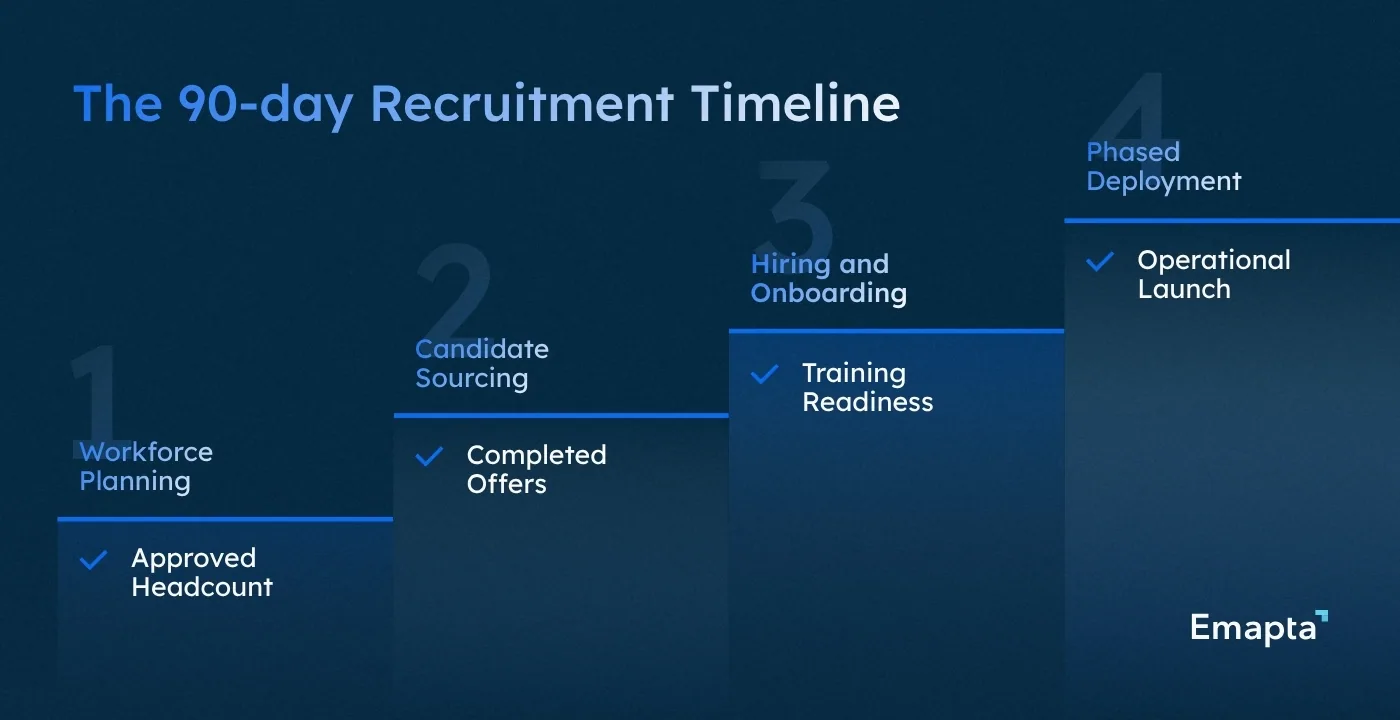
Your BPO recruitment strategy should establish clear priorities early, keep hiring and operational preparation moving together, and introduce new employees in manageable groups. This coordinated approach is essential for rapid workforce scaling.
If your goal is to build an offshore team in 90 days, the following steps can help you organize recruitment, onboarding, and operational preparation around that deadline.
Days 1 to 15: Define your workforce requirements
Before sourcing candidates, establish what your new team needs to accomplish. Start by identifying:
- Required positions, headcount, and experience levels
- Essential technical and communication skills
- Compensation expectations and target locations
- Reporting structures and management responsibilities
- Training requirements and expected productivity levels
This is also the time to align your enterprise recruitment strategy with your BPO partner, agreeing on hiring targets, interview responsibilities, and decision-making timelines.
For larger workforce changes, workforce transformation planning can help you connect recruitment decisions to your broader operational goals.
Days 16 to 30: Source and assess candidates
After you have defined your requirements, your recruitment partner can start looking for candidates using local talent networks, professional platforms, referrals, and current recruitment channels.
Instead of waiting for all applications to come in before starting interviews, begin screening and assessing candidates as soon as they apply.
For high-volume BPO recruitment, consistency matters. Use standardized interview questions, practical assessments, and clear selection criteria to evaluate candidates fairly.
Your internal managers should remain involved in final decisions, particularly for specialized and leadership positions.
Days 31 to 60: Finalize hiring and prepare onboarding
By this stage, suitable candidates should be moving through final interviews, employment offers, and pre-employment requirements.
Meanwhile, your operational teams should be preparing:
- Equipment and system access
- Training materials and documented workflows
- Security permissions and compliance requirements
- Team leaders and reporting arrangements
- Initial performance expectations
This is where working with an established enterprise outsourcing partner can help coordinate recruitment with the operational requirements of building a new team.
Days 61 to 90: Train, launch, and stabilize your team
Your first hires should now be progressing through training, supervised work, and initial performance reviews.
Instead of bringing everyone into full production at once, consider onboarding staff in waves. This gives managers time to identify knowledge gaps and resolve operational issues before additional employees begin handling live workloads.
By day 90, your goal should be a functioning team with clear responsibilities, established workflows, and measurable performance.
Remember that operational launch and full proficiency are different milestones. Complex positions may require additional months of experience before employees reach their expected productivity.
How BPO Providers Maintain Hiring Quality at Scale
Recruiting quickly should never mean hiring poor-quality talent just because it’s available.
The more employees you hire, the more important it becomes to apply consistent standards throughout recruitment and onboarding.
A strong BPO recruitment strategy should focus on three areas.
Use structured, skills-based assessments
Resumes tell you where candidates have worked. They don’t always show how well someone will perform in your operation.
Practical exercises, technical evaluations, language assessments, and structured interviews help determine whether candidates have the capabilities your roles require.
Technology is also enhancing the process. According to HR.com’s 2024–2025 recruitment technology research, 53% of surveyed organizations reported using AI in recruitment, compared with 26% in the previous study.
Still, automated tools can help with repetitive recruitment tasks, but human oversight remains important when evaluating suitability and making employment decisions.
Make onboarding part of your recruitment strategy
A successful hire is not simply someone who accepts an offer. It’s someone who understands the job and can contribute to your business.
Provide new employees with documented procedures, structured training, access to experienced colleagues, and clear expectations for their first months.
When managing geographically distributed teams, consistent communication and supervision are equally important. Establishing effective practices for managing remote teams can help new employees feel connected to your operation.
Monitor performance after hiring
Your BPO partner should remain accountable for outcomes after employees join.
Review early performance, training completion, manager feedback, and employee retention. If several new hires struggle with the same task, the problem may be related to recruitment criteria or training, not individual performance.
These insights will allow you to improve subsequent hiring waves.
Which Roles Can Enterprises Recruit Through a BPO Partner?
Depending on the provider’s capabilities, enterprises can recruit professionals across operational, technical, and specialized business functions. BPO recruitment is no longer limited to just hiring customer support talent.
Common examples include:
| Business Function | Potential Roles |
|---|---|
| Customer experience | Customer service representatives, technical support specialists, team leaders |
| Finance and accounting | Accountants, bookkeepers, payroll specialists, financial analysts |
| IT and technology | Software developers, IT support professionals, cybersecurity analysts |
| Human resources | Recruitment specialists, HR coordinators, payroll administrators |
| Sales and marketing | Sales development representatives, digital marketers, marketing analysts |
| Administration and operations | Executive assistants, data analysts, procurement specialists |
The right recruitment and onboarding approach depend on the complexity of the work.
For example, a customer support team may be recruited in larger groups using standardized assessments. A finance or technology team may require more individualized screening, technical interviews, and longer knowledge transfer.
Your recruitment strategy should reflect those differences rather than applying the same hiring timeline to every position.
Common Risks of Rapid Enterprise Hiring and How to Manage Them
Even with a solid BPO recruitment strategy, scaling your workforce quickly comes with risks. Without clear procedures and proper oversight, small hiring challenges can turn into operational problems that continue long after recruitment ends.
Three risks deserve particular attention.
1. Hiring volume affects retention
Your workforce strategy should focus on bringing in the right talent to improve business performance, not simply adding more people to your team.
Address retention risks through competitive compensation, realistic job descriptions, career development, and regular employee feedback initiatives.
You should also know how to calculate employee retention rates across your workforce to assess whether your hiring strategy is delivering lasting results.
2. Inadequate preparation delays productivity
Imagine hiring 30 employees on schedule, only to discover that half are still waiting for system access. Then, you may have met your recruitment target, but not your operational one.
Prevent this by assigning clear ownership for equipment, technology, documentation, training, and approvals before employees start.
3. Compliance and security requirements are overlooked
Recruiting internationally introduces responsibilities involving local employment regulations, personal information, contractual arrangements, and access to business systems.
Before hiring begins, confirm how your provider manages employment compliance, data protection, background checks, and security controlssecurity controls.
These requirements should be built into your recruitment timeline rather than addressed after candidates have accepted offers.
How to Choose a BPO Recruitment Partner
Your recruitment partner plays an important role in your enterprise talent acquisition strategy, influencing how quickly your team grows, how effectively employees settle into their roles, and how much additional management your internal teams need to provide.
Start by looking beyond promises of fast hiring. Ask prospective providers about:
- Recruitment capabilities: Can they demonstrate experience hiring for your required roles and headcount?
- Talent availability: Do they have established sourcing networks in the locations you are considering?
- Quality controls: How do they assess technical skills, communication, and role suitability?
- Operational support: Can they coordinate onboarding, employment administration, infrastructure, and training?
- Compliance: What processes protect employee information and sensitive business data?
- Reporting: Which recruitment and workforce performance metrics will you receive?
It’s also worth asking for a realistic implementation schedule showing responsibilities, dependencies, and potential risks. A clear recruitment process outsourcing strategy should account for these factors before hiring begins.
For enterprises considering new locations or workforce structures, workforce transformation services can help evaluate talent availability, operating requirements, and the most suitable approach to expansion.
Which recruitment metrics should you track?
Hiring speed matters, but it should not be your only measure of success. Track the following indicators throughout your recruitment project:
| Metric | What It Tells You |
|---|---|
| Time-to-fill | How long it takes to fill an approved vacancy |
| Offer acceptance rate | Whether your compensation and opportunities appeal to candidates |
| Cost-per-hire | How much you spend recruiting each employee |
| Quality-of-hire | How effectively new employees meet performance expectations |
| Employee retention | How many new hires remain after 30, 60, and 90 days |
| Time-to-productivity | How quickly employees reach agreed performance standards |
The goal is to use these metrics together. A shorter hiring cycle means little if new employees leave early or struggle to meet operational expectations.
Dedicated Staffing: A Smarter BPO Recruitment Strategy
When your internal recruiters are stretched thin, specialized talent is hard to find, and onboarding takes longer than expected, outsourcing recruitment alone may not be enough.
This is where dedicated staffing makes a difference. Unlike traditional outsourcing, which typically focuses on volume, standardization, and vendor-managed processes, dedicated staffing allows you to build a team that works exclusively for your business, follows your processes, and supports your long-term goals.
Beyond filling vacancies, dedicated staffing also gives you greater control over how your workforce operates and develops. Your team becomes an extension of your business, helping you maintain consistency as you scale.
Traditional outsourcing may work for standardized processes that require filling limited vacancies, but business-critical functions often require closer collaboration, flexibility, and long-term workforce continuity.
Understanding these differences can help you avoid the limitations of conventional outsourcing models.
Where Does Traditional Outsourcing Fall Short?
Explore why conventional BPO models may struggle to meet the demands of business-critical operations.

Wrapping Up
The right BPO recruitment strategy does more than fill open positions. It helps you bring in qualified talent, support business growth, and build a workforce that can keep up with your evolving needs.
A structured 90-day roadmap makes that possible. From defining workforce requirements and sourcing candidates to onboarding, training, and launching your team, each stage helps you move forward without compromising hiring quality.
Ultimately, choosing the right outsourcing partner is critical to your workforce strategy’s success. With the right recruitment expertise, operational support, and long-term commitment, you can scale confidently and build a team ready to deliver.
Frequently Asked Questions
A BPO recruitment strategy involves working with an outsourcing provider to source, assess, hire, and onboard employees. It helps enterprises expand recruitment capacity, access broader talent pools, and build teams without relying entirely on internal HR resources.
A BPO partner may help you build an enterprise team in under 90 days, depending on the roles, hiring volume, talent availability, and onboarding requirements. A structured recruitment roadmap covering workforce planning, candidate selection, hiring, and training helps keep the process on schedule.
Enterprises can maintain hiring quality through standardized interviews, skills-based assessments, consistent selection criteria, and structured onboarding. Regular performance reviews and employee retention tracking also help identify recruitment gaps and improve future hiring decisions.
BPO providers can recruit professionals across customer support, finance, accounting, IT, human resources, sales, marketing, and administrative functions. Available roles depend on the provider’s recruitment capabilities, talent networks, and experience with specialized positions.
Enterprises should track time-to-fill, offer acceptance rate, cost-per-hire, quality-of-hire, employee retention, and time-to-productivity. Together, these metrics help measure recruitment efficiency, hiring quality, and how effectively new employees contribute to business operations.