
6 Best Nearshore Outsourcing Countries in Latin America
Scaling hiring in the U.S. is getting harder as companies face rising costs, talent shortages, and growing demand for specialized skills. For businesses considering talent closer to home, finding the best nearshore outsourcing countries is a practical first step.
Nearshoring helps address these challenges by lowering costs and providing access to skilled talent, similar working hours, smoother teamwork, and more flexibility to expand your team.
If you’re not sure which talent market fits your needs, this guide compares 6 leading nearshore destinations, their key strengths and risks, and how to choose the right one for your business.
6 Best Nearshore Outsourcing Countries at a Glance
This comparison gives you a shortlist, not an answer. The better way to choose is to start with the work your team needs to perform and then find the market that supports it.
| Country | Strong fit for | U.S. workday alignment | Main consideration |
|---|---|---|---|
| Colombia | Finance, tech, professional services, BPO | Excellent | Talent depth varies by specialization |
| Mexico | Tech, engineering, supply chain, finance | Excellent | Competition for specialist talent |
| Dominican Republic | BPO, finance, technical support, back office | Excellent | Smaller specialist talent pool |
| Argentina | Software, data, product, creative roles | Strong | Economic and currency volatility |
| Brazil | Tech, engineering, data, enterprise services | Strong | Language and compliance complexity |
| Costa Rica | Tech, business services, regulated industries | Excellent | Higher costs than some LATAM markets |
How We Evaluated the Best Nearshore Outsourcing Countries in Latin America
A country with low salaries but limited talent for your role is not necessarily cost-effective. Neither is a large talent market if your outsourced employees cannot collaborate when you need them.
A fully comprehensive comparison should consider:
- Talent depth and specialization
- U.S. workday overlap
- Labor and operating costs
- English and bilingual capabilities
- Outsourcing and professional-services maturity
- Digital and business infrastructure
- Ease of scaling
- Labor, compliance, and economic considerations
The importance of each factor depends on the role. A customer success team needs different things from a group of software engineers or financial analysts.
6 Best Nearshore Outsourcing Countries in Latin America
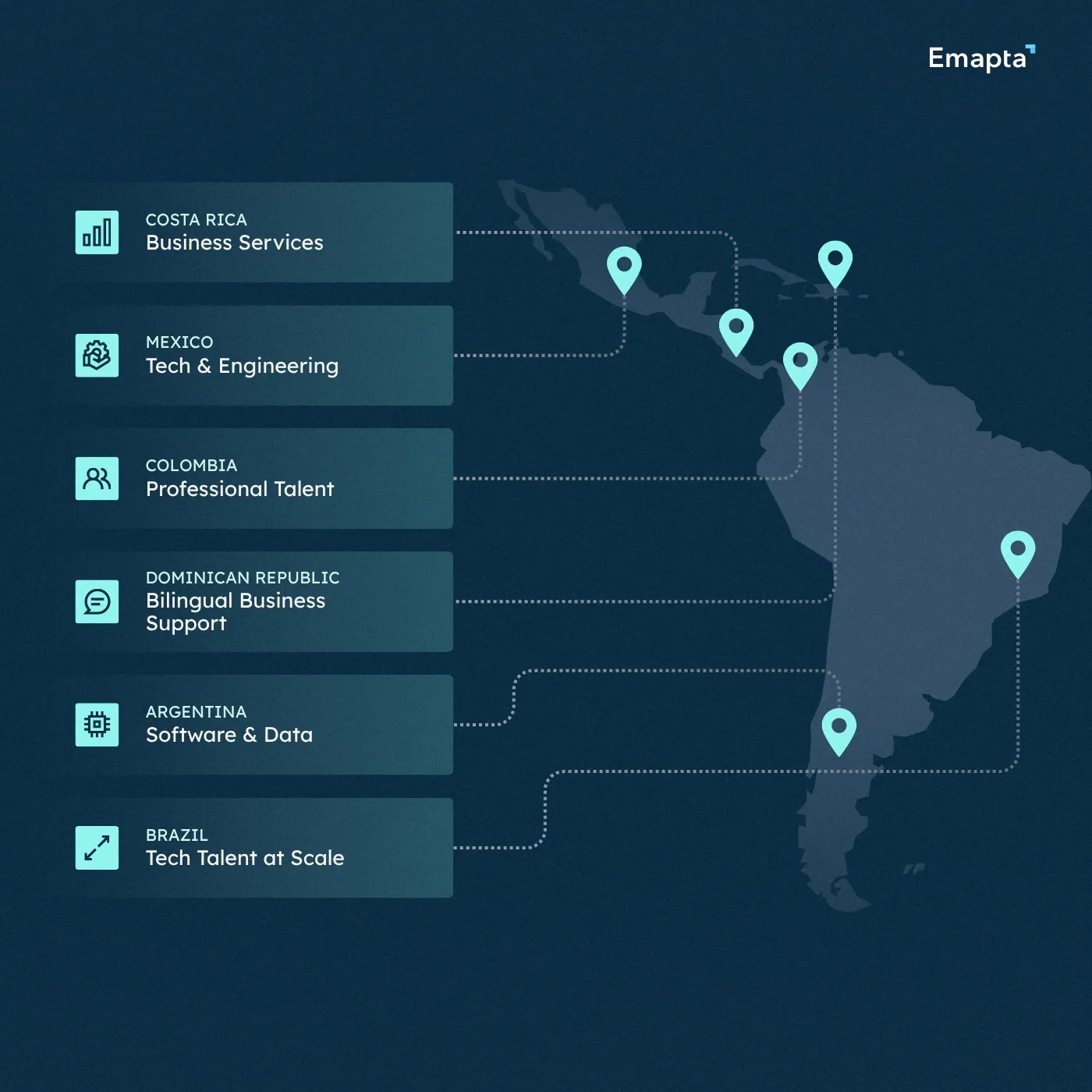
There is no universal winner among the best LATAM countries for outsourcing. But three markets deserve particular attention when you need to balance talent, collaboration, and accessibility: Colombia, Mexico, and the Dominican Republic.
The other markets on this list become especially relevant when a particular specialization, talent pool, or operating environment matters more.
1. Colombia – Versatile Professional Talent
Colombia stands out as top-tier LATAM hub when you need specialized talent that can work closely with your U.S. team.
Its workday aligns closely with North American business hours, so teams can discuss problems, make decisions, and move work forward within the same day.
Bogotá and Medellín, country’s main talent hubs, offer established talent across finance, technology, customer operations, marketing, and shared services, supported by solid business and digital infrastructure.
But the main advantage is its growing, skilled talent pipeline. According to a recent report from ProColombia, more than 126,000 STEM professionals graduated in Colombia in 2024, representing nearly a quarter of the country’s higher-education graduates.
For companies, that means access to more than transactional support. Colombia’s talent hub can provide specialized professionals across technical and business functions while keeping them connected to the people and decisions driving your U.S. operation.
See how a U.S. law firm grew its team 40x in one year with nearshoring.

2. Mexico – Technical Talent Next to the U.S.
Mexico becomes particularly interesting when you need technical capabilities without putting significant distance between your outsourced and U.S. teams.
Mexico City, Guadalajara, and Monterrey provide access to talent across technology, engineering, finance, supply chain, and enterprise operations. Their location also makes cross-border travel more practical for training, planning sessions, or face-to-face collaboration.
The engineering pipeline is a particular strength. In a 2026 assessment, the OECD found that Mexico has the highest share of tertiary-level engineering graduates in the Americas, exceeding the OECD average.
That helps explain why Mexico is a strong option for highly technical functions. If you need software, engineering, data, automation, or other specialized roles, you can tap into a skilled talent pipeline while keeping your team close to home.
3. Dominican Republic – A Bilingual Hub Moving Beyond CX
If you still associate nearshoring to the Dominican Republic mainly with call centers, you may be overlooking how the market is developing.
The country’s established BPO sector now supports finance, technical support, HR, sales, healthcare administration, and other back-office functions. And because the country operates on UTC-4 year-round, those teams can spend most of their day working alongside U.S. colleagues.
Its bilingual workforce is also being developed deliberately, making it one of the best Latin American countries for outsourcing. Official government sources reported that around 175,000 people had completed its English Immersion for Competitiveness program by 2026, with plans to provide training to an additional 27,000 participants.
That investment matters when you need people who can work directly with English-speaking customers and U.S. colleagues. It also helps the Dominican Republic talent hub expand beyond traditional CX into more technical and professional support roles.
4. Argentina – Specialized Knowledge and Technology Talent
Argentina is worth considering when you need specialized talent for technical and knowledge-intensive work.
The country has an established workforce across software development, data, product, fintech, engineering, and digital services, with working hours that remain closely aligned with U.S. teams.
That specialization runs deep. According to Argentina’s Ministry of Economy, the country’s knowledge economy supported more than 285,000 formal jobs in 2025, with 80% of that workforce having university studies.
For you, that means access to experienced professionals in a market already built around delivering knowledge-intensive services.
The main consideration is economic volatility, which makes the right employment and pricing model particularly important for long-term planning.
5. Brazil – Scale for Complex Technical Work
Brazil stands out when you need technical talent at scales that match those in the U.S.
Its large technology ecosystem supports software development, data, cybersecurity, enterprise IT, fintech, and engineering. That gives you room to build beyond a few specialist hires as your needs grow.
The size of that workforce puts the opportunity into perspective. A 2026 official report identified approximately 943,000 formally employed ICT professionals across Brazil, including more than 252,000 systems-development analysts.
For businesses, that means a deeper pool to draw from when building larger or more specialized technical teams. This is why Brazil ranks among the best countries for nearshore tech outsourcing.
Portuguese-language requirements and local employment and tax rules add complexity, so the operating model, just as in Argentina, should be considered alongside the available talent.
6. Costa Rica – A Mature Knowledge-Services Market
Costa Rica makes a strong case when you value experience in professional and knowledge-intensive services.
The country has built capabilities across business services, technology, life sciences, and other specialized functions, creating an established environment for companies that need more than transactional support.
Its export mix reflects that specialization. According to 2025 official data from the Ministry of Foreign Trade of Costa Rica, business services accounted for 21% of the country’s total exports, making them the second-largest export category behind medical devices. That points to a market with significant experience delivering higher-value services internationally.
The trade-off is scale and cost: Costa Rica has a smaller workforce, and experienced bilingual specialists can come at a premium compared with other LATAM markets.
What Risks Should You Consider When Choosing a Country?
Nearshoring can reduce the friction created by distance, but geography does not remove outsourcing risk.
The issues with nearshore outsourcing to these countries to evaluate include:
- Labor compliance – employment, subcontracting, benefits, and contractor rules vary by country
- Talent competition – experienced bilingual and technical professionals can be highly sought after in major hubs
- Economic volatility – inflation and currency movements can affect salaries and long-term budgets
- Data and IP protection – access controls, devices, personal information, intellectual property, and offboarding need clear safeguards
- Location differences – infrastructure, security, costs, and talent availability can vary significantly between cities in the same country
- Provider quality – a strong market cannot compensate for weak recruitment, poor compliance, or unclear pricing
This is why country selection, or operational costs, should be only one layer in your decision.
How to Choose the Right One from the List of Top Nearshore Outsourcing Countries
Start by picturing the team six months after launch.
Who will they work with every day? How quickly do they need answers? Which skills are difficult to hire domestically? Do you need five people today but twenty next year?
Then match those requirements to the market.
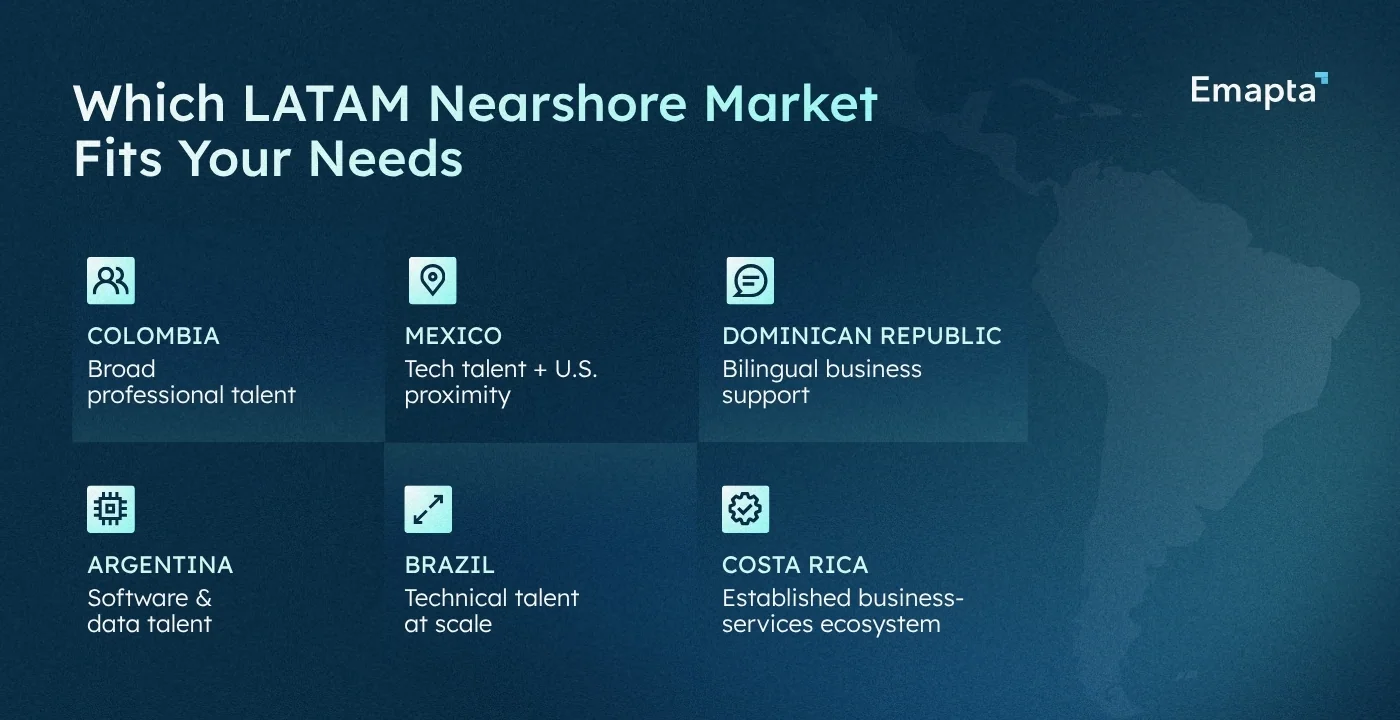
If you want a broad professional talent base and close U.S. collaboration, Colombia deserves consideration.
If technical specialization and physical proximity matter, Mexico may make more sense.
If bilingual customer-facing and business-support capabilities are central to the team, the Dominican Republic might offer the combination you need.
Argentina and Brazil can expand your options when deeper technical specialization or scale becomes the priority, while Costa Rica can be attractive for knowledge-intensive and multinational services.
You also do not need one country to solve every workforce problem. Many U.S. companies already use outsourcing across different functions and locations. The stronger strategy is to place each team where the available talent and operating environment fit the work.
Wrapping Up
The real opportunity in nearshoring is not finding the cheapest place to hire. It’s finding the right talent market for the capabilities your business needs.
Colombia gives you broad professional talent and close U.S. workday alignment. Mexico combines specialist capabilities with North American proximity. The Dominican Republic offers bilingual talent backed by an increasingly diverse outsourcing sector.
So, instead of asking which are the best nearshore outsourcing countries in LATAM, start with the team you want to build. Once you understand the skills, collaboration, scale, cost, and risk profile you need, choosing the right nearshore destination becomes much easier.
Frequently Asked Questions (FAQ)
Colombia, Mexico, the Dominican Republic, Argentina, Brazil, and Costa Rica are six strong options for U.S. companies. Colombia, Mexico, and the Dominican Republic can be particularly practical starting points when U.S. workday collaboration is a priority.
There is no single best country for every business. Colombia offers broad professional talent and U.S. time-zone alignment; Mexico combines specialized talent with geographic proximity; and the Dominican Republic can be attractive for bilingual customer-facing and business-support teams. Other markets may be stronger when your requirements call for a specific specialization or scale.
There is no reliable single answer because costs change by role, seniority, city, language requirements, benefits, and outsourcing model. Compare the fully loaded cost of the team rather than national salary averages or advertised hourly rates.
Start with the role and workflow. Compare the countries that can provide the talent you need, then evaluate working-hour overlap, total cost, language capabilities, scalability, compliance, security, and provider quality. The best destination is the one that supports how your team actually needs to work.