
Workforce Transformation vs Workforce Planning – Main Differences
Workforce transformation vs workforce planning is a comparison many leaders skip because the two terms sound interchangeable. Both deal with people, skills, and the future of work, yet each one answers a different question.
Workforce planning asks how many people and which skills your business will need. Workforce transformation asks how your business will change the way work gets done.
Treat them as one process, and you risk headcount plans that never touch the operating model or change programs with no talent roadmap behind them. This guide explains what each means, where they differ, and how to use them together.
What Are the Key Takeaways on Workforce Planning vs Workforce Transformation?
- Workforce planning forecasts the people, skills, and costs a business needs to deliver its strategy over a defined period
- Workforce transformation redesigns roles, processes, structures, technology, and ways of working so the business can operate differently
- Planning is a recurring discipline, while transformation is a time-bound program of change with a defined end state
- Planning tells a transformation where the talent gaps are and when to close them, so the two work best as one connected system
- A combined approach uses shared data, shared metrics, and a regular review cycle to keep both on track
What Is Workforce Transformation?
Workforce transformation is the deliberate redesign of how an organization uses its people, skills, technology, and structure to work in a new way. The meaning of workforce transformation goes beyond hiring or training. It changes what jobs exist, how teams are organized, and which tasks people, tools, and partners handle.
Companies usually start a workforce transformation strategy when the current model can no longer support where the business is going. Common triggers include AI adoption, a new business model, a merger, rising operating costs, or expansion into new markets.
A transformation program typically includes several of these moves:
- Role redesign: Rewriting job scopes so people focus on higher-value work while automation or AI tools take on repetitive tasks
- Process change: Removing manual steps, standardizing workflows, and introducing new systems
- Structural change: Moving from siloed departments to cross-functional teams or new operating models
- Talent model change: Shifting the mix of full-time, contract, and offshore talent to gain capacity or skills the business lacks
- Leadership and culture change: Preparing managers to lead teams through new ways of working
Workforce redesign sits at the core of this work, delivered as a program with a starting point, a target state, and a timeline.
What Is Workforce Planning?
Workforce planning is the process of forecasting the people, skills, and labor costs an organization needs to meet its goals, then building a plan to close the gap between today and that future state. In practical terms, the meaning of workforce planning is simple: having the right people with the right skills in the right roles at the right time and cost.
Planning happens at two levels. Operational planning covers near-term needs such as open roles, team capacity, and the next budget cycle. Strategic workforce planning looks three to five years out and starts from the business strategy rather than current headcount.
A typical workforce planning process follows five steps:
- Set direction: Clarify the business goals the workforce must support
- Analyze supply: Map current headcount, skills, performance, turnover, and internal mobility
- Forecast demand: Estimate the roles, skills, and capacity needed under different growth scenarios
- Identify gaps: Compare supply against demand to find shortages, surpluses, and critical-role risks
- Act and review: Put the plan into action, then revisit it as business conditions change
Unlike transformation, future workforce planning never really ends. It keeps headcount and capability aligned with strategy year after year.
Workforce Transformation vs Workforce Planning at a Glance
The table below summarizes how the two approaches compare across the areas leaders ask about most.
| Area | Workforce Transformation | Workforce Planning |
|---|---|---|
| Core question | How should work, roles, and structures change? | What people, skills, and costs will we need? |
| Nature | A change program with a defined target state | A recurring planning discipline |
| Time horizon | Varies widely depending on scope, could be as little as 2 months with right partner | Annual cycles, with strategic plans spanning three to five years |
| Scope | Roles, processes, technology, structure, and culture | Headcount, skills, capacity, and labor costs |
| Typical owner | Executive leadership with HR, IT, and operations | HR and finance, in partnership with business leaders |
| Main outputs | New operating model, redesigned roles, adopted tools | Demand forecasts, gap analyses, hiring, and development plans |
| Success measures | Adoption, productivity, cost-to-serve, internal mobility | Headcount vs. plan, time to fill, skills coverage, turnover |
6 Key Differences Between Workforce Transformation and Workforce Planning
The difference between workforce transformation and workforce planning shows up in six practical areas, from who owns each effort to how success is judged.
1. Purpose
Workforce planning aims to match talent supply with business demand. Workforce transformation aims to change the demand itself by redesigning how work is done. Planning keeps the engine running, while transformation rebuilds parts of it.
2. Scope
Planning stays within the workforce itself, while transformation also reshapes the systems and structures people work within. For example, a planning exercise might add 10 analysts, while a transformation might redesign the analyst role around AI tools entirely.
3. Time Horizon and Cadence
Planning runs on a repeating cycle, usually tied to annual budgets with quarterly check-ins. Transformation runs as a program with phases, milestones, and a target end state.
4. Ownership
HR and finance typically lead planning, with input from department heads. Transformation needs executive sponsorship because it cuts across functions and often changes budgets, reporting lines, and technology investments at the same time.
5. Outputs
Planning delivers decisions: who to hire, train, or move, and when. Transformation delivers visible change, such as teams working in new structures and using new systems day to day.
6. Risk Profile
Poor planning tends to cause gradual problems such as overstaffing, slow hiring, or rising turnover in critical roles. A poorly run transformation creates sharper risks, including disrupted service, lost talent, and failed technology rollouts. That is why skills matter so much: according to the World Economic Forum’s Future of Jobs Report 2025, 63% of employers name skill gaps as the biggest barrier to business transformation through 2030.
Viewed side by side, workforce transformation vs workforce planning is less a choice between two options and more a question of which problem you need to solve first.
Avoid the 7 headcount planning mistakes that quietly stall enterprise growth

How Workforce Planning Supports Workforce Transformation
Transformation sets the destination, and planning maps the route. Without that route, change programs stall because the right people are not ready when new roles or tools go live.
a) It Defines the Talent Gap
A transformation changes which skills matter. Planning measures how far the current workforce is from that new requirement. According to the World Economic Forum, workers can expect 39% of their existing skill sets to be transformed or become outdated between 2025 and 2030, so this gap is rarely small.
b) It Sequences the Change
Planning decides when each capability needs to be ready. It lines up hiring, training, and redeployment with transformation milestones so new systems are not launched before people can use them.
c) It Protects Business Continuity
Role redesign and restructuring create temporary capacity gaps. Planning identifies critical roles, succession risks, and coverage needs so day-to-day operations continue while the change takes hold.
d) It Feeds Data Back Into the Program
Planning data shows whether a transformation is landing. If attrition rises in redesigned roles or critical positions stay open, leaders can adjust early instead of after rollout.
How to Integrate Workforce Planning Into a Transformation Strategy
The debate over workforce transformation vs workforce planning fades once both run on the same data and the same calendar. These five steps help connect them.
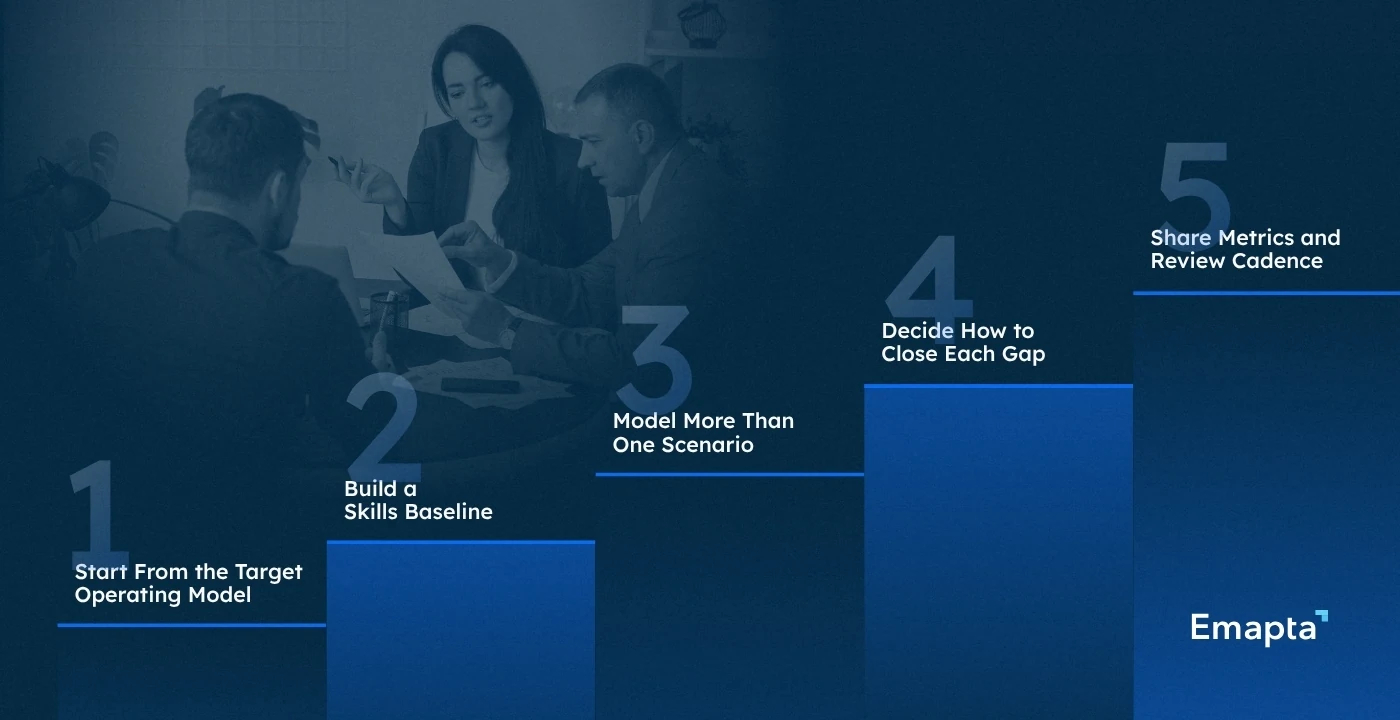
1. Start From the Target Operating Model
Before forecasting headcount, define what the business will look like after the change. Agree on which processes will be automated, which roles will be redesigned, and which capabilities will sit in-house, offshore, or with partners. If your leadership team is still aligning on scope, this guide to the drivers and types of workforce transformation is a useful starting point.
2. Build a Skills Baseline
Create a skills inventory that shows what your current workforce can do, not just job titles. This baseline makes gap analysis accurate and highlights employees who could move into redesigned roles.
3. Model More Than One Scenario
Transformations rarely go exactly to plan. Model best-case, expected, and slower-adoption scenarios so you know how hiring, training, and costs would shift under each one.
4. Decide How to Close Each Gap
For every gap, choose the most practical source of talent:
- Build: Upskill or reskill current employees for new roles
- Buy: Hire externally for skills that cannot be developed in time
- Redeploy: Move people from shrinking functions into growing ones
- Extend: Add dedicated offshore team members to gain capacity and specialist skills faster. With a partner like Emapta, your business directs the day-to-day work while Emapta handles HR, compliance, IT, and facilities
5. Share Metrics and a Review Cadence
Give transformation leaders and workforce planners one dashboard that combines program and people metrics, then review it quarterly so both can adjust together.
Conclusion
Workforce planning and workforce transformation solve different problems, but they depend on each other. Planning gives a transformation its talent roadmap, while transformation gives planning a clear picture of the future it is preparing for.
Businesses that connect the two can change faster without losing the people and skills that keep operations running. Ultimately, the real value of workforce transformation vs workforce planning lies in using both together.
Frequently Asked Questions (FAQ)
Workforce planning makes sure a business has enough people with the right skills to deliver its goals. Workforce transformation changes the work itself through new roles, processes, structures, and technology. Planning repeats every cycle, while transformation runs as a program with a defined end state.
Yes, in most cases. Workforce planning is one of the core building blocks of a transformation because it identifies the skills and capacity the new model needs. It also continues after the transformation ends to keep the new operating model staffed.
It can. A strategic planning exercise often reveals gaps that hiring alone cannot fix, such as roles that automation will reshape or skills the market cannot supply. Those findings frequently become the business case for a broader transformation.
A company needs transformation when hiring and training alone can no longer close the gap between today’s workforce and tomorrow’s strategy. Warning signs include skill gaps that keep coming back, processes that slow growth, and major shifts such as AI adoption or a merger.
They should. When companies treat workforce transformation and workforce planning as connected efforts, transformation goals give the plan direction and planning data sets a realistic pace for change.