
10 Emerging Jobs Your Company Might Hire Globally Before 2030
The future of hiring is already taking shape, whether businesses are ready or not. Across industries, specialized jobs are emerging in areas that require new combinations of expertise. By the time a position becomes a hiring priority, the competition for qualified professionals may already be well underway.
To make smarter workforce decisions, you need to look beyond familiar job titles and recognize where new opportunities for hiring are opening up. With that perspective, you can tap into global talent more strategically and build a team that can take on what’s next.
The Factors Redefining What Companies Hire For
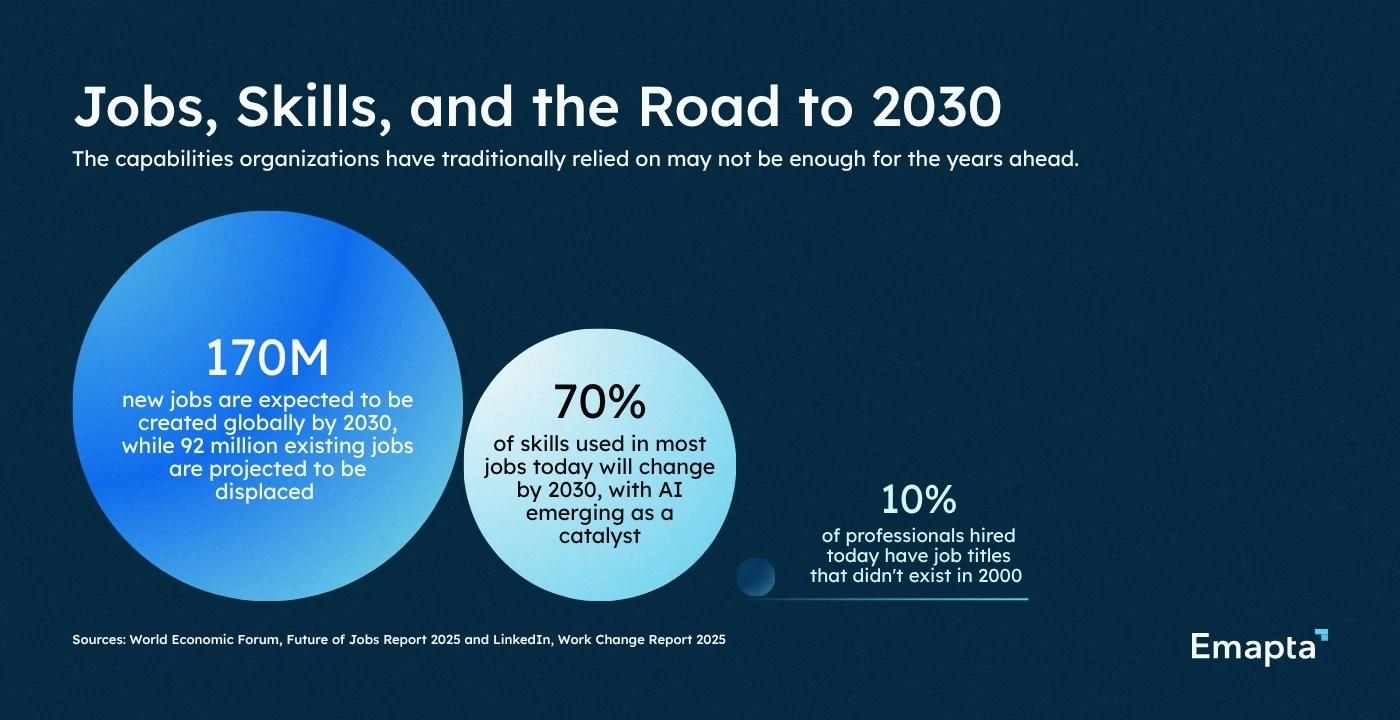
Hiring priorities are increasingly shaped by factors that extend beyond the labor market itself. Against a backdrop of economic uncertainty, geopolitical tensions, technological advances, and fast-changing customer expectations, organizations across industries are facing an increasingly complex and unpredictable operating environment.
Together, these developments are changing the nature of work and the skills companies need to carry it out. As new responsibilities emerge, so do in-demand jobs that extend beyond the scope of traditional positions.
How Early Access Creates a Talent Advantage
Organizations that can access emerging expertise to fill next-generation jobs have an advantage over those starting their talent pipelines from scratch. This head start can translate into several competitive benefits:
- Faster execution – pursue new opportunities without lengthy recruitment processes delaying progress
- Earlier innovation – experiment with new AI technologies and develop offerings before competitors catch up
- Greater adaptability – respond to changing business priorities without having to build every capability internally
- Stronger market positioning – establish a foothold in emerging areas while competitors are still developing their expertise
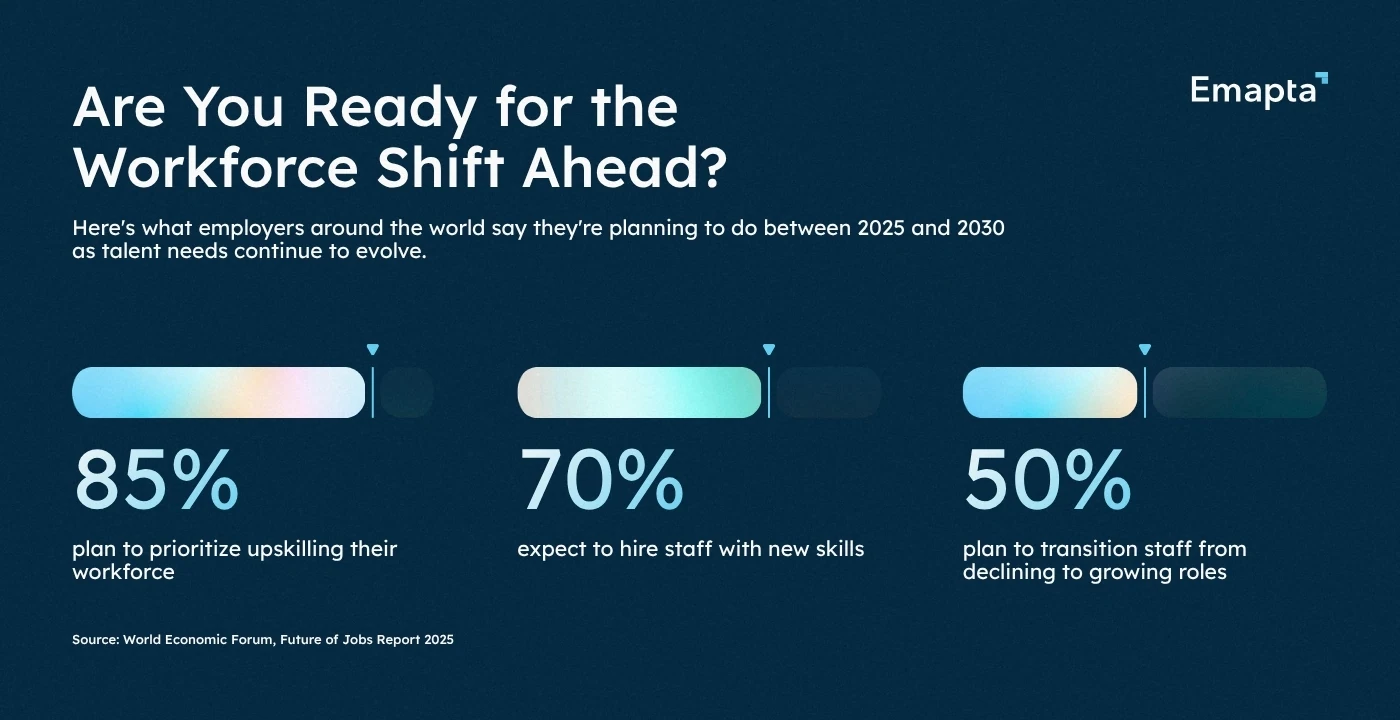
And companies aren’t standing still. The World Economic Forum also found that 70% of employers expect to hire talent with new skills, while 50% plan to move employees from declining to growing roles. As more organizations put these plans into motion, those that delay risk falling behind in the race to recruit for jobs that will matter most in the future.
Outsourcing Offers Faster Access to Emerging Skills
Finding and hiring professionals with evolving skill sets isn’t always straightforward. Specialized talent can be scarce, and demand for future-ready capabilities may outpace traditional recruitment and training efforts. This makes it particularly challenging for companies relying solely on internal hiring resources.
That’s where outsourcing can offer an alternative. By building global teams, companies can reach specialized professionals across different markets, broaden their hiring options, and bring new expertise into the business without having to develop every capability from scratch.
It’s an approach that many companies are already embracing. Everest Group reports that 78% of enterprises use outsourcing as a strategic growth lever, highlighting its role in modern workforce planning.
Top 10 Emerging Jobs to Consider for Your Global Team
So, where should your organization start looking to get ahead of tomorrow’s talent needs?
Drawn from Emapta’s Talent Heatmap™, the following emerging roles offer possibilities across 10 core business functions. They extend beyond the transactional work traditionally associated with outsourcing, covering analytical, managerial, and specialized professional positions that require considerable expertise and judgment.
1. AI Compliance Auditor
AI Compliance Auditor is an emerging job gaining relevance as AI becomes more deeply integrated into finance and accounting processes. These professionals assess AI-driven financial systems, identify potential risks, and evaluate whether appropriate controls are in place to maintain accuracy, transparency, and regulatory compliance.
What This Role Enables
- Establish AI audit controls early
- Access expertise in financial compliance and AI risks
- Scale audit coverage alongside AI adoption
2. AI Design Engineer
Designing complex systems requires balancing performance, efficiency, cost, and technical constraints. Within the architecture and engineering function, AI Design Engineers use AI-powered tools to explore alternative approaches and develop solutions that meet specific technical requirements.
What This Role Enables
- Accelerate complex design and prototyping
- Reduce resource waste by identifying design issues earlier
- Improve design accuracy through AI-assisted analysis
3. Prompt Engineer
Getting consistent, reliable results from generative AI requires more than simply knowing what to ask. Prompt Engineers are emerging as technology specialists with the skills to develop and refine instructions that help AI systems produce accurate, relevant, and useful outputs.
What This Role Enables
- Increase productivity across AI-supported operations
- Reduce costs associated with inefficient AI use
- Accelerate the delivery of AI-driven initiatives
4. Contract Management Specialist
As businesses expand across borders, managing contracts becomes increasingly complex. Contract Management Specialists in legal services oversee agreements, track obligations, and identify risks. Adding these professionals to your global team can strengthen oversight as contractual demands grow.
What This Role Enables
- Reduce exposure to contractual and financial risks
- Prevent costly disputes and missed obligations
- Support business expansion through stronger contract oversight
5. Supply Chain Data Analyst
Supply chains are becoming harder to predict as global disruptions create new operational challenges. Supply Chain Analysts use data to identify potential bottlenecks, forecast demand, and improve the movement of goods. As you consider future jobs, this expertise could become increasingly valuable for keeping your operations resilient.
What This Role Enables
- Reduce costs from inventory shortages and excess stock
- Minimize disruptions to business operations
- Improve profitability through better resource allocation
The jobs featured here are only part of the picture. For more insights from Emapta’s Talent Heatmap™, read about the emerging and in-demand outsourced roles shaping global hiring trends and what they could mean for your workforce strategy.

6. B2B Customer Success Manager
In customer experience, maintaining strong relationships requires ongoing attention well beyond the initial sale. B2B Customer Success Managers can take on this responsibility as part of your global team, helping clients get continued value from your products or services. As you evaluate emerging jobs for your outsourced team, this is one worth considering for its long-term commercial value.
What This Role Enables
- Improve customer retention and reduce churn
- Increase revenue through account expansion
- Strengthen long-term customer loyalty
7. Sales Automation Specialist
Sales operations are becoming increasingly reliant on automation to manage growing workloads without sacrificing personalized customer engagement. Among the top jobs emerging in this function, outsourced Sales Automation Specialists help businesses streamline repetitive tasks, integrate sales technologies, and improve workflows across the sales cycle.
What This Role Enables
- Increase sales productivity and capacity
- Shorten sales cycles and accelerate revenue generation
- Reduce operational costs through greater efficiency
8. Medical Coding and CDI Specialist
Accurate clinical records and reimbursement are critical to healthcare operations. Medical Coding and Clinical Documentation Improvement (CDI) Specialists review patient records, assign appropriate codes, and improve documentation quality. Qualified professionals in your global team can support these needs as patient volumes and compliance demands grow.
What This Role Enables
- Reduce revenue losses from coding errors and denied claims
- Improve reimbursement accuracy and financial performance
- Strengthen compliance with healthcare documentation standards
9. Underwriting Support Analyst
As emerging technologies transform mortgage underwriting, the skills needed to support loan assessments are also evolving. An outsourced Underwriting Support Analyst can help you manage automated workflows, verify borrower information, and resolve documentation issues before files reach final review.
What This Role Enables
- Accelerate mortgage application turnaround times
- Reduce costly errors and manual processing delays
- Improve efficiency across automated underwriting workflows
10. Data Ethics Manager
As organizations rely more heavily on data analytics and research to guide business decisions, questions around privacy, fairness, and responsible data use are becoming increasingly important.
Data Ethics Managers develop governance policies, assess ethical risks, and oversee how information is collected and used. As you plan for future workforce needs, this is one of the jobs worth prioritizing to protect stakeholder trust.
What This Role Enables
- Reduce exposure to data misuse and reputational risks
- Build greater trust in data-driven decisions
- Strengthen accountability in AI and data governance
Why Dedicated Staffing Fits This Wave of Global Hiring
Unlike traditional outsourcing, dedicated staffing allows you to build global teams who work exclusively for your organization. Unlike other outsourcing arrangements where providers manage service delivery, these professionals operate as an extension of your in-house workforce, working directly with your teams under your management and direction.
Many of the emerging jobs discussed above require close collaboration, specialized expertise, and an understanding of your business. Dedicated global teams are well suited to these requirements, offering several advantages that can also strengthen your future workforce readiness:
- Broader access to specialized talent beyond local hiring markets, with 60% of enterprises citing access to specialized expertise as a reason for choosing dedicated staffing, according to Everest Group
- Deeper business integration to keep specialized expertise aligned with your operations and goals
- Long-term continuity to retain institutional knowledge as emerging roles evolve
- Greater control over how professionals contribute to strategic initiatives
- Workforce adaptability to respond to changing priorities without rebuilding your team from scratch
- More opportunities to adopt and scale AI, with Everest Group also finding that 44% of enterprises are expanding their outsourcing scope to leverage AI tools, data capabilities, and specialized tech talent
Staying Ahead of Tomorrow’s Talent Needs
Preparing for the next generation of work doesn’t mean rushing to fill positions your organization may not need yet. It’s about understanding where your business is headed, anticipating which skills will become important, and knowing how to access the right expertise when the need arises.
As emerging jobs become a bigger part of the global workforce, the ability to compete will increasingly depend on more than the talent you already have. For your organization, the real advantage lies in being able to draw on a wider world of expertise, turning new possibilities into meaningful business progress while others are still figuring out their next move.
Build a Workforce Ready for What’s Next
Partner with Emapta to access specialized talent and build dedicated global teams that can keep pace with your organization’s evolving needs.