
Global Finance Teams – 10 Questions Your Board Will Ask
Building global finance teams can offer significant financial and operational benefits. But identifying the opportunity is only the first step. Getting your board to support it requires a business case that goes well beyond potential cost savings.
As a finance leader, you need to demonstrate how the model will work, what risks it introduces, and whether it supports your organization’s long-term priorities.
To help you prepare for that discussion, we’ve outlined 10 questions your board is likely to ask, along with the key considerations and evidence you’ll need to make your case.
10 Questions to Prepare for Before Presenting Your Global Finance Strategy to the Board
Your board will evaluate your proposal from several angles, including financial returns, operational control, risk management, and long-term scalability. Here are the 10 questions you should be prepared to answer, along with the considerations that can help you build a stronger business case.
1. What Will the Actual Financial Return Be?
The financial value of a global finance team depends on total workforce costs, expected savings, and the time needed to recover your investment.
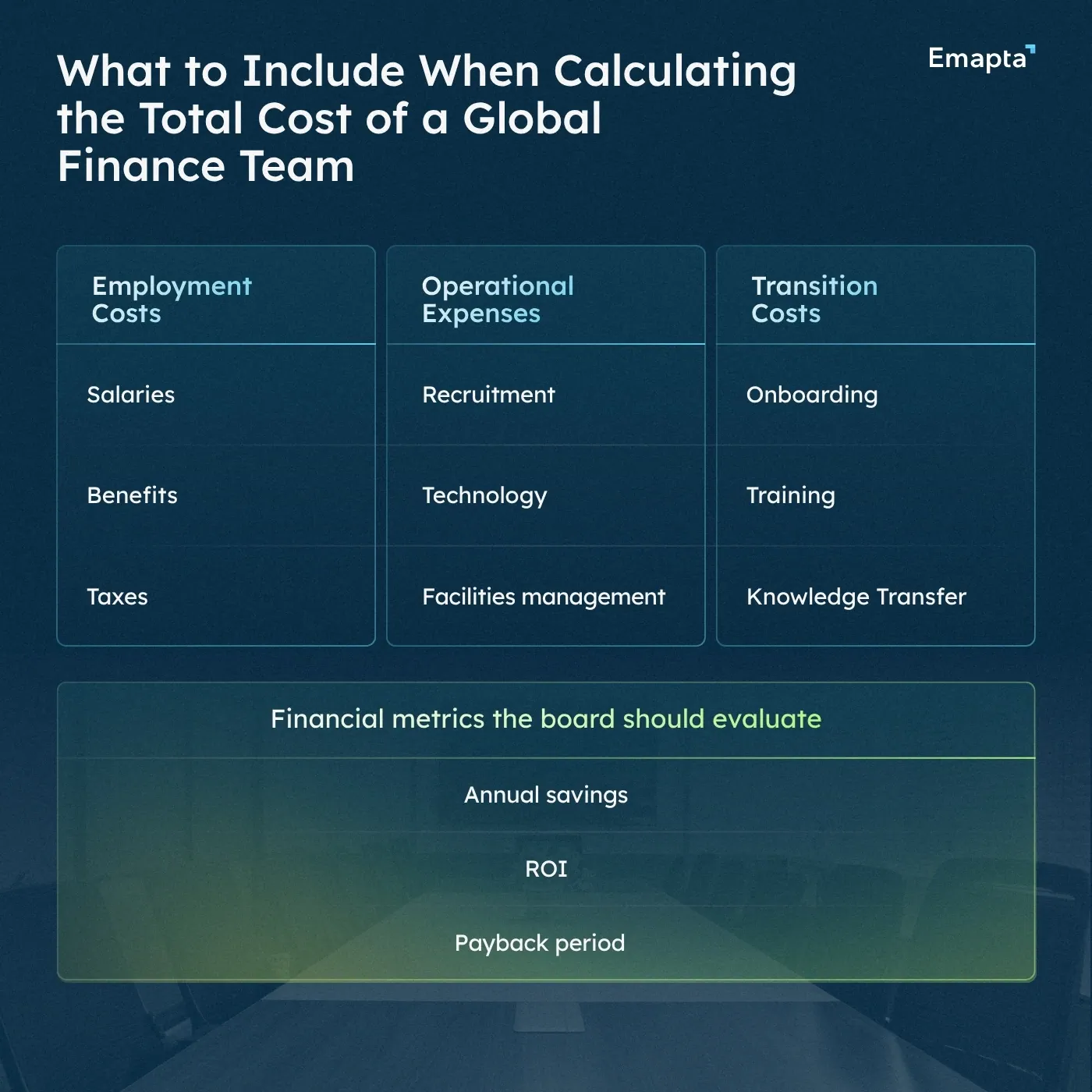
Your board will want more than a comparison of domestic and offshore salaries. Include factors such as:
- Employment costs: Salaries, benefits, taxes, and related obligations.
- Operational expenses: Recruitment, technology, facilities, and management.
- Transition costs: Onboarding, training, knowledge transfer, and temporary productivity losses.
Consider these factors to calculate projected annual savings, return on investment (ROI), and payback periods.
Present conservative and optimistic scenarios to show how the financial return could change if implementation takes longer, or productivity develops more slowly than expected.
2. Are There Hidden Costs or Contractual Commitments?
Lower monthly staffing costs don’t always mean a better financial arrangement. Your board will want to understand the full commitment before approving a new workforce model.
Review your provider’s pricing structure, including salary markups, service fees, recruitment charges, setup costs, and potential annual adjustments.
Contract flexibility matters, too. Confirm minimum terms, termination conditions, and any costs to increase or reduce headcount.
Ask for a complete breakdown of projected costs over at least the first year, including what happens if your business requirements change.
3. Who Will Control Our Finance Operations?
You can maintain direct oversight of your finance function with the right staffing model and governance structure.
Traditional outsourcing generally involves delegating processes to a provider that manages their delivery. With dedicated global staffing, professionals work exclusively for your organization, follow your procedures, and report to your leadership.
Your controller, for example, can continue overseeing reconciliations, approving transactions, and managing financial reporting while employees work overseas.
Before moving forward, establish clear reporting lines, approval responsibilities, escalation procedures, and performance expectations. Your board should understand exactly who remains accountable for financial outcomes.
4. How Will We Maintain Quality and Audit Readiness?
Financial accuracy can be ensured with qualified professionals, consistent processes, and clear performance standards.
Start with recruitment. Consider technical assessments, relevant industry experience, and familiarity with accounting standards and financial systems to determine whether candidates meet your requirements.
Once your offshore accounting team is operating, monitor indicators such as:
- Month-end close timelines
- Reconciliation completion and accuracy
- Financial reporting errors
- Rework and correction rates
Audit readiness also requires documented approvals, segregation of duties, and reliable transaction records.
Apply the same controls to your global team as you do to local employees and involve internal audit in reviewing the arrangement before implementation.
5. How Will We Protect Sensitive Financial Data?
Your board needs to be reassured that the financial information will be protected and that the regulatory requirements can be met.
According to IBM’s 2025 Cost of a Data Breach Report, the average global cost of a data breach was $4.44 million. Although this figure isn’t specific to offshore staffing, it highlights the importance of effective security controls.
When evaluating the risks of finance outsourcing, you need to consider where the data is stored, who can access it, how activity is monitored, and what the incident response plan is.
Review independent assurance reports, including SOC 2 Type II where relevant, and applicable security certifications.
For example, Emapta’s premium dedicated staffing model allows employees to work within clients’ existing systems under client-defined permissions.
Ultimately, your IT, compliance, and finance leaders should verify that the proposed safeguards meet your organization’s requirements.
6. Will Time Zones and Communication Affect Performance?
Working across countries doesn’t have to disrupt financial operations if your team’s schedules and communication processes align with business needs.
Consider your month-end close. If employees need immediate approvals or frequent coordination with your controller, overlapping working hours become important.
Evaluate potential locations based on time-zone alignment, language proficiency, and the availability of finance professionals with the right experience.
You should also establish reporting schedules, communication channels, and escalation procedures.
The objective is to ensure your global team can collaborate effectively without delaying critical financial activities.
7. How Quickly Can We Implement a Global Finance Team?
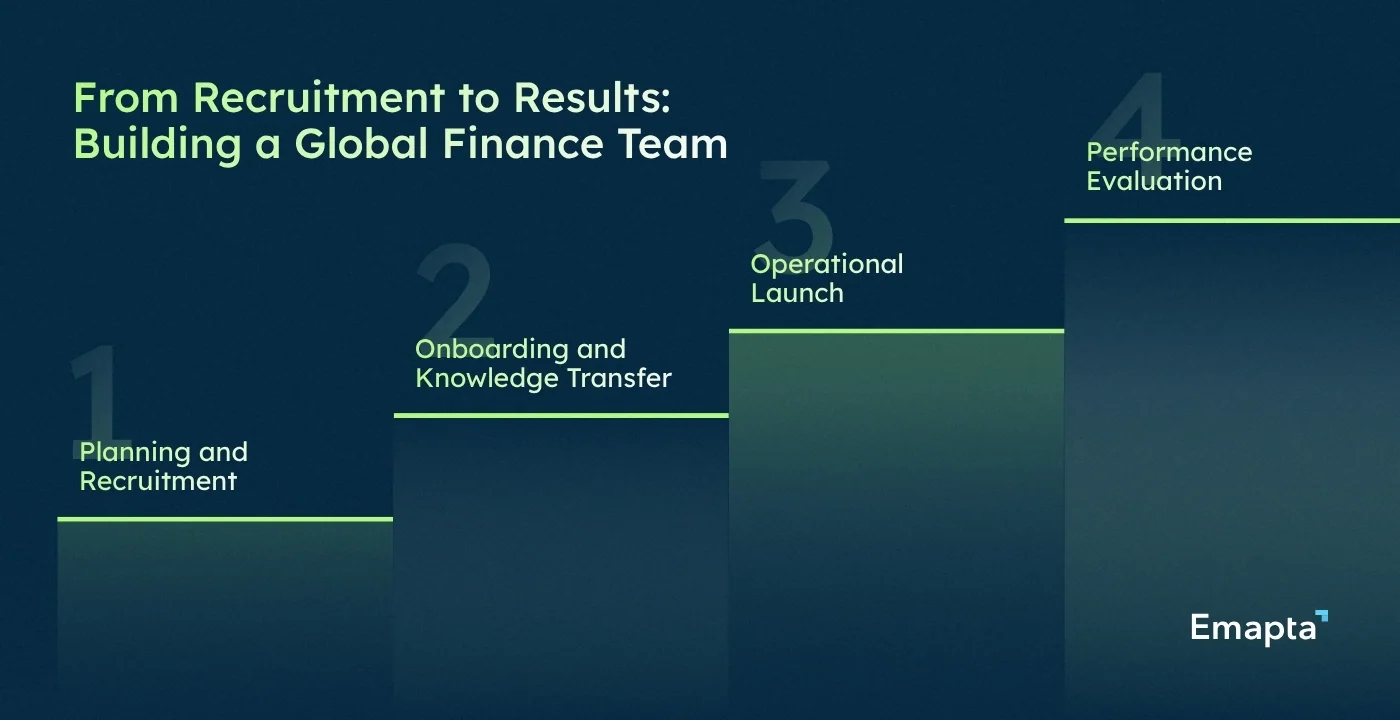
A global finance team may begin operating within weeks, but reaching full productivity and delivering measurable financial returns takes longer.
Emapta, for example, outlines a six-week onboarding framework covering workforce planning, recruitment, and operational launch.
A phased transition can help manage implementation risks. Consider starting with defined processes, such as accounts payable, receivables, or routine reconciliations, before introducing more complex responsibilities.
Set milestones for recruitment, training, operational readiness, and performance. Identify who will approve each phase and how existing operations will continue during the transition.
8. What Happens if Key Team Members Leave?
Employee turnover can affect productivity, reporting schedules, and the continuity of critical finance processes. Your workforce strategy should address these risks from the beginning.
When evaluating a provider, review retention performance, replacement timelines, professional development programs, and succession arrangements. Documented processes and cross-training might help you reduce dependence on individual employees.
Scalability is equally important. Confirm how quickly you can add specialized roles or adjust team size as your business evolves, without compromising quality or operational control.
If you need an actual estimate on the financial impact of employee turnover, Emapta’s CFO Retention Calculator can help you estimate the potential financial impact.
9. How Will We Manage Unexpected Disruptions?
Your global finance staffing arrangement should include a business continuity plan that protects critical processes when operations are interrupted.
An office outage, connectivity failure, or other unexpected event can affect payroll processing, transaction management, and reporting deadlines.
Review your provider’s backup infrastructure, alternative working arrangements, incident response procedures, and recovery capabilities.
Identify which activities are most critical, how long interruptions can be tolerated, and who will coordinate recovery.
Your board should see evidence that continuity procedures are documented, tested, and compatible with your organization’s own plans.
10. Why Is This the Right Decision Now?
Maintaining your current workforce structure may seem safer, but it can also create costs through recruitment delays, limited capacity, and growing workloads.
Before proposing a change, compare the financial and operational implications of:
- Maintaining your current workforce
- Expanding through global finance staffing
- Increasing efficiency through automation and process improvements
These approaches can work together. What matters is identifying which combination best supports your business priorities, available resources, and long-term growth.
Your Board Readiness Shortlist
Before presenting your proposal, use this quick-reference checklist to confirm that you have the evidence needed to address each question.
| Board question | Evidence to bring to the board |
|---|---|
| 1. What is the financial return? | Three-year cost projections, ROI assumptions, expected savings, and payback analysis. |
| 2. Are there hidden costs or contractual commitments? | Itemized cost breakdown, pricing terms, contractual obligations, and exit conditions. |
| 3. Who controls operations? | Governance structure, reporting lines, approval matrix, and accountability framework. |
| 4. How is quality and audit readiness maintained? | Finance KPIs, internal controls, audit procedures, and performance monitoring plans. |
| 5. How is sensitive financial data protected? | Security assurance reports, access controls, compliance requirements, and incident response procedures. |
| 6. Will time zones and communication affect performance? | Working-hour overlap, communication protocols, reporting schedules, and escalation procedures. |
| 7. How quickly can the team be implemented? | Implementation timeline, recruitment, and onboarding milestones, and expected time to productivity. |
| 8. What happens if key team members leave? | Retention metrics, replacement procedures, knowledge transfer plans, and scaling capabilities. |
| 9. How will unexpected disruptions be managed? | Business continuity plan, recovery procedures, backup infrastructure, and evidence of testing. |
| 10. Why is this the right decision now? | Cost-of-inaction analysis, workforce capacity assessment, and comparison of alternative solutions. |
Use this shortlist to identify missing information, involve the right stakeholders, and validate your assumptions before the board meeting.
Build a Business Case Your Board Can Stand Behind
A successful workforce decision requires financial justification, defined operational responsibilities, and appropriate risk controls.
These questions can help you prepare a proposal that addresses your board’s concerns without overlooking the practical implications of implementation.
Ready to evaluate the financial opportunity?
Before taking your proposal to the board, establish the financial case for building global finance teams. Use Emapta’s CFO Workforce ROI Calculator to estimate potential savings and start building a business case grounded in your organization’s workforce costs.