

Nearshore vs Offshore Outsourcing – Which Is Better for U.S. Companies
Choosing between nearshore VS offshore outsourcing is about how your team will work, not just about geography.
If your outsourced employees need to collaborate with in-house teams during the day, time zone alignment is important. And if the work is standardized, independent, or can benefit from overnight coverage, a more distant location might can work just as well.
Neither model is universally better and the right choice will depend on the role, collaboration needed, talent available, operating hours, and total cost.
So, if you’re unsure of which option to choose, here’s a guide to help you pick the best model for your business.
Nearshore vs Offshore Outsourcing – Key Takeaways
- Choose nearshore outsourcing when real-time collaboration and U.S. workday overlap are important
- Choose offshore outsourcing when scale, specialized talent, cost efficiency, or extended coverage matter more
- Compare total operating cost, not only salary or hourly rates
- Match the location to the role and workflow
- Many companies can benefit from combining both models
What Is Nearshore Outsourcing?
Nearshore outsourcing means hiring an external team in a nearby country, usually with minimal time-zone differences. For U.S. companies, nearshore outsourcing to Latin America often includes markets such as Colombia, Mexico, the Dominican Republic, Brazil, and Argentina.
Its main strategic advantage is alignment. Nearshore teams can work during the same hours as your internal employees, which makes meetings, approvals, customer interactions, and fast feedback easier to manage.
What Is Offshore Outsourcing?
Offshore outsourcing means building or hiring a team in a more distant country, usually with a larger time-zone difference. Common offshore destinations for the U.S. include the Philippines, India, Sri Lanka, or Vietnam.
Its strategic advantage is coverage. Established offshore hubs often combine large talent pools with mature outsourcing infrastructure and deep expertise across technology, finance, customer operations, engineering, and other specialized functions.
5 Key Differences Between Nearshore and Offshore Outsourcing
| Factor | Nearshore | Offshore |
|---|---|---|
| Time-zone overlap | Usually high | Minimal overlap |
| Cost | Competitive vs U.S. hiring | Often more significant cost savings |
| Collaboration | Strong real-time overlap | Strong asynchronous or extended-hour coverage |
| Talent access | Strong regional talent pools | Large, mature global talent pools |
| Operating model | Collaborative, integrated work | Scale, specialization, standardized work |
1. Time-zone overlap
This is usually the clearest difference between nearshore vs offshore outsourcing models.
Nearshore teams can often join meetings, respond to requests, and work alongside U.S. employees during the same business day. That matters in roles where decisions depend on frequent interaction.
Offshore teams may require schedule adjustments, but they can also extend operations beyond normal U.S. hours.
2. Cost
Offshore outsourcing can offer stronger direct labor savings in many roles. But the lowest rate does not automatically create the lowest total cost.
Communication delays, additional management time, rework, shift premiums, and slower approvals can all affect the final economics of a team.
That is why cost comparisons should include how the work will actually operate, not just what each employee costs.
3. Collaboration
The more frequently a role interacts with U.S. colleagues, clients, or leadership, the more valuable time-zone overlap can become.
This is one reason nearshore outsourcing for U.S. companies is often attractive for software development, finance, recruiting, customer success, sales support, marketing, and other collaborative functions.
Research into geographically distributed software teams has also found advantages for nearshore arrangements in communication-intensive projects, including lower coordination effort and fewer communication problems.
4. Talent access
Talent availability can be one of the strongest arguments for offshore outsourcing.
Large offshore hubs such as the Philippines and India have built mature outsourcing ecosystems over decades, giving companies access to deep talent pools across customer operations, finance, technology, IT, engineering, and shared services.
That depth can make it easier to hire at scale, add specialized capabilities, and expand teams without depending on a single local market.
Nearshore markets also offer strong professional and technical talent, but their advantage is often more targeted. For U.S. companies, they can provide access to skilled teams that combine relevant capabilities with closer time-zone alignment and easier day-to-day collaboration.
The practical takeaway is simple: when it comes to nearshore vs offshore, offshore can offer greater talent depth and scale, while nearshore can offer a stronger fit when the right skills also need to work closely with U.S. teams.
5. Operating model
Teams have different needs when it comes to collaboration. Some teams thrive on continuous interaction, while others perform best with clear processes and the ability to work independently.
For example, a customer success team in Colombia can effectively communicate with U.S. clients throughout the day due to the similar time zones.
In contrast, a transaction-processing team in the Philippines, designed to follow established workflows, may operate even more efficiently than a nearshore team despite being +10 hours away.
Therefore, the decision about the team’s location should begin with an understanding of the specific tasks required and how they align with one of these operational models.
When Should U.S. Companies Choose Nearshore Outsourcing?
Choose nearshore when the role depends heavily on collaboration during U.S. business hours.
It is particularly useful when your team needs:
- Frequent meetings and live feedback
- Direct customer or stakeholder interaction
- Rapid approvals and problem solving
- Agile or highly collaborative workflows
- Easier travel between your U.S. and outsourced teams
Nearshore is also useful when you want outsourced employees to feel closely integrated into your existing operation rather than functioning as a separate delivery unit.

When Should U.S. Companies Choose Offshore Outsourcing?
Choose offshore when your priorities include scale, deep specialist talent, cost-efficient growth, or operations that benefit from extended or around-the-clock coverage.
It can be a strong fit when you need:
- Large pools of specialized talent
- Mature outsourcing ecosystems
- Rapid team expansion
- Overnight or 24/7 coverage
- Standardized or independently managed workflows
- Stronger labor cost advantages
Many U.S. companies already use offshore teams as part of broader workforce strategies to strengthen customer service, improve performance, and extend coverage.
Which Roles Work Best for Nearshore and Offshore Teams?
There is no strict rule that specialized roles belong nearshore and transactional roles belong offshore. Both nearshoring vs offshoring models can support high-skill work. The more useful distinction is how each role operates.
| Nearshore | Offshore | Works Well in Both |
|---|---|---|
| Customer Success | Data Processing | Software Development |
| Recruiting & HR | Accounts Payable & Receivable | Technical Support |
| Sales Support | Bookkeeping | Finance & Accounting |
| Marketing Support | QA & Software Testing | Customer Service |
| Project & Business Analysis | Administrative Operations | IT Support |
The best location is the one that gives the role the right combination of talent, schedule, cost, and communication.
How to Choose Between Nearshore and Offshore Outsourcing
Before choosing a destination, ask five questions:
- How often must this role communicate with your U.S. team?
- Does the work need rapid feedback or independent execution?
- Do you need U.S. hours coverage, overnight coverage, or both?
- Which market has the strongest talent for the specific role?
- What is the total operating cost once management and coordination are included?
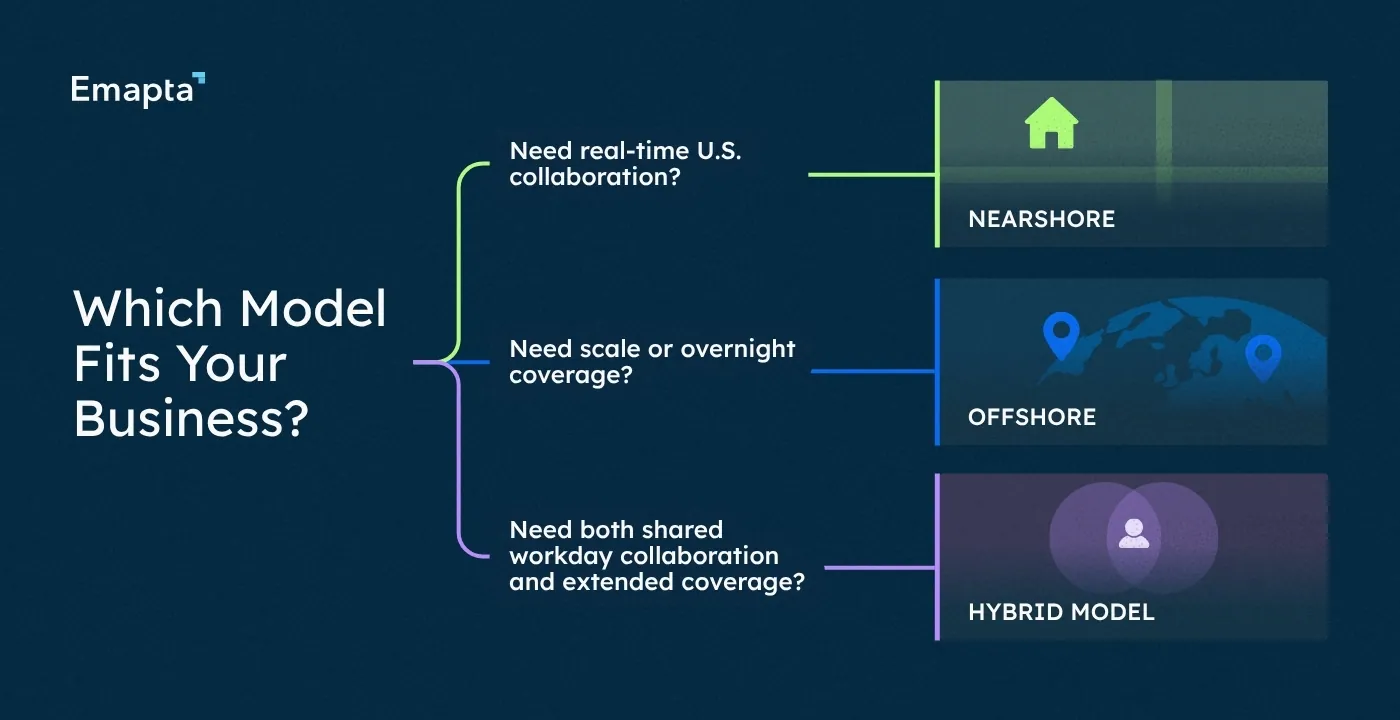
The answers to those questions will usually make the right model much clearer. But here’s the greatest takeaway of this blog: you do not have to choose only one model.
A company could use a nearshore customer success team during U.S. hours and an offshore technical team overnight. Finance analysts could work from Latin America while standardized processing happens in another region.
The result can be a connected global workforce, with each team positioned where it can deliver the most value.
Why Latin America Is a Leading Nearshore Destination for U.S. Companies
Nearshore outsourcing in Latin America has become increasingly attractive because it combines proximity to the U.S. with a growing pool of professional and technical talent. The region is also moving beyond its traditional association with contact centers.
In Colombia, global business services teams now support functions including finance, technology, HR, data analytics, procurement, and automation.
The Dominican Republic talent hub has also expanded beyond customer service to a specialized professionals market. Official sources highlight capabilities across back-office operations, software and web development, technical support, and other business services.
The point is not that nearshore outsourcing in Latin America should replace established offshore destinations. It simply gives U.S. companies more ways to match each role with the right operating model.
Conclusion
Nearshore offers closer time-zone alignment, easier collaboration, and stronger integration with U.S. teams. Offshore provides deeper talent pools, mature delivery ecosystems, extended coverage, and often greater cost advantages.
The right choice in the nearshore vs offshore outsourcing decision depends on the role, workflow, and business priorities.
For many companies, the best option is a combination of both, using nearshore where collaboration matters most and offshore where scale, specialization, or extended coverage adds more value.
Frequently Asked Questions (FAQ)
Nearshore outsourcing uses teams in geographically closer countries, usually with stronger U.S. time-zone overlap. Offshore outsourcing uses more distant markets, often with larger time differences and broader opportunities for scale, cost savings, and extended-hour coverage.
Not necessarily. Offshore markets often provide lower direct labor costs. However, the better comparison is total operating cost, including management effort, communication, rework, shift requirements, and productivity.
Neither model is always better. Nearshore works well for collaboration-heavy roles, while offshore can be stronger for scale, specialized talent, standardized processes, and extended coverage.
Yes. Many companies can use nearshore teams for U.S. hours collaboration and offshore teams for specialized, standardized, or overnight work. A hybrid model lets each function operate from the location that best supports it.