

9 Finance and Accounting Outsourcing Mistakes to Avoid
Finance and accounting outsourcing mistakes can turn what should be extra support into another problem for you to manage.
Maybe your team is stretched, reporting is slowing down, or you need skills you do not have in-house. Outsourcing can help, but only if you are clear about what to move, who should handle it, and how the relationship will work.
Today, we will take a look at the most common mistakes to avoid so you can add finance capacity without losing visibility, quality, or control.
Finance Outsourcing Mistakes – Key Takeaways
- Know what problem you need outsourcing to solve
- Choose expertise and reliability over the lowest price
- Set clear processes, controls, and accountability from the start
- Build a model that can grow with your business
9 Finance and Accounting Outsourcing Mistakes to Avoid
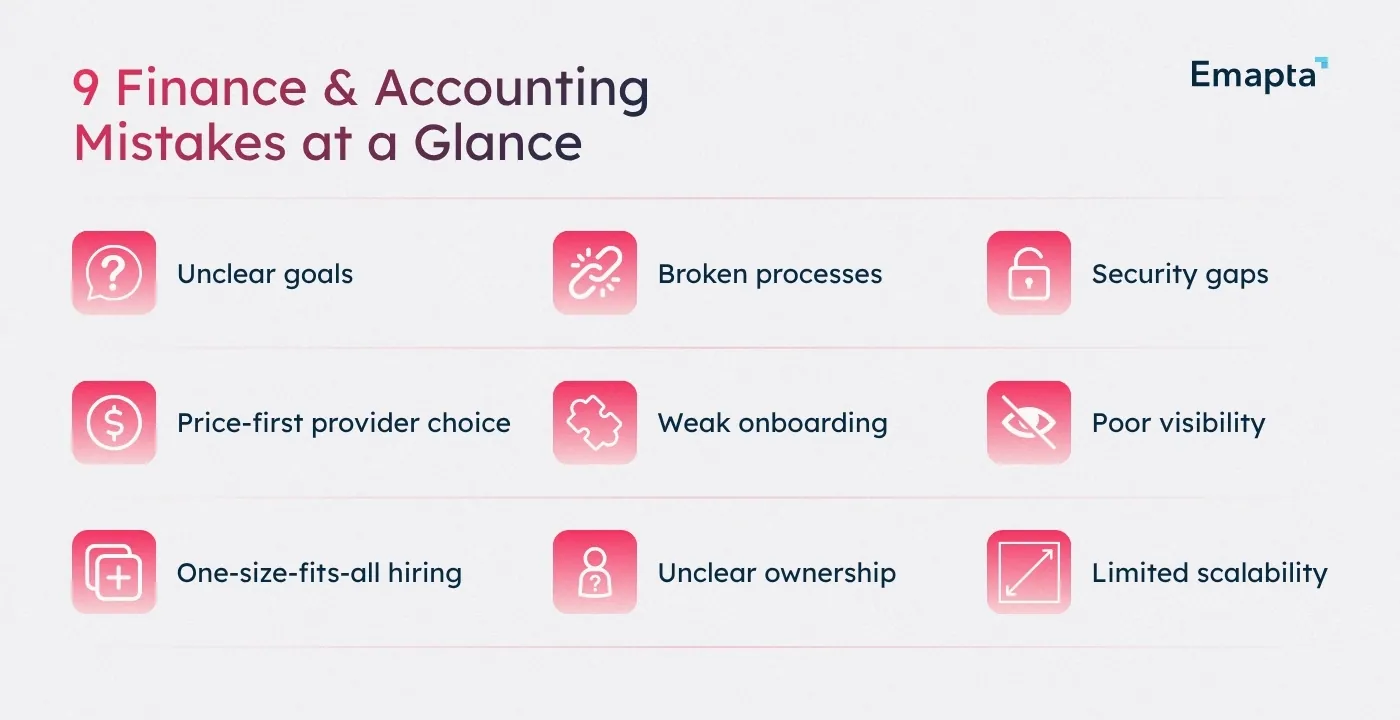
Most mistakes come from weak planning, and the biggest risks usually involve scope, provider selection, team design, processes, onboarding, security, visibility, and scalability.
Address these 9 challenges early, and outsourcing will make your finance function far easier to manage.
1. Outsourcing Without Knowing What You Want to Fix
Before you outsource, define the problem you want to solve. A slow close, reporting gaps, transactional overload, and missing specialist skills all require different solutions.
Ask where the pressure is coming from. Are reports late? Are reconciliations piling up? Is your controller spending too much time on repetitive work?
Then define what success should look like, such as:
- Shorter month-end close
- Fewer reconciliation backlogs
- Faster reporting
- More AP or AR capacity
- Access to specialist finance skills
- More time for senior staff to focus on analysis
When you start with the outcome, the right team structure becomes much easier to identify.
2. Choosing a Provider Mainly Because It’s Cheaper
Cost matters, but it should not make the decision for you. A low rate can become expensive if your internal team spends too much time correcting work, chasing answers, or supervising avoidable issues.
Compare providers on:
- Accounting expertise
- Industry experience
- Quality controls
- Technology
- Data security
- Management structure
- Scalability
One of the biggest finance outsourcing mistakes is asking only, “Who costs less?” A better question is, “Who has the most proven expertise in solving our specific problem?”
3. Expecting One Person to Solve Every Finance Problem
One person will rarely cover every finance need as your business grows. You need different skills across reconciliations, reporting, forecasting, analysis, compliance, or audit support.
Start by mapping the work. Then separate recurring transactional tasks from responsibilities that need deeper expertise.
Your requirements may span bookkeeping, AP/AR, month-end close, reporting, forecasting, financial analysis, and controller support.
Building around the work helps you avoid hiring one generalist only to discover that important skill gaps remain.
4. Handing Over a Broken Process
Fix and document the process before outsourcing it. Unclear responsibilities or reporting standards are among the easiest finance and accounting outsourcing mistakes to avoid. Outsourcing a broken process doesn’t solve these issues. It simply moves the confusion elsewhere.
Before transition, document:
- Who prepares, reviews, and approves each task
- Required systems and access
- Deadlines and reporting formats
- Escalation procedures
- Approval thresholds
- Key controls and KPIs
Understanding how finance and accounting outsourcing works can also help you decide which repeatable processes to move, and which responsibilities should remain internal.
5. Treating Onboarding as a System Login
Good onboarding helps outsourced professionals understand your business, not just your software. This is one of the biggest accounting outsourcing mistakes most companies make.
They need to know your workflows, priorities, deadlines, escalation paths, and common exceptions. Without that context, even skilled accountants can struggle to perform effectively.
Talent creates more value when considered as an extension of your finance and accounting team, rather than a separate group waiting for instructions.
6. Failing to Assign Clear Internal Ownership
Someone inside your business should clearly own the outsourcing relationship. Without that ownership, decisions can stall, escalations can get lost, and priorities can drift.
Your internal owner should:
- Make or coordinate key decisions
- Handle escalations
- Review performance and KPIs
- Keep priorities aligned
- Connect the outsourced team with internal stakeholders
The goal is to keep the relationship accountable, aligned, and moving in the right direction.
7. Assuming Security Is the Provider’s Problem
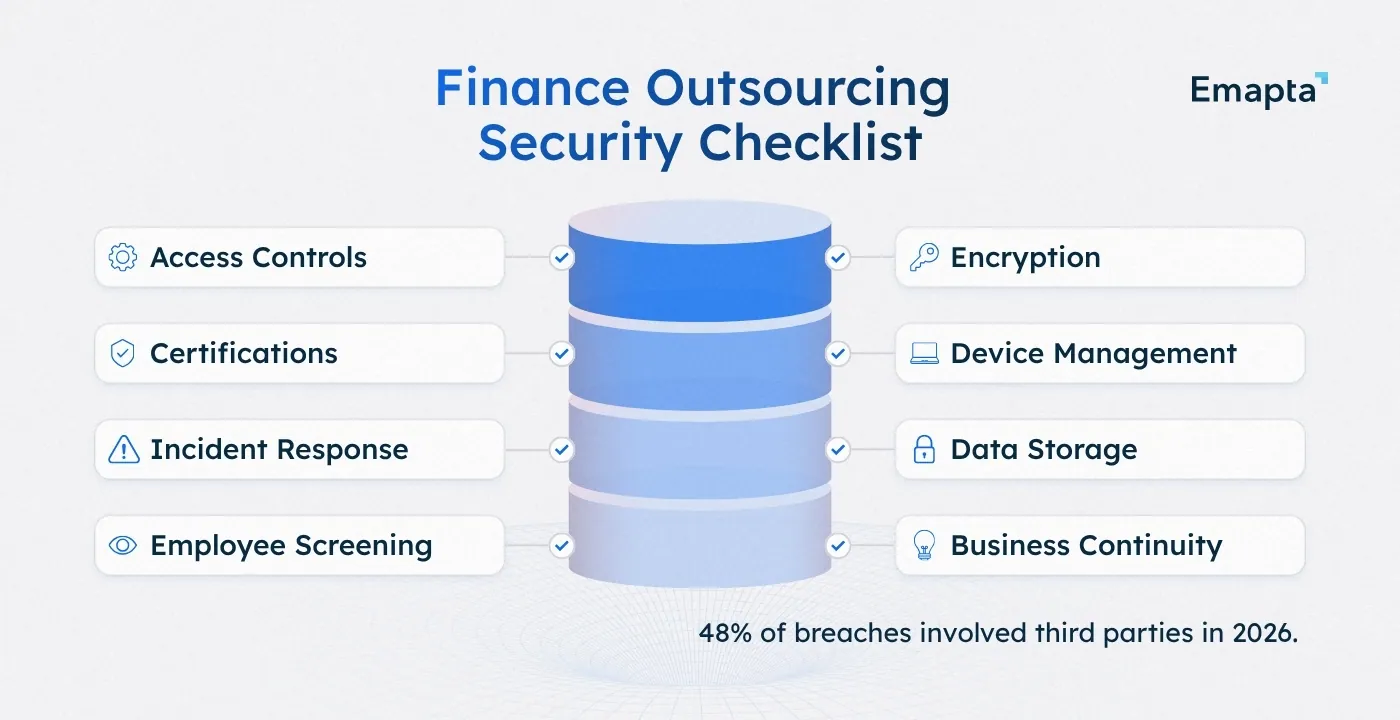
Treat data security as a shared responsibility from day one. If a provider will handle banking data, payroll records, invoices, tax information, or credentials, you need to know exactly how those assets are protected.
To prevent a breach, thoroughly review these factors before granting access to any provider:
- Access controls
- Encryption
- Security certifications
- Device management
- Incident response
- Data storage
- Employee screening
- Business continuity
If you operate in a regulated environment, it’s important to assess accounting outsourcing solutions that address compliance, controls, and continuity.
8. Outsourcing the Work and Losing Sight of It
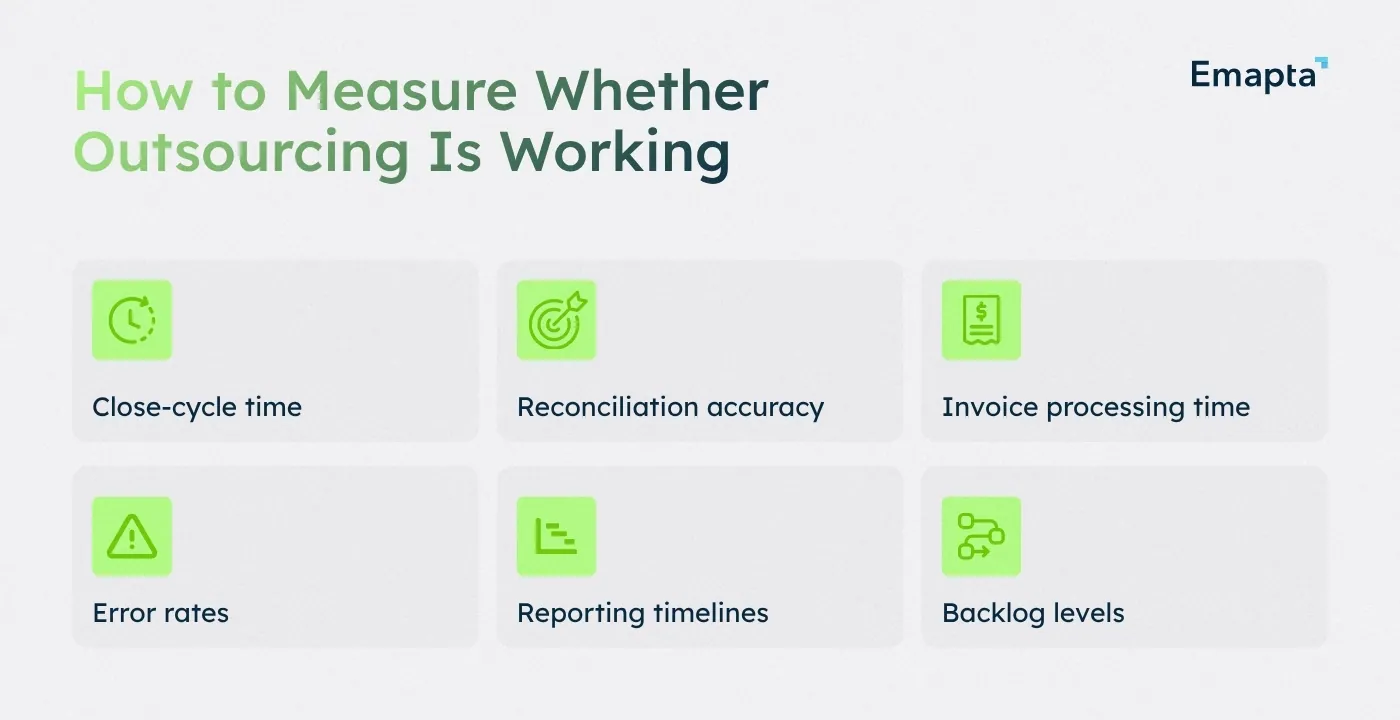
Outsourcing should give you more visibility, not less. You still need KPIs, reporting, regular reviews, escalation paths, and internal ownership.
Track measures that show whether performance is actually improving, such as:
- Close-cycle time
- Reconciliation accuracy
- Invoice processing time
- Error rates
- Reporting timeliness
- Backlog levels
The goal is to make sure you can identify problems early and see whether outsourcing is delivering the result you expected.
9. Building for Today’s Workload Only
Build for the business you’re planning to become, not only the workload you have today.
New markets, acquisitions, higher transaction volumes, or additional reporting requirements can quickly stretch a team designed too narrowly.
That long-term view is becoming more common: 80% of executives plan to maintain or increase investment in finance and accounting outsourcing.
This suggests businesses are increasingly treating outsourcing as an ongoing part of how they scale finance operations, not simply as a short-term response to workload pressure.
Wrapping Up
The best way to avoid finance and accounting outsourcing mistakes is to treat outsourcing as a change to how your finance function works, not simply a transfer of tasks.
Start with the right problem, choose the right provider, document your processes, protect your data, and keep visibility over performance.
Get those fundamentals right, and outsourcing can give your finance leaders more capacity for analysis, planning, and better decisions without creating another problem to manage.
Frequently Asked Questions
The 5 most common types of accounting errors are errors of omission, errors of commission, errors of principle, errors of original entry, and compensating errors. They occur when transactions are missed, recorded incorrectly, classified wrongly, entered at the wrong value, or offset by another error.
Common bookkeeping mistakes include failing to reconcile accounts, mixing business and personal expenses, misclassifying transactions, duplicating entries, losing receipts, and recording transactions too late.
Bad bookkeepers tend to have recurring problems such as late records, unexplained discrepancies, weak documentation, poor communication, missing reconciliations, or an inability to explain the sources of financial figures.
Current major issues in accounting include talent shortages, AI and automation, cybersecurity risks, faster reporting expectations, and increasingly complex compliance requirements.