

6 Employer of Record Benefits – Pros, Cons & Use Cases
The essential Employer of Record benefits involve improved compliance, reduced legal risks, faster hiring that is often within 2 to 5 days, and a lower expansion cost, which can be cheaper by up to 40%.
And with an EOR, your company gets access to local tax, payroll, and administration benefits in any country. Let’s dive into the details and see how you can fully benefit by using Employer of Record services.
EOR Benefits Key Takeaways
- An EOR speeds up international hiring by allowing companies to employ talent without first opening a local entity
- Local payroll, contracts, benefits, and compliance support reduce pressure on internal HR, finance, and legal teams
- Businesses gain access to a wider talent pool based on skills, language, location, and time-zone needs
- Choosing the right provider is essential, as costs, service quality, security, and employee support can vary
What Are the Main Benefits of an Employer of Record?
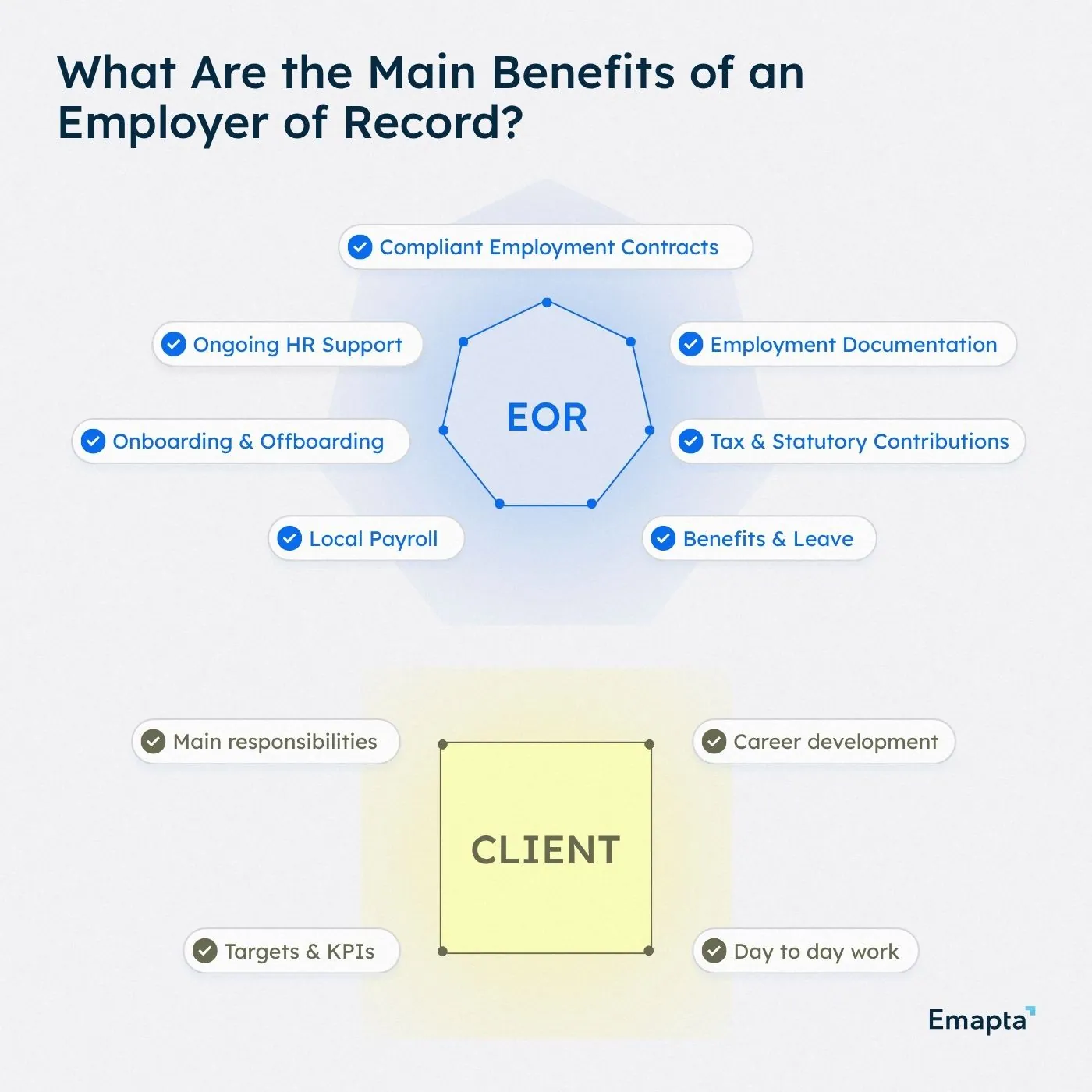
Some of the main benefits of using this hiring model include faster market entry, local employment support, and the ability to hire internationally without creating a subsidiary first.
An EOR usually manages:
- Locally compliant employment contracts
- Payroll in the employee’s local currency
- Tax withholding and statutory contributions
- Mandatory benefits and leave
- Employee onboarding and offboarding
- Local employment documentation
- Ongoing HR administration
Meanwhile, your business continues to manage the employee’s responsibilities, targets, development, and daily work.
This division allows you to build an international workforce without creating separate payroll, legal, and HR systems in every country.
6 Vital Employer of Record Benefits
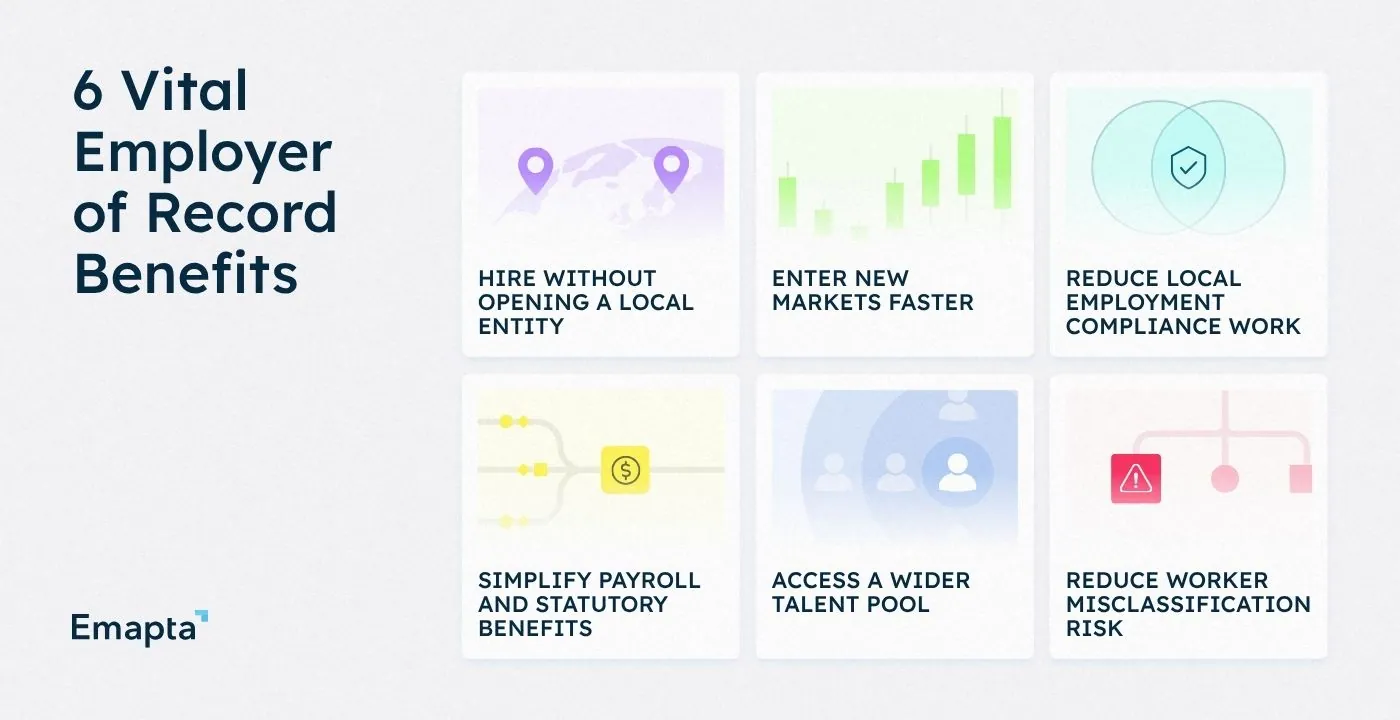
As you learn how to use an EOR successfully, the real value lies in what becomes possible. This includes entering new markets with less friction, building global teams sooner, and redirecting internal resources toward growth instead of administration.
The following benefits of EOR show how the model can give your business a competitive advantage, not simply another way to hire.
1. Hire Without Opening a Local Entity
An EOR allows you to employ people in a new country without immediately registering a subsidiary or branch.
Opening an entity may require corporate registration, tax accounts, banking, payroll systems, local advisers, employment policies, and recurring reporting. An EOR already has the employment structure needed to support your hire.
This can be particularly useful when you want to:
- Make your first hire in a country
- Retain an employee who is relocating
- Test demand in a new market
- Place a specialist closer to customers
- Build a small team before making a larger investment
2. Enter New Markets Faster
One of the clearest EOR business benefits is speed. You can begin recruiting and onboarding without waiting for every part of a local operation to be established.
This matters when you need to fill an urgent role or a strong candidate may not remain available for long. Entity-setup delays can lead to lost talent, slower market entry, and added pressure on your existing employees.
The model also gives you a more flexible way to explore global talent hubs before committing to a long-term location strategy.
3. Reduce Local Employment Compliance Work
Every country has its own rules covering contracts, minimum pay, probation, working hours, leave, notice periods, termination, and statutory contributions.
An EOR applies the relevant local requirements to the employment relationship. This reduces the need for your internal teams to interpret and manage every employment rule independently.
The benefits of Employer of Record services may include support with:
- Contract preparation
- Payroll deductions
- Mandatory leave
- Social security registration
- Employment tax filings
- Statutory benefits
- Compliant termination processes
However, you should still review how the provider operates in each country. Local expertise, licensing, service coverage, and employment structures can vary between providers.
4. Simplify Payroll and Statutory Benefits
Running international payroll requires more than converting a salary into another currency.
The employer must calculate wages, withhold taxes, make required contributions, issue payslips, manage leave, and meet local filing deadlines. An EOR brings these activities into one employment process.
The social security benefits of using an Employer of Record can include properly managed pension, healthcare, unemployment, insurance, and other mandatory contributions.
This gives employees a clearer local employment experience while reducing the number of payroll vendors and advisers your business must coordinate.
5. Access a Wider Talent Pool
One of the biggest EOR benefits is that it allows you to recruit according to skill, language, experience, customer proximity, and time-zone coverage rather than existing office locations.
That reach becomes even more valuable as your workforce needs change. AI, big data, cybersecurity, analytical thinking, resilience, leadership, and collaboration are among the capabilities shaping workforce demand through 2030.
An EOR helps you search for those skills across a broader talent pool rather than limiting recruitment to locations where your business already operates.
6. Reduce Worker Misclassification Risk
Hiring an international worker as an independent contractor may appear simpler, but the arrangement must reflect how the person actually works.
A contractor relationship may become risky when your business controls the worker’s schedule, processes, tools, responsibilities, and ongoing performance as it would for an employee.
This matters because workers treated incorrectly as contractors may lose access to wage, overtime, and other employment protections.
One of the most practical benefits of using an EOR is access to a formal employee structure when contractor status would not accurately reflect the relationship.
This can help provide:
- A local employment contract
- Statutory worker protections
- Tax withholding
- Mandatory benefits
- Formal leave entitlements
- More reliable payroll
An EOR does not eliminate every classification or tax question, but it provides a clearer employment route for roles that function as regular employment.
3 Important Employer of Record Disadvantages
Now that we’ve seen the biggest benefits from partnering with an EOR provider, let’s take a look at some of the disadvantages your business may face from using this hiring model.
1. Costs Can Increase as the Team Grows
EOR pricing may be practical for your first hires or a small team. However, recurring per-employee fees can become less economical as your headcount increases.
As your operation grows, establishing your own entity or adopting a different staffing structure may eventually become more economical.
2. Service Quality Depends on the Provider
You rely on the EOR for payroll accuracy, local documentation, employee support, benefits administration, and regulatory updates.
Data security is another important consideration. The IBM Cost of a Data Breach Report 2025 placed the global average cost of a breach at approximately USD 4.4 million, reinforcing the importance of choosing a provider with robust data security policies, recognized security certifications, and appropriate controls for protecting sensitive employee and business information.
3. You Still Own the Employee Experience
An EOR handles legal employment. It does not replace good management.
Your business remains responsible for onboarding, communication, workload, development, culture, recognition, and performance. Employees may feel disconnected when your business treats the EOR as their manager rather than as the employment provider.
PEO vs. EOR vs. CBA
EOR, Professional Employer Organization (PEO), and Contractor-Based Arrangements (CBA) support different workforce relationships. The following CBA vs PEO vs EOR group benefits comparison can help you identify which model best fits your hiring needs.
| Factor | EOR | PEO | CBA |
|---|---|---|---|
| Legal relationship | EOR is the legal employer | Client and PEO share employer responsibilities | Worker remains independent |
| Local entity required | Usually no | Usually yes | Usually no |
| Payroll | Managed by EOR | Managed with PEO support | Contractor submits invoices |
| Benefits | Local statutory benefits | Often includes group benefits | Usually managed by contractor |
| Best fit | International employees where no client entity exists | Companies with an existing entity that need HR support | Independent, project-based work |
| Main advantage | Fast international employment | HR and benefits administration | Flexibility |
| Main risk | Provider dependence and recurring fees | Shared responsibility and entity requirement | Worker misclassification |
Choose an EOR When
- The worker should be an employee
- Your business has no local entity
- You need to hire quickly
- You are testing a new market
- You need local payroll and compliance support
Choose a PEO When
- Your business already has a legal entity
- You need payroll, HR, and benefits support
- A co-employment relationship is suitable
- Your workforce is concentrated in an established market
Choose a CBA When
- The work is genuinely independent
- The engagement has a defined scope
- The contractor controls how the work is performed
- The relationship does not function like permanent employment
Wrapping Up
Global hiring brings added complexity, from payroll and compliance to worker classification and employee experience.
Understanding the relevance of the hiring model and the numerous Employer of Record benefits can help you to choose the right provider, who can assist you manage these challenges without slowing growth.
With the right support, you can build remote teams faster, access stronger talent, and maintain greater control over performance, culture, and long-term expansion.