
7 Headcount Planning Mistakes Enterprise Companies Should Avoid
Headcount planning mistakes can drain an enterprise budget long before anyone spots them in a quarterly review.
In large organizations, one misjudged hiring wave can ripple across dozens of teams, locations, and cost centers. Most of these errors come from process gaps rather than poor intent: siloed decision-making, rigid annual plans, and forecasts built on last year’s numbers.
Today, we will walk you through 7 of the most common mistakes enterprise companies make, explains why they happen, and shows how to build a headcount planning process that keeps hiring aligned with strategy, budget, and growth.
Key Takeaways
- Enterprise headcount planning works best as a shared exercise across human resources (HR), Finance, and business leaders
- Rolling forecasts and milestone-based hiring adapt faster than fixed annual targets
- Accurate forecasts start from business goals and total employee cost, not last year’s headcount or base salary alone
- Monthly tracking of variance, attrition, and skills gaps helps prevent overhiring
- Flexible workforce models give enterprises room to scale without locking in fixed costs
What Is Enterprise Headcount Planning?
Enterprise headcount planning is the process of forecasting how many people a large organization needs, in which roles and locations, and at what cost, to deliver on its business goals. It connects hiring decisions to revenue targets, operating budgets, and long-term strategy.
At the enterprise level, the process covers far more than open requisitions. It includes current headcount, planned backfills, attrition forecasts, contractor and outsourced roles, and the skills each function will need over the next one to three years. Done well, headcount planning and analysis gives HR, Finance, and business leaders a single, trusted view of the workforce.
Why Does Headcount Planning Fail in Large Organizations?
Scale is the main reason. A plan that works for a 50-person company struggles when it has to account for thousands of employees across multiple business units, countries, and cost centers.
At that size, data lives in disconnected systems, decisions pass through more layers of approval, and priorities shift faster than annual plans can keep up. Small planning errors become costly ones, and the seven mistakes below are how they usually play out.
7 Headcount Planning Mistakes Enterprise Companies Should Avoid
Each of these is common in enterprise workforce planning, and each one points to a practical way forward your teams can start using right away.
1. Treating Headcount as an HR-Only Exercise
When HR builds the headcount plan alone, Finance reviews requests without full context, and business leaders approve roles without seeing the long-term budget impact. Each hire turns into a negotiation, and overruns tend to surface late.
A stronger headcount planning strategy treats the plan as a shared input from the start. When HR, Finance, and functional leaders work from one model with clear accountability for budget, approvals, and hiring priorities, decisions move faster and alignment holds.
2. Locking In a Rigid Annual Plan
Annual plans assume the year will unfold as expected, but revenue shifts, attrition changes, and priorities move. As a result, teams either overhire against outdated targets or freeze roles just as momentum builds.
If you’re working out how to avoid overhiring, rolling forecasts and milestone-based hiring gates are a good place to start. By tying each hiring wave to a business signal, such as a revenue target, product launch, or pipeline threshold, and reviewing the plan at least every quarter, you can keep hiring in step with actual performance.
3. Forecasting From Historical Data Alone
Last year’s headcount shows what happened, not what the business needs next. Carrying historical numbers forward ignores new products, automation, market expansion, and changes in productivity, which makes it one of the most common headcount planning mistakes in large organizations.
Knowing how to forecast headcount accurately starts with working backward from business goals. Once you define the revenue or output target, you can estimate the capacity required, adjust for productivity, ramp-up time, and expected attrition, and then test the plan against best-case, likely, and worst-case scenarios.
4. Underestimating the Full Cost of Each Employee
Budgeting on base salary alone makes a plan look affordable on paper. The real cost includes benefits, payroll taxes, bonuses, equity, equipment, software, and recruiting spend. According to the U.S. Bureau of Labor Statistics (BLS), benefits made up 30% of total employer compensation costs for private industry workers in June 2026.
Recruiting adds to that total. Recruiting adds to that total. According to the Society for Human Resource Management’s (SHRM) 2025 Recruiting Benchmarking report, the median cost per hire was $1,200 for nonexecutive roles and $10,625 for executive roles in 2025.
That’s why accurate headcount budget planning depends on a total cost of employment model applied to every request. Building in location-based adjustments for teams in different markets keeps the numbers realistic and helps Finance trust the plan.
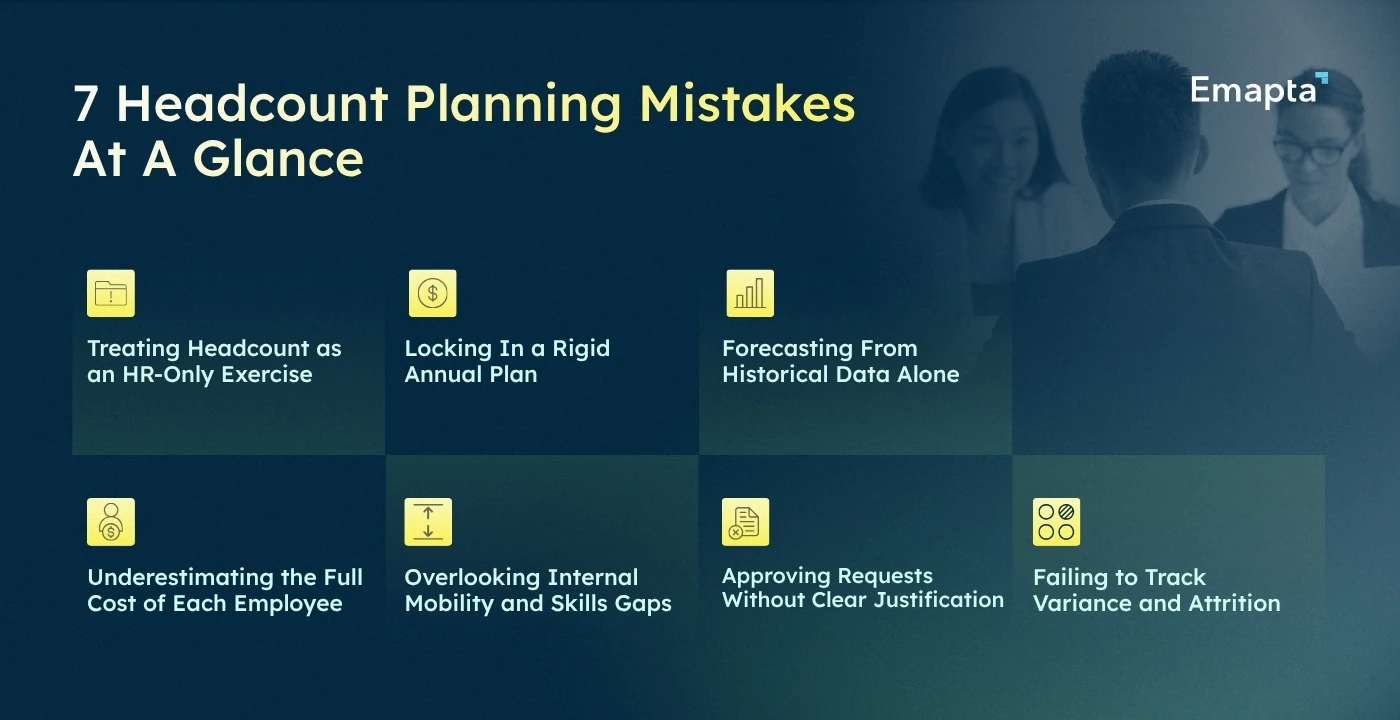
5. Overlooking Internal Mobility and Skills Gaps
Defaulting to external hiring overlooks capability that already exists in the business. Filling org chart gaps instead of skills gaps can also lead to the wrong hires, such as adding a generalist when the team actually needs a data specialist.
Running a skills gap analysis at least twice a year helps you see which gaps can be closed through upskilling and which truly require new hires. Giving internal candidates first look at open roles lowers hiring costs and improves retention, and it sits at the heart of a broader workforce transformation strategy.
6. Approving Requests Without Clear Justification
Requests like “my team is stretched” rarely give Finance enough to evaluate a hire. Without data, approvals stall, or roles get approved for the wrong reasons.
A standard request template changes the conversation. When managers show current capacity, workload trends, and the expected business outcome of the role, whether that’s revenue growth, cost savings, or risk reduction, Finance can make faster and better-informed decisions.
7. Failing to Track Variance and Attrition
A plan set in January can be well off course by June. Hiring may run ahead of revenue, or unexpected attrition may leave critical teams short, and small gaps quietly grow into budget problems.
Monthly reviews of headcount, open roles, budget burn, and attrition keep those surprises manageable. When HR and Finance share one dashboard, both teams can spot variances as they appear and adjust the plan before issues escalate.
How Poor Headcount Planning Affects Business Performance
The impact of headcount planning mistakes extends well beyond the HR budget. For enterprises, the effects usually show up in four areas:
- Margin pressure: Overhiring raises fixed costs faster than revenue grows.
- Missed targets: Underhiring leaves teams without the capacity to deliver launches or customer commitments.
- Lower morale: Burnout from understaffing, or layoffs after overhiring, erodes trust and engagement.
- Slower execution: Long approval cycles and unclear priorities delay the work that drives growth.
An outside perspective often helps break the cycle of recurring workforce planning mistakes. An intelligent workforce transformation approach can help leaders assess their current model, identify cost and capacity gaps, and redesign how teams are built.
Which Metrics Should Enterprises Track During Headcount Planning?
Headcount alone tells only part of the story. Tracking a few core metrics alongside it gives HR and Finance a fuller picture of workforce health, cost, and productivity.
Plan vs. Actual Headcount
This metric shows whether hiring is on track by team, function, and location. Large gaps in either direction are an early signal that the plan needs adjusting.
Total Cost of Employment
Once your total cost of employment model is in place, tracking it by team and location shows where workforce costs are rising fastest. It also helps Finance compare the cost of hiring locally with alternative workforce models.
Attrition and Retention Rates
Attrition and retention rates signal where backfills will be needed and which teams may be at risk. Our guide on how to calculate employee retention rate walks through the formula step by step.
Time to Fill and Time to Productivity
Time to fill measures how long a role stays open, while time to productivity measures how quickly a new hire starts contributing. Together, they show how fast new headcount translates into capacity.
Revenue per Employee
Revenue per employee tracks productivity as the workforce grows. A declining trend can point to inefficient hiring, slow ramp-up, or roles that no longer match business priorities.
Budget Burn Rate
Budget burn rate compares actual spend against the approved headcount budget. It’s often the first metric to show when hiring is outpacing the plan.
Tracking these metrics consistently is one of the most reliable headcount planning best practices, giving leaders the context to adjust hiring decisions with confidence.
How Flexible Workforce Models Support Headcount Planning
Even the best forecast can’t predict every market shift. Flexible workforce models give enterprises room to scale capacity up or down without locking every new role into fixed, local headcount costs.
Dedicated staffing is one of the most effective options. It gives businesses full-time team members who work exclusively for them, with a partner managing the backend. Through innovative enterprise solutions, businesses like yours direct the day-to-day work, while Emapta handles HR, compliance, information technology (IT), and facilities.
This model supports strategic headcount planning in several ways:
- Lower total cost of employment by tapping Global Talent markets such as the Philippines, where Emapta operates 16 offices
- Faster scaling with access to the top 1% of highly-skilled talent, trained to work with industry-leading AI tools for greater productivity and efficiency
- Greater hiring visibility through the Emapta Talent Marketplace (ETM), which gives businesses direct access to pre-vetted talent
Discover how moving beyond traditional BPO models to dedicated staffing offers you transparency, control and flexibility.

Distributed teams also need the right management habits to perform well. These tips on how to manage remote teams cover communication, accountability, and culture across locations.
Conclusion
Enterprise workforce planning works best when it is shared, flexible, and grounded in real data. By aligning HR and Finance, forecasting from business goals, budgeting for total cost, and keeping the plan under regular review, large organizations can build teams that grow with the business rather than ahead of it. With the right processes and partners in place, enterprises can avoid the costly headcount planning mistakes that hold growth back.
Frequently Asked Questions (FAQ)
Headcount planning is how a business decides how many people it needs, where, and when, based on its goals and budget. It helps leaders build capacity in step with demand without overspending.
The most common mistakes include planning headcount in HR silos, relying on rigid annual plans, forecasting from historical data alone, underestimating total employee costs, overlooking internal talent, approving poorly justified requests, and failing to track variance against the plan.
HR, Finance, and business unit leaders should build the plan together. HR brings workforce and skills data, Finance owns budget and cost modeling, and department heads define capacity needs. Executive sponsors should approve the final plan and review it regularly.
Most enterprises benefit from monthly reviews of actuals against plan and a deeper quarterly reforecast. Major events, such as a funding change, acquisition, or market shift, should also trigger an immediate review.
Tie hiring to business milestones rather than fixed annual targets, model multiple growth scenarios, and track headcount, attrition, and budget burn monthly. Flexible workforce models, such as dedicated staffing, also let enterprises add capacity as demand grows, without long-term local hiring commitments.