

The Missing Link in Your Healthcare Operations Isn’t More AI
The answer to underwhelming AI performance in healthcare is not always another tool, model, or platform. Sometimes, the bigger issue is whether the rest of the organization is set up to turn that technology into value.
That is where your operating model deserves a closer look. It’s what connects digital investment to execution, from how work flows to how expertise is deployed. When you get that foundation right, AI becomes easier to scale, sustain, and translate into greater impact across healthcare operations.
AI Changes More Than the Task It Automates
According to an NVIDIA survey, 70% of organizations across healthcare and life sciences are actively using AI. That adoption is showing up in areas such as patient intake, claims processing, request routing, routine patient inquiries, and more.
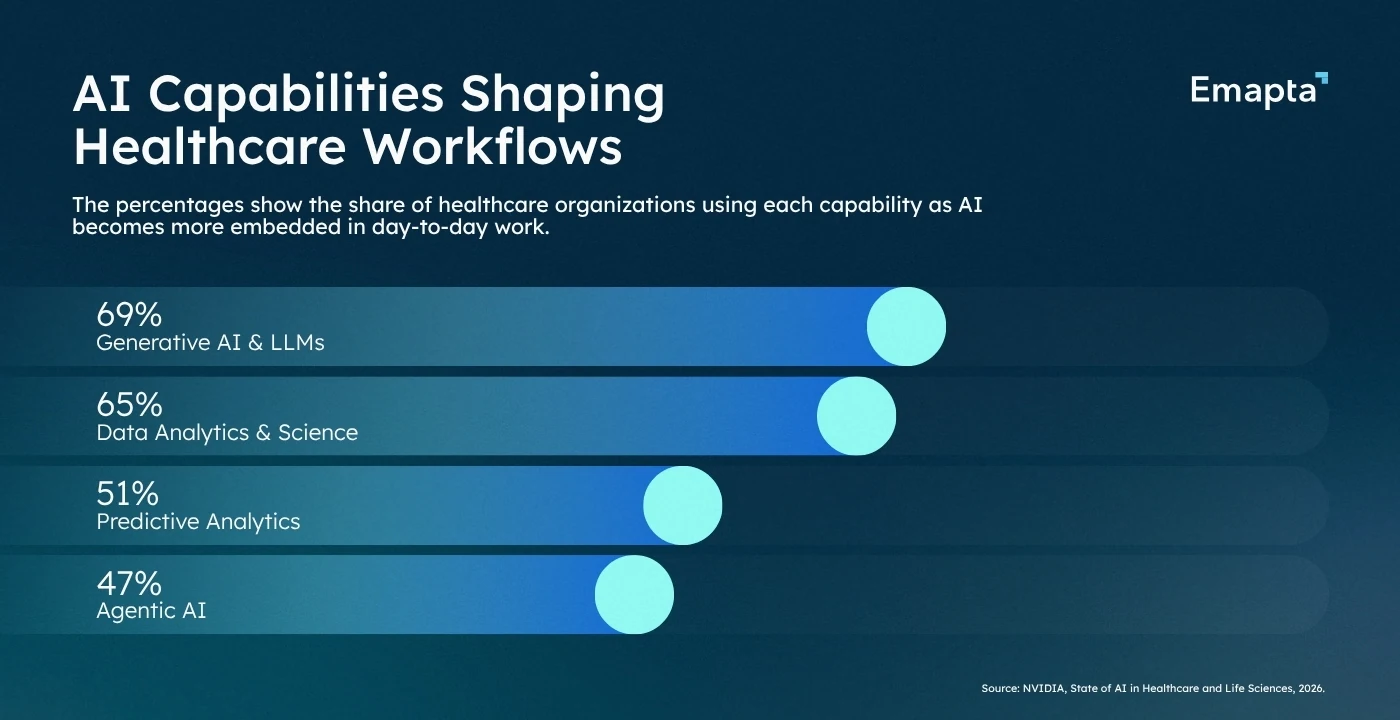
These applications can make individual tasks faster and less manual, but the operational impact rarely stops at the task itself. Once AI alters one part of a workflow, it can also affect volumes, dependencies, handoffs, turnaround times, controls, and surrounding healthcare processes.
That creates a wider set of operating questions:
- What happens to the steps before and after the automated task?
- Can downstream processes handle the additional speed or volume?
- Do existing handoffs and approval points still make sense?
- Where are new checks or controls needed?
Because the impact extends across the wider workflow, the considerations do too. According to Dr. Barry Chaiken, bestselling author, industry advisor, and physician featured in an Emapta webinar on healthcare operations, one of them is the risk of accepting AI outputs at face value.
“There’s this automation bias. There’s an acceptance of what the tool gives you back as a fact,” he noted. “If you do not design the workflow and the processes so that it prevents that from happening, you will have problems and you will have errors.”
Explore the full discussion in our webinar, “The Healthcare Operating Model Is Changing. Is Yours?” for more insights from Dr. Barry Chaiken.
The Operational Weaknesses AI Exposes in Healthcare
As AI changes how work moves through the organization, it also puts new pressure on the processes, systems, and structures around it. Gaps that were easier to overlook can become more visible, especially once they begin affecting the reliability of AI-enabled work.
In that sense, AI is not just a new capability in healthcare. It can also serve as a test of how well the underlying foundation can support it, revealing operational cracks that can limit adoption, performance, and trust.
1. Processes That Cannot Flex with Change
Resilient health systems often depend on fixed sequences and long-established routines. When AI changes the speed or volume of work, rigid processes can struggle to adapt, creating new bottlenecks instead of removing old ones.
2. Disconnected Systems and Handoffs
From clinical and administrative work to financial and support functions, efficiency depends on coordination across multiple areas. AI can make the friction between them more visible when delays or handoff issues interrupt the flow of healthcare work.
3. Workforce Structures That No Longer Fit the Work
As AI takes on more routine or information-heavy tasks, the way work is allocated begins to shift. That can expose mismatches in staffing levels, role design, and skill distribution, especially when talent decisions are still based on older ways of working.
What a Stronger Healthcare Operating Model Requires
One study found that 42% of U.S. health systems deploy AI across multiple use cases, but only 4% have achieved scaled implementation with measurable outcomes. That raises another question: if access to technology is increasing, what else determines whether it delivers sustained value?
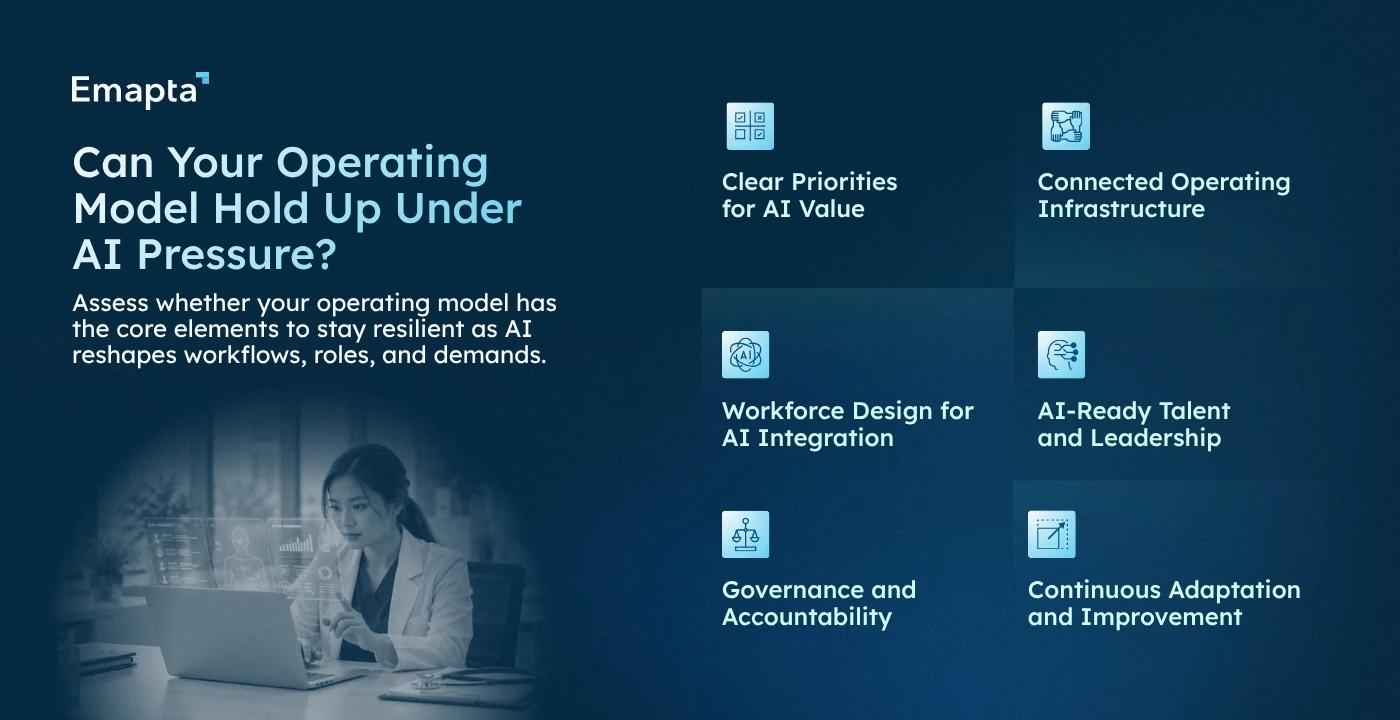
One place to look is your operating model. You need to assess whether it can translate new capabilities into reliable performance without weakening the human, structural, or strategic foundations that support care delivery. Building that resilience under AI-driven pressure typically means bringing the following together:
1. Clear Priorities for AI Value
Clear priorities keep digital investments tied to outcomes that matter. Without that focus, you can end up scaling tools and use cases that add complexity without improving performance.
A stronger operating model uses those priorities to guide where resources, redesign efforts, and attention should go as AI becomes more embedded in day-to-day healthcare processes.
What It Looks Like in Practice
- AI use cases tied to patient, workforce, or financial outcomes
- Clear criteria for scaling, refining, or retiring pilots
- Investment choices aligned with care delivery and enterprise priorities
2. Connected Operating Infrastructure
As AI moves beyond isolated pilots, the infrastructure beneath it must support expansion without creating a patchwork of disconnected tools. That requires a common foundation for scaling new AI capabilities across care delivery, administration, and support. Otherwise, each new use case risks adding another layer of complexity.
What it Looks Like in Practice
- Shared data standards that support consistency across connected systems
- Interoperable AI tools designed to support end-to-end healthcare workflows
- Flexible architecture that makes it easier to add or replace platforms
3. Workforce Design for AI Integration
AI can take on more work, but it still depends on the right talent to interpret outputs, make decisions, and step in when technology reaches its limits. As these tools become more embedded in healthcare, the strength of the workforce around them becomes even more important.
“Healthcare is an industry that requires compassion, caring, empathy. And at least right now, we don’t have any of these AI tools that can be able to do any of that work.”
— Dr. Barry Chaiken | Physician, Bestselling Author & Industry Advisor
That makes workforce design a core part of a resilient operating model, not a separate talent issue. You need roles and capacity built around where human effort adds the most value and where technology can meaningfully extend it.
What It Looks Like in Practice
- Healthcare work deliberately divided between people and AI based on where each adds value
- Roles redesigned around where human judgment and interaction matter most
- Staffing models adjusted as automation changes workload and capacity needs
4. AI-Ready Talent and Leadership
You need human capability at two critical levels: professionals who can use AI well and leaders who can shape how it is used. That means team members with enough fluency to question outputs and apply judgment, and leaders with enough understanding to set direction and decide where AI belongs in your healthcare operation.
What It Looks Like in Practice
- AI fluency built into relevant role profiles and hiring criteria
- Access to practical training for safe and effective AI use
- Leaders equipped to evaluate use cases and guide adoption across healthcare operations
5. Governance and Accountability
As technology takes on a bigger role in healthcare decisions and workflows, governance gives your organization the structure to use AI with confidence. Clear ownership, oversight, and accountability help new capabilities scale while protecting trust, quality, and control.
What It Looks Like in Practice
- Approval gates for higher-risk or patient-impacting AI use cases
- Documented standards for privacy, validation, and acceptable use
- Audit trails and escalation paths for errors or unexpected outcomes
6. Continuous Adaptation and Improvement
AI will keep changing which operating choices still make sense. This means your operating model cannot stay fixed. You need to continuously adapt and be willing to rethink how work gets done, where different capabilities are best sourced, and how performance is measured.
What It Looks Like in Practice
- Regular reviews of AI-enabled healthcare workflows against patient experience, efficiency, and financial outcomes
- Ongoing upskilling as tools, roles, and expectations evolve
- Performance measures updated as automation changes quality, capacity, and service expectations
“The organizations that benefit the most from AI may not be those that are simply adopting the most technology. They may be the ones who are doing the best job of redesigning the work around them.”
— Dr. Barry Chaiken | Physician, Bestselling Author & Industry Advisor
Where Your Workforce Strategy Fits in AI Adoption
Conversations about operating models eventually lead to workforce discussions for a reason. The way work is designed only matters if you have the talent and capacity to carry it out. In healthcare, those decisions shape how reliably work gets done as AI becomes more integrated, with consequences for access, continuity, and patient experience.
That is why your organization’s workforce strategy cannot sit downstream of your AI strategy. When technology decisions happen first and talent decisions follow later, the operating model is forced to absorb a gap between what AI makes possible and what your workforce is prepared to deliver.
On the other hand, when your workforce strategy evolves alongside AI, you can anticipate how new capabilities will reshape talent, roles, and capacity instead of reacting after deployment. That gives you a stronger basis for deciding:
- Which capabilities to build internally or source elsewhere
- How roles, staffing levels, and capacity should shift
- Which skills to hire, develop, or redeploy
- Where work should sit based on expertise, cost, and scalability
- When workforce changes need to happen as AI use expands
This helps shift the focus from simply adding more AI tools to making better use of the capabilities you already have across your healthcare operations. In turn, your technology investments have a stronger chance of delivering real business value.
How Dedicated Global Teams Support AI-Enabled Operations
Organizations in the healthcare industry are already competing for scarce talent, which is why many turn to outsourcing to expand access to skills and capacity. But not every outsourcing model provides the consistency and context needed to support AI-enabled operations as they continue to evolve.
Emapta offers a more embedded approach through dedicated staffing. Your outsourced team works exclusively for your organization, allowing them to build deeper familiarity with your processes and priorities while using industry-leading AI tools to improve healthcare efficiency. This enables you to:
- Build hard-to-find healthcare capabilities with access to the top 1% of global talent across data, automation, and process support
- Redesign your workforce for AI-enabled work with strategic guidance on team structures, location planning, and future-state operating models
- Respond quickly to changing skill needs through Emapta Talent Marketplace (ETM), which allows you to hire in as little as 9 days
- Plan resourcing with greater cost visibility through transparent pricing with no salary markups or hidden fees
- Adjust your workforce with flexible, easy-in, easy-out terms as AI reshapes roles and healthcare workflows
From Reactive Adoption to Operational Readiness
AI will undoubtedly continue to reshape the economics and mechanics of health systems. The organizations that stay ahead will be those that redesign their operating models around that reality, making deliberate choices about where technology can create meaningful value and what needs to shift around it.
That same discipline has to extend to workforce strategy. As healthcare work evolves, global talent can help you build the expertise your operating model now demands, turning AI-driven change into a stronger foundation for how care is supported and delivered.
Bring AI-Ready Healthcare Expertise into Your Team
Partner with us to shape a workforce strategy with global professionals skilled in healthcare support and AI-enabled operations.