

How to Build an Offshore Team That Works Like Your Own
Building an offshore team that works like your own starts with choosing a dedicated team model that integrates with your business, follows your processes, and operates as an extension of your in-house workforce.
This approach gives you access to highly skilled global talent, greater control over day-to-day operations, and the flexibility to scale your team without sacrificing quality, collaboration, or company culture.
Many organizations have adopted dedicated offshore teams to overcome talent shortages, accelerate growth, and build long-term operational capacity rather than simply reduce costs.
This article shows you the best practices for building an offshore team that delivers the same standards, accountability, and performance as your in-house employees.
Build an Offshore Team – Key Takeaways
- Offshore teams go beyond cost savings – they help companies access quality talent, scale faster, and keep operations moving across time zones
- Dedicated teams work best for long-term needs – they learn your systems, customers, and processes over time
- Structure matters before scaling – clear roles, the right location, strong onboarding, and secure systems reduce confusion from the start
- Success should be measured by business impact – track quality, speed, retention, engagement, security, and customer satisfaction
Why Should You Build a Dedicated Offshore Team?
Companies should build a dedicated offshore team when they need long-term access to skilled talent that integrates with their business, scales with demand, and operates like an extension of their in-house workforce.
Unlike traditional outsourcing models focused primarily on cost savings, dedicated offshore teams give businesses greater control, stronger collaboration, and the ability to fill talent gaps that local hiring cannot always solve.
This is why organizations increasingly use dedicated offshore teams to access specialized expertise, support business growth, accelerate project delivery, and provide around-the-clock coverage while maintaining consistent quality and accountability.
Build a dedicated offshore team when you need:
- Long-term capacity
- Direct control over priorities
- Access to specialized global talent
- Faster hiring in competitive roles
- Better time zone coverage
- More flexibility as the business changes
- A team that can grow across departments
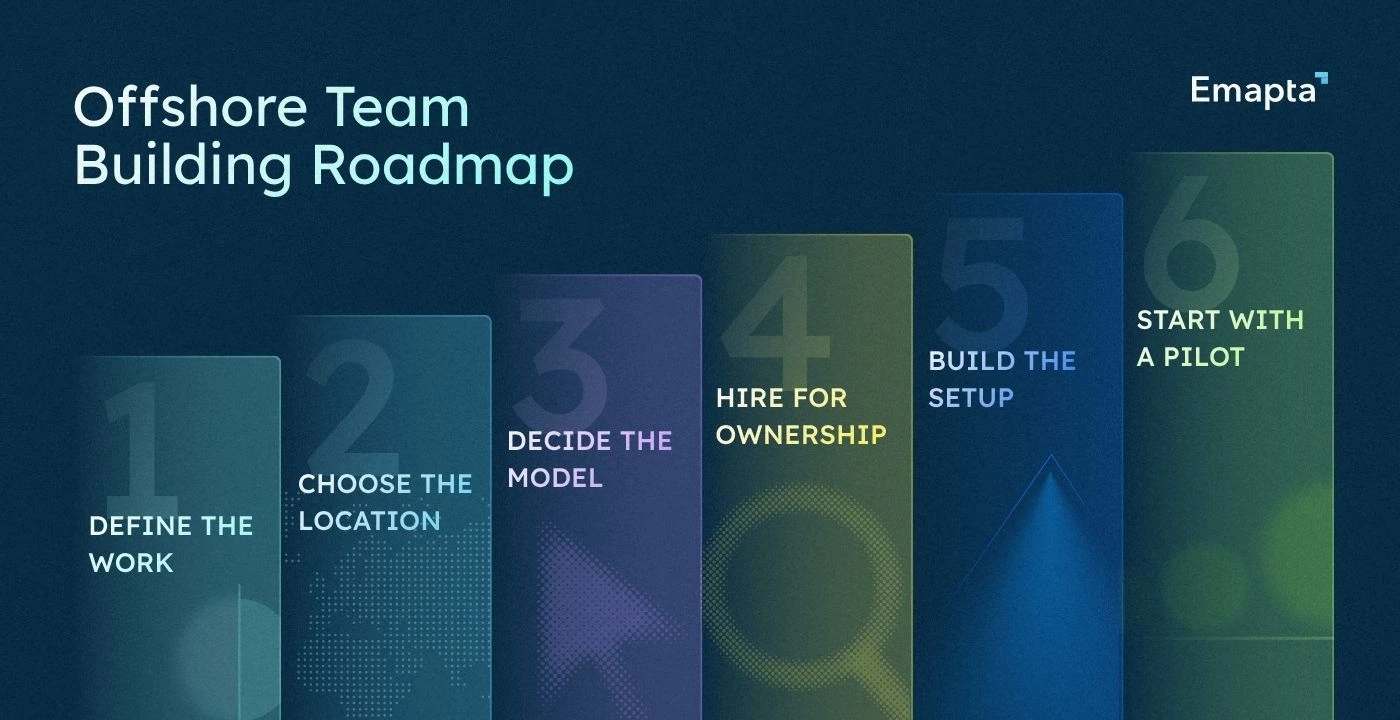
6 Key Steps to Build Your Offshore Team
Many business leaders look offshore because they need to scale quickly.
However, the companies that achieve the best long-term results take the time to build a strong foundation first. They clearly define the work, choose the right engagement model, hire the right people, and establish the processes needed to manage and support their team effectively.
So, what does that look like in practice?
Here are six practical tips for successfully building an offshore team that delivers long-term success.
1. Define the Work Before the Roles
A common mistake is starting with headcount: “We need five developers” or “We need three support agents” or “We need an offshore marketing team.”
Those requests may be valid, but they are incomplete. Before deciding how many people to hire, define the work the team will actually own and then ask yourself:
- What problem should this team solve?
- Which tasks will move offshore?
- Which tasks should stay onshore?
- Who will manage the team day to day?
- What decisions can the offshore team make?
- What does success look like in the first 90 days?
2. Choose the Right Offshore Location
Even though there are proven global talent hubs, there’s no such thing as ‘the right location.’ It depends on the function you want to outsource.
Some companies want to build an offshore team in the Philippines because of the country’s well-established outsourcing industry, access to high-skill talent, strength in English-speaking service roles, customer support, and knowledge work.
Conversely, nearshore markets can be a better choice when time zone overlap matters. Colombia, for instance, is a growing talent market that caters to thousands of companies in North America with real-time collaboration.
Choose a location based on:
- Talent availability
- Time zone overlap
- English proficiency
- Salary expectations
- Infrastructure quality
- Data security needs
- Local employment rules
- Cultural fit
- Scalability
3. Decide the Model
Not every offshore setup works the same way as some companies outsource complete projects. Others use staff augmentation, build global capability centers, or choose dedicated staffing.
The right model determines how much control, flexibility, and visibility you keep.
Common offshore team models include:
- Project outsourcing – best for a fixed project with a defined outcome
- Staff augmentation – best for adding individual specialists to an existing team
- Dedicated offshore team – best for long-term work that needs control and integration
- Global capability center – best for large enterprises building their own overseas entity
4. Hire for Ownership, Not Just Skills
A strong CV is not enough. Offshore team members need the technical skills to do the work, but they also need the communication habits to do it across distance.
That means they must be comfortable asking questions, documenting decisions, raising blockers, and working with people they’d probably never interact with in person.
When building your offshore team, look for:
- Role-specific skills
- Clear communication
- Problem-solving ability
- Ownership mindset
- Comfort with remote tools
- Ability to document work
- Cultural alignment
- Security awareness
5. Build the Operating Setup
An offshore team needs more than laptops and logins; it needs an operating system: a combination of tools, rules, documentation, meetings, permissions, and performance habits that allow the team to work without confusion.
With that in mind, carefully set up the following:
- Communication tools
- Project management tools
- Knowledge base
- Role expectations
- Escalation paths
- Access controls
- Security policies
- Onboarding plans
- Reporting cadence
- Performance reviews
6. Start With a Pilot Team
A pilot protects the business from scaling too early. Instead of hiring 30 people at once, start with a smaller dedicated team that proves the model.
The first 60 to 90 days should show whether the team can deliver quality work, communicate clearly, follow security rules, and integrate with internal teams.
A pilot can help test:
- Role clarity
- Hiring quality
- Onboarding speed
- Tool adoption
- Communication habits
- Productivity
- Rework levels
- Team fit
- Manager capacity
How to Manage a Dedicated Offshore Team
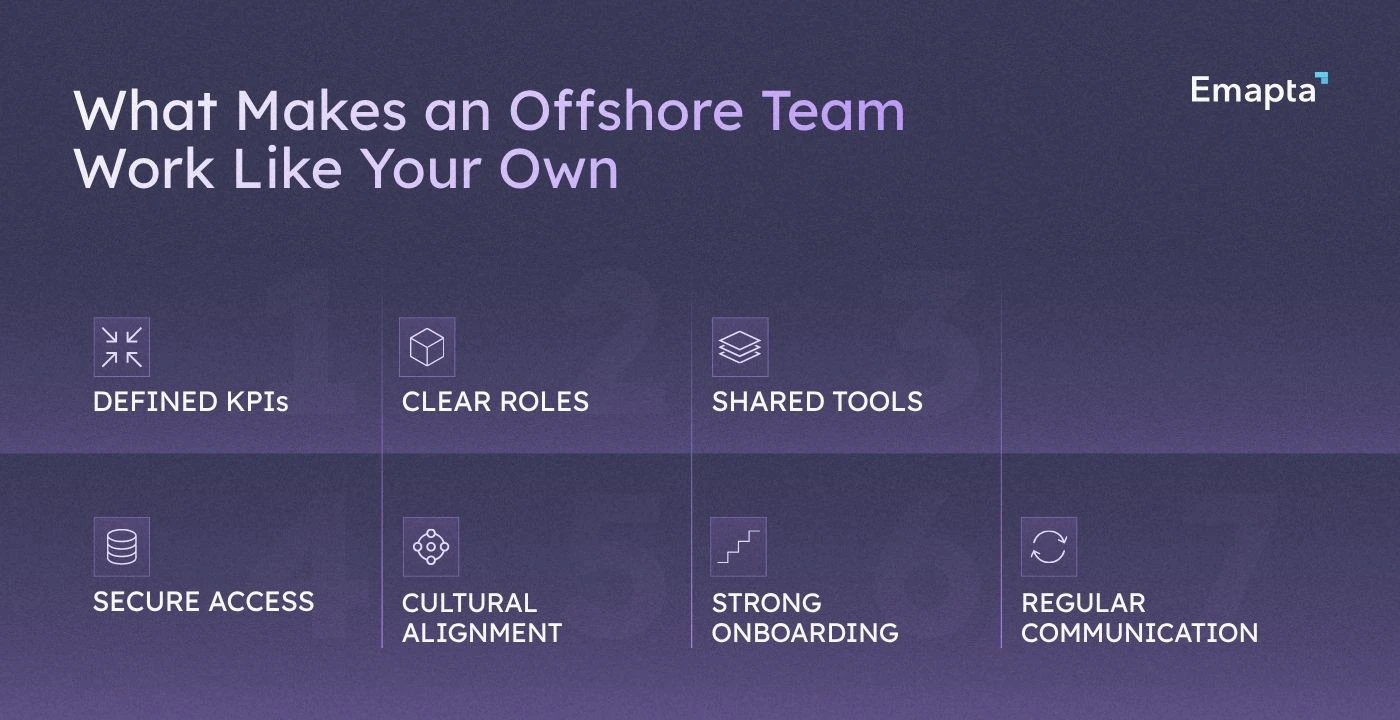
Managing an offshore team is all about creating clarity through well-defined processes, clear ownership, and consistent communication.
When expectations, responsibilities, and goals are aligned, offshore employees can work as a true extension of your business. Shared context and regular collaboration help bridge geographical distance, strengthen accountability, and keep everyone focused on the same outcomes.
Use a simple management rhythm:
- Weekly planning
- Daily or near-daily check-ins
- Clear written priorities
- Shared project boards
- Documented decisions
- Regular performance reviews
- Monthly team health checks
- Quarterly business reviews
The offshore team you built should not receive second-hand information. They should hear from you what are the business goals, customer needs, quality standards, and the direct impact of their work.
Engagement also matters as recent retention trends show that employee turnover is rising, and offshore teams are even more exposed to feel disconnected than in-house staff.
To foster their best performance, you need to provide clear expectations, room to grow, regular recognition, and a real connection to the business.
What to Track When You Build an Offshore Team
The success of a dedicated offshore team should not be measured by cost savings alone. Instead, businesses should evaluate performance based on quality, productivity, reliability, and the overall impact the team has on business outcomes.
The best KPIs connect the offshore team’s work to business outcomes. They should show whether the team is helping the company move faster, serve customers better, protect quality, and retain knowledge.
Common KPIs include:
| Category | Metrics to track |
|---|---|
| Productivity | Ramp-to-productivity, task completion rate, throughput, on-time delivery |
| Quality | Quality of work, rework rate, defect/error rate, documentation quality |
| Performance | SLA or KPI achievement (where applicable), adherence to project milestones |
| People | Retention, absenteeism, employee engagement |
| Compliance | Security compliance, policy adherence, audit results |
| Business impact | Cost efficiency, process improvement, stakeholder satisfaction |
What to Avoid When You Build an Offshore Team
The biggest offshore challenges usually happen before the team starts.
They come from weak planning, unclear ownership, or treating offshore talent as a cheaper version of the same local structure.
1. Choosing the Cheapest Option First
The lowest rate is not always the lowest cost. If the team needs constant correction or heavy management, the savings disappear.
2. Hiring Without a Clear Scope
Offshore employees cannot succeed without clear expectations. Before hiring, define what they own, who they report to, what tools they use, and how performance will be measured.
3. Treating the Offshore Team Like an External Vendor
A dedicated offshore team should not feel separate. If the team is excluded from meetings, updates, and decisions, it will struggle to build ownership.
4. Ignoring Security
Use least-privilege permissions, device controls, secure tools, and clear data policies. To build an offshore team for AI and software, add code review, model governance, and secure development practices.
5. Forgetting About Culture
Cultural alignment does not happen by accident. Offshore employees need to understand how the company communicates, makes decisions, handles feedback, celebrates wins, and solves problems.
Wrapping Up
Building an offshore team is about creating a scalable extension of your business that provides access to global talent, increases operational capacity, and supports long-term growth.
The most successful offshore teams are built with clear roles, structured onboarding, consistent communication, and shared performance goals. When managed effectively, they operate as a seamless extension of your in-house workforce.
Ultimately, building an offshore team is about creating a long-term capability that grows with your business, not a short-term solution to immediate hiring challenges.
Frequently Asked Questions (FAQ)
An offshore team means a group of professionals located in another country who work for your business.
An offshoring team is a team that performs business work from a different country. Companies use offshoring to access talent, expand capacity, reduce operating costs, or support customers across more time zones.
Offshore support teams handle support-based functions from another country. These may include customer support, technical support, IT help desk, administrative support, finance operations, or back-office processes.
An onshore team works in the same country as the hiring company. An offshore team works from another country. Nearshore teams are located in nearby countries with closer time zone overlap.