

Complete Guide on Dedicated Teams [with Benefits & Examples]
Offshore staffing allows businesses to build dedicated teams of professionals who work exclusively for their organization. This approach offers a more integrated and scalable alternative to traditional BPO models that rely on rigid processes and shared resources.
Let’s take a closer look at how dedicated staffing works, its benefits, and where it can create the greatest business impact.
What Are Emapta’s Dedicated Team Staffing Services?
Emapta’s staffing services enable businesses to extend their workforce with professionals who work exclusively for their organization. Unlike traditional outsourcing models that may use shared resources, dedicated staffing provides companies with team members who are aligned with their processes, goals, and culture, operating as an integrated part of their workforce.
While many providers offer dedicated staffing, Emapta takes the model further by building custom offshore and nearshore teams that operate as a true extension of your organization.
Our approach delivers the benefits of outsourcing without the common trade-offs of transactional BPOs, backed by:
- Top 1% highly skilled, AI-enabled global talent
- Industry-leading 98% employee retention rate
- Easy in, easy out contracts with no minimum hires
- Transparent pricing with no salary markups, no hidden fees

Dedicated Staffing Services
Build an offshore team with dedicated staffing and top EOR solutions.
- Full Control
- Transparency
- No Salary Markups
3 Critical Reasons Why Businesses Choose Dedicated Offshore Teams
For many organizations, the decision to outsource dedicated specialists is driven by a simple reality: traditional hiring models are no longer keeping pace with business demands.
Whether the goal is finding specialized talent, supporting growth, or improving operational capacity, offshore staffing provides businesses with a flexible workforce model that can be tailored to their unique needs and scaled as business demands evolve.
These are the 3 key reasons why dedicated global teams define the next era of work:
1. Filling Critical Skill Gaps Beyond Local Markets
As competition for specialized skills intensifies, businesses often struggle to find qualified talent and fill critical roles quickly, delaying projects and slowing growth. Dedicated offshore teams help address this challenge by expanding the talent search beyond local markets, giving businesses access to professionals with the specific expertise they need without being limited by borders.
Example: Finding Software Developers with AI Expertise
As AI adoption accelerates, demand for developers with machine learning, automation, and AI integration experience continues to rise.
Many companies struggle to find these specialists locally due to:
- Limited talent pools, particularly outside major technology hubs
- Intense competition from larger organizations with bigger hiring budgets
- Rising salary expectations for in-demand AI skills
Through a dedicated team, businesses can tap into global talent markets where AI-ready teams and software development skills have expanded rapidly in response to growing demand. This broader talent pool gives organizations access to AI-ready developers who can accelerate innovation and project delivery.
2. Supporting Growth Without Increasing Complexity
Business growth often creates a paradox as more customers, projects, and opportunities generate an increase in demand.
However, they also place greater pressure on internal teams, so recruiting and onboarding additional staff can quickly become costly and time-consuming.
Dedicated teams provide a scalable way to increase capacity without repeated hiring cycles. They can grow alongside business needs while maintaining operational continuity.
Example: Expanding Customer Support During Peak Seasons
An e-commerce retailer may experience significant spikes in customer inquiries during major shopping events such as Black Friday or the holiday season.
Common challenges often include:
- Hiring enough support staff quickly to meet seasonal demand
- Training new team members before peak periods begin
- Managing fluctuating staffing needs throughout the year
Offshore support agents can help retailers scale service capacity efficiently while maintaining a consistent customer experience.
3. Allowing Internal Teams to Focus on Higher-Value Work
Many organizations find that highly skilled employees spend a significant portion of their time on repetitive administrative and back-office tasks. When companies delegate these process-driven responsibilities to dedicated teams, they can free up internal capacity and enable employees to focus on customer relationships and strategic growth.
Example: Reducing Administrative Burdens in Healthcare
Healthcare providers often rely on highly trained staff to manage both patient care and operational responsibilities. Administrative tasks can consume valuable time that could otherwise be spent on higher-priority activities, including:
- Managing appointment scheduling during periods of high patient demand
- Verifying insurance information and processing patient records
- Handling medical data entry and administrative documentation
By working with offshore admin specialists, healthcare providers can improve operational efficiency while enabling internal teams to focus on patient outcomes and strategic initiatives.
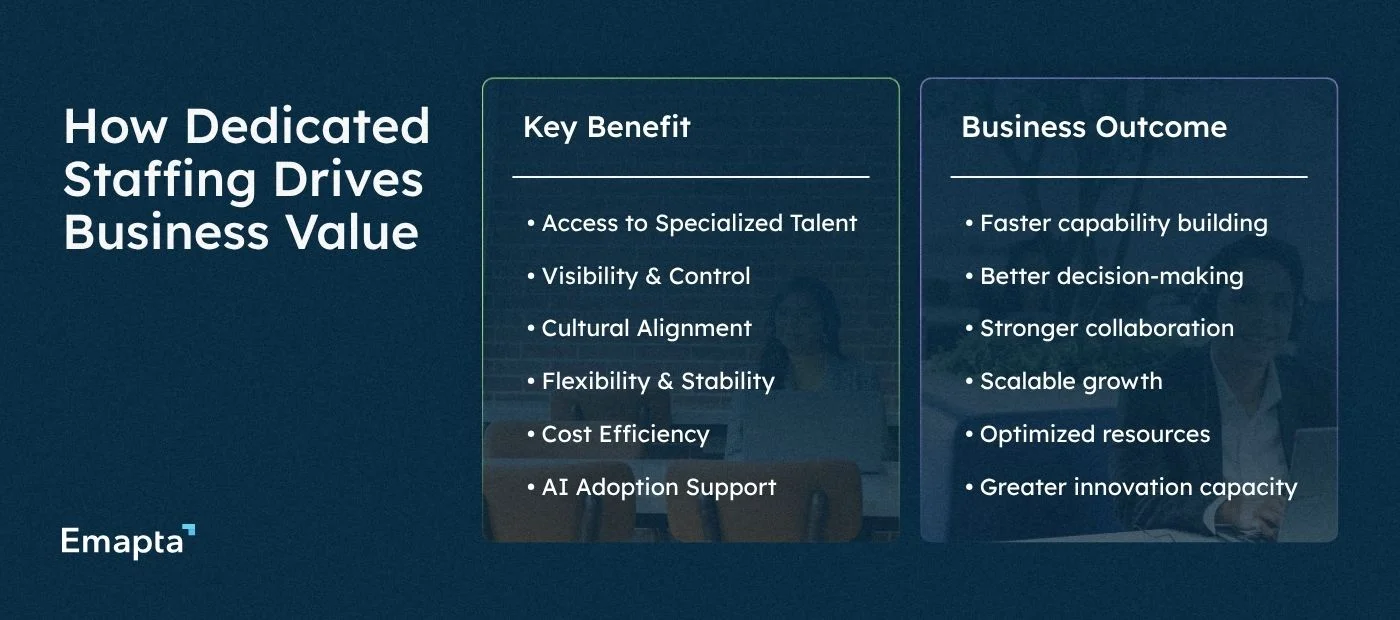
6 Key Benefits of Dedicated Offshore Teams
Dedicated teams have become a proven outsourcing strategy, with a report by Everest Group, supported by Emapta, finding that 49% of enterprises already use this model, with 35% planning to adopt it within 12-18 months or are actively considering adopting it in the future.
Unlike traditional BPO, team members work exclusively for your organization, creating a more integrated workforce that improves continuity, retains institutional knowledge, and drives stronger long-term outcomes institutional knowledge, and drives stronger long-term outcomes.
1. Access to Specialized Talent
With 74% of employers worldwide struggling to fill roles due to skilled talent shortages, access to specialized talent has become a competitive advantage.
A dedicated team helps you overcome local talent constraints, enabling you to:
- Fill hard-to-hire and niche roles more efficiently
- Access specialized skills that may be difficult to source locally
- Reduce hiring bottlenecks that can delay growth initiatives
2. Greater Visibility and Control
According to a Deloitte survey, 55% of organizations cite a lack of benefit realization tracking and reporting as a barrier to outsourcing success. Offshore staffing helps address this challenge because team members work exclusively for your organization and align with your processes and priorities, giving you greater oversight of your workforce.
This enables you to:
- Maintain direct visibility into team performance and outcomes
- Exercise greater control over day-to-day priorities and workflows
- Improve accountability through clearer reporting and oversight
3. Stronger Cultural Alignment and Team Integration
Organizations known for high cultural alignment enjoy 18% higher productivity rates and 23% higher retention rate. Dedicated teams naturally become more integrated into your onshore operations over time, creating stronger connections between people, processes, and business objectives.
This allows you to:
- Build stronger collaboration between in-house and offshore teams
- Create greater alignment around business goals and priorities
- Foster a more connected and engaged workforce
4. Flexible Engagement, Stable Teams
78% of enterprises cite increased flexibility as a key driver for outsourcing. The challenge is achieving that flexibility without sacrificing continuity. Because your offshore dedicated team remains focused on your organization, you can adapt to changing business needs while maintaining workforce stability.
This makes it possible to:
- Scale teams in line with changing business needs
- Preserve institutional knowledge and process expertise
- Support sustainable growth without disrupting team continuity
5. Cost Efficiency Without Sacrificing Quality
Strategic outsourcing can reduce costs by up to 70%, making it an attractive option for businesses looking to scale efficiently. But unlike cost-cutting approaches that compromise performance, a dedicated team provides access to skilled professionals who deliver consistent, high-quality support across your operations.
As a result, you can:
- Achieve greater output without significantly increasing overhead
- Improve operational efficiency while maintaining service quality
- Reinvest savings into strategic growth initiatives
6. Advancing AI Adoption
Everest Group also found that 44% of enterprises are expanding their outsourcing scope to leverage providers’ AI tools, data capabilities, and specialized talent. As AI becomes a business priority, offshore staffing provides access to professionals with the expertise needed to implement, manage, and optimize emerging technologies.
This helps you to:
- Turn AI initiatives into practical business applications
- Improve operational efficiency through automation and data-driven processes
- Scale innovation efforts while maintaining focus on core business priorities
Simple 4-Step Process to How Dedicated Staffing Works
Successful dedicated teams are built through a structured process that aligns talent, business goals, and operational requirements. When executed effectively, this approach helps create outsourced teams that integrate seamlessly into day-to-day operations and support long-term business growth.

Dedicated Offshore Teams Drive Enterprise Transformation
Dedicated staffing allows for redesigned workflows as teams work exclusively for the enterprise.
- Speed
- Cost Efficiency
- Consistent Quality
Step 1: Discovery and Planning
The process starts with understanding your business objectives, workforce requirements, and operational challenges. Your outsourcing partner should serve as a strategic workforce advisor, helping you identify the roles, skills, and dedicated team structure needed to support both your immediate priorities and long-term goals.
Examples of Activities During This Stage
- Reviewing workforce gaps and capacity constraints
- Defining required roles, skills, and experience levels
- Mapping out a location strategy and delivery footprint
- Establishing team objectives and success metrics
Step 2: Talent Sourcing and Selection
Once workforce requirements have been defined, your provider begins sourcing candidates who match the required skills, experience, and cultural fit. You remain actively involved throughout the selection process, from interviewing candidates to making final hiring decisions, helping ensure that candidates align with your expectations.
Examples of Activities During This Stage
- Sourcing and screening candidates based on defined requirements
- Conducting interviews, assessments, and skills evaluations
- Collaborating with stakeholders on candidate selection and hiring decisions
Step 3: Onboarding and Team Integration
With the hiring process complete, the focus shifts to onboarding and integration. At this point, your offshore dedicated team becomes familiar with your processes, tools, workflows, and expectations, helping them operate as a seamless part of your organization.
Examples of Activities During This Stage
- Introducing team members to company systems, tools, and processes
- Establishing communication channels and workflow expectations
- Aligning performance goals, responsibilities, and reporting structures
Step 4: Scaling as Your Needs Evolve
As business priorities change, your dedicated team can grow alongside them. Whether you need additional capacity, specialized expertise, or support for new initiatives, the team can be expanded without disrupting existing workflows or team continuity.
Examples of Activities During This Stage
- Adding new roles and capabilities to support business growth
- Expanding team capacity during periods of increased demand
- Introducing specialized skills to support new projects and initiatives
When Should You Use Dedicated Staffing Services?
A dedicated team is worth considering when hiring challenges begin slowing down your ability to execute, grow, or scale effectively. If you’re experiencing any of the following situations, it may be time to explore a dedicated staffing model:
- Talent shortages are limiting your ability to grow or meet business demands
- Critical roles are taking too long to fill through traditional hiring methods
- Business growth is outpacing your ability to build internal teams
- New initiatives require specialized expertise that is difficult to source locally
5 Best Roles You Can Fill with Dedicated Staffing
While offshore staffing can be applied across a wide range of business functions, certain teams benefit particularly from having professionals who develop long-term knowledge of the business, processes, and goals they support.
These functions often see greater value from this workforce strategy than traditional BPO models that rely on shared or rotating resources.
1. Finance & Accounting
Finance and accounting roles require accuracy, consistency, and a strong understanding of business processes. Dedicated teams develop institutional knowledge over time, helping maintain continuity across reporting, compliance, and day-to-day financial operations.
| Commonly Outsourced Roles | ||
| Staff Accountant | Tax Accountant | Accounts Receivable |
| Controller | Accounts Payable | Auditor |
2. Technology & IT Services
Technology teams often support long-term projects that require specialized expertise and ongoing collaboration. Dedicated professionals can build deeper knowledge of systems, processes, and business objectives, helping ensure continuity across initiatives.
| Commonly Outsourced Roles | ||
| Software Engineer | AI Compliance Lead | Cloud Engineer |
| Tech Support Representative | Backend Developer | Cyber Security Analyst |
3. Customer Service
This essential function benefits from continuity, product knowledge, and a strong understanding of customer expectations. Dedicated teams become more familiar with your products, processes, and service standards over time, helping deliver a more consistent customer experience.
| Commonly Outsourced Roles | ||
| Customer Service Representative | Virtual Assistant | Inside Sales Representative |
| Account Executive | Sales Development Representative | Administrative Support |
4. Healthcare Support
Administrative and operational processes in healthcare require accuracy, compliance awareness, and consistent execution. As offshore professionals become more familiar with your workflows, systems, and service standards, they can work more efficiently while helping maintain quality patient experiences.
| Commonly Outsourced Roles | ||
| Billing/Coding Specialist | Revenue Cycle Management Analyst | Data Analyst |
| Medical Records Specialist | Compliance Officer | EI Analyst |
5. Supply Chain
Supply chain operations rely on coordination, process consistency, and visibility across multiple stakeholders and workflows. Long-term familiarity with your systems, suppliers, and operational requirements can help drive greater efficiency and consistency across supply chain operations.
| Commonly Outsourced Roles | ||
| Supply Chain Analyst | Demand Planner | Financial Analyst |
| Logistics Coordinator | Estimator | Inventory Controller |
Wrapping Up
The future of offshore staffing is about designing a workforce that understands your business, contributes to its long-term goals, and scales as your needs evolve.
When done right, offshore staffing can help you build a dedicated team that works for your organization and creates value at every stage of growth.
A dedicated staff means an outsourced professional who works exclusively for one client, unlike shared BPO workers who rotate across accounts.
The three most common types of staffing are permanent staffing, temporary staffing, and contract staffing.
- Permanent staffing – focuses on long-term employees
- Temporary staffing – fills short-term workforce needs
- Contract staffing – provides specialized talent for specific projects or periods of time
The term staffing means the process of sourcing, hiring, and deploying the right people to meet an organization’s workforce needs, covering everything from recruitment and screening to placement and team management.
Dedicated staffing gives you exclusive access to global talent while keeping you in full control of your team, while traditional outsourcing typically means shared resources and less oversight.
Businesses can save up to 70% on labor costs compared to hiring locally. Savings come from lower salary benchmarks and reduced overhead, without compromising on talent quality.
Yes, you can fully manage your dedicated offshore team. Your team operates as a direct extension of your business, meaning you set the workflows, tools, and standards.