

How to Manage an Offshore Team Without Losing Control
To successfully manage an offshore team, you need to set up standard processes, establish clear communication protocols, raise cultural awareness, and utilize the right tools.
This will ensure your team remains productive and aligned across different time zones, finishing their work on time and with great quality.
Let’s dive into the details and see how exactly you can do that.
Managing Offshore Teams Key Takeaways
- Clear ownership keeps work moving – offshore teams need to know who sets priorities, approves work, and removes blockers
- Good delegation reduces rework – every task should include the goal, expected output, deadline, and definition of “done”
- Time zones need structure – a clear rhythm for meetings, updates, and handoffs helps teams avoid delays
- KPIs should focus on results – track quality, delivery time, rework, blockers, engagement, and security, not just online activity
- Culture matters – regular feedback, trust, and controlled access help offshore teams work as part of the business
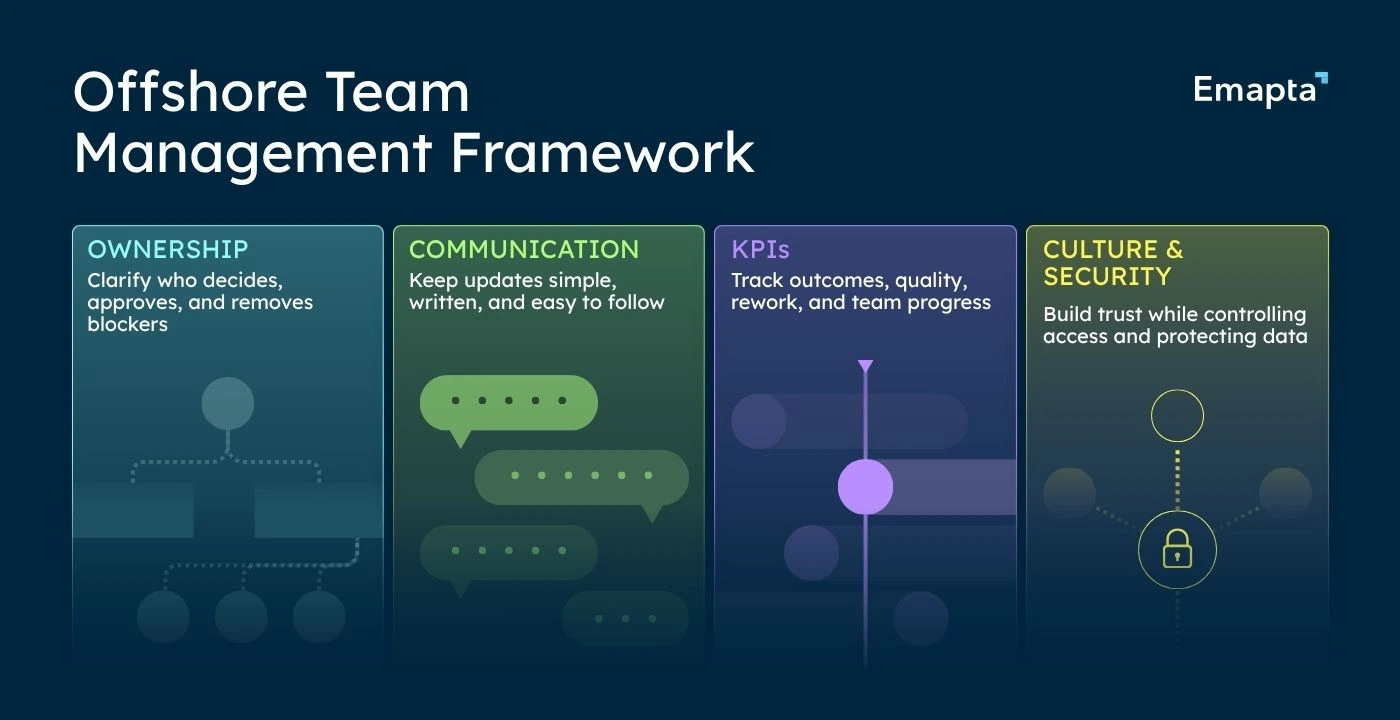
8 Tips on How to Effectively Manage a Dedicated Offshore Team
An offshore team can either become a real extension of the business or another layer of work to manage.
When you set ownership, delegate what matters, communicate clearly and effectively, and give the right tools to your team, your business can make remote collaboration more manageable and would streamline decision-making.
1. Set Clear Ownership Before Work Begins
The first mistake many companies make is treating offshore hiring as the finish line. They find a dedicated staffing talent, onboard the team, assign work, and assume the rest will function like an in-office department.
In reality, it rarely works that smoothly.
A dedicated offshore team can be skilled and still struggle if the work around them is unclear. They may not know who owns final decisions, which deadline matters most, or even when to ask for help or when to move forward.
Before assigning work, define:
- Who owns priorities
- Who approves final output
- Who removes blockers
- Who manages daily performance
- Who gives feedback
- Which decisions the offshore team can make independently
This is especially important when leading offshore team members across time zones. The team should never lose a full day waiting for a decision that could have been clarified in advance.
2. Delegate With Context
The most common thing offshore teams keep getting wrong that forces you to redo the work is delegation without context. It’s where many offshore relationships begin to break down. The issue isn’t a lack of capability. It’s that teams are expected to deliver without enough business, technical, or product context to make the right decisions.
A manager sends a task that feels obvious, the offshore team receives it without the same background, customer context, or internal conversation that shaped the request. Then, the work comes back incomplete, and both sides feel frustrated.
To delegate well, every important task should include:
- The business goal behind the task
- The expected output
- Examples of good work
- Known risks or edge cases
- What “done” means
- Who will review the work
This answers one of the most common questions: how to correctly delegate to an offshore team?
Good delegation turns a task into a decision-ready brief and gives the team the reason behind the work, not just the instruction.
In many cases, it is not the offshore team getting it wrong. It’s the work being handed over without enough context.
3. Build a Time-Zone Management Process
Time-zone differences can slow work down, but they can also speed up work if the process is designed correctly.
Microsoft reported that modern employees are facing an “infinite workday”, with digital communication stretching work into early mornings and evenings.
That is a warning sign for companies that rely too much on live meetings to manage an offshore team.
However, the goal is not to eliminate meetings, but to make live overlap count.
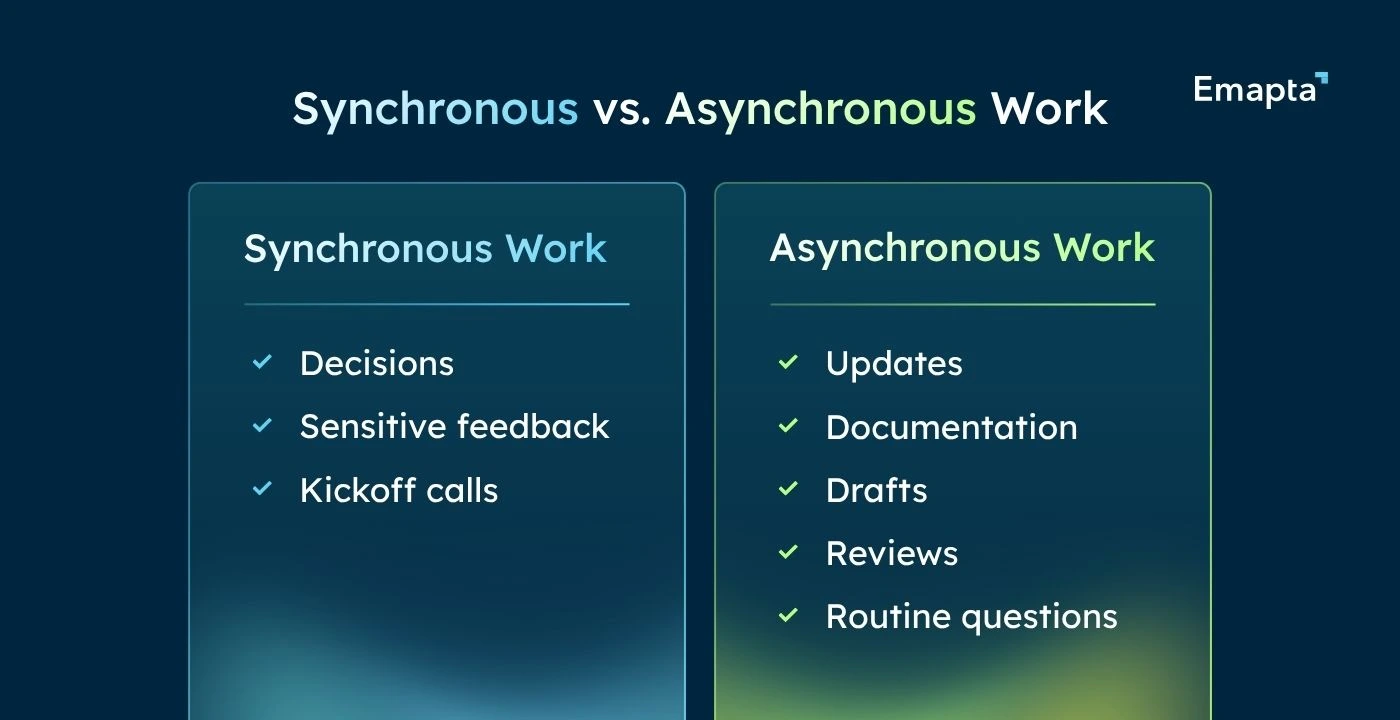
Divide the work into two categories:
Synchronous Work
- Decisions
- Complex problem-solving
- Sensitive feedback
- Kick-off calls
Asynchronous Work
- Task updates
- Documentation
- Status reports
- Drafts
- Reviews
- Routine questions
A simple weekly rhythm could look like this:
- Monday: confirm priorities and owners
- Midweek: review blockers and decisions
- End of week: check progress, feedback, and improvements
This helps management effectively because the team knows when to move, when to ask, and when to wait for live alignment.
4. Keep Communication Simple and Written
One of the biggest challenges when managing remote teams is ensuring effective communication. To successfully manage an offshore team, means fewer vague comments, wrong assumptions, and messages that only make sense to people who heard them live.
Good written communication should be:
- Short
- Direct
- Specific
- Easy to search later
- Attached to the task, ticket, or project record
After important calls, send a short recap with:
- The decision
- The owner
- The deadline
- The next step
5. Give the Team the Right Tools and Access
Offshore teams struggle when they are expected to deliver like insiders but treated like outsiders.
If they do not have access to the right dashboards, project tools, customer notes, SOPs, or brand guidance, they will fill the gaps with assumptions. Some assumptions will be right, others will become avoidable rework.
Give the team the tools they need, but do it safely.
For a successful offshore team management, access should be:
- Role-based
- Documented
- Approved by the right owner
- Reviewed regularly
- Removed quickly when no longer needed
6. Build Culture Through Regular Engagement Habits
Culture does not travel automatically across time zones, it needs to be built into the way the team works.
Cultural alignment matters because global employee engagement fell to 20% in 2025, costing the global economy around $10 trillion in lost productivity.
For offshore teams, weak engagement often shows up as silence as people stop raising risks early. They do only what is written, even when they see a better option.
Culture improves when the team get to experience:
- Weekly one-on-ones
- Monthly retrospectives
- Recognition for strong work
- Shared onboarding sessions
- Clear feedback loops
- Time for relationship-building, not only task updates
7. Measure Outcomes and Goals
When working with offshore teams, it can be tempting to manage through activity, such as hours online, messages sent, meetings attended, or screenshots captured.
The team looks busy, but the business still cannot tell whether work is improving.
Better measurement focuses on outcomes:
- Is work delivered on time?
- Is quality improving?
- Is rework going down?
- Are blockers resolved quickly?
- Are customers or internal stakeholders satisfied?
8. Treat Security as Part of Team Management
Security is a part of managing external work responsibly. It matters because offshore teams may work with company systems, customer data, internal documents, and AI-enabled tools.
Security should cover:
- Role-based access
- Multi-factor authentication
- Approved devices and repositories
- Clear data handling rules
- Fast offboarding processes
- Regular access reviews
What to Track When Managing Offshore Teams
The right KPIs help leaders see whether the offshore team is gaining speed, improving quality, and becoming easier to manage over time.
Do not track everything, rather track the signals that show whether the system is working.
1. Communication KPIs
Communication is improving when fewer things depend on emergency calls. Useful communication KPIs include:
- Average response time during agreed working hours
- Number of repeated clarification questions
- Number of decisions documented after meetings
- Number of blockers escalated on time
- Number of last-minute meetings needed to fix unclear work
2. Productivity and Quality KPIs
Productivity should measure whether the work is useful, accurate, and delivered with fewer corrections over time.
To understand how to work with offshore teams, track the following productivity and quality KPIs:
- On-time delivery rate
- First-pass approval rate
- Rework rate
- Cycle time per task or project
- Error rate
- SLA adherence
- Stakeholder satisfaction
3. Culture and Engagement KPIs
Culture is harder to measure, but it is not invisible. A healthy offshore team usually shows:
- Consistent one-on-one attendance
- Low avoidable attrition
- Active participation in retrospectives
- Early risk escalation
- Clear understanding of business priorities
- High internal stakeholder trust
4. Security and Compliance Signals
Security should also be measured as part of offshore performance. Useful security signals include:
- Access review completion rate
- Number of inactive accounts removed
- MFA adoption rate
- Policy acknowledgment completion
- Incident response time
- Device compliance
- Offboarding completion time
What to Avoid When Managing Offshore Teams
The risks of offshore work are real, but the good news is that most of them are both manageable and preventable with the right processes in place.
The biggest problems usually appear when companies expect offshore teams to overcome unclear systems by working harder.
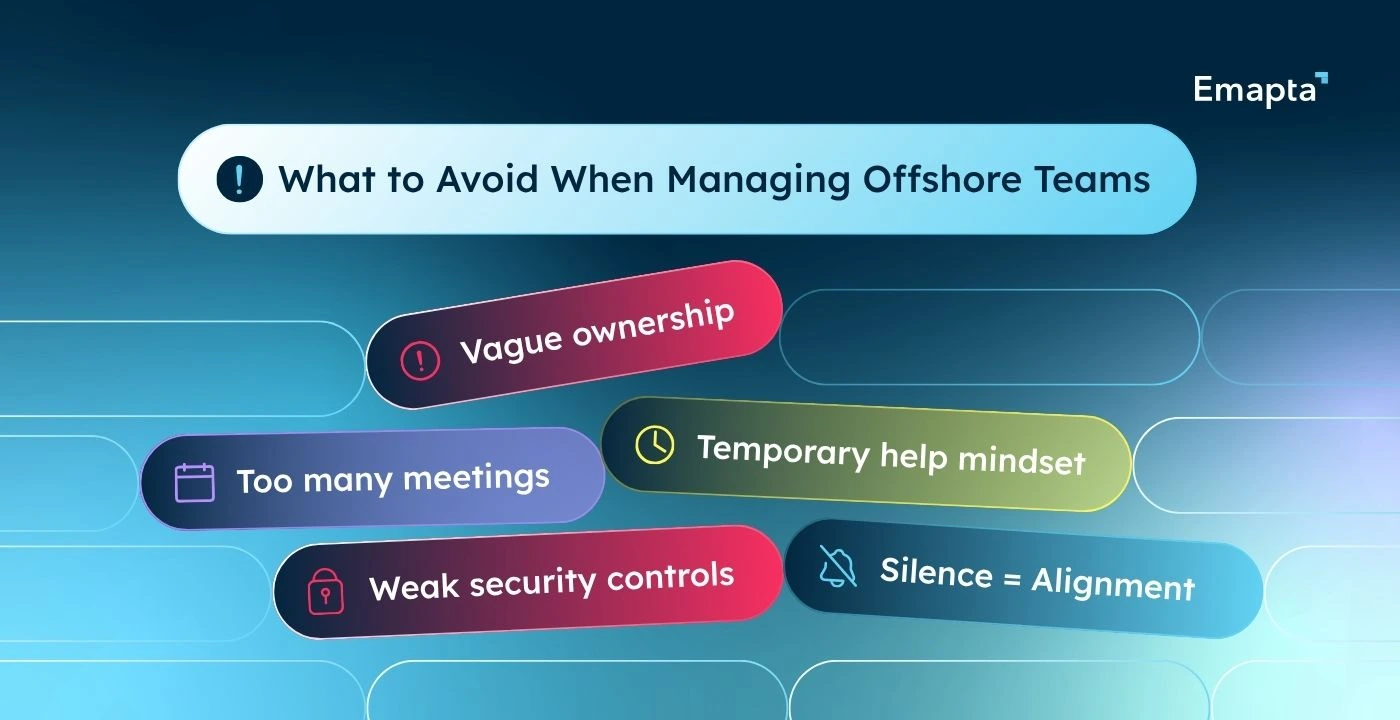
Some of the most recurrent challenges of working with an offshore team are:
1. Vague Ownership
If everyone assigns work and nobody owns the priorities, the offshore team will receive mixed signals, leading to delays, duplicate work, and frustration.
Avoid this by defining:
- One operational owner
- One escalation path
- One source of priority
- One final approver for each workflow
2. Meeting-Heavy Management
Non-stop meetings do not always mean better alignment. More often than not, too many meetings mean the team lacks documentation, decision rights, or trust.
Avoid using meetings for every update and use meetings for decisions, problem-solving, and relationship-building.
Managing offshore teams effectively means using written updates for the following:
- Task status
- Routine questions
- Meeting recaps
- Progress reports
- Simple approvals
3. Treating the Team Like Temporary Help
A dedicated offshore team should not feel disposable. If the team is only brought in for overflow work, urgent fixes, or repetitive tasks, it will never build the confidence or business knowledge needed to improve the operation.
Avoid treating the team like temporary help by making sure they are not limited to:
- Overflow tasks with no long-term ownership
- Urgent fixes without enough context
- Repetitive work disconnected from business goals
- Execution-only tasks with no room to suggest improvements
- Meetings where they listen but are never asked to contribute
- Processes they support but do not understand end to end
4. Assuming Silence Means Alignment
Silence can mean agreement, but it can also mean confusion, hesitation, or fear of challenging the client.
Instead of asking, “does everyone understand?” ask:
- “What is your understanding of the next step?”
- “What could block this?”
- “What information is missing?”
- “What would you do differently?”
- “Where do you see risk?”
5. One-Size-Fits-All Management
Different locations may require different management rhythms. For U.S companies, for example, working with offshore teams in India or the Philippines may require a different overlap schedule than working with teams in Colombia, Mexico or the Dominican Republic.
The same applies to:
- Local holidays
- Language expectations
- Feedback style
- Meeting times
- Cultural norms
6. Weak Security Controls
Do not wait until the team is large to tighten access. By then, permissions, shared credentials, and informal workarounds may already be part of the workflow.
So, make sure to avoid:
- Shared logins
- Unapproved AI tools
- Untracked file downloads
- Informal access requests
- Delayed offboarding
- Overly broad permissions
Wrapping Up
Successfully managing an offshore team can be difficult when ownership, communication, and expectations are unclear. Without the right structure, teams can run into delays, rework, too many meetings, and missed context.
The solution is to create a simple system with clear owners, better task briefs, written updates, useful KPIs, regular feedback, and secure access help offshore teams work with more confidence and less friction.