

How to Build a Remote Marketing Team That Drives Real Growth
To successfully build a remote marketing team, you need to have a clear focus on how you communicate and support your team, which tools you’d want to use for management purposes, and what kinds of roles you’d want to outsource.
When you optimize this structure, you can effectively organize responsibilities, workflows, marketing roles, and make sure you scale efficiently without compromising quality.
Let’s take a look at the necessary steps to make this goal a reality.
Building Remote Marketing Teams – Key Takeaways
- Create and set a clear structure that will allow you to define core roles and then scale at a steady pace
- Look for a good cultural fit and candidates who are communicative and with strong remote work discipline
- Set clear goals and KPIs to align everyone on outcomes, accountability, and transparency
- Use the right management tools for collaboration, project management, and marketing analytics and automation
Why You Should Build a Remote Marketing Team
Building a remote marketing team offers businesses a wide range of advantages that can strengthen their marketing efforts. Greater flexibility, cost savings, and access to a diverse global talent pool are key benefits that can give companies a competitive edge.
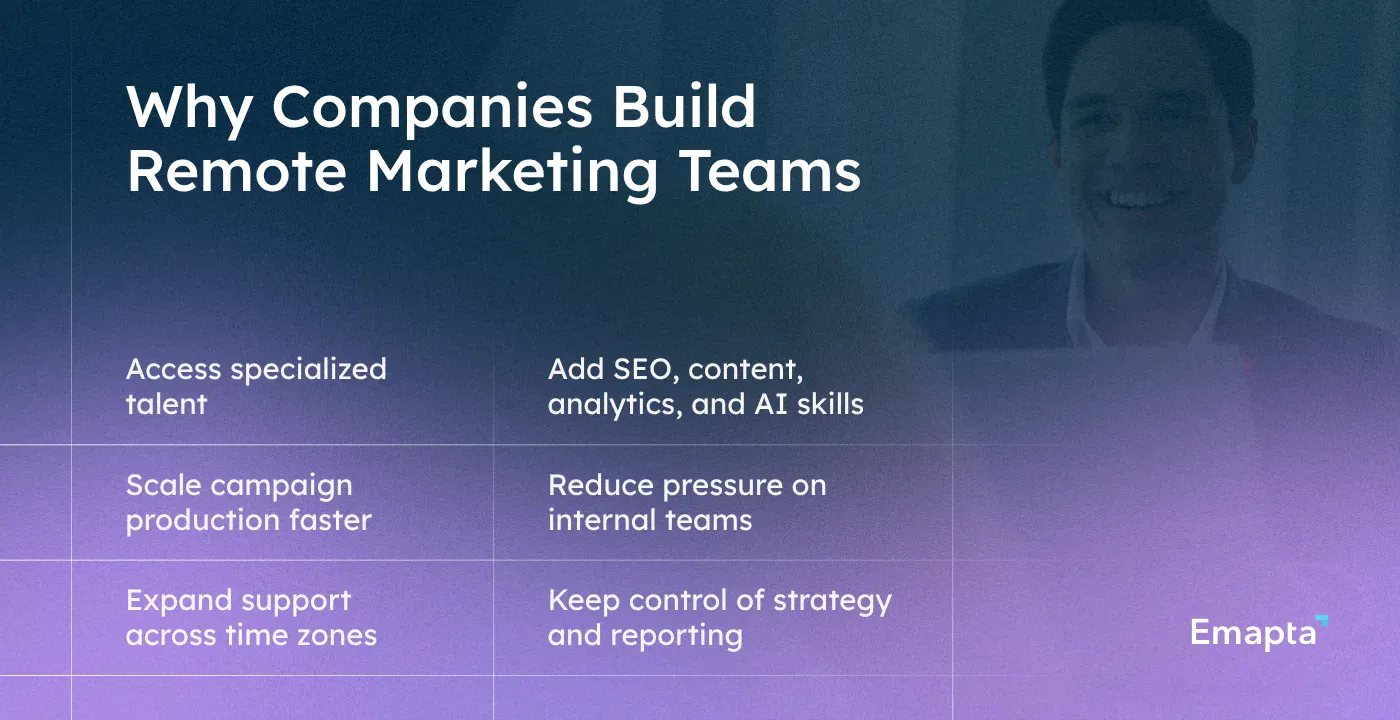
A remote marketing team gives companies a way to solve those gaps with more flexibility. It can help businesses:
- Access specialized marketing talent beyond one city or region
- Scale campaign production without overloading internal teams
- Build stronger coverage across time zones and markets
- Add skills in SEO, content, paid media, analytics, design, automation, or AI
- Improve speed without moving every task to an agency
- Keep control of strategy, brand, reporting, and execution
But the bigger reason is simple: modern marketing needs more skills than most companies can hire locally at the right speed.
The latest marketing skills report found that marketers’ largest skill gaps include digital marketing, data and analytics, proving ROI, and data privacy or compliance. Remote hiring gives leaders a broader way to access these roles.
7 Tips on How to Build a Remote Marketing Team
A good remote team is a seamless system, consisting of a group of talented people working from different places.
The roles, workflows, tools, goals, creative standards, approvals, and reporting all need to connect. Without that structure, even skilled marketers can end up working in silos, duplicating tasks, or wasting time waiting for feedback.
To successfully build remote marketing teams that can actually support growth, start with these seven steps.
1. Define What the Team Will Own
The first step is to map the work, before even venturing into hiring. Do you need help with strategy, execution, reporting, or all three? Will the team manage content, SEO, paid media, social, email marketing, design, web updates, campaign operations, or analytics?
These are the questions you should be asking as clear ownership prevents confusion later. So, start by defining:
- Core channels
- Campaign types
- Target audience
- Sales handoffs
- Brand and messaging standards
- Approval process
- Reporting cadence
- Tools and systems
- What stays in-house
- What the remote team can own directly
This step matters because marketing work can quickly become messy when no one knows who owns the final result.
For example, a remote content marketing team may write blog posts, update landing pages, and repurpose assets. But if no one owns the keyword strategy, content calendar, review process, and final publishing checklist, production will slow down.
2. Hire for Skill, Judgment, and Ownership
It’s easy to think that recruiting remote teams is about finding people who can work independently. That is only part of it.
Remote marketers also need strong judgment. They need to understand how their work affects revenue, customer acquisition, brand trust, and sales alignment.
The best candidates usually show:
- Strong written communication
- Clear portfolio or work samples
- Comfort with digital tools
- Good documentation habits
- Ability to receive feedback
- Ownership of deadlines
- Curiosity about customers and competitors
- Comfort working across time zones
- Understanding of performance metrics
A practical hiring process should include a role scorecard, a short work sample, and a live review of the candidate’s thinking on core issues. This helps you see how they solve problems, not just how good their resume is.
3. Build the Core Team Around Your Growth Motion
A remote digital marketing team should match the way your business grows.
If your company depends on inbound leads, content and SEO should come first. If you rely on paid acquisition, you may need a copywriter instead of a content writer, then a performance marketer and a designer before adding other roles.
A simple team structure could look like this:
- Marketing lead or manager
- Content strategist
- Content writer
- Copywriter
- SEO specialist
- Paid media specialist
- Designer
- Marketing analyst
- Email or lifecycle marketer
- Marketing operations specialist
You don’t need every role on day one. In many cases, the best approach is to start with the roles that remove the biggest bottlenecks.
A lean team may begin with a marketing lead, a content specialist, and a performance or analytics specialist. From there, you can add design, automation, web, or lifecycle support as the team matures.

4. Create Briefs, Workflows, and Review Rules Before Volume Increases
Remote teams move faster when the work is easy to understand before it starts. That means briefs have a big impact on output.
A strong brief should explain the goal, audience, message, channel, deadline, owner, review steps, and success metric. Without that, remote teams waste too much time guessing.
For marketing teams, useful workflow assets include:
- Campaign briefs
- Content briefs
- Creative request forms
- SEO checklists
- Brand voice guidelines
- Design templates
- Landing page QA checklists
- File naming rules
- Approval timelines
- Reporting templates
This structure protects quality and reduces the back-and-forth that makes remote teams feel slower than they really are.
5. Set Up the Right Tools and Access
The tools should help the team work clearly, not create another layer of noise. A reliable setup usually needs:
- Project management tool
- Internal chat and video platform
- Shared documentation hub
- Cloud file storage
- Design and creative tools
- SEO and analytics tools
- CRM and marketing automation platform
- Reporting dashboard
- Password and identity management
- Secure access controls
The most important point is that the team fully understands the purpose of each tool.
6. Use AI to Support the Team, Not Replace Thinking
AI can help remote marketers move faster, especially when they are managing several channels at once. The best use cases include:
- Content outlines
- Keyword clustering
- Campaign variations
- Ad copy drafts
- Meeting summaries
- Customer research synthesis
- Reporting summaries
- Creative versioning
- Workflow automation
That said, AI should not replace strategy, brand judgment, or customer understanding. Marketing still needs people who can decide what matters, what sounds right, what should be tested, and what should never go live.
A good rule of thumb is to use AI to remove repetitive work, then keep human review for strategy, accuracy, tone, and final approval.
7. Keep the Team Integrated with the Business
Remote teams fail when they feel like an outside production desk. They perform better when they operate inside the business, use the same tools, follow the same standards, and report against the same goals as the in-house team.
The right model gives companies:
- Shared goals
- Shared reporting
- Shared campaign calendars
- Clear ownership
- Regular feedback
- Direct manager visibility
- Strong onboarding
- Flexible scaling
- Consistent brand standards
This is where a dedicated staffing model stands out. With the right partner, remote marketers can work as an extension of your business while the partner supports recruitment, HR, payroll, compliance, onboarding, and setup.
A strong staffing partner should also offer access to high-quality global talent, transparent pricing, and flexible scaling options. That way, companies can build remote teams without giving up control.
How to Manage a Remote Marketing Team
Managing a remote team takes more structure than handling people who sit in the same room. You cannot rely on hallway conversations or quick desk check-ins.
Everything needs to be visible enough for leaders to stay in control, but not so heavy that marketers spend more time updating tools than doing the work.
The following practices will help you manage remote teams with more clarity and less friction.
a) Set a Weekly Operating Rhythm
A remote team needs a steady rhythm. However, this doesn’t mean having more meetings, rather it means ensuring the team knows when planning, feedback, and decision-making take place, as well as when results are reviewed.
A simple rhythm could include:
- Weekly planning meeting
- Weekly campaign status update
- Weekly or biweekly 1:1s
- Monthly KPI review
- Monthly content or campaign retrospective
- Quarterly skills and capacity review
b) Protect Focus Time
Marketing work needs consistency and a lot of focus. Strategy, writing, design, campaign analysis, and reporting all suffer when the day is broken into too many meetings and messages.
According to a 2025 Microsoft report, employees are interrupted every two minutes by meetings, emails, or notifications, leading to an average of 275 interruptions each day. Some helpful tips to keep your remote team focused are:
- Using async updates for status
- Using meetings for decisions
- Using project management tools for ownership
- Using comments for feedback
- Using dashboards for performance
- Keeping creative reviews focused and time-bound
c) Give Managers Better Dashboards
Remote marketing team management works best when performance is visible.
Managers should be able to access updated dashboards for each task, not with the objective of micromanaging, but to identify issues early and support the team before small delays turn into missed opportunities.
Useful dashboards may include:
- Campaign calendar
- Content production tracker
- SEO performance report
- Paid media dashboard
- Website conversion dashboard
- Lead and pipeline report
- Creative request tracker
- Team capacity overview
d) Promote Communication and Culture
Remote marketers can be productive and disconnected at the same time, which is why culture needs to be part of the operating model.
These are the practical ways to build connection:
- Clear communication rules
- Dedicated team channels
- Regular campaign retrospectives
- Recognition for strong work
- Peer reviews and learning sessions
- Shared wins with sales and leadership
- Ongoing coaching
Additionally, Gallup reports that managers account for 70% of the variance in team-level engagement. That makes manager quality one of the biggest factors in whether a remote team feels connected, trusted, and productive.
What to Track When Building & Managing a Remote Marketing Team
The most important part of building and managing a remote marketing team is knowing what to track and how to track it. Setting up Key Performance Indicators (KPIs) helps ensure your team stays accountable, aligned, and focused on the company’s goals.
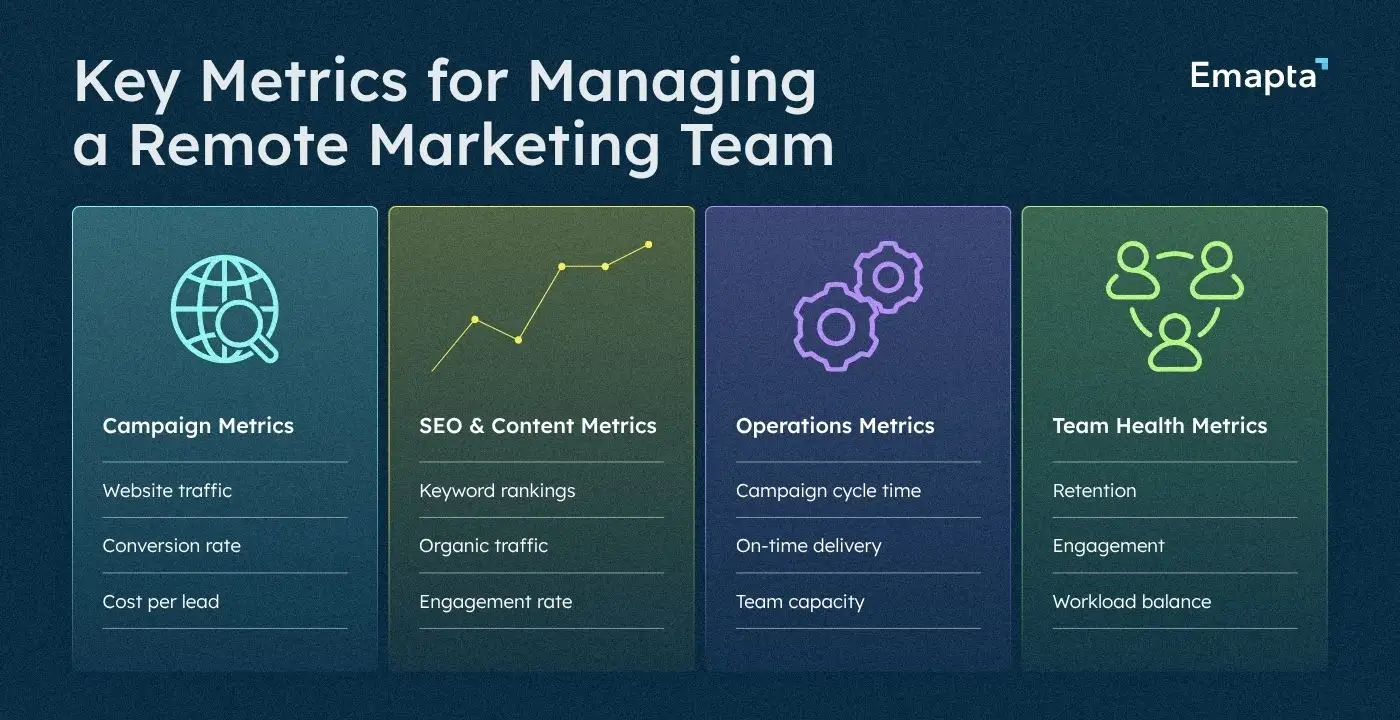
For successful remote marketing team recruitment, it’s important to monitor a balanced set of metrics across four areas. These include the following:
| Campaign and Demand Metrics | Content and SEO Metrics | Operations Metrics | Team Health Metrics |
|---|---|---|---|
| Website traffic | Keyword rankings | Campaign cycle time | Retention |
| Organic clicks | Organic sessions | On-time delivery | Engagement |
| Paid clicks | Blog traffic | Creative turnaround time | Training completion |
| Click-through rate | Content-assisted conversions | Number of experiments launched | Feedback cadence |
| Cost per click | Backlinks | Brief completion quality | Workload balance |
| Conversion rate | Engagement rate | Review delays | Manager 1:1 consistency |
| Cost per lead | Average position | Team capacity | |
| Marketing-qualified leads | Content production velocity | ||
| Sales-qualified leads | Content refresh performance | ||
| Pipeline influenced | |||
| Revenue influenced |
What to Avoid When Building a Remote Marketing Team
Remote teams may face a variety of obstacles, but proactive solutions can turn these challenges into strengths. These are the most common challenges that you should avoid when building your remote team.
Treating Remote Work as the Strategy – Remote work is only the setup, as teams still need clear goals, ownership, workflows, tools, and leadership to perform well.
Hiring Too Many Specialists Too Early – Adding more roles won’t solve unclear processes, so focus on the biggest bottlenecks first, then scale as the team grows.
Measuring Activity Instead of Result – Online presence is not performance, which is where you need to track campaign progress, content quality, conversions, reporting accuracy, and business impact instead.
Relying Too Much on Meetings – Important decisions should not live only in calls, but should also be present within document briefs, approvals, and updates to keep teams aligned across locations.
Ignoring Collaboration and Integration – Remote marketers should feel connected to the business, understand the brand, and work within the same systems and goals as the in-house team.
Conclusion
As businesses grow, marketing teams are often pushed to handle more campaigns, channels, and reporting with limited time and resources.
Building a remote marketing team helps solve those gaps by giving companies access to specialized talent, flexible support, and additional production capacity.
With the right structure, communication, and performance management in place, remote marketers can become a natural extension of the business, helping teams move faster, stay focused, and support long-term growth more effectively.