

The Rise of the AI-Augmented Workforce in ANZ
AI is everywhere in business conversations right now. But for many leaders, the practical workforce impact is still blurry.
Some of the headlines are about layoffs. Others are about productivity, copilots, and new tools. What is less clear is what all of that adds to the business.
That is where the idea of the AI-augmented workforce starts to matter. In simple terms, it describes a workplace where people aren’t just working alongside new technology. They are working differently because of it.
This Isn’t A Story About Job Loss
A lot of AI coverage still swings between two extremes. Either AI is replacing people, or it is making everyone more productive.
The reality looks more nuanced than that.
In Australia, Jobs and Skills Australia says generative AI is more likely to augment work than replace jobs outright. The research describes AI as a force that is starting to reshape tasks, workflows, and the way work gets done across the labour market.
At the same time, structural change is real. Across industries, roles that rely heavily on repetitive, process-driven tasks are being reduced or redesigned as AI becomes more capable. But the same shift that is displacing some roles is creating others.
Research from Deel found that demand for AI trainers surged by 283% globally in 2025, with Australia emerging as the second-largest employer of AI trainers in the Asia Pacific region. A nurse’s ability to spot a flawed medical summary or an accountant’s eye for a miscalculated financial output is becoming directly useful in training smarter, more reliable AI systems.
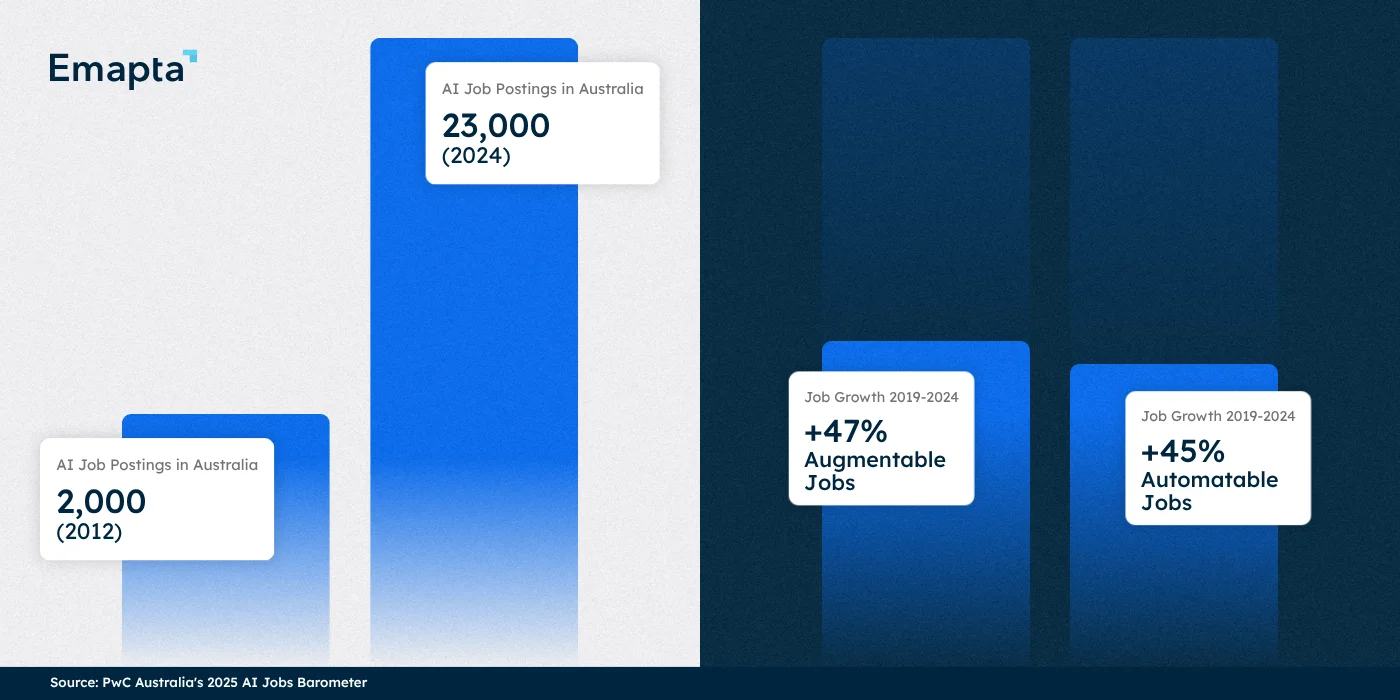
The numbers tell a similar story. According to PwC Australia’s 2025 AI Jobs Barometer, job postings requiring AI skills in Australia grew from just 2,000 in 2012 to 23,000 in 2024. Between 2019 and 2024, both augmentable and automatable jobs grew, at 47% and 45% respectively, suggesting AI is expanding workforce demand rather than simply contracting it.
Why “Wait and See” is No Longer a Viable Position
The pace of AI adoption means that businesses delaying workforce redesign are already falling behind. The gap between organisations that have integrated AI into their operations and those that have not is becoming increasingly visible, showing up in productivity, turnaround times, and service quality.
The challenge for most ANZ leaders isn’t access to AI tools. It is having the right people to use them effectively. And that isn’t just about hiring people who have heard of ChatGPT. It means bringing in professionals who are actively trained to work with industry-leading AI tools, who understand how to apply them within real business workflows, and who can drive measurable improvements in productivity and efficiency from day one.
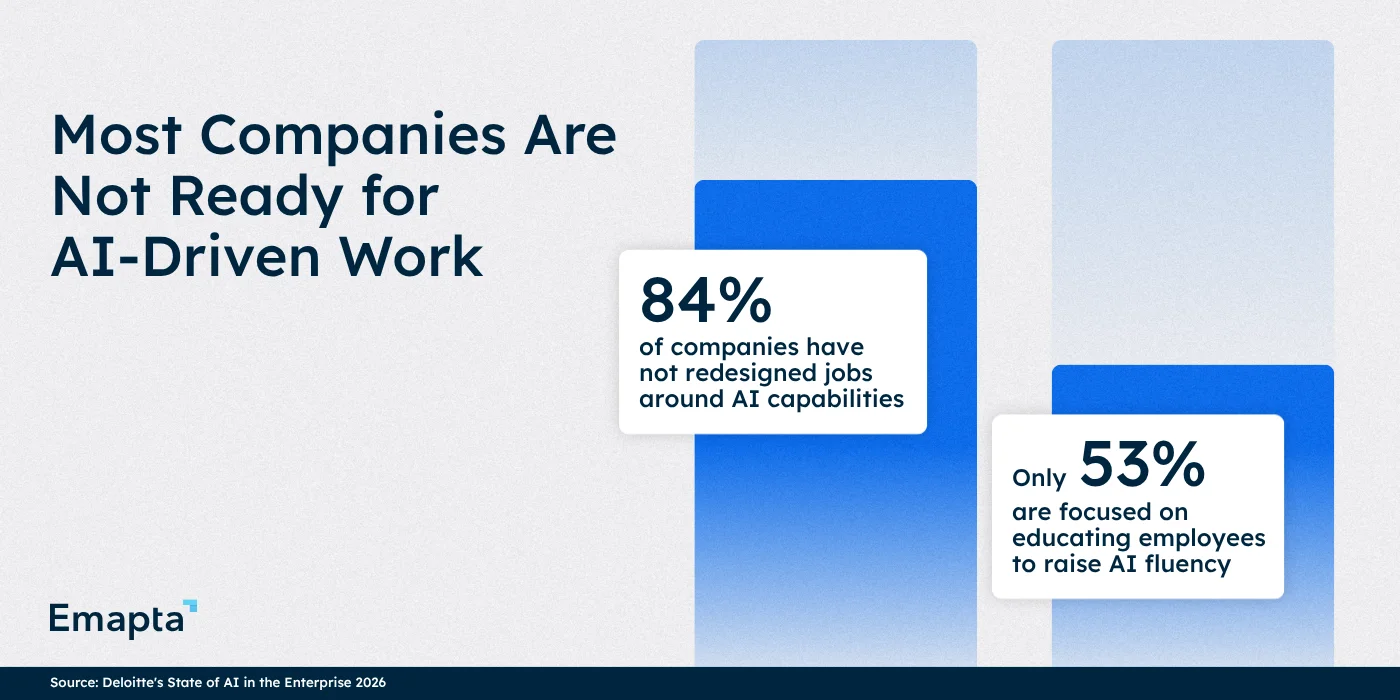
The data underscores the urgency. Deloitte’s State of AI in the Enterprise 2026, a survey of more than 3,200 business and IT leaders globally including Australia, found that 84% of companies have not yet redesigned jobs or the nature of work around AI capabilities. Insufficient worker skills are cited as the biggest barrier to integrating AI into existing workflows, yet fewer than half of companies are making significant adjustments to their talent strategies.
That requires a deliberate approach to workforce composition, not just a software investment. And increasingly, that means looking beyond local hiring. Global research backs this up further.
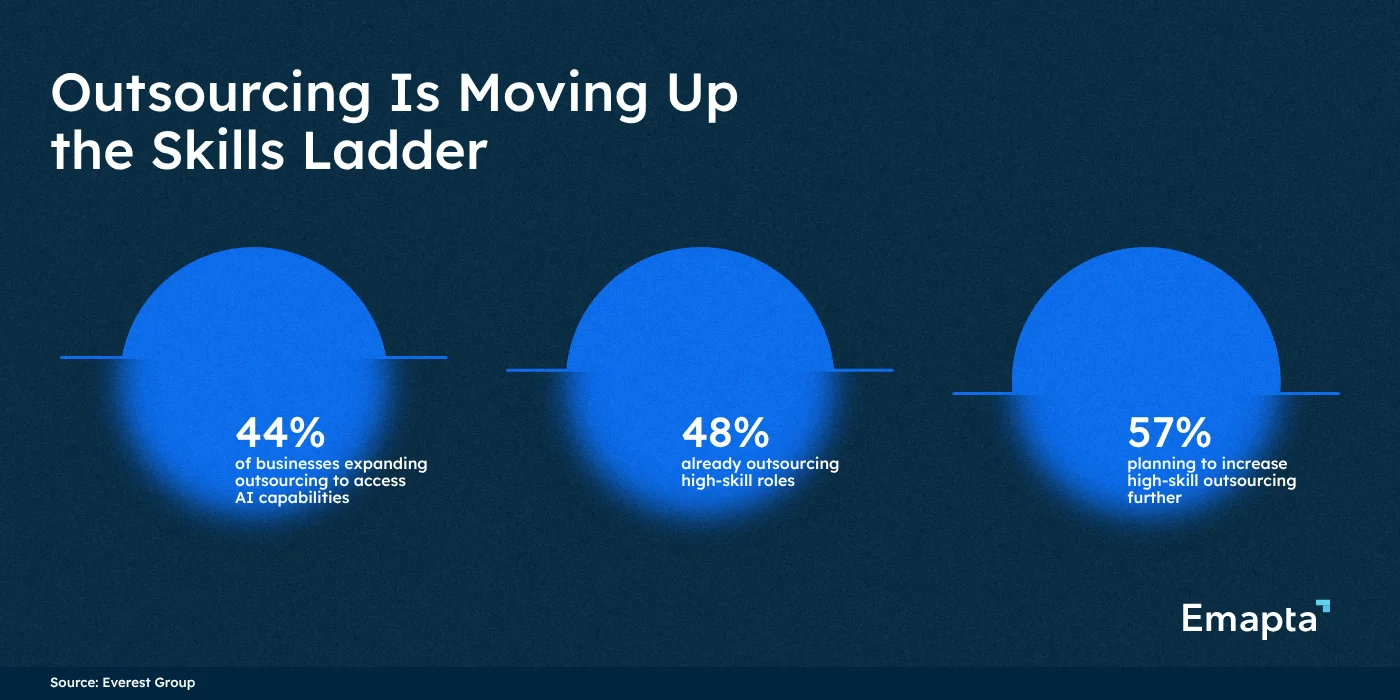
A report by Everest Group, supported by Emapta and drawing on surveys of more than 100 C-suite and senior executives, found that 44% of businesses are now expanding outsourcing specifically to access AI capabilities they don’t have in-house. According to the same research, 48% of companies now outsource high-skill roles, with 57% planning to increase that further, challenging the outdated assumption that outsourcing is reserved for low-level operational tasks. Outsourcing is increasingly becoming the execution layer of AI strategy, not a workaround for it.
Importantly, the businesses gaining the most from this shift are not turning to global talent simply to cut costs. They are using it to access capabilities they cannot build locally fast enough, and to redesign how work gets done in an AI-driven environment.
What AI-enabled Global Talent Actually Means
Building AI-ready teams starts with talent, not technology. While there’s a lot of noise around “AI-ready talent,” the term itself doesn’t offer much clarity to leaders. In practice, it means building a team of top-tier professionals, those in the top 1% of their fields, who are trained to work with industry-leading AI tools to drive greater productivity and efficiency across real business functions.
This isn’t about replacing human judgment with automation. It is about professionals who know which AI tools to use, when to use them, how to quality-check outputs, and how to integrate them into existing workflows without disrupting delivery. The result is a team that moves faster, catches more, and scales more efficiently than a traditionally composed workforce.
When this capability is embedded into a fully dedicated global team, built exclusively around one business, the productivity advantage compounds. Rather than sharing a resource pool or managing a vendor at arm’s length, businesses get a high-performance team trained in AI-enabled ways of working, operating inside their tools, culture, and processes.
The Augmented Workforce Model in Practice
The most effective response to AI disruption isn’t replacing people with technology or ignoring technology in favour of people. It is building a workforce where human capability and AI tools reinforce each other.
In practice, this means rethinking which tasks require senior onshore talent, which can be handled by skilled global professionals, and where AI can remove friction from both. Organisations that get this balance right are finding they can do more with leaner teams, faster turnaround times, and lower operational overhead, without sacrificing quality or control.
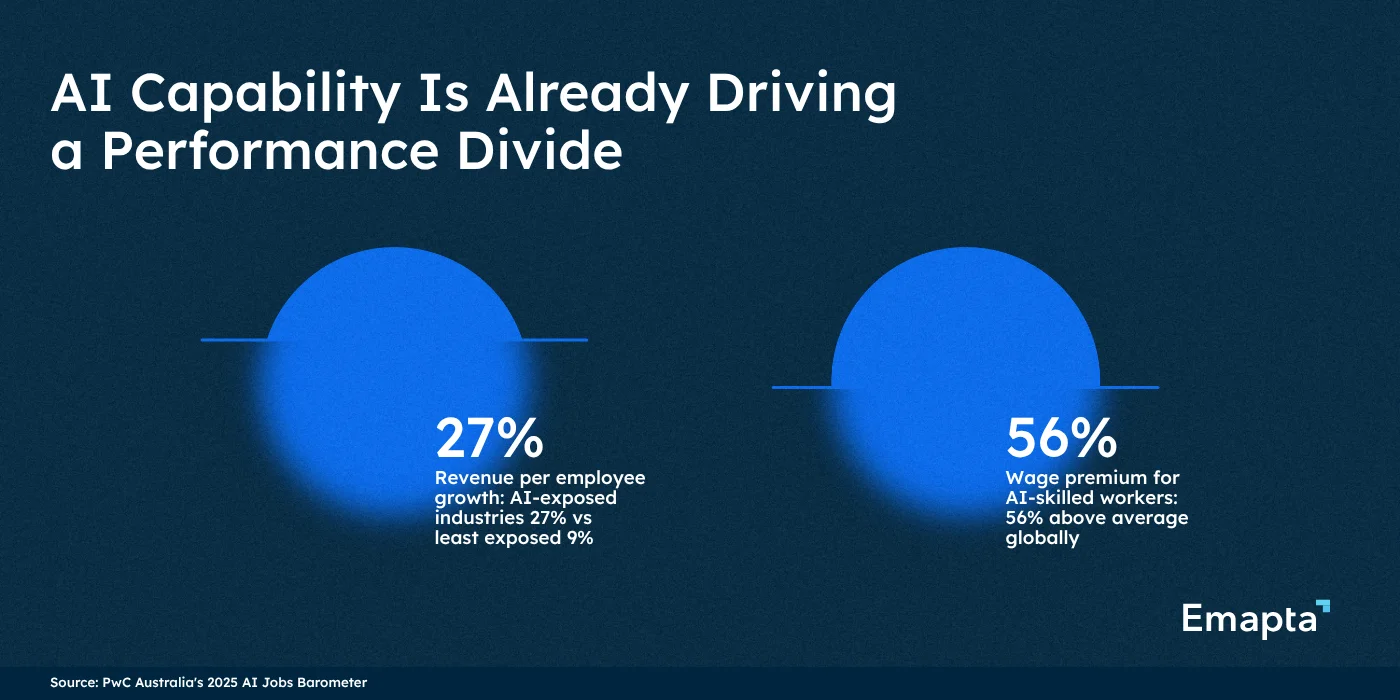
The productivity case is compelling. PwC’s research found that industries most exposed to AI saw three times higher growth in revenue per employee compared to those least exposed, at 27% versus 9%. AI-skilled workers are also commanding a 56% wage premium globally, reflecting just how scarce and valuable this capability has become.
This shift is already well underway at an enterprise level. The Everest Group research found that nearly 60% of enterprises now outsource three or more business functions, expanding well beyond IT and back-office roles into data and analytics, finance, sales, and strategy. Companies are increasingly looking beyond traditional back-office functions, building global teams around mid-level and specialist roles that sit closer to core business delivery.
How More Telecom Built a Scalable, AI-era Team
More Telecom, a Melbourne-based telecommunications provider, faced a version of this challenge as it scaled. The business needed to grow its workforce quickly and cost-effectively without compromising on service quality or operational control.
Starting with just seven team members through Emapta’s 16-office network in the Philippines, More Telecom expanded to a global team of 365 across customer service, IT development, QA testing, UI/UX design, multimedia, and data analytics. The model meant one Australian hire equated to bringing on up to two highly skilled global professionals, allowing the business to reinvest in capability rather than overhead.
Critically, More Telecom didn’t lose visibility or control in the process. Their Emapta team was built exclusively for them, fully embedded in their workflows, tools, and culture, with complete transparency over costs and team composition throughout.
The result is a workforce built for scale and, increasingly, for the kind of multi-function, AI-enabled delivery that modern business demands.
Why Emapta’s Model is Built Differently
Most conversations about outsourcing still conjure images of cost-cutting and lost control. The dedicated staffing model that is gaining traction among leading enterprises is built on a different set of principles entirely, and the results are starting to reflect that.
According to the same Everest Group research, 49% of enterprises are already using dedicated staffing models, with a further 35% planning to adopt them. The reason is straightforward: dedicated global teams offer something most models do not, a genuine balance between control, quality, and scalability.
What to Look for in a Global Talent Partner
Choosing the right global talent partner means looking beyond cost savings to find a model built for performance, transparency, and long-term impact. When evaluating a global talent partner, here’s what matters most:
Dedicated global teams, not traditional outsourcing. Exclusive, highly skilled teams that work only for you, fully embedded in your tools, workflows, and culture, with you retaining full control and visibility at all times.
Modern workforce design, not labour arbitrage. Custom-built global teams across finance, data, AI, engineering, supply chain, and operations, designed to scale with flexibility and intent, not just to reduce costs.
Radical pricing transparency. A clear breakdown of individual salaries and service costs, with no salary markups and no hidden margins. Savings come from smarter design, not opacity.
Flexibility without lock-ins. No long-term contracts, no minimum hires. You get the freedom to scale, reshape, or pivot as your business evolves.
AI-enabled talent built for performance. Through Emapta’s Talent Marketplace (ETM), businesses access pre-vetted talent sourced from the top 1% of their fields, trained to work with industry-leading AI tools for greater productivity and efficiency, and supported by dedicated client success partners so teams deliver impact from day one. ETM isn’t just a hiring tool. It is the engine behind how Emapta matches the right talent to the right business at speed, with precision.
A genuine commitment to training. Emapta invests continuously in the development of its people, with a particular focus on AI upskilling, so that the teams businesses build today remain high-performing as tools and workflows evolve.
What Resilient Workforce Strategy Looks Like Now
The companies adapting best to the talent environment aren’t waiting for conditions to normalise. They’re building more than one way to access skilled capability, and they’re doing it with the same focus on quality, continuity, and control they’d apply to any critical business function.
The businesses building durable advantages right now aren’t waiting for the perfect hire or the right market conditions. They are designing workforces with global talent at the centre, AI-enabled capability embedded throughout, and the flexibility to scale without being locked in.
For businesses looking to build that kind of capability, the model needs to be transparent, flexible, and built around the business rather than around the provider. That means full visibility over costs, no lock-in commitments, and a team that is genuinely embedded in how the business operates.
For leaders navigating AI-driven workforce change, the tools are only part of the answer. The more durable question is whether the business has a workforce model flexible enough to evolve as the environment does.