

7 Reasons Why Businesses Outsource in the Philippines
The benefits of outsourcing to the Philippines have helped turn the country into one of the world’s most trusted global talent hubs.
For decades, businesses have looked to the country for skilled professionals, cost-efficient support, strong English communication, and proven offshore experience. But the real value today goes far beyond traditional outsourcing.
So, what have thousands of businesses found in the Philippines after years of working with one of the world’s leading outsourcing markets?
Why Businesses Choose the Philippines for Outsourcing
The main reasons businesses outsource in the Philippines often come down to four needs: reducing costs, accessing skilled talent, improving service delivery, and scaling teams faster.
For many businesses, outsourcing to the Philippines also gives local teams breathing room. Instead of stretching in-house staff across admin, customer support, or other back-office tasks, companies can build offshore teams that handle critical work every day.
That balance is what makes the Philippines stand out. It’s not only a cost-saving option. It is a long-term workforce strategy for companies that need flexibility, consistency, and room to grow.
7 Business Benefits of Outsourcing to the Philippines
The business benefits of outsourcing to the Philippines are strongest when companies look beyond cost alone.
The country can help organizations build reliable teams, extend capacity, and support long-term growth when the right roles, processes, and outsourcing partner are in place. Let’s explore the 7 main reasons to outsource to the Philippines.
1. Cost-Efficient Operations That Support Growth
Cost efficiency is one of the first reasons companies consider outsourcing, and the Philippines remains one of the strongest markets for it.
Businesses can reduce operating costs up to 70% while still accessing qualified professionals who support a wide range of industries. That matters for companies facing rising local salaries, tight hiring markets, or pressure to do more with leaner teams.
But cost should not be the only goal. The strongest outsourcing strategies use savings to support better growth. That may mean investing more in local leadership, technology, customer experience, product development, or new markets.
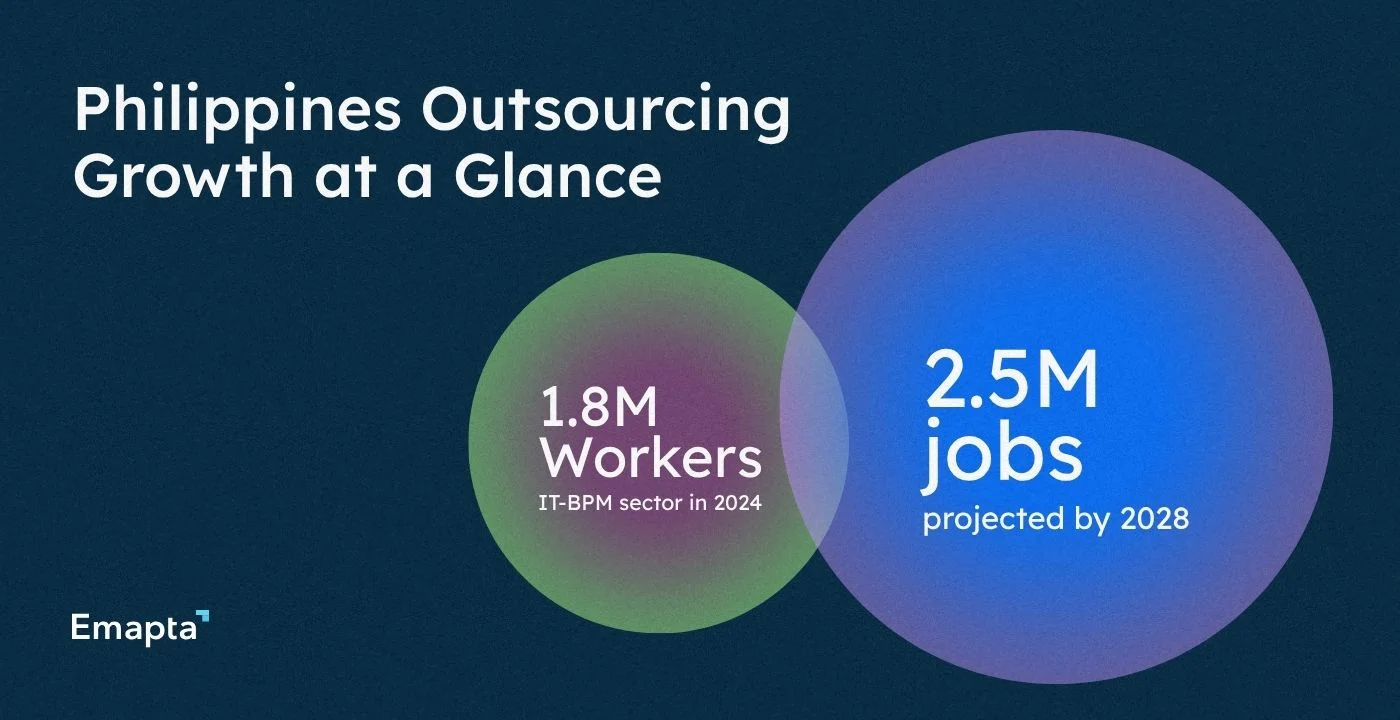
The growth of the Philippines IT-BPM industry demonstrates that cost efficiency goes hand in hand with strong demand. Reuters reported that the sector grew by 7% in 2024, reaching $38 billion in revenue and supporting 1.82 million jobs. This number is expected to grow to 2.5 million jobs by 2028.
That scale gives businesses more confidence. Rather than entering an untested market, they are building teams in a country with an established outsourcing ecosystem and years of experience serving global clients.
2. Large Workforce for Scalable Offshore Hiring
For businesses that need to outsource and scale teams, the Philippines offers the depth of talent needed to support long-term hiring.
The Philippine Statistics Authority reported that 51.30 million Filipinos were in the labor force in April 2026. This large talent pool gives businesses access to professionals across a wide range of industries and functions, making it easier to build teams beyond traditional back-office support.
A large workforce also gives businesses more room to grow. A company might start with two customer support specialists, then expand into billing, reporting, documentation, lead generation, or technical support as the model proves itself.
This is one of the reasons businesses outsource work to the Philippines when local hiring becomes slow, costly, or difficult to maintain. With the right partner, companies can build offshore teams and relieve pressure on their local staff.
3. Diverse Talent Pool
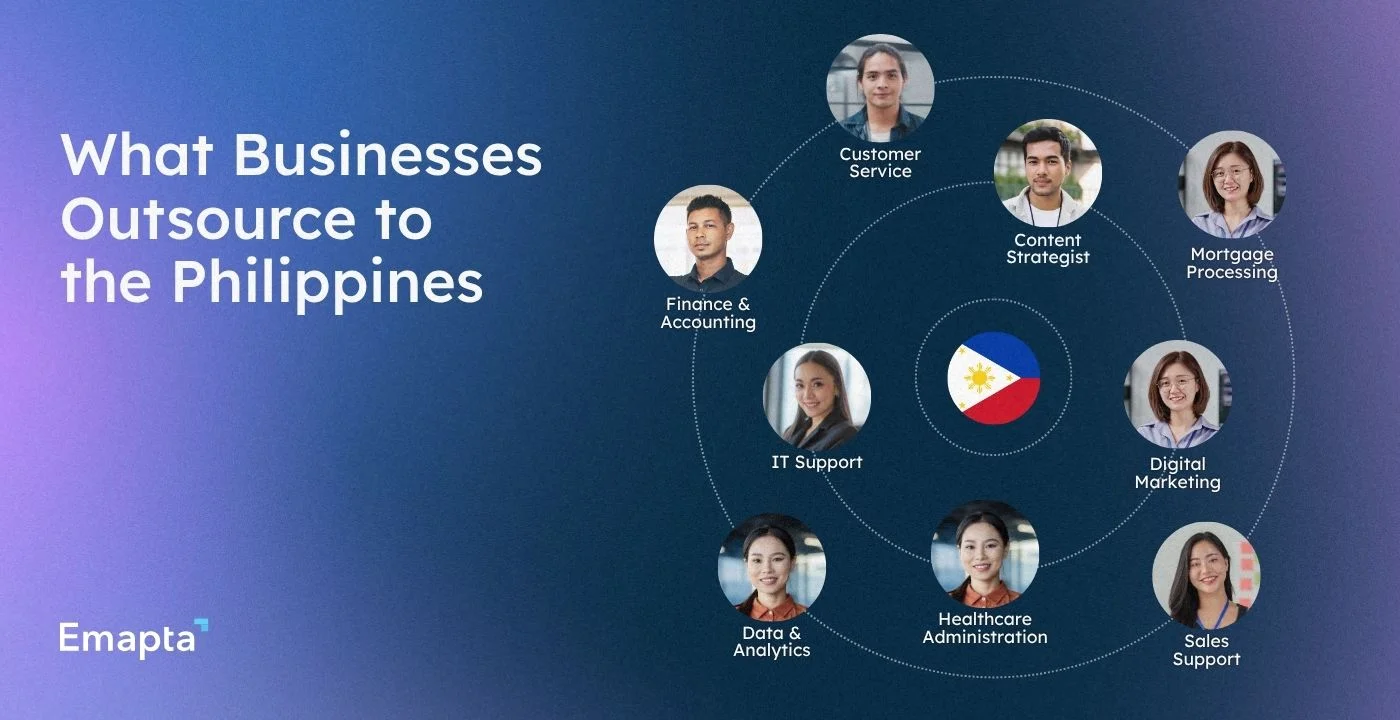
The Philippines is often associated with call centers, but its talent market is much broader than that. Today, companies outsource a wide range of functions beyond customer support, including:
- Finance and accounting
- IT support
- Software development
- Healthcare administration
- Mortgage processing
- Sales support
- Creative production
- Digital marketing
- Data entry and analytics
For companies, this means the Philippines can support more than basic task execution. With the right hiring strategy, businesses can build teams that take ownership of daily operations and become a steady part of the company’s growth.
4. Strong Work Ethic and Cultural Fit
Strong work ethic and cultural fit remain key reasons businesses choose the Philippines for outsourcing.
Filipino professionals are widely recognized for being service-oriented, adaptable, and collaborative. These qualities are especially valuable in customer service roles, where patience, clear communication, and customer experience shape brand trust.
Cultural fit also helps offshore teams integrate faster.
Many Filipino professionals are familiar with Western business practices, customer expectations, and communication styles. That reduces friction during onboarding and helps teams work more naturally with Western companies.
This is one of the benefits of outsourcing to the Philippines that is harder to measure, but easy to feel in daily operations. When offshore team members understand service standards and collaboration habits, the working relationship becomes smoother.
For businesses, that can lead to faster response times, better customer experiences, and stronger trust between local and offshore teams.
5. Talent Quality and Communication
A strong offshore team should not simply complete tasks. It should improve capacity, protect service quality, and help the business move faster. That requires people with the right technical and communication skills and the highest quality standards.
The Philippines offers a large pool of experienced talent across functions such as finance and accounting, customer service, IT, healthcare, marketing, and administrative support. Many professionals have experience working with international companies and are familiar with global business practices, performance standards, and service expectations.
English proficiency is another advantage. The EF English Proficiency Index ranked the Philippines #28 globally, reflecting strong English skills across key business functions. This supports clear communication in documentation, reporting, training, meetings, handovers, and day-to-day collaboration.
Together, these strengths make the Philippines an attractive outsourcing destination for businesses that need skilled professionals who can contribute effectively across customer-facing roles, internal operations, and specialized functions.
6. Long-Term Team Scalability
Outsourcing in the Philippines now goes far beyond customer service. Businesses are building specialized teams for roles that require industry knowledge, accuracy, and speed.
That is where Emapta’s model can make a difference. Rather than simply filling seats, Emapta helps businesses build dedicated offshore teams with transparent pricing, strong recruitment support, secure infrastructure, and the flexibility to scale as needed.
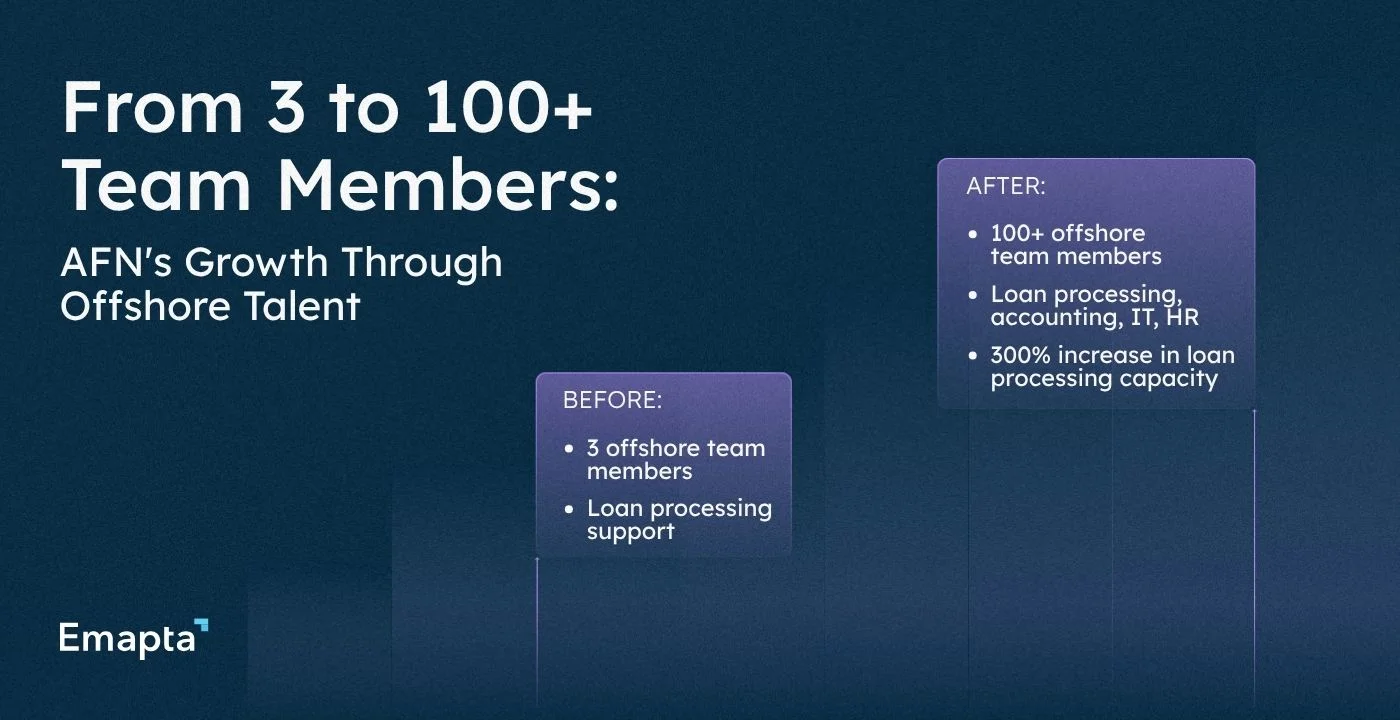
American Financial Network saw this firsthand. The U.S. mortgage company first partnered with Emapta to strengthen their loan processing capabilities, then quickly found talent for other key support functions, including accounting, IT, and human resources.
As a result, AFN’s offshore team grew from three people to more than 100 in less than nine months, helping the company increase loan processing capacity by 300%.
For companies operating in complex industries, this demonstrates the Philippines’ ability to accommodate a wide range of functions. With the right partner, offshore teams can take on specialized functions, expand capacity, and free local teams to focus on higher-value work.
7. Time Zone Flexibility
Time zone coverage is an important consideration when building an offshore team. Businesses often need support outside standard working hours to serve customers, maintain operations, or collaborate across multiple regions.
The Philippines offers flexibility for companies in North America, Europe, Australia, New Zealand, and other international markets. Many professionals are experienced in working evening, overnight, or rotating shifts to align with client requirements.
This flexibility helps businesses extend service hours, provide faster response times, and maintain continuity across different time zones. It can also support round-the-clock operations without requiring local teams to work outside their regular schedules.
What Services Can Businesses Outsource to the Philippines?
Businesses can outsource many functions to the Philippines. The best roles to outsource are usually process-driven, talent-constrained, or time-consuming for local teams. While these functions are critical to business performance, they can often be handled effectively by offshore professionals.
Common services include:
- Finance and accounting
- IT support
- Cybersecurity support
- Sales and lead generation
- Digital marketing
- Healthcare administration
- Mortgage and loan processing
- Real estate support
- Customer service
- Administrative support
- Data entry and back-office operations
- Analytics and reporting support
The right functions depend on the company’s goals. Some businesses need better customer coverage. Others need to reduce admin pressure, speed up finance workflows, support compliance, or build a more flexible operational base.
Is Outsourcing to the Philippines Right for Your Business?
Outsourcing to the Philippines can be a strong option for businesses that need to scale capacity, reduce costs, or access skilled offshore talent without overloading local teams.
It works best when the business has clear role expectations, defined workflows, and measurable performance goals. Offshore teams need structure to succeed, just like local teams do.
It may be a strong fit if your business needs to:
- Scale without overloading local teams
- Reduce costs while protecting service quality
- Fill roles that are hard to hire locally
- Extend operating hours or improve response times
- Build long-term offshore capacity
- Support specialized or process-heavy work
- Free local teams to focus on higher-value priorities
Outsourcing may be less effective if the business has unclear processes and weak internal ownership.
How to Choose the Right Outsourcing Partner in the Philippines
Choosing the right partner is key for businesses outsourcing to the Philippines because the provider shapes recruitment quality, team performance, security, and scalability.
The country offers a strong talent market, but the partner determines how that talent is hired, supported, managed, and retained.
Look for a provider that can guarantee:
- Transparent pricing
- Strong recruitment and talent matching
- Dedicated offshore teams
- Secure IT infrastructure
- HR, payroll, and compliance support
- Onboarding and retention
- Scalable operations across roles and departments
- Clear communication between local and offshore teams
Emapta helps businesses build dedicated teams in the Philippines with the infrastructure, support, and flexibility needed to scale sustainably. That means companies can access the top 1% of global talent while keeping control over their team’s structure and performance.
Ready to Start Outsourcing to the Philippines?
Companies outsource to the Philippines because the country offers a rare mix of cost-efficient talent, workforce depth, English communication, service expertise, industry maturity, and long-term scalability.
For businesses looking to grow without stretching local teams, the Philippines remains one of the strongest offshore destinations. The country can support customer-facing roles, back-office operations, specialized functions, and full dedicated teams.
The strongest results come from matching the country’s talent market with the right outsourcing partner. With Emapta, businesses can build dedicated offshore teams in the Philippines with the recruitment, infrastructure, transparency, and support needed to scale with confidence.
Frequently Asked Questions (FAQ)
Companies outsource to the Philippines to reduce costs, access skilled English-speaking talent, improve service delivery, and scale teams faster. The country also has a mature outsourcing industry that supports global businesses across various functions.
The main business benefits include cost-efficient talent, strong English communication, workforce scalability, service experience, mature outsourcing infrastructure, and access to roles beyond traditional call center support.
Yes. The Philippines remains one of the world’s top outsourcing destinations, supported by a large IT-BPM industry, a strong services workforce, and continued demand from international clients.
Businesses can outsource customer service, admin support, finance, accounting, IT support, cybersecurity support, sales, marketing, healthcare administration, mortgage processing, real estate support, data entry, and reporting roles to the Philippines.
No. While the Philippines is well-known for customer service, companies also outsource finance and accounting, IT, healthcare support, marketing, sales, admin, analytics, and other specialized roles.
Look for a provider with transparent pricing, strong recruitment, secure IT systems, HR and compliance support, proven onboarding processes, and the ability to build dedicated teams that match your business goals.