

15 Job Interview Statistics That Explain Hiring in 2026
Job interview statistics this year paint an interesting picture. Interviews are getting harder to reach, but employers are spending more time on the candidates who make it through.
Applications have surged, recruiting teams are leaner, and companies are interviewing more before making each hire. At the same time, post-interview ghosting remains common, and AI can now generate answers while an interview is happening.
We looked at the most recent facts to make sense of what is happening in the hiring market right now.
Key Interview Statistics [2026 – 2027]
- Companies conduct about 20 interviews for every hire, up 33% from 2021
- Technical roles require about 75% more interviews than non-technical roles
- Only 3% of inbound applicants reach the interview stage
- 78.2% of UK candidates have experienced a live online interview
- 61% of candidates said they had been ghosted after an interview
- 68% of job seekers would replace resumes with assessments and structured interviews
Global Job Interview Statistics
Companies now conduct about 20 interviews for every successful hire, 33% more than in 2021, while technical roles require about 75% more interviews than non-technical roles. Only 3% of inbound applicants reach the interview stage, compared with 40% of referrals and 42% of internal candidates. Structured interviews show about a 2.2 times stronger relationship with later job performance than unstructured interviews.
1. Companies Conduct About 33% More Interviews for Every Successful Hire Than in 2021.
Getting a good employee seems harder now, as businesses now conduct 20 interviews across the candidate pool before making one hire, compared with about 15 in 2021.
- Hiring volume remains about 30% below 2021 levels
- Recruiting teams are 14% smaller
- Recruiters handle 93% more applications
- Only about 0.5% of applicants ultimately get hired
- Interviews per hire have increased by 33%
Source: Gem, 2026 Recruiting Benchmarks Report
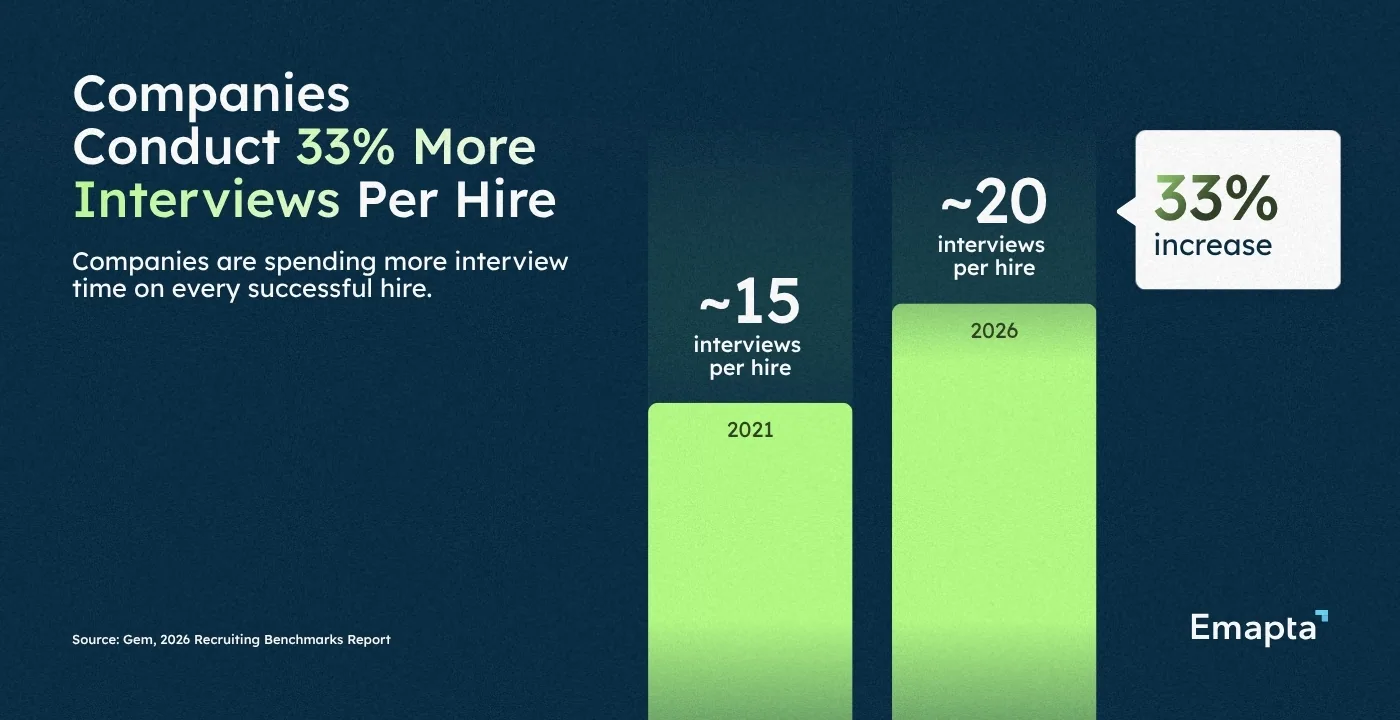
Even though companies are hiring less, recruiters are not doing less work. With leaner teams and AI now doing routine tasks, each remaining hire is more significant.
That may help explain why employers are spending more time before committing.
And it’s especially true for technical roles.
2. Filling Technical Roles Requires 75% More Interviews Than Non-Technical Roles.
Filling a technical position requires 35 to 36 interviews per hire, compared with around 20 for non-technical roles.
The gap makes sense when you look at the roles. Technical employees often work on systems, products, data, or processes that other teams (and the company itself) rely on.
A weak hire can slow projects, create rework, and put more pressure on people around them.
The difference is visible across several technical functions:
- Engineering: 35–36 interviews per hire, or about 26 interviewer hours
- Design and Product Management: 37–39 interviews, or around 23–25 hours
- Data Science: 38.5 interviews per hire
Source: Gem, 2026 Recruiting Benchmarks Report
Reaching an interview seems like winning the lottery for some candidates.
The following numbers show just how selective the process has become.
3. Only 3% of Inbound Applicants Reach an Interview.
There is no reliable universal answer to how many candidates are usually shortlisted for an interview. Recent data shows that the chance of reaching an interview depends heavily on where the candidate came from.
Across more than 38 million applications:
- 3% of inbound applicants reached an interview
- 25% of sourced candidates did
- 40% of referrals did
- 42% of internal candidates did
Source: Ashby, Candidate Referral and Hiring Funnel Research
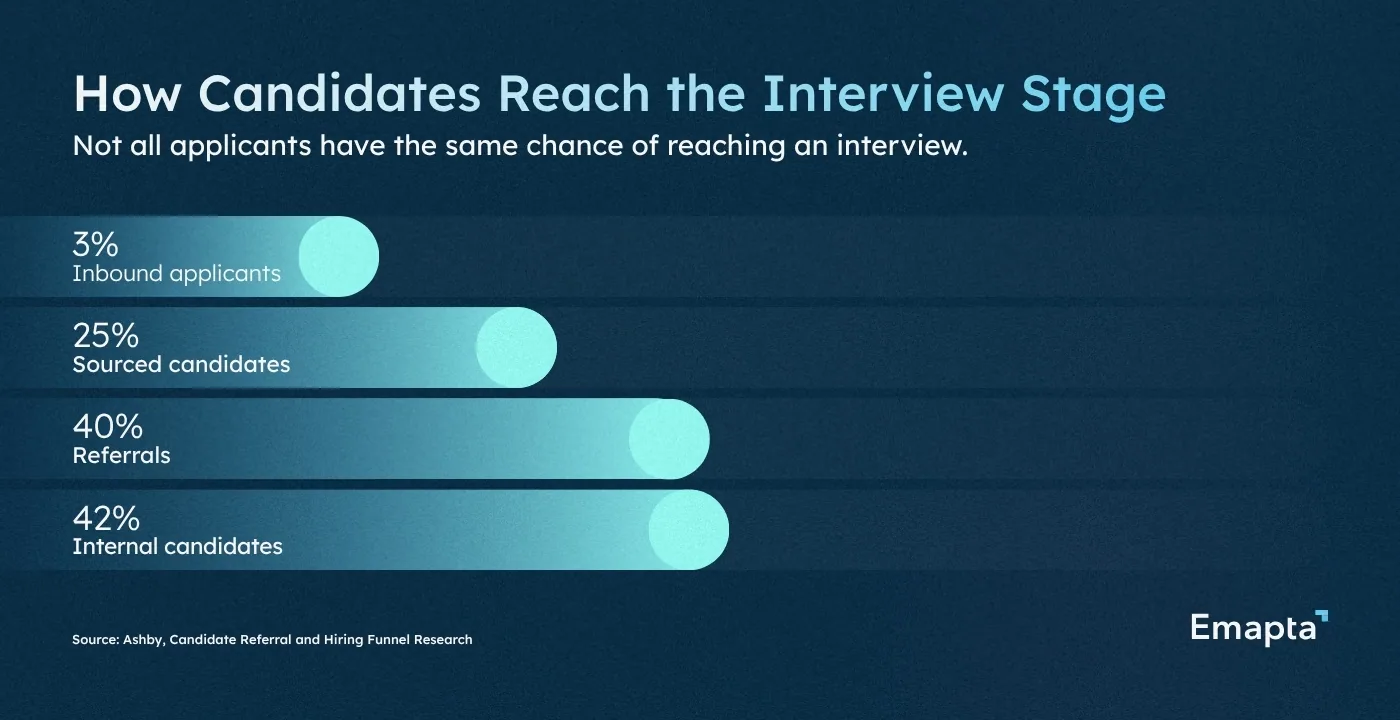
The difference is significant.
Employers are processing far more applications than a few years ago, and many are not strong matches for the role. The reason is that in a slow job market, candidates also tend to apply more broadly.
Sourced candidates and referrals start from a better position because they already have some level of fit or trust.
4. Structured Interviews Show a 2.2x Stronger Link with Job Performance.
Not all interviews are equally useful. Structured interviews, where candidates answer the same job-related questions and are scored against the same criteria, had a validity score of .42 for predicting future job performance. Unstructured interviews scored just .19.
Source: Sackett et al., personnel selection validity research
Job Interview Statistics by Country
Interview practices and pain points vary across markets. 71% of German candidates report biased or discriminatory interview questions. Live online interviews are already common, with 78.2% of UK candidates, 77.8% in North America, and 72.7% in South Africa reporting experience with them. The UK also recorded the highest post-AI-interview ghosting rate in one five-country study, at 42%.
5. 71% of German Candidates Report Biased or Discriminatory Interview Questions.
Germany stands out in recent interview data, with 71% of candidates saying they had faced biased or discriminatory questions during an interview.
For context:
- Germany: 71%
- US: 64%
- UK: 63%
Age-related questions were the most common issue across all three markets. The figure was highest in the US at 55%, followed by Germany at 48%.
Source: Greenhouse, 2024 State of Job Hunting Report
6. Almost 78% of Candidates in North America Had a Live Online Interview.
Virtual interview statistics show that live online interviews are already common across several markets. In 2025, 78.2% of UK candidates, 77.8% in North America, and 72.7% in South Africa had experienced one.
One-way recorded interviews were far less common, ranging from 17.8% in the UK to 27.3% in South Africa.
Source: Zibarras et al., Wiley Online Library
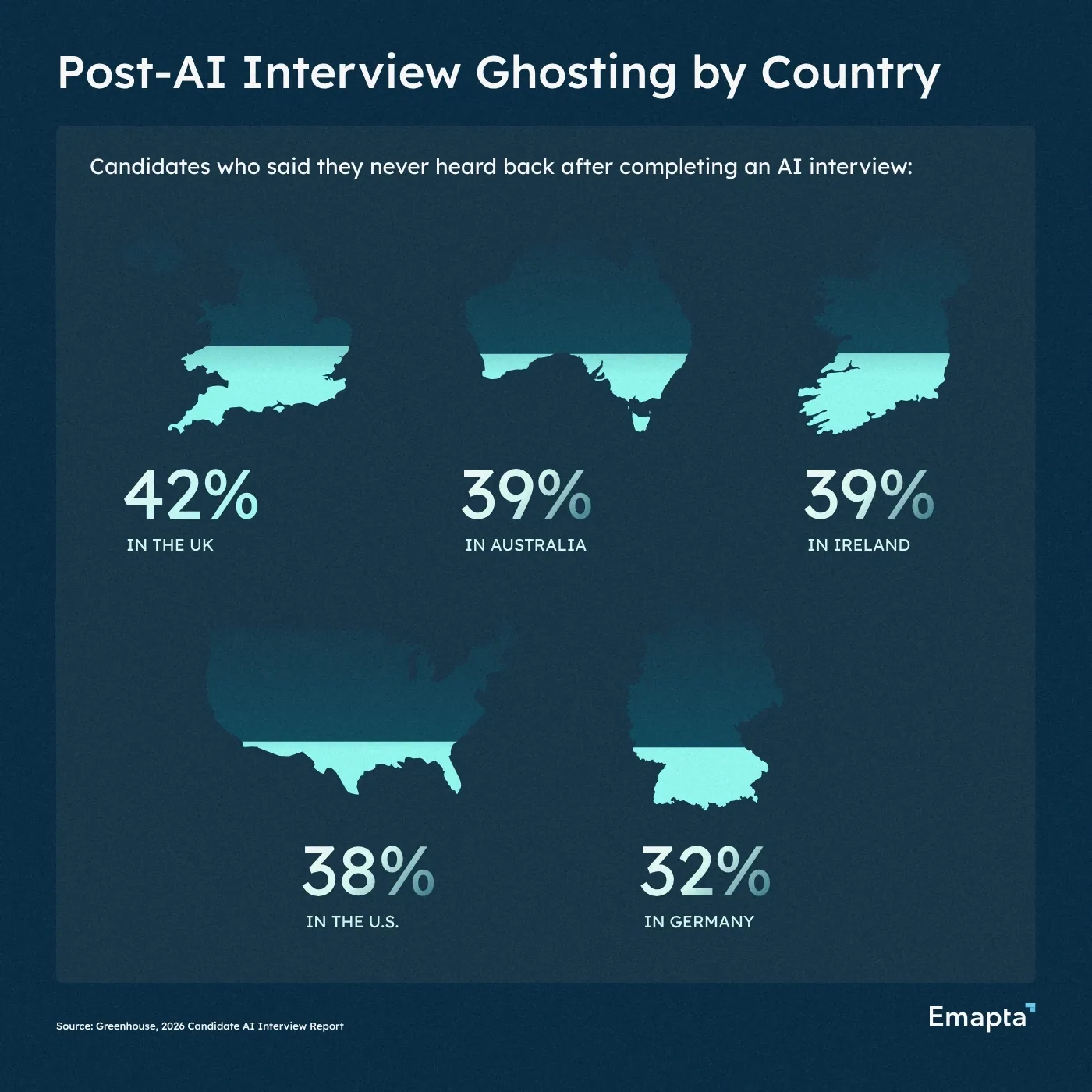
7. 42% of UK Candidates Were Ghosted After an AI Interview.
The UK had the highest post-AI-interview ghosting rate among the five markets surveyed. 42% of UK candidates said they never heard back after completing an AI interview.
The country comparison shows that the problem is widespread:
- UK: 42%
- Australia: 39%
- Ireland: 39%
- US: 38%
- Germany: 32%
Source: Greenhouse, 2026 Candidate AI Interview Report
Candidates spend time researching the company, tailoring their CV, and preparing for the role.
If that effort is met with what looks like an effortless AI interview from the employer side, followed by silence, frustration is almost inevitable.
Even if the candidate eventually gets the job, starting the relationship that way is hardly ideal.
Job Interview Statistics by Year
Interviews have become harder to reach but more likely to lead to an offer once a candidate gets through. By Q1 2026, application-to-interview rates had fallen to 4.7% for business roles and 3.6% for technical roles, while the interview success rate rose to 10.4% and 7.3%.
8. Applicants Are About 50% Less Likely to Reach an Interview Than in 2021.
In 2021, approximately 7% to 8% of applications resulted in an interview. By Q1 2026, the rate had fallen to 4.7% for business roles and 3.6% for technical roles.
Application volume helps explain the shift. Employers have far more candidates to screen, so fewer reach the interview stage.
Source: Ashby, 2026 Recruiter Productivity Report
But what percentage of job interviews are successful in this noise?
9. Interview Success Rates Reached 10.4% for Business Roles in 2026.
One trend stands out when we look at what percentage of job interviews are successful. In early 2023, only 5% of interviewed business candidates and 3.9% of technical candidates reached the offer stage.
By Q1 2026, those rates had risen to 10.4% for business roles and 7.3% for technical roles. So while fewer applicants receive interviews, candidates who make it through the first filter are now more likely to progress to an offer.
Source: Ashby, 2026 Recruiter Productivity Report
10. Post-Interview Ghosting Rose 9 Percentage Points During 2024.
Job interview statistics from late 2024 shows that 61% of job seekers said they had been ghosted after an interview, up nine percentage points since April of that year.
The increase happened as recruitment teams dealt with heavier applicant volume:
- Recruiter workload increased 26% in one quarter
- 38% of job seekers said they were mass applying to roles
It looks like candidate communication is deteriorating while recruiters are dealing with much greater application volume. Poor communication during hiring can damage trust before employment even begins, potentially affecting retention and the factors covered in these job satisfaction statistics.
Source: Greenhouse, 2024 State of Job Hunting Report
11. In-Person Interviews Increased 29% From 2022 to 2025.
In 2025, 44% of candidates interviewed in person, the same percentage that completed live virtual interviews. In-person interviewing had increased 29% since 2022.
That is not a full return to old hiring practices. In-person interviews remain below their 2019 level of 67%. Instead, the interview trends point toward a mixed model in which live video and face-to-face interviews both remain common.
Source: Survale, 2025 Candidate Experience Benchmark Research
12. One-Way Video Interview Fairness Rose 15 Points in One Year.
Candidate fairness ratings for one-way recorded video interviews rose from 56 in 2024 to 71 in 2025.
For the first time, candidates rated one-way video interviews as fairly as live virtual and in-person formats.
Source: Survale, 2025 Candidate Experience Benchmark Research
Future Interview Statistics & Trends
AI is now affecting both sides of the interview. 20% of male and 10% of female job seekers report using AI for live answers, while 6% of candidates admit to interview fraud. 74% of recruiting executives expect candidate AI use during interviews to grow, and Gartner predicts one in four candidate profiles could contain material identity misrepresentation by 2028.
13. One in Four Candidate Profiles Could Be Fake by 2028.
By 2028, one in four candidate profiles worldwide could be fake and contain material identity misrepresentation, according to Gartner’s forecast.
Employers are already responding:
- 81% of organizations use video interviews to mitigate fraud
- 74% use in-person interviews
- 62% of candidates say an in-person interview would make them more likely to apply
Source: Gartner HR Symposium/Xpo Candidate Fraud Research
This suggests that employers and candidates are becoming more cautious with each other.
However, the biggest takeaway is more encouraging: as resumes become easier to polish, candidates appear increasingly open to hiring processes that put more weight on what they can actually do:
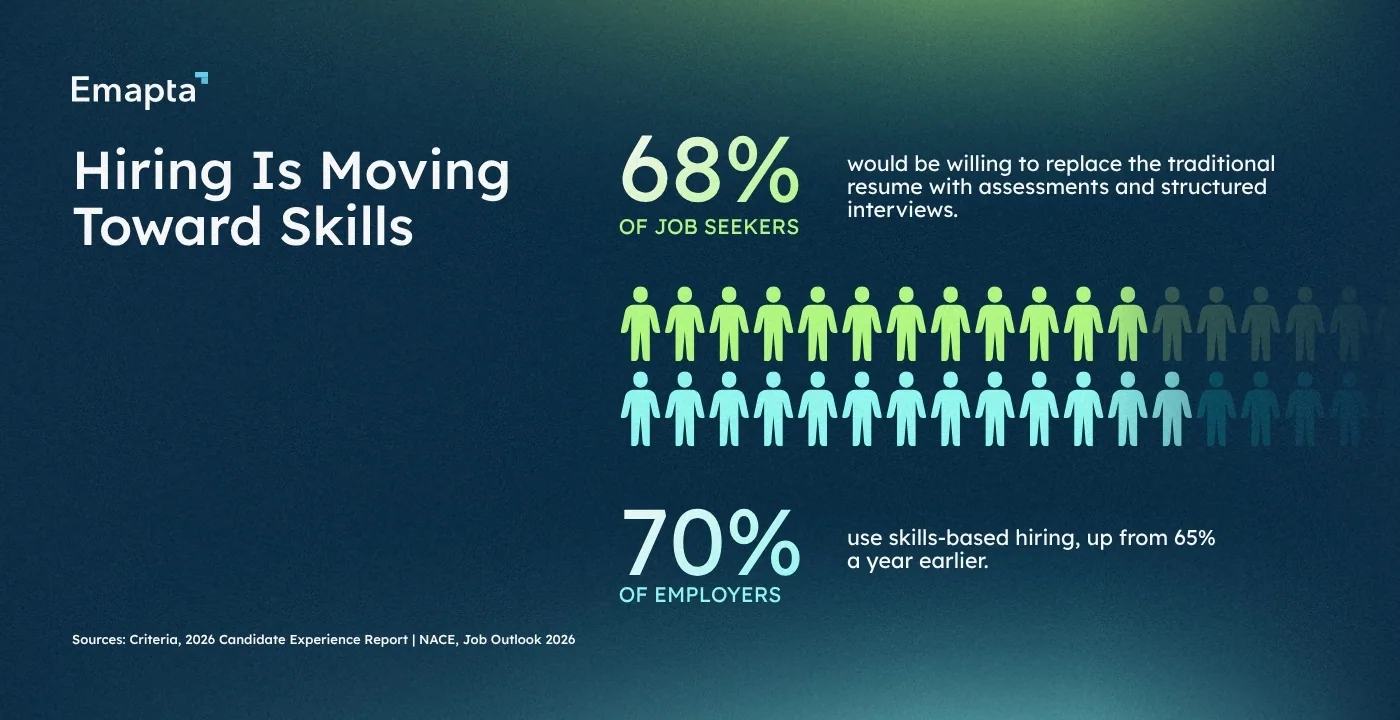
14. 68% of Job Seekers Would Replace Resumes with Assessments and Structured Interviews.
One of the most interesting interview insights is that 68% of job seekers say they would be willing to skip the traditional resume in favor of assessments and structured interviews.
Source: Criteria, 2026 Candidate Experience Report
Employers are responding:
15. 70% of Employers Use Skills-Based Hiring, Up From 65%.
Skills-based hiring is also changing interviews. 70% of employers now use it, up from 65% a year earlier, and 87% use it during interviews.
It seems that employers trust resumes less, and they are putting more weight on what candidates can actually do.
Source: NACE, Job Outlook 2026
What Do These Job Interview Statistics Mean for Employers?
A good hiring process should end as a win-win: the candidate gets a job worth taking, and the company gets someone worth keeping. But the 2026 data shows more defensive behavior. Candidates lean on AI and mass applications, while employers respond with more rounds, more checks, and more verification.
The more important shift may be happening among strong candidates. They are tired of competing in the noise and want a fair way to show what they can actually do.
The answer is a stronger signal earlier in the process through better sourcing, skills assessment, and vetting.
That is where Emapta fits. It narrows the field to candidates worth interviewing, while clients keep control of the final hiring decision. The result is closer to what hiring should be: strong candidates get a chance to prove themselves, and companies make decisions with more confidence.