

11+ Healthcare Outsourcing Statistics to Know in 2026
The latest healthcare outsourcing statistics show an industry trying to care for more patients while managing rising costs, staffing pressure, administrative workloads, and increasingly complex technology.
If you work in healthcare, you probably recognize the tension. You need to grow and improve patient service, but every new patient, system, location, or requirement can create more work behind the scenes.
Let’s see what the numbers tell us about outsourcing in healthcare.
6 Key Healthcare Industry Growth Numbers
Healthcare outsourcing is growing quickly as providers look for more efficient ways to handle rising workloads and operational demands. These numbers give you a quick look at how large the market has become and where that growth is heading.
- $462.2B — Estimated global hospital outsourcing market in 2026
- $686.3B — Projected market size by 2030
- 10.3% — Global CAGR, 2025–2030
- 69.9% — North America’s share of global revenue in 2024
- 11.2% — Europe projected CAGR, 2025–2030
- 11.9% — Asia-Pacific projected CAGR, 2025–2030
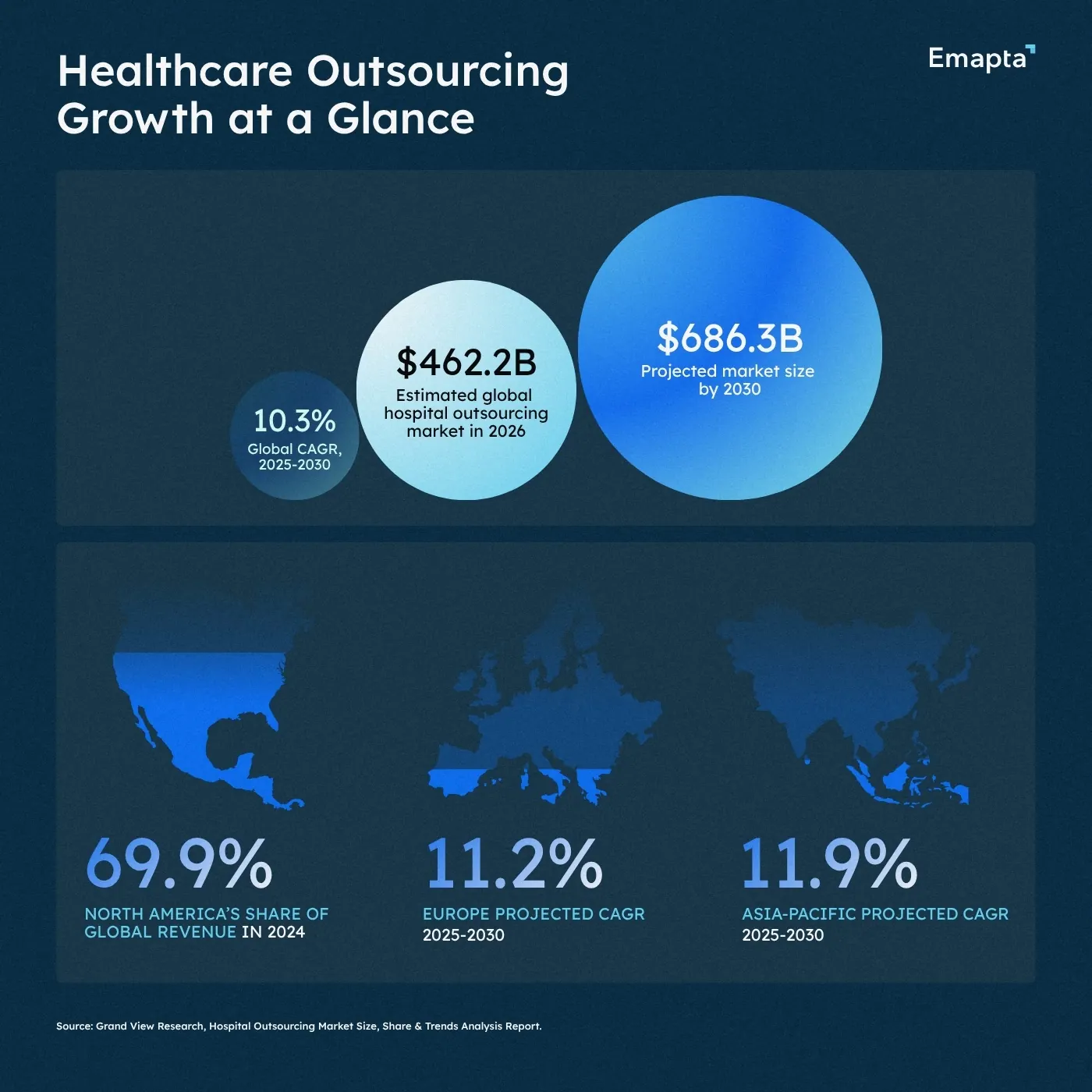
The numbers point to growth across every major market. The global hospital outsourcing market is expected to surpass $460 billion in 2026 and keep expanding through 2030, while North America already accounts for more than two-thirds of global revenue.
Europe and Asia-Pacific are growing quickly too, with both regions projected to record double-digit growth through 2030.
What these healthcare outsourcing statistics show us is that external support is becoming an increasingly important part of how healthcare organizations manage capacity and growth.
Healthcare Outsourcing Market Overview -What Does the Market Look Like?
Healthcare outsourcing is no longer limited to a handful of back-office tasks.
As the market expands, healthcare organizations are using external teams across a wider range of functions to add capacity, access specialized skills, and keep their internal teams focused on patient care.
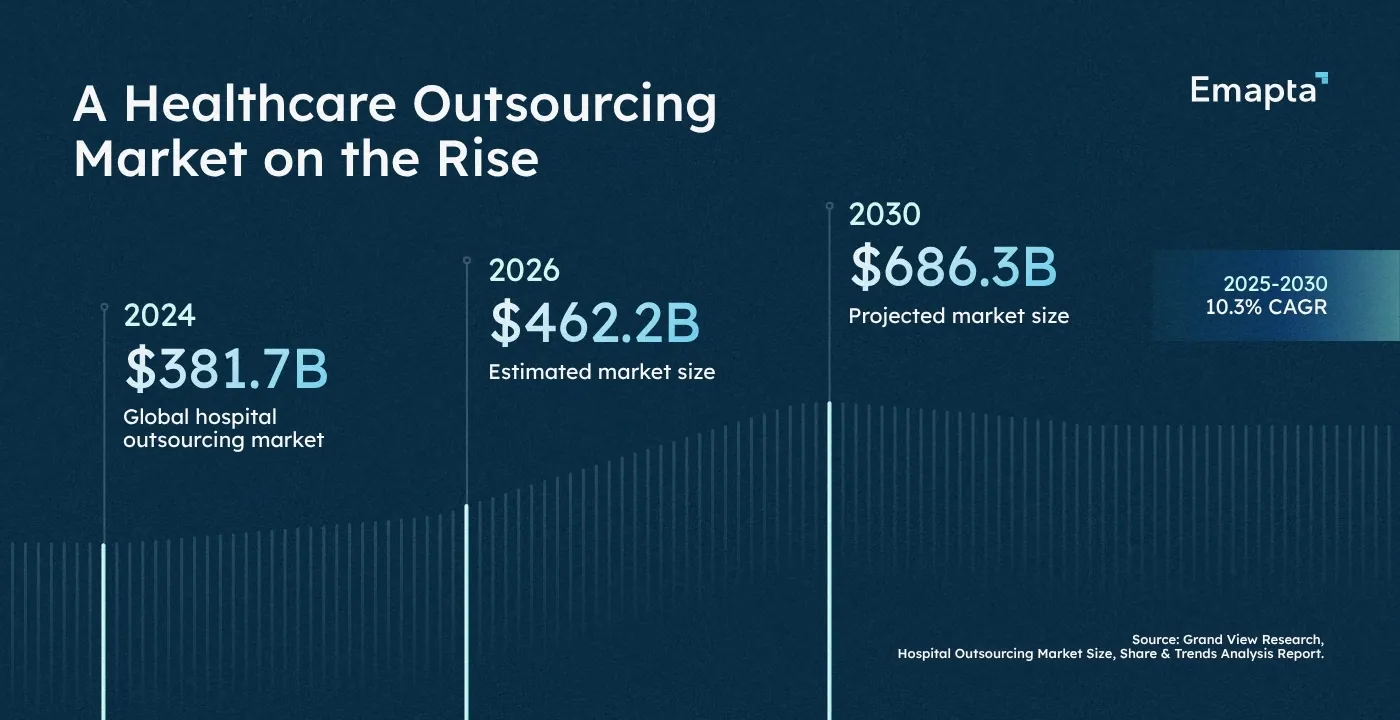
This growth in the healthcare industry reflects a broader change in how workforce is distributed.
As operational demands increase, outsourcing can provide additional capacity across administrative, technical, and specialized functions without requiring every capability to be built internally.
How Many U.S. Hospitals and Companies Outsource Healthcare?
Around 45% of U.S. hospitals surveyed already outsource certain functions, while another 45% are considering it. These findings from FTI Consulting’s 2025 Hospital Operations Survey show just how common outsourcing has become as hospitals look for additional capacity and operational support.
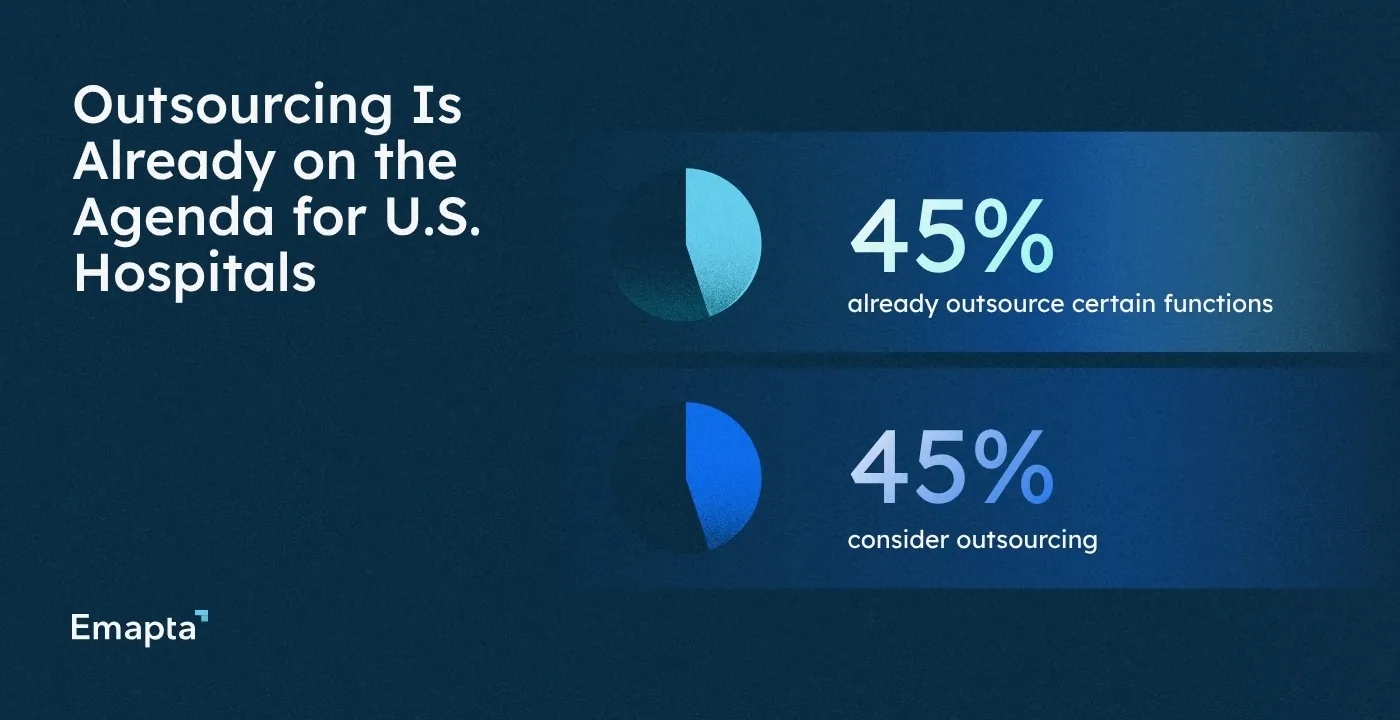
This healthcare industry growth rate reflects a market responding to increasing reimbursement complexity, claim denials, and growing patient and claims volumes. Do any of these pressures sound familiar in your own operation?
When your front desk is constantly catching up on calls, billing teams face growing claims volumes, or clinical employees spend time on administrative work, the problem is not always poor performance. Sometimes, the organization has simply outgrown the way their work is distributed, which means it needs outsourced healthcare solutions to keep up with its growth.
How Many European Hospitals and Companies Outsource Healthcare?
According to the latest hospital healthcare industry growth trends in 2026, Europe accounts for approximately 28% of the global hospital outsourcing market.
Germany, the UK, and France are among the key markets, with healthcare IT, clinical support, and business services widely outsourced across both public and private hospitals.
There is an interesting country-level picture as well. Germany represents roughly 10% of Europe’s hospital outsourcing market, while the UK accounts for around 6%.
In both markets, hospitals are using external providers for functions ranging from healthcare IT and clinical support to documentation and business operations.
The takeaway? European healthcare is not following one outsourcing formula. Instead, the healthcare facility outsourcing trends are responding to the same basic challenge in different markets: protecting scarce internal capacity.
As the healthcare industry increases demand on existing systems, that ability to decide what your core team truly needs to own becomes more important.
5 Asia-Pacific Healthcare Outsourcing Trends
Asia-Pacific is becoming a larger share of the global healthcare outsourcing market, accounting for around 32% of the global hospital outsourcing market.
While continued investment in healthcare, digital capabilities, and outsourcing talent is creating new opportunities across the region, these trends might show you a much clearer picture of outsourcing in the region.
1. Hospital outsourcing is growing fast
Asia-Pacific’s hospital outsourcing market is projected to grow at an 11.9% CAGR from 2025 to 2030, the fastest rate among major regions. Rising healthcare demand and the need to manage resources more efficiently are helping drive this growth.
2. India is leading regional healthcare industry growth
India is expected to be the fastest-growing hospital outsourcing market in Asia-Pacific, with a projected 14.7% CAGR from 2025 to 2030. Its established outsourcing industry and large talent pool continue to strengthen its position in the region.
3. Healthcare IT is becoming more important
Digital health investment is creating greater demand for external technology expertise.
Across Asia-Pacific, cloud-based healthcare platforms, cost-effective talent, and a growing supplier ecosystem are supporting healthcare IT outsourcing growth, expanding the role external providers can play in healthcare operations.
4. Outsourcing is moving beyond basic support
External teams are no longer limited to routine administrative work. Healthcare organizations across Asia-Pacific are outsourcing functions across healthcare IT, clinical services, and administrative operations, giving them more flexibility to decide which capabilities truly need to remain in-house.
5. APAC’s outsourcing ecosystem keeps expanding
Asia-Pacific is not only increasing its use of outsourcing but also strengthening its ability to deliver these services. India, China, and Southeast Asia are benefiting from skilled talent and expanding healthcare outsourcing ecosystems, supported by continued investment in digital health and technology.
What Are the Most Common Healthcare Functions Being Outsourced?
Healthcare organizations typically outsource functions that require significant time, specialized skills, or consistent support. Understanding how outsourcing in healthcare works can help you decide which responsibilities make sense to move outside your internal team.
Depending on your operation, that can include everything from revenue cycle work to patient support and healthcare IT.
a) Medical Billing, Coding, and Revenue Cycle Management
Billing and revenue cycle functions are among the most established areas for healthcare outsourcing. External teams can help manage the work behind claims, payments, and collections while keeping revenue processes moving.
Roles you can build into this team include:
- Medical Billers
- Medical Coders
- Revenue Cycle Specialists
- Claims Processing Specialists
- Accounts Receivable Specialists
- Payment Posting Specialists
- Denial Management Specialists
- Billing and Collections Specialists
- Prior Authorization Specialists
b) Patient Administration and Support
A large part of the patient experience happens outside the consultation room. Additional support can help you manage these interactions while reducing the administrative workload placed on clinical and front-office employees.
Depending on your needs, you can outsource roles such as:
- Patient Service Representatives
- Appointment Schedulers
- Patient Intake Specialists
- Insurance Verification Specialists
- Patient Support Representatives
- Referral Coordinators
- Prior Authorization Specialists
- Medical Receptionists
- Healthcare Customer Service Representatives
c) Healthcare IT and Data Support
As healthcare becomes increasingly digital, organizations need specialized talent to keep systems, data, and everyday technology operations running reliably. These capabilities do not always need to be built entirely in-house.
Your external technology team could include:
- Healthcare IT Support Specialists
- Help Desk Specialists
- Systems Administrators
- Network Administrators
- EHR/EMR Support Specialists
- Healthcare Data Analysts
- Data Entry Specialists
- Database Administrators
- Software Developers
- Cybersecurity Specialists
d) Clinical and Documentation Support
Documentation can take valuable time away from patient-facing work. Selected support functions can be handled externally while licensed professionals retain control over clinical decisions and patient care.
Common roles in this area range from:
- Medical Scribes
- Medical Transcriptionists
- Clinical Documentation Specialists
- Medical Records Specialists
- Health Information Management Specialists
- Clinical Data Specialists
- Medical Documentation Reviewers
e) Healthcare Finance and Administrative Support
Behind every healthcare organization is a range of corporate functions keeping the business running. Judging by these healthcare outsourcing statistics, outsourcing selected responsibilities can give your internal teams more capacity without requiring every support position to be hired locally.
This can extend to roles such as:
- Accountants
- Bookkeepers
- Accounts Payable Specialists
- Payroll Specialists
- Finance Analysts
- Administrative Assistants
- Executive Assistants
- HR Specialists
- Recruitment Specialists
- Compliance Support Specialists
f) Supply Chain and Operational Support
Hospitals and healthcare companies depend on complex supply chains to keep facilities properly equipped. External talent can support the administrative and analytical side of these operations without taking resources away from core healthcare delivery.
Some of the roles that can support these operations are:
- Supply Chain Analysts
- Procurement Specialists
- Inventory Specialists
- Order Management Specialists
- Purchasing Specialists
- Logistics Coordinators
- Vendor Management Specialists
- Transportation Coordinators
Wrapping Up
Rising costs, staffing pressure, and growing workloads are making growth harder to manage with internal teams alone.
Outsourcing can help you add specialized talent across billing, patient support, IT, finance, and other key functions while keeping your core teams focused on patient care.
These healthcare outsourcing statistics show us that with the right approach, you can build scalable healthcare teams, distribute work more efficiently, and create the capacity your organization needs to keep growing.