
AI + Global Talent – The New Private Equity Operating Model
AI in private equity has moved from boardroom talking point to a line item in almost every value creation plan. Yet many operating partners are finding that new tools layered onto old workflows deliver less than the business case promised.
The firms pulling ahead treat AI as one part of a broader operating model redesign. They simplify how work gets done, automate what technology can handle, augment people with AI, and then decide deliberately where each role should sit.
Combined with a global talent strategy, that sequence turns AI from a series of pilots into lasting margin improvement and EBITDA growth.
Key Takeaways
- Most portfolio companies are using AI, but far fewer can tie it to earnings and the gap is usually a process problem, not a technology problem
- Redesigning workflows before deploying AI is one of the strongest predictors of real financial impact
- A five-step sequence (Simplify, Automate, Augment, Localize, Globalize) gives operating teams a repeatable way to rebuild how work gets done
- Deciding where work should sit is now as important as deciding what technology to buy, especially as AI talent remains scarce
- Dedicated global teams help PE firms scale proven operating practices across the portfolio while keeping control of the work
Why AI Alone Won’t Fix Portfolio Company Operations
The math of private equity has changed. According to Bain & Company’s Global Private Equity Report 2026, a typical deal now needs around 10% to 12% annual EBITDA growth to reach a 2.5x multiple on invested capital (MOIC) over five years, compared with 5% during the 2010s.
With cheap leverage and multiple expansion no longer doing the heavy lifting, operational improvement has to carry more of the return. AI looks like the natural lever, and most firms have already pulled it. The problem is that adoption and impact are moving at very different speeds.
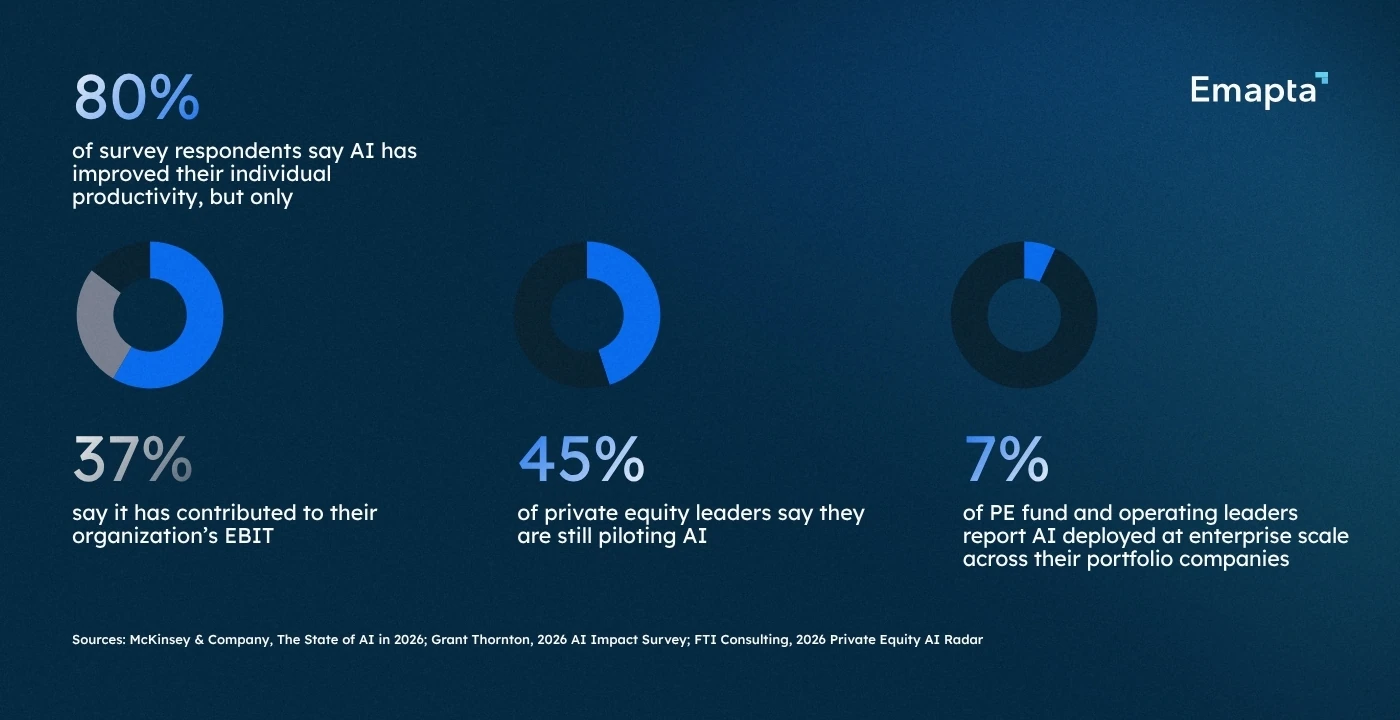
Sources: McKinsey & Company, The State of AI in 2026; Grant Thornton, 2026 AI Impact Survey; FTI Consulting, 2026 Private Equity AI Radar
The gap is rarely about the technology itself. It usually comes down to what the technology is applied to. When AI is layered onto fragmented workflows, duplicated approvals, and processes that vary from one business unit to the next, it tends to speed up the inefficiency rather than remove it. This is especially common in buy-and-build platforms, where every add-on acquisition brings its own systems, habits, and workarounds.
The companies that do see financial returns approach it differently. In McKinsey’s latest State of AI research, nearly three-quarters of AI high performers (organizations attributing at least 5% of EBIT to AI) say they have fundamentally redesigned workflows because of AI, compared with one-quarter of other organizations. In other words, the firms getting results rethink the work first and then decide where AI fits.
There is also a people dimension that technology budgets cannot solve. McKinsey’s research on how AI creates value in private equity identifies talent scarcity as a key factor holding PE firms back, with many portfolio companies reluctant to build their own AI teams. That puts workforce design, including where roles sit and who fills them, firmly on the AI agenda.
A Five-Step Framework for AI-Enabled Workforce Transformation
Rebuilding how work gets done works best as a sequence, not a menu. Each step narrows the work that remains for the next, so technology and talent decisions are made on a smaller, cleaner, and better-understood set of activities.
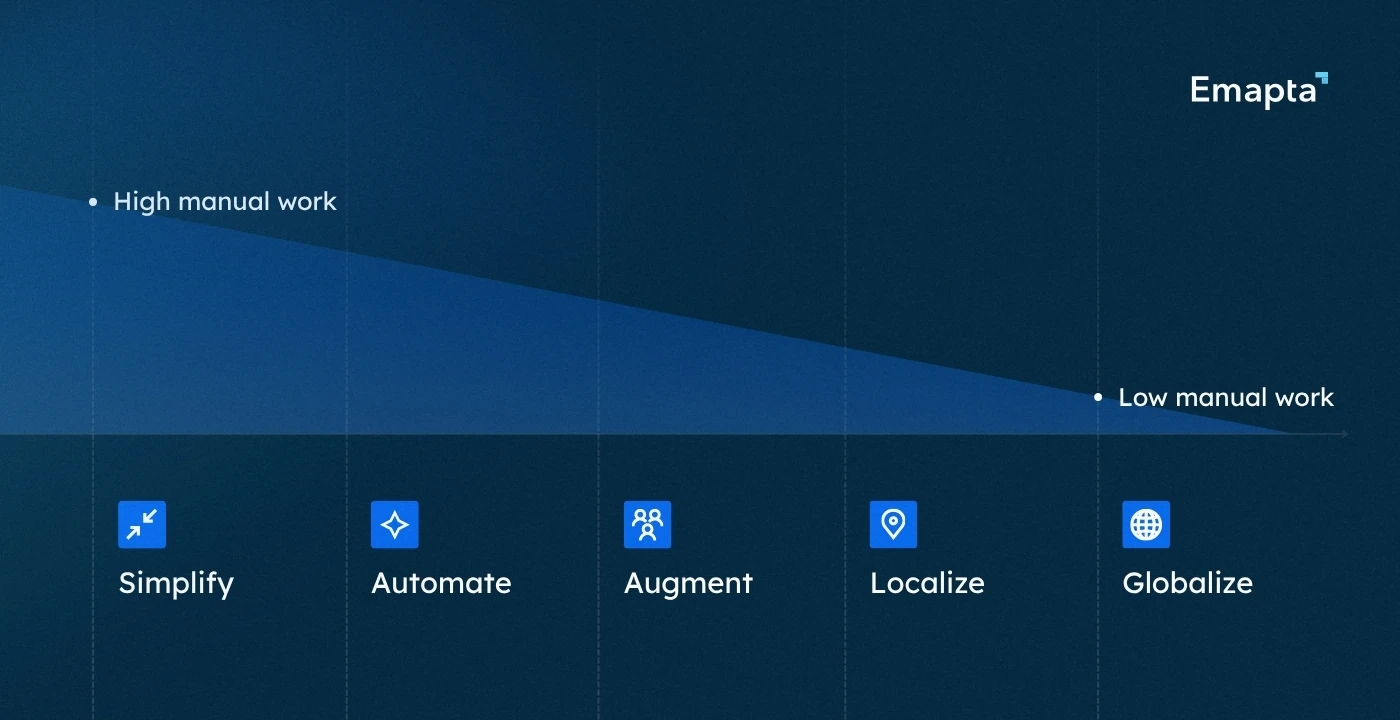
Step 1. Simplify: Eliminate Unnecessary Work
Start by mapping each workflow activity by activity and asking a simple question: why does this step exist? Most portfolio companies carry legacy reports nobody reads, duplicated reconciliations, and approval chains that have outlived the risk they were designed to manage.
Removing this work first is the biggest efficiency gain available, and it keeps the automation budget from being spent on tasks that should not exist. It also creates a clean baseline, which makes the impact of every later step easier to measure in the value creation plan.
Step 2. Automate: Hand Repetitive Tasks to Technology
With the workflow simplified, identify activities that follow clear rules and run at high volume, such as data entry, invoice matching, report generation, and routine vendor communications. Many of these can be handled by tools portfolio companies already pay for, including ERP workflows and built-in automation features, before any new AI investment is needed.
The goal at this stage is consistency as much as speed. Automated tasks run the same way every time, which reduces errors and makes performance easier to track.
Step 3. Augment: Use AI to Raise Human Performance
Not every task should be fully automated. Work that involves judgment, exceptions, or relationships, such as financial planning and analysis (FP&A), credit review, customer escalations, or sales forecasting, usually benefits more from AI that supports people than from AI that replaces them.
This is where productivity gains start to compound. When analysts use AI to draft, summarize, reconcile, and flag anomalies, more of their time goes to interpretation and decisions. It also means the profile of the people doing the work matters, since teams need to be trained to work with AI tools rather than around them.
Step 4. Localize: Decide What Truly Needs to Stay Close
Once the shape of the remaining work is clear, assess which activities genuinely require local presence. Typical examples include roles that depend on local regulatory or tax expertise, direct customer and stakeholder relationships, on-site operations, and leadership positions that anchor company culture.
Discipline matters in both directions. Keeping too much work onshore by default limits scalability and margin, while moving work that depends on proximity creates risk. A role-by-role view lets operating partners make that call based on evidence rather than habit.
Step 5. Globalize: Design the Optimal Workforce Architecture
Everything that does not need to sit locally becomes a question of where the right skills, domain expertise, time zone coverage, and cost structure best align. Intelligent talent mapping compares markets on these factors, so each function, whether finance and accounting, software engineering, data analytics, or customer support, is placed where it can perform best.
For many PE-backed businesses, this is where dedicated global teams for private equity portfolio companies become part of the core operating model. A dedicated team works exclusively for the portfolio company, follows its processes and tools, and reports into its leadership, while a partner such as Emapta manages the backend, including HR, compliance, IT, and facilities.
Through the Emapta Talent Marketplace (ETM), firms can access the top 1% of highly-skilled talent, trained to work with industry-leading AI tools for greater productivity and efficiency, and hire in as little as nine days. With 16 offices across the Philippines and talent hubs in other key markets, portfolio companies can match each role to the location where it delivers the most value.
How a Six-Time Inc. 5000 Company Built a 35-Person Global Team
Ncontracts turned key business units into high-performing global teams with talent sourced through Emapta. See how they scaled across departments without compromising quality.

From Operational Efficiency to Portfolio-Wide Value Creation
Applied to a single company, the five steps deliver a leaner, more productive operation. Applied across a portfolio, they become something more valuable: a repeatable playbook that operating teams can run in every new acquisition, with each deployment faster and more predictable than the last.
Deciding who runs that playbook matters just as much. Firms can centralize AI expertise at the fund level for common use cases, or embed dedicated teams in portfolio companies where the work justifies sustained investment. Dedicated global teams make the second option viable for assets that could not justify building that capability onshore.
The financial case builds over the hold period. In the same McKinsey analysis of 471 PE-backed companies, businesses that embedded AI into their operating models generated roughly 20% higher revenue per employee than companies using it only opportunistically. Those gains come from the combination the framework is built around: less unnecessary work, more consistent processes, and people whose output is amplified by AI.
For operating partners, the outcomes typically show up in five places:
- Lower operational complexity and cost. Fewer steps, handoffs, and systems mean less to maintain, both in people’s time and in technology spend.
- Higher productivity per employee. Automation and AI augmentation let teams handle more volume and more complex work without proportional increases in head count.
- Access to specialized capabilities. Global talent markets give portfolio companies AI, data, engineering, and finance skills that are scarce or slow to hire locally.
- Standardized, scalable practices. A shared operating model gives every portfolio company the same proven foundation, from finance processes to reporting standards.
- Stronger margins and EBITDA growth. Together, these levers support the double-digit earnings growth that today’s returns require.
There is also an exit story to tell. A portfolio company with documented, redesigned workflows, a clear workforce architecture, and AI embedded in daily operations is easier for a buyer to underwrite than one whose efficiency depends on a handful of tools layered onto old habits.
Talent location is a growing part of that story. Markets such as India are emerging as deep sources of AI and data skills, which is why many firms are now building AI-ready teams in India to close their technology talent gaps. Treating these decisions as part of the value creation plan, rather than an afterthought, gives the operating model room to scale.
Building the Next Generation of PE Operating Models
The firms that win the next cycle will not be the ones that buy the most AI. They will be the ones that redesign work with the most discipline and treat every AI investment as part of a broader change in how the business operates.
That makes process, technology, and workforce design one conversation rather than three. Dedicated global teams fit naturally into that model, giving portfolio companies a workforce that can grow alongside each new AI capability.
The opportunity is significant, but so is the cost of standing still while return expectations keep rising. Operating partners who treat AI in private equity as an operating model decision, not a technology purchase, will be best placed to turn it into lasting value.
Frequently Asked Questions (FAQ)
AI improves efficiency most when it follows process redesign. Portfolio companies should first remove unnecessary work, then automate repetitive, rules-based tasks and use AI to support judgment-heavy roles such as FP&A and customer escalations. Applied this way, AI reduces errors, frees teams for higher-value work, and creates consistent processes that can be replicated across the portfolio.
It is a way of running portfolio companies in which processes, technology, and workforce design are planned together. Workflows are simplified and standardized, AI is embedded in daily operations, and roles are placed where skills, cost, and coverage align best. The result is a scalable model that supports sustained EBITDA growth.
Global talent gives portfolio companies faster access to specialized skills, such as AI, data, engineering, and finance, that are scarce or costly to hire locally. Dedicated global teams work exclusively for the business under its own leadership, helping companies scale capacity and protect margins as they grow.
What Could a Global Team Save Your Portfolio? See the Numbers Across 50+ Roles
Compare onshore and offshore costs for finance, IT, engineering, and support roles, and see where a dedicated global team can strengthen margins.