

Security & Compliance Guide when Outsourcing Financial Services
Growth and protection are not opposing forces when it comes to building a global finance and accounting team. They are two sides of a well-built outsourcing model, allowing you to scale without compromising the security and compliance when you are outsourcing financial services.
Let’s take a closer look at the key requirements and security risks involved, the safeguards that matter most, and how to tell whether a potential outsourcing partner is equipped to protect your operations.
What Is Financial Services Outsourcing Compliance?
Financial outsourcing compliance means ensuring that external service providers handling your finance and accounting functions follow all applicable laws, industry standards, and regulatory requirements. It covers areas such as:
- Data security
- Tax obligations
- Financial reporting
- Internal control
- Vendor oversight
Is Outsourcing Finance & Accounting Safe?
Finance and accounting outsourcing is a secure way to extend your team’s capabilities when the right protections are in place from the start. Reputable providers operate under the same regulatory and compliance frameworks your internal team would, backed by certifications that hold them accountable for how they handle your financial data.
Those protections are not based on the firm’s word alone. Independent audits and recognized certifications put their controls under regular scrutiny, giving you confidence that the security behind the service holds up in practice.
The global finance and accounting BPO market is projected to grow from USD 76.5 billion in 2026 to USD 142.7 billion by 2033, as more companies expand their capabilities beyond internal teams. At that level of adoption, the question is less about whether outsourcing can be secure and more about choosing a provider with the right controls and safeguards.
7 Key Financial Compliance Outsourcing Requirements
The requirements and standards that apply to your outsourcing setup depend on the markets you operate in, the scope of services, and the type of data involved. Being familiar with the most common frameworks can help you identify which ones apply to your organization and assess whether a potential provider has the expertise to meet them.
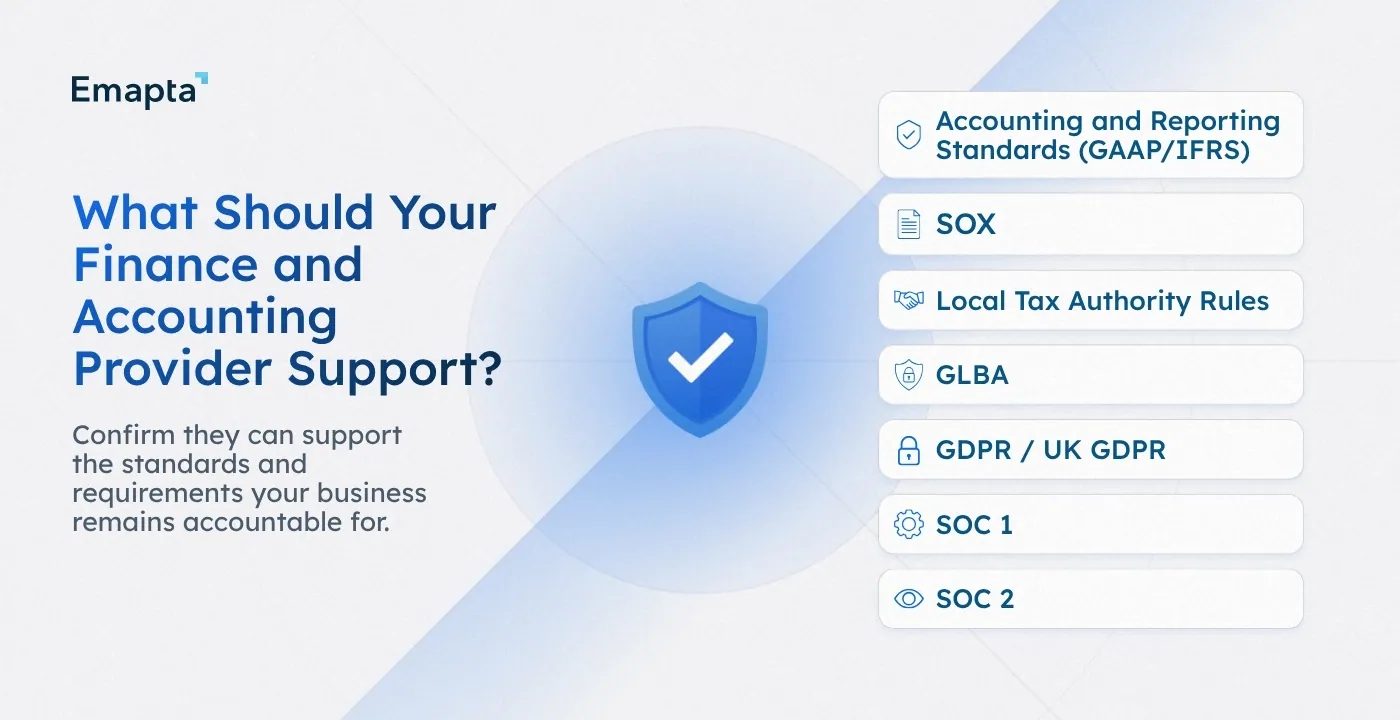
1. Accounting and Reporting Standards (GAAP/IFRS)
Accounting standards govern how companies prepare and report financial information. Companies in the U.S. follow Generally Accepted Accounting Principles (GAAP), while many other markets use International Financial Reporting Standards (IFRS).
These standards still apply when accounting work is outsourced, so providers need the expertise to follow the appropriate framework for each client.
2. Sarbanes-Oxley (SOX)
The Sarbanes-Oxley Act (SOX) requires publicly traded companies to maintain internal controls over financial reporting (ICFR).
When accounting tasks such as transaction processing or reconciliation are handled through outsourcing, the provider’s processes may become part of the controls the company relies on for compliance.
3. Local Tax Authority Rules
This includes tax laws, filing requirements, and reporting obligations in the country where outsourced services are performed. The specific obligations vary by jurisdiction and how the outsourcing arrangement is structured.
For example, employee income tax requirements in Colombia are administered by the National Tax and Customs Directorate (DIAN).
4. Gramm-Leach-Bliley Act (GLBA)
The Gramm-Leach-Bliley Act (GLBA) requires U.S. financial institutions, including banks, lenders, and insurers, to protect consumers’ non-public personal information.
This can include account numbers, payment history, and other information collected through financial transactions or applications.
5. GDPR / UK GDPR
GDPR, or General Data Protection Regulation, applies to personal data in the EU and EEA, while the UK GDPR applies similar data protection rules in the UK.
When it comes to compliance with outsourcing financial services, your provider might be required to follow one or both frameworks when handling personal data.
6. SOC 1
SOC (System and Organization Controls) 1, is an audit report that examines controls around financial data processing, transaction handling, and related business processes.
It is intended for providers whose services can materially affect a client’s financial reporting.
7. SOC 2
SOC 2 is widely used to assess how service providers manage customer data and maintain controls around security, availability, processing integrity, confidentiality, and privacy.
While it is not specific to the finance and accounting industry, it can be especially relevant when outsourcing functions that involve sensitive information.
4 Potential Data Security Risks in Finance & Accounting Outsourcing
Outsourcing to an external provider can create new points of exposure for sensitive financial information, increasing both security and compliance risks. These risks often stem from how data is accessed, shared, stored, and managed across different teams and systems.
1. Poorly Governed Access Controls
When access isn’t tightly managed, offshore or nearshore team members may be able to see or handle financial information beyond what their roles require. That creates more opportunities for unauthorized activity, errors, or misuse.
Potential Outcomes
- Fraudulent transactions
- Unauthorized changes to records
- Privacy violations involving confidential data
2. Data Breaches & Cyberattacks
Cybercriminals may target outsourced teams, systems, or connections to gain access to sensitive data. A breach can also occur if security weaknesses exist anywhere across the provider’s technology environment.
Potential Outcomes
- Theft of sensitive financial data
- Disrupted finance operations
- Costly incident response and recovery
3. Data Handling Errors
When outsourcing financial services, maintaining compliance can become more complex as sensitive data often moves between different people, systems, and locations. This creates more opportunities for information to be handled incorrectly during sharing, storage, or transfer.
Potential Outcomes
- Regulatory fines and penalties
- Delayed financial close
- Failed audits or restatements
4. Third-Party Security Vulnerabilities
Your outsourcing provider may rely on subcontractors, software vendors, or other third parties that also access or process sensitive financial data. Weak security controls anywhere in that chain can introduce additional risk.
Potential Outcomes
- Loss of client trust
- Additional data recovery challenges
- Liability for third-party failures
How to Vet Your Finance & Accounting Outsourcing Partner
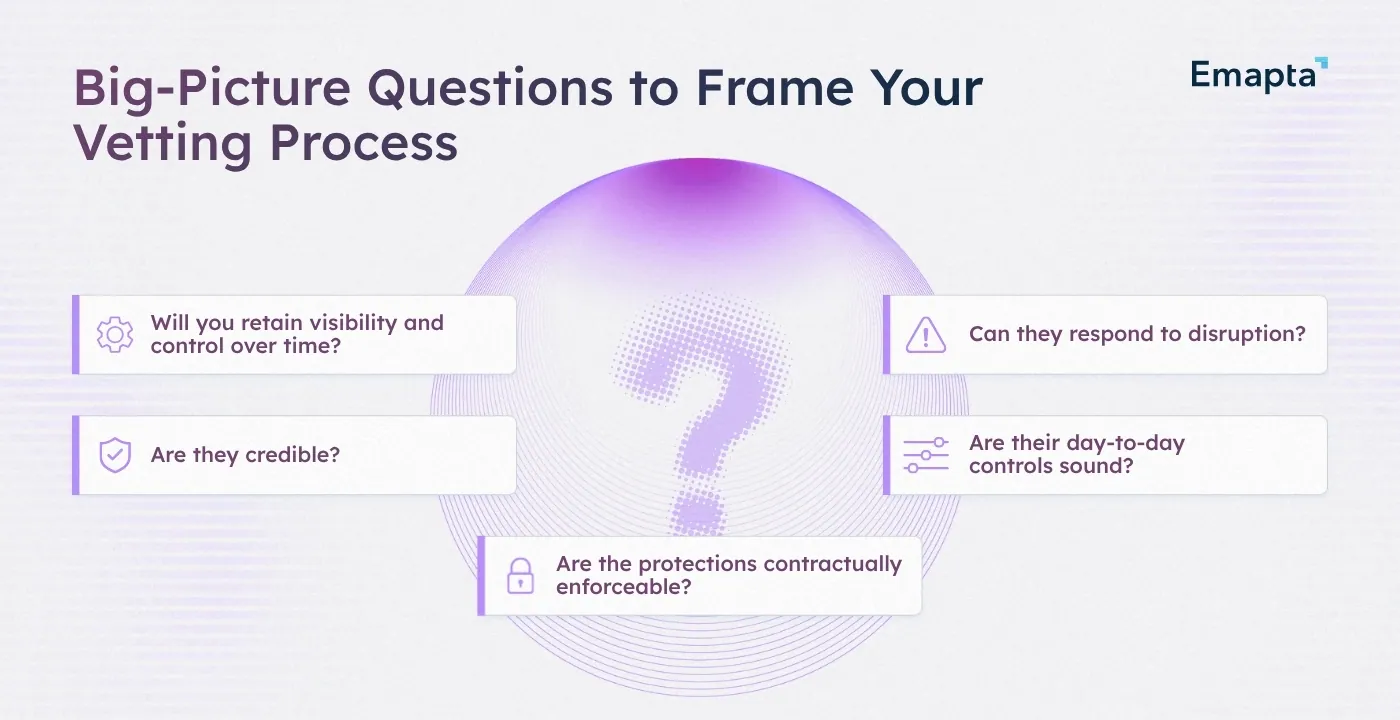
A strong vetting process looks beyond what an outsourcing provider says and into how they actually support accounting compliance when outsourcing. It should give you a clear picture of whether their measures meet the level of scrutiny your business requires.
1. Verify Security and Compliance Credentials
Credentials show whether a provider has been formally assessed against recognized security and compliance standards. They give you documented proof of its security posture before you entrust it with sensitive financial work. Key areas to review include:
- Certifications
- Independent audit reports
- Data privacy standards
- Overall security posture
2. Assess Data, Access, and Workforce Controls
These controls cover how financial data is handled, how system permissions are assigned and monitored, and how the devices employees use are secured, particularly when work is performed remotely. Reviewing them shows whether access stays aligned with each employee’s role, activity can be traced to a specific user. Key policies and protocols to check include:
- Device and endpoint security
- Access management
- Segregation of duties
3. Check Incident Response and Business Continuity
Incident response and business continuity plans show how prepared a provider is to contain security incidents and keep critical finance operations running during a disruption. They help reduce the impact on your data, systems, and ability to continue essential work if something goes wrong. Identify the measures in place for:
- Detecting and responding to security incidents
- Maintaining critical operations during disruptions
- Restoring systems and recovering data after an incident
4. Review the Contractual Security Framework
Compliance when outsourcing financial services is of paramount importance, so you should make sure that the provider’s commitments to financial security are legally binding, with clear accountability if something goes wrong. It should also define your rights and protections, along with each party’s responsibilities, throughout the relationship. Contract terms to review may include:
- Security and breach notification obligations
- Subcontractor responsibilities
- Exit, data return, and deletion provisions
5. Plan for Ongoing Oversight
Oversight should continue after onboarding so you can see whether the provider is meeting agreed standards and address issues early. Ongoing reviews help you maintain visibility over performance, security, and compliance over time. Set a regular cadence for:
- Reviewing performance and compliance reports
- Monitoring SLAs and service levels
- Holding scheduled governance reviews
Advantages of Emapta’s State-of-the-Art Compliance & Security
When you choose Emapta as your outsourcing partner, you can expand your capabilities through a dedicated finance and accounting team without compromising your standards for data protection, compliance, or visibility.
This enables you to:
- Protect data across onshore and offshore/nearshore operations
- Retain oversight as finance and accounting work moves across borders
- Keep outsourced roles aligned with your compliance obligations
- Preserve business continuity through operational disruptions
- Scale your global team without lowering established security standards
Security is built into our model as a core service, shaping how work is delivered from the outset instead of being added after the team is in place. This secure-by-design foundation creates a layered protection for your organization.
Core components include:
- 24/7/365 IT Command Center managed by IT/cybersecurity experts
- Certifications and attestations, including ISO 27001, ISO 27701, and SOC 2
- Advanced office environments with layered physical and endpoint safeguards
- Enterprise-grade encryption for sensitive financial data
Why Compliance & Data Security is Essential
Security and compliance are essential in finance and accounting outsourcing because the entire business depends on the integrity of the work. Any weakness in how the data is handled puts that integrity at risk, with consequences for the wider organization.
As outsourcing trends shift more core finance work to global teams, the same standards of security and accountability must follow the work across organizational boundaries. Applying those standards consistently allows companies to gain external capability without creating gaps in how the function is protected.
Wrapping Up
A secure outsourcing setup should leave nothing to guesswork. When access, ownership, and response procedures are clearly defined, outsourced professionals can work across borders without creating blind spots that only show up during an audit, incident, or period of rapid growth.
By choosing a provider that ensures compliance when outsourcing financial services, you can turn outsourcing into a long-term operational advantage. That gives your global team room to grow without leaving security or accountability behind.