

Dedicated Team vs Staff Augmentation – Comparison Guide
Choosing between a dedicated team and staff augmentation affects how quickly you can scale, how much control you have, and how your team operates. Staff augmentation adds skilled professionals to your existing team, while a dedicated team gives you a long-term unit focused on your business goals.
Both help solve talent shortages, but they work differently.
With that in mind, let’s check the key differences, when to use each model, and how to determine which one best fits your business needs.
What is the Difference Between Dedicated Teams and Staff Augmentation?
Both dedicated teams and staff augmentation give businesses access to external talent, but they differ in team structure, management, engagement length, and business purpose. Staff augmentation adds individual specialists to your existing team, while a dedicated team provides a long-term team that works exclusively for your business.
With staff augmentation, your managers oversee day-to-day work, making it a strong option for filling skill gaps, increasing capacity, or bringing in specialized expertise for a specific project. A dedicated team, on the other hand, is built for long-term collaboration. The provider manages recruitment, HR, payroll, and operations, while your business focuses on strategy and business outcomes.
Ultimately, staff augmentation helps you strengthen an existing team, while a dedicated team helps you build one.
| Staff Augmentation | Dedicated Team |
|---|---|
| Adds individual specialists to your existing team | Builds a team that works exclusively for your business |
| Best for short- to mid-term projects | Best for long-term initiatives |
| Client manages day-to-day work | Management responsibilities are shared |
| Flexible resource scaling | Stable, long-term team continuity |
| Ideal for filling skill gaps | Ideal for building ongoing capability |
Real-World Example – American Financial Network (AFN)
AFN faced rapid growth during a mortgage market surge. Rather than recruiting individual employees locally, AFN built a dedicated offshore team that grew from 3 to more than 150 professionals in just nine months. The expanded team supported a 300% increase in loan processing volume while enabling nationwide operations.
AFN’s growth shows how a dedicated team can provide the continuity and scalability needed to support long-term expansion.
Dedicated Team vs Staff Augmentation – 3 Key Differences
At a glance, dedicated teams and staff augmentation may seem similar, but they differ in team structure, management, and long-term value. The 3 differences below will help you determine which model best fits your business.
1. Staff Augmentation vs Dedicated Staffing Management
Staff augmentation gives your managers full control over day-to-day work, priorities, and performance because external professionals become part of your existing team. This makes it easier to add expertise while maintaining your current workflows.
Dedicated teams follow a shared management model. Your business sets priorities and strategic direction, while your outsourcing partner manages recruitment, HR, payroll, and administrative operations. This reduces operational overhead without taking control away from your business.
Takeaway – staff augmentation is best when you want complete operational control, while dedicated teams reduce management overhead as your team grows.
2. Dedicated Team vs Staff Augmentation Cost
Staff augmentation offers flexibility by allowing you to pay for individual professionals as your needs change. This makes it a practical option for short-term projects, temporary skill gaps, or fluctuating workloads.
Dedicated teams can be incredibly cost-effective, if set up with the right partner. Working with the same team reduces repeated hiring, onboarding, and knowledge transfer costs while providing predictable pricing as your operations scale.
Takeaway – staff augmentation optimizes short-term flexibility, while dedicated teams deliver better overall long-term value.
3. Staff Augmentation vs Dedicated Staffing Knowledge Retention
Staff augmentation helps you access expertise quickly, but knowledge often leaves when the engagement ends. As new professionals join, your business must repeatedly onboard them and rebuild project knowledge.
Dedicated teams stay with your business over the long term, allowing them to build a deeper understanding of your products, processes, and goals. Over time, this continuity improves collaboration, reduces onboarding, and supports faster decision-making.
Takeaway – staff augmentation solves immediate resource needs, while dedicated teams build lasting knowledge that supports long-term growth.
| Finding | Impact |
|---|---|
| Consistent team composition prevents knowledge loss and enables faster problem-solving | Institutional knowledge compounds over time, reducing ramp-up time |
| Ongoing strategic communication in distributed teams produces better outcomes than transactional task management | Deeper collaboration on product roadmap and architecture improves project success |
Want to Learn the Benefits & Process of Building Dedicated Teams?
Read this next: Complete Guide on Dedicated Teams [with Benefits & Examples]
Bonus Comparison – Staff Augmentation vs Professional Services vs Contractors
Although these models all provide access to external talent, they differ in how work is managed, who owns delivery, and how teams integrate with your business.
Staff augmentation strengthens your existing team by adding skilled professionals who work within your processes and under your day-to-day direction. Contractors, by comparison, typically work independently and focus on delivering specific tasks with less integration into your business. Lastly, professional services follow a different approach. Instead of providing people to extend your team, the vendor owns project delivery and is accountable for the final outcome. Your involvement is focused on defining objectives rather than managing day-to-day execution.
For businesses focused on long-term growth, dedicated teams combine the strongest elements of both models. You retain strategic control while gaining a stable team that builds institutional knowledge, integrates with your business, and supports sustainable growth over time.
| Aspect | Staff Augmentation | Professional Services | Contractors |
|---|---|---|---|
| Who Controls Work | Client directs day-to-day work | Vendor manages delivery | Client directs, independent execution |
| Accountability | Shared between client and specialists | Vendor accountable for deliverables | Individual contractor accountable |
| Integration | Embedded within existing teams | Operates alongside organization | Often less integrated |
| Best For | Skill gaps, capacity expansion | Defined projects, implementations | Short-term expertise, temporary support |
| Team Continuity | Depends on resource retention | Tied to vendor’s delivery team | Depends on individual availability |
How to Choose Between Staff Augmentation or Dedicated Team
When comparing dedicated team vs staff augmentation models, the right choice depends on your project’s timeline, internal capacity, and strategic goals.
1. Consider Your Timeline
If you’re addressing a temporary skills shortage, meeting a tight deadline, or supporting a short-term initiative, staff augmentation provides the flexibility to scale quickly without long-term commitments. If you’re building a product, expanding operations, or investing in an ongoing business function, a dedicated team offers the stability needed to maintain momentum over time.
2. Assess Your Internal Capacity
Staff augmentation works best when you already have experienced managers who can onboard new specialists, assign work, and oversee delivery. If your internal leaders are already stretched across multiple priorities, a dedicated team can reduce operational overhead by sharing responsibility for workforce management while allowing you to retain strategic control.
3. Evaluate Your Budget Model
Hourly rates tell only part of the story. For long-term initiatives, factors such as employee retention, onboarding effort, productivity, and knowledge transfer often have a greater impact on total cost than the engagement model itself. Organizations should evaluate overall business value rather than focusing solely on short-term savings.
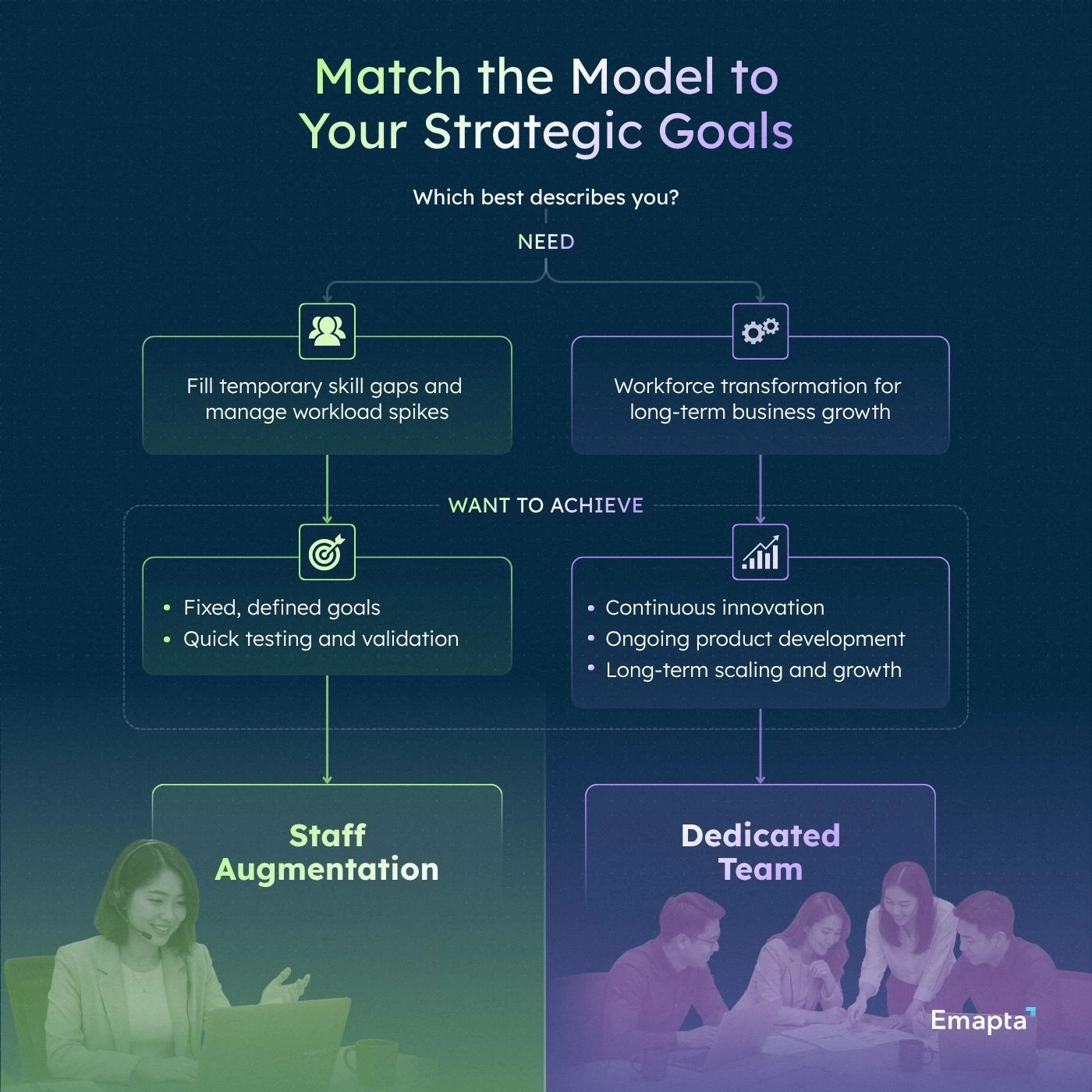
4. Match the Model to Your Strategic Goals
Staff augmentation works for temporary problems like skill gaps, workload spikes, and quick validation. Dedicated teams build sustained competitive advantage through evolving roadmaps, ongoing innovation, and long-term scaling. Pick augmentation if you’re filling a temporary gap. Pick dedicated teams if you’re building a capability that compounds.
Verdict – staff augmentation is well suited to fill temporary gaps and short-term projects, while dedicated teams are designed to build long-term capability. With that in mind, for organizations that focus on sustainable growth, operational stability, and scalability, a dedicated staffing solution is the stronger strategic investment.
Why Dedicated Teams Consistently Deliver Better Results
While staff augmentation solves immediate hiring challenges, many organizations transition to dedicated teams as they mature. Long-term initiatives benefit from continuity, shared business knowledge, and stable collaboration.
Unlike project-based work, dedicated teams remain embedded in your organization. As they learn your products, customers, and processes, they contribute beyond task execution by improving processes, sharing ideas, and supporting long-term goals.
Ncontracts scaled from 0 to 32 offshore professionals in two months with Emapta. Rather than temporary resources, the team became integral to operations. As Brayden Smith, SVP of Ncontracts, explains:
“There’s a big difference between Emapta and other talent providers… it really feels like the top 1% talent.”
For organizations investing in sustained growth, dedicated teams offer more than capacity. They provide scalable operations supported by experienced talent, long-term continuity, and infrastructure.
Wrapping Up
Choosing between a dedicated team vs staff augmentation comes down to your business goals, project timeline, and long-term strategy. Staff augmentation is a practical choice for filling temporary skill gaps, increasing capacity, and supporting short-term initiatives.
A dedicated team provides the continuity, stability, and institutional knowledge needed to support sustainable growth. If your business is investing in long-term capability rather than solving a temporary resource challenge, a dedicated team is the stronger choice.
If you match the workforce model to your objectives, you can build a team that delivers value today while supporting your business as it grows.
Frequently Asked Questions (FAQ)
The difference between staffing services and staff augmentation is that staffing services connect you with temporary contractors for transactional roles while staff augmentation brings specialized professionals into your team structure with integration and strategic alignment.
Staff augmentation is temporary reinforcement you manage directly while dedicated teams are long-term partnerships where a vendor builds and manages a complete team with deeper product knowledge.
Temporary staffing uses short-term generalists with minimal integration while staff augmentation brings specialized professionals integrated into your processes for defined periods.
Extended teams are temporary workforce expansions, similar to augmentation, and dedicated teams are professionals assigned exclusively to your project long-term. The models are often used interchangeably.