

Workforce Transformation Strategy – 8 Steps to Success
Every business wants to grow and evolve. But as your plans move forward, is your workforce ready to keep up?
A workforce transformation strategy helps you prepare for these changes without disrupting the operations your business depends on.
By connecting your business goals with workforce planning, skills development, technology, and employee support, you can build a team ready for what comes next.
So, where should you start? Here’s how to build a practical strategy that prepares your workforce for what’s next, from identifying skills gaps to implementing changes and measuring results.
What Is a Workforce Transformation Strategy?
A workforce transformation strategy is a structured plan for aligning your employees, skills, roles, and ways of working with your organization’s future business needs.
Rather than focusing only on hiring or training, it considers how your entire workforce should evolve as your business grows, adopts new technologies, or changes its operating model.
For example, introducing automation into your finance department may reduce manual processing. However, your employees will still need the skills to manage exceptions, interpret financial information, and oversee automated workflows.
Your strategy should address both sides of that change: what technology will be used and how your people will contribute.
When Does an Organization Need Workforce Transformation?
Workforce transformation becomes necessary when your existing capabilities or operating structures can no longer support your business objectives.
You may already recognize some warning signs. Your teams could be spending too much time on repetitive tasks, struggling to recruit specialized professionals, or finding that existing job descriptions no longer reflect the work employees perform.
Common triggers include:
- Technology adoption: Introducing AI, automation, or digital systems that change how employees work.
- Business expansion: Entering new markets or scaling operations beyond your current workforce capacity.
- Skills shortages: Finding that critical capabilities are difficult to recruit or develop.
- Operational inefficiencies: Experiencing duplicated responsibilities or productivity challenges.
- Organizational restructuring: Redefining departments or responsibilities.
Don’t wait for any of these disruptions to react. Addressing these challenges early gives you more time to develop capabilities and manage change.
What Should a Workforce Transformation Strategy Include?
An effective workforce transformation strategy connects your business priorities with the people, processes, and resources needed to achieve them. Your plan should establish five essential components:
- Business objectives: The operational improvements, growth targets, or capabilities your organization needs.
- Workforce assessment: Your current headcount, skills, roles, performance, and capability gaps.
- Future workforce requirements: The roles, skills, technologies, and operating structures you’ll need.
- Implementation roadmap: The activities, timelines, responsibilities, and resources required to make changes.
- Performance measures: The indicators you’ll use to evaluate progress and adjust your approach.
These components should work together. A training program, for example, won’t deliver meaningful transformation if employees return to processes that don’t allow them to apply their new skills.
How to Build a Workforce Transformation Strategy in 8 Steps
Building your workforce transformation strategy starts with understanding where your business is heading and what your employees will need to help you get there.
The following eight steps provide a practical workforce transformation roadmap that you can adapt to your organization’s size, priorities, and resources.
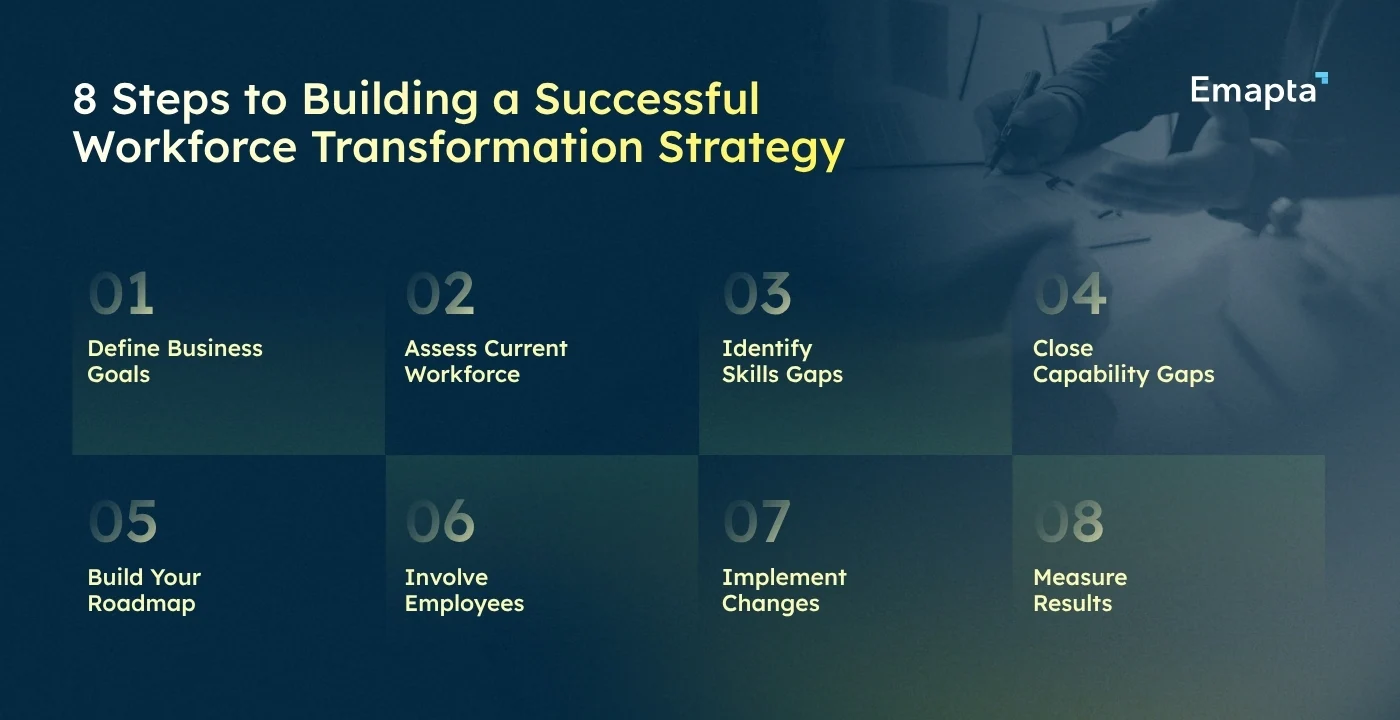
Step 1: Define your business goals
Before changing roles or introducing new tools, determine what your organization wants to accomplish: international expansion, improved customer service, reduced processing times, or AI across specific functions.
Translate these priorities into specific workforce requirements. If your goal is to improve customer response times, for example, consider whether the solution requires additional employees, better scheduling, new technology, or different skills.
Your transformation efforts should support measurable business outcomes rather than change for its own sake.
Step 2: Assess your current workforce
Next, establish a clear picture of your existing workforce. Review employee capabilities, headcount, organizational structures, productivity, and current technology usage.
Work with HR and department managers to identify:
- Critical skills and areas of expertise
- Roles experiencing capacity constraints
- Repetitive or inefficient workflows
- Employee development opportunities
- Positions that may need to evolve
This assessment gives you a starting point for determining which capabilities you can develop internally and where will you require additional support.
Step 3: Identify future skills and workforce gaps
Once you understand your current capabilities, compare them with what your business will need over the next few years. Moreover, consider how technology, customer expectations, and growth plans could affect individual roles.
For instance, a customer support operation introducing AI-assisted responses may need fewer manual information searches but stronger problem-solving, escalation management, and technology oversight skills.
Prioritize gaps based on their business impact, urgency, and difficulty to address.
Step 4: Choose how to close capability gaps
Not every workforce challenge requires external recruitment. Depending on your requirements, you could:
- Upskill employees for evolving responsibilities
- Reskill existing staff for different positions
- Recruit specialists for capabilities unavailable internally
- Redeploy employees to higher-value activities
- Work with external teams to access additional expertise or capacity
The right approach may combine several options. Understanding the relevance of workforce transformation to reshape roles and skills can help you decide which capabilities to develop internally and where to grow your team.
For example, if you’re expanding a finance function, you might train existing employees on new reporting systems while recruiting specialists to handle more complex requirements.
Step 5: Build your workforce transformation roadmap
Your workforce transformation plan should turn priorities into a realistic implementation schedule.
Avoid attempting to transform every department simultaneously. Start with functions where the business need is clear and progress can be measured.
A practical workforce transformation roadmap might look like this:
| Phase | Priority | Expected outcome |
|---|---|---|
| Days 1–30 | Workforce assessment and goal setting | Approved priorities and capability baseline |
| Days 31–60 | Skills gap analysis and solution design | Defined future roles and action plans |
| Days 61–90 | Pilot programs and employee preparation | Initial training and workflow testing |
| Months 4–6 | Phased implementation | Updated processes and workforce capabilities |
| Months 7–12 | Evaluation and refinement | Measured results and further improvements |
These timelines are illustrative. Enterprise workforce transformation strategy may require a longer implementation period. Remember to assign a responsible leader, budget, milestones, and success criteria to each activity.
Step 6: Involve employees and managers early
Even a well-designed strategy can struggle if employees don’t understand how the changes affect them. Explain what’s changing, why it’s necessary, and what support employees will receive.
Your department managers are especially important. They can identify practical workflow challenges, communicate expectations, and help employees apply new skills.
Create opportunities for feedback throughout implementation. Employees working directly with your systems and customers may identify problems that aren’t immediately visible to leadership.
Step 7: Implement changes in manageable phases
Consider testing your approach with one department or process before expanding it across the organization.
Suppose you’re introducing AI-supported invoice processing. Begin with a defined group, train employees on the new workflow, and monitor accuracy, processing times, and exception handling.
Use the results to resolve problems before introducing the system to additional teams. This approach helps you secure operational continuity while learning what works.
Step 8: Measure results and refine your strategy
Workforce transformation doesn’t end when employees complete training or a new system goes live.
You need to determine whether the changes improve business performance. Track measures such as skills gap closure, time-to-productivity, employee retention, technology adoption, operational productivity, and employee engagement.
| Metric | What it tells you |
|---|---|
| Skills gap closure | Whether employees are developing required capabilities |
| Time-to-productivity | How quickly employees become effective in new roles |
| Employee retention | Whether your organization retains critical talent |
| Technology adoption | Whether employees are using new systems effectively |
| Operational productivity | Whether workflows are becoming more efficient |
| Employee engagement | How employees are responding to workplace changes |
Compare these indicators against your initial baseline and business objectives.
If technology adoption increases but processing errors remain unchanged, you may need to revisit training or workflow design rather than introducing more tools.
How to Incorporate AI and Work Redesign into Your Strategy
AI can support workforce transformation, but introducing technology alone won’t necessarily improve how your business operates. The more important question is: how work should change once new capabilities become available?
A 2025 World Economic Forum report states that employers expect 39% of workers’ existing skill sets to be transformed or become outdated between 2025 and 2030.
For your organization, this makes skills planning an important part of technology adoption. Start by examining individual tasks rather than assuming entire positions need to change. Identify activities technology can support and responsibilities that will still require human judgment.
For example, AI may help a recruitment team screen information or prepare interview materials, but recruiters will still need to evaluate candidates, manage relationships, and make informed hiring decisions.
Provide appropriate training, establish human oversight, and monitor quality, security, and employee experience. The objective is to redesign work, so your employees and technology contribute effectively together.
Common Workforce Transformation Mistakes to Avoid
Strategic workforce transformation can create additional operational challenges when organizations move too quickly or overlook employee needs.
Three mistakes are particularly worth avoiding.
1. Investing in technology without preparing employees
Purchasing new systems doesn’t guarantee adoption.
Employees need training, clear procedures, and time to adjust their workflows; otherwise, they may continue using familiar processes alongside the new technology, increasing complexity rather than reducing it.
2. Treating transformation as an HR-only project
Your HR department plays an important role, but it cannot redesign your operating model independently.
Business leaders, IT teams, finance, and department managers should share responsibility for planning and implementation.
3. Measuring activities instead of outcomes
Completing training sessions or deploying software may indicate progress, but these milestones don’t necessarily demonstrate business value.
Focus on whether employees can perform new responsibilities effectively and whether your organization is achieving its operational goals.
When Should You Work with a Workforce Transformation Partner?
External support can be valuable when your workforce transformation needs exceed your internal capacity, involve unfamiliar labor markets, or require specialized expertise.
A workforce transformation partner can help with workforce planning, specialized recruitment, international talent access, employment support, and operational setup.
Even so, you should be careful about evaluating the partner’s level of experience, talent networks available, compliance procedures, and ability to meet your workforce long-term needs before entering into any agreement.
You should also establish which decisions remain with your internal leadership and how progress will be measured. The right partnership should complement your existing capabilities rather than create additional management complexity.
Ready to Take Your Workforce Transformation Further?
See how Emapta’s smart workforce solutions can help you bring your people, skills, and operations in line with your business goals.

Wrapping Up
A successful workforce transformation strategy helps you build a team that can adapt to changing business needs. More importantly, it allows your organization to embrace new opportunities while maintaining operational stability.
To get there, start by assessing your current capabilities, identifying skills gaps, and developing a clear roadmap. Involve your employees, introduce changes gradually, and measure results to keep your strategy on track.
Remember, you don’t have to manage every change alone. Choosing the right workforce transformation partner can provide the expertise, talent, and operational support you need to move forward confidently.
Frequently Asked Questions (FAQ)
A workforce transformation strategy should include clear business objectives, an assessment of current workforce capabilities, future skills requirements, a workforce transformation roadmap, employee development plans, and measurable performance indicators.
Start by defining your goals and assessing workforce gaps. Prioritize the changes with the greatest business impact, assign responsibilities and resources, establish milestones, and implement improvements in phases.
Executive leaders, HR, department managers, IT, finance, and employees should all contribute. Each group provides different insights into business priorities, workforce needs, technology, costs, and practical implementation.
Compare performance against your initial objectives using measures such as skills development, productivity, technology adoption, employee retention, time-to-productivity, and operational efficiency.