

Surviving Seasonal Surges: Why U.S. COOs Need a Flexible Workforce
In the U.S., seasonal surges aren’t a surprise – they’re a ritual. Black Friday lines snake around parking lots. Cyber Monday turns websites into stress tests. December logistics look less like a supply chain and more like a game of Jenga with missing pieces.
For Chief Operating Officers (COOs), the calendar itself is the enemy. It’s not if the surge comes, it’s when. And each year, the demand curve climbs a little higher while the workforce feels a little thinner.
What happens? Strained supply chains, frazzled customer service teams, and retail managers who’d rather face a snowstorm than another surge season without backup.
The U.S. Challenge: High Expectations, Low Slack
Seasonal spikes in the U.S. hit harder because consumer expectations are relentless:
- Two-day shipping? Too slow – Amazon trained everyone to expect next-day.
- Customer service delays? Forget it – one bad experience and they’re tweeting at your competitors.
- Empty shelves? Not an option – “out of stock” has become a scarlet letter.
The U.S. labor market doesn’t make things easier. Hiring seasonal staff is slow and expensive, especially when competition for talent peaks at the same time. Training them in weeks (or days) is a fantasy. Attrition is almost guaranteed.
Rigid workforce models crumble under these conditions. Which is why more American COOs are asking the same question: how do we build operations that flex with demand instead of breaking under it?
Outsourcing: The Unsung Hero of Surge Season
Most people think outsourcing is about long-term cost savings. But in the U.S. market, it’s increasingly about seasonal survival.
With outsourced teams, COOs can:
- Add surge capacity in weeks, not months
- Staff for peak seasons without being stuck with excess headcount in January
- Support multiple functions – from retail operations to customer service to supply chain analytics
- Extend coverage across time zones so overnight doesn’t mean downtime
Instead of scrambling for temp workers or stretching in-house teams past their limits, COOs get a workforce that breathes with the business cycle.
Case in Point: The Supply Chain Squeeze
Remember the holiday shipping crisis a few years back? Ports clogged, trucks backed up, retailers panicked. The companies that made it through weren’t necessarily the biggest – they were the most flexible.
Some had outsourced logistics support teams monitoring supply lines 24/7. Others leaned on outsourced analysts who modeled scenarios and flagged bottlenecks before they became headlines. By distributing critical roles globally, COOs gained the resilience they couldn’t buy in the overheated U.S. labor market.
Retail, CX, and Beyond: The Multi-Front Battle
Surges don’t attack in one place. They hit every part of the COO’s empire:
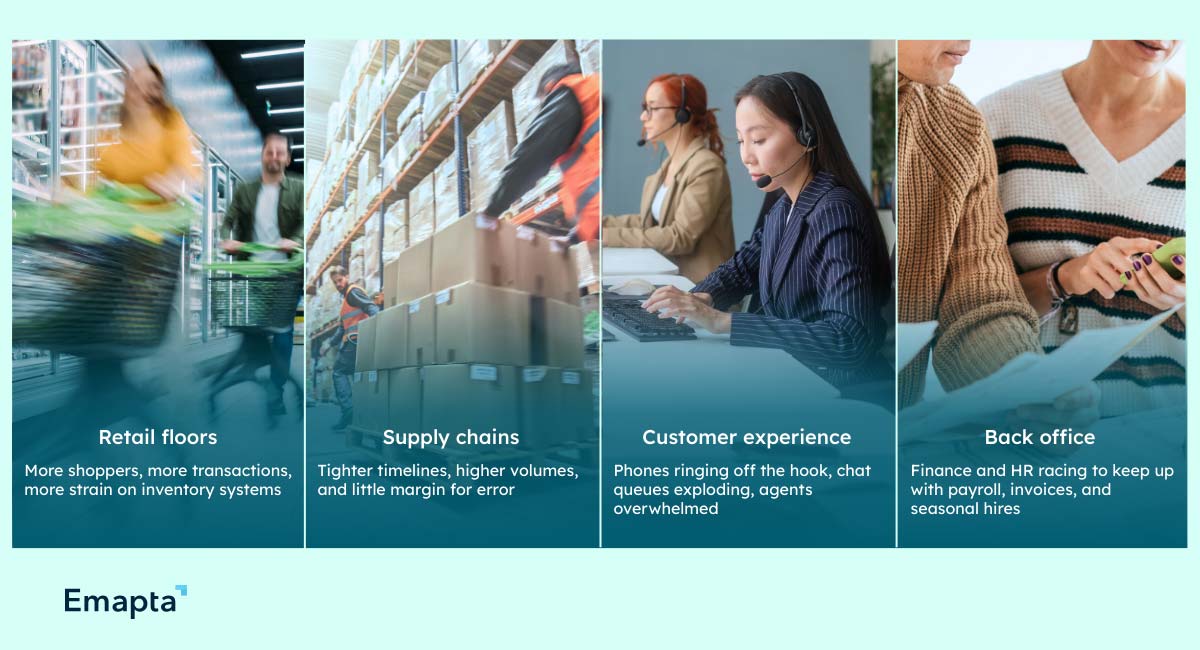
- Retail floors: more shoppers, more transactions, more strain on inventory systems
- Supply chain challenges: tighter timelines, higher volumes, and little margin for error
- Customer experience: phones ringing off the hook, chat queues exploding, agents overwhelmed
- Back office: finance and HR racing to keep up with payroll, invoices, and seasonal hires
Trying to cover all that with just local, short-term staff is like trying to patch a dam with duct tape. Outsourcing provides specialized, scalable teams that slot in where pressure is highest – without draining the core team.
Why COOs Can’t DIY Their Way Out
Every year, American companies tell themselves the same story: “We’ll hire faster, train better, and be ready this time.” And every year, the surge laughs.
DIY surge prep fails because:
- Hiring cycles are too slow. By the time seasonal staff are trained, peak demand is already tapering off.
- Budgets can’t justify permanent hires for temporary spikes.
- Burnout drives attrition, forcing COOs back to square one.
The reality: COOs can’t simply stretch their existing teams further. They need a flexible workforce model that absorbs the seasonal shock without creating long-term overhead
The Emapta Advantage for U.S. COOs

This is where Emapta steps in. We provide dedicated outsourced teams that American COOs can scale up or down to match seasonal surges. With Emapta, you get:
- Access to the top 1% of skilled global talent – customer service specialists, supply chain analysts, retail support, and more.
- Rapid scaling – build surge-ready teams in weeks.
- Transparent pricing – no seasonal markups, no hidden fees.
- Seamless integration – your processes, your culture, your control.
Whether it’s keeping CX queues under control on Cyber Monday, smoothing retail ops during the holiday rush, or managing supply chain stress tests, Emapta gives COOs the operational agility the U.S. market demands.
Ready For The Surge Season
Surges aren’t going away. If anything, they’re multiplying – driven by e-commerce growth, global supply chains, and increasingly unforgiving customer expectations.
The COOs who thrive won’t be the ones with the biggest budgets. They’ll be the ones with the most flexible operations – able to flex headcount, expand coverage, and absorb shocks without missing a beat.
Outsourcing isn’t just a workaround. For U.S. COOs, it’s becoming the superpower that turns seasonal chaos into consistent performance.
Frequently Asked Questions (FAQ)
Why are seasonal surges so challenging in the U.S.?
Because demand spikes align with labor shortages, high wage pressures, and consumer expectations shaped by next-day delivery and instant service.
Which functions can be outsourced for surge season?
Retail ops, supply chain support, customer experience, IT monitoring, finance, and HR — wherever COOs face bottlenecks.
How fast can outsourcing help during peak periods?
With Emapta, surge-ready teams can be onboarded in weeks, giving COOs agility to match U.S. seasonal demand cycles.