

Building Future-Ready Operations: Outsourcing, Automation & Agility
The COO job description has quietly mutated over the past decade. Once it was about keeping the trains running on time. Now it’s about keeping the trains running while also redesigning the tracks, adding bullet trains, and making sure passengers have Wi-Fi and oat milk lattes. In other words: execution and transformation. Efficiency and innovation. Growth and resilience. Oh, and don’t forget the budget.
Here’s the paradox: COOs are tasked with modernizing operations – bringing in automation, embedding AI, chasing agility – but their in-house teams are already stretched to the breaking point.
The result? Half-baked transformation projects, overworked staff, and an operations strategy that reads well in PowerPoint but collapses in practice.
Automation Without Talent Is Just Theater

Every board deck has a slide that says “AI + Automation” these days. It’s the corporate version of putting kale on the menu – it signals progress, even if no one’s eating it.
But here’s the uncomfortable truth: automation without the right people to implement and manage it is just theater. AI doesn’t run itself. Workflows don’t magically rewire because you signed a software contract. Someone has to translate the tech into results, and that someone is already buried under emails and meetings.
This is where outsourced teams change the equation. By bringing in dedicated, trained specialists – in data, IT, CX, finance – COOs suddenly have the bandwidth to make automation more than a buzzword.
Why “DIY Modernization” Doesn’t Work
A lot of companies try the do-it-yourself approach. The COO rallies the troops, sets up a task force, and announces that operations will be “AI-driven” by Q4. It looks ambitious on paper, but in reality, the same overextended people who keep the business running are now asked to reinvent it at the same time.
What happens next is predictable: timelines slip, automation tools gather dust, and the COO ends up explaining to the board why “transformation” looks suspiciously like the old process with a new software license.
Future-ready operations don’t come from heroics. They come from designing a model that separates everyday execution from transformation work. That’s where outsourced teams matter – they absorb the day-to-day load so in-house leaders can finally focus on strategic projects. Instead of squeezing change into the margins, COOs can actually drive it.
Outsourcing as the Hidden Accelerator

Most people still think of outsourcing as a cost-cutting exercise. Hire offshore, save a few dollars, call it a day. That’s outdated thinking.
In reality, outsourcing is a force multiplier for modernization. It provides:
- Specialized talent that knows how to integrate AI tools and streamline processes.
- Agility to scale teams up or down as projects evolve.
- Continuity across time zones, ensuring automation actually runs around the clock.
Outsourcing doesn’t replace automation; it makes it usable. It’s the difference between buying a Formula 1 car and actually hiring a driver.
The Agility Trifecta: COOs, Tech, and Talent
So what does a future-ready operation actually look like?
It’s not just a shiny tech stack. It’s a trifecta:
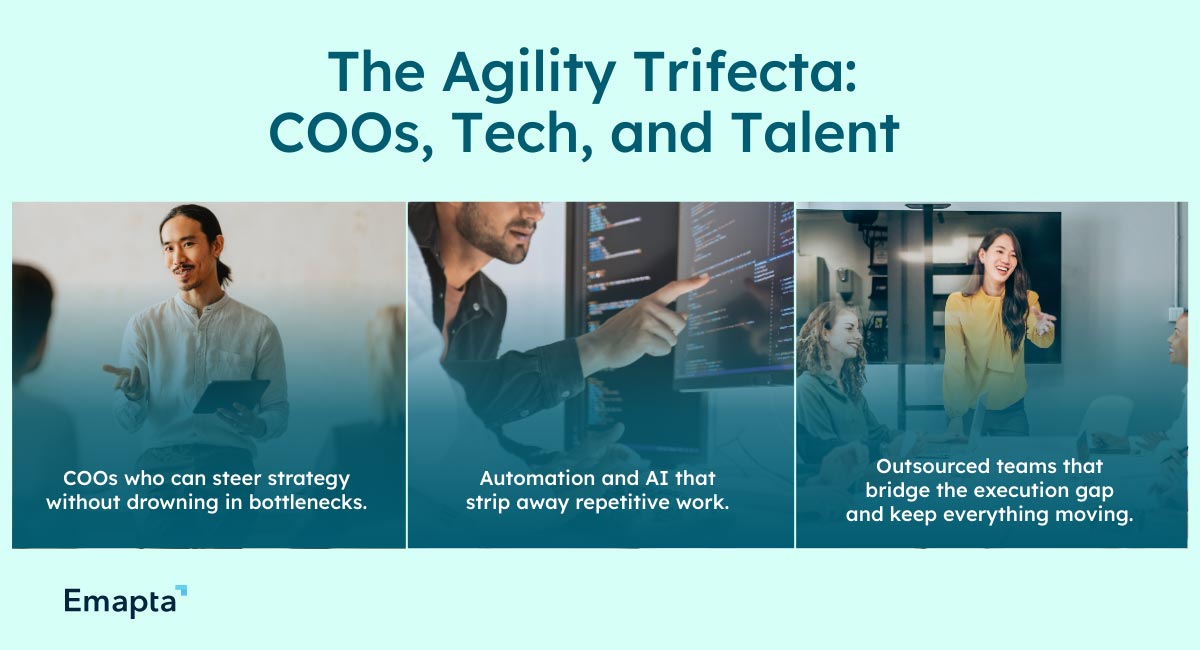
Together, they create agility. The kind of agility that lets you enter new markets faster, respond to seasonal retail demand without panic hiring, and pivot operations when the next global curveball arrives.
A Quick Story
One global logistics firm had invested heavily in automation – workflow software, predictive analytics, the works. But adoption stalled because the in-house team didn’t have the bandwidth to configure and manage it. Instead of ripping out the tech (and explaining another sunk cost to the board), they partnered with Emapta.
Within weeks, a dedicated outsourced team was in place to handle system integration, training, and support. Suddenly, the automation tools started doing what they were supposed to: reducing manual work, speeding up delivery timelines, and freeing the COO to focus on strategy instead of troubleshooting.
That’s not cost-cutting. That’s operational acceleration.
Why Emapta Is the Right Partner for Future-Ready Ops

Not all outsourcing is created equal. The wrong partner gives you warm bodies; the right partner gives you a competitive edge.
Emapta builds dedicated outsourced teams that do more than fill seats – they future-proof operations. Here’s what that looks like for you:
- Top 1% Global Talent: Access to highly skilled, hard-to-find professionals across CX, IT, data, and supply chain.
- AI-Enabled Upskilling: Teams trained to integrate automation and AI tools into daily workflows, turning tech into tangible results.
- Flexibility and Control: Scale from 5 to 50 roles without losing ownership of your processes, culture, or performance.
- Resilience Built In: 20 global offices give you redundancy and continuity, no matter the disruption.
For COOs, that’s the difference between dabbling in transformation and actually making it happen. If you’re looking to pair automation with agility – and build operations that can bend without breaking – Emapta gives you both the tech-ready talent and the operational model to get there.