

Outsourcing vs Freelancing vs In-House Hiring: Which Model Works Best for Your Business?
If you’re building a team in 2025 and beyond, you’ve got more options than ever. So, what’s the best choice to make? Should you hire in-house, team up with a freelancer, or build a flexible outsourced team that grows with you? Each model has its perks — and its pitfalls.
In this guide, we’ll walk through the pros and cons of the three most popular hiring models. By the end, you’ll have a clear sense of which options align best with your current needs, upcoming projects, and long-term goals.
Understanding the Three Workforce Models
Before we dive into comparisons, let’s take a moment to get clear on what we’re actually choosing between. Today’s businesses have three main ways to build a team, and each approach solves a different kind of challenge:
- In-House Hiring: This is the traditional approach. In essence, you bring on full-time employees who work only for your company. They might work onsite, remotely, or in a hybrid setup, but they are fully part of your organization. They live your culture, use your systems, and grow with you over time.
- Freelancing: Freelancers are independent professionals who take on specific projects or tasks. You can usually find them through platforms like Upwork or Fiverr, or through your professional network. This option is great when you need quick support or a highly specialized skill for a short-term need.
- Outsourcing (Dedicated Teams): With outsourcing, you partner with an external provider to build a full-time team that works off-site. These team members are officially employed by the provider, but their day-to-day work is directed by you. They follow your processes, communicate with your other employees, and align with your core business goals.
Each of these models can help you solve different challenges, and many modern businesses use a mix of all three approaches. This kind of hybrid strategy allows you to stay adaptable without losing momentum or diluting your company values.
Let’s explore how each model stacks up.
Model 1: In-House Hiring
Hiring full-time employees is still the foundation for many companies, especially when roles are closely tied to your brand, product, or internal culture. If you’re building an internal team to undertake highly collaborative work or carry long-term strategic responsibilities, having in-house staff may suit your needs and give you greater control. However, it’s important to consider the pros and cons.
Pros of In-House Hiring
- Stronger cultural alignment: Full-time team members are immersed in your values, vision, and day-to-day ways of working. Over time, they help shape your company’s culture and become an integral part of its core.
- Full control over work and workflows: You manage priorities, processes, and timelines directly, which can lead to more consistent project outcomes.
- Real-time collaboration: When your team is sitting together or working in the same time zone, it’s easier to brainstorm, pivot, and solve issues quickly.
- Richer institutional and specialized knowledge: In-house employees develop a deep understanding of your product, goals, and customers, which is hard to replicate with external teams.
Cons of In-House Hiring
- Higher costs: A full-time in-house team comes with salaries, benefits, training, office space, and more. These operational costs can add up quickly, especially in competitive job markets.
- Slower hiring process: Finding, vetting, and onboarding the right talent takes time, particularly for niche or technical roles.
- Less flexibility: It’s harder to scale up or down quickly when demand changes or a project shifts.
- Limited talent pool: Geography or industry-specific shortages can affect how quickly and affordably you can fill critical roles.
Most Common Roles for In-House Hiring
- Executive and strategic leadership positions
- Product managers and long-term project owners
- Marketing, brand, and customer success roles that benefit from deep cultural alignment
- Engineering leads or architects focused on high-level infrastructure strategy
Model 2: Freelancing
If you need someone fast for a clearly defined task, freelancers can be a great solution. You’re paying for the work, not the overhead, which makes this model especially attractive for startups, small businesses, or early-stage experimentation. Just keep in mind that freelancers are usually best for specialized work, not core operations.
Pros of Freelancing
- Fast access to specific skills: Whether it’s a designer, copywriter, or niche development team, you can find the right people quickly without committing long-term.
- Cost-effective for short-term needs: You only pay for what you need, and this cost efficiency can help keep budgets lean.
- Great for testing ideas: If you want to try a new product concept, campaign, or feature, a freelancer can help you test before investing further.
- Low commitment: This model is ideal when you’re unsure what your long-term needs look like.
Cons of Freelancing
- Direct communication challenges and inconsistency: Freelancers often work independently, which can make collaboration harder if expectations aren’t crystal clear.
- Quality standards can vary: Time zone mismatches, language barriers, or lack of process alignment can affect the quality of work.
- Less control: Unless the freelancer is fully integrated into your systems, it’s easier for things to get lost or delayed.
- Less accountability: Freelancers typically juggle multiple clients, so your project may not always be their top priority.
Most Common Roles for Freelancers
- Graphic designers, video editors, and other creatives
- Blog writers, social media marketers, or SEO specialists
- Frontend developers for one-off builds or small feature support
- Consultants or advisors for short-term audits or assessments
Model 3: Outsourcing Dedicated Teams
Outsourcing a dedicated team gives you a great balance between control and cost-effectiveness. You retain ownership of the work and direction, while your outsourcing partner handles hiring, payroll, infrastructure, and other admin tasks. It’s a great option when you need to bring in extra know-how, but keeping your team aligned and accountable is still a top priority.
Pros of Outsourcing
- Access to global talent: Reach experienced professionals in markets you may not have access to locally, often at lower costs.
- Reduced operational overhead: The outsourcing provider handles recruiting, HR, and infrastructure, so you can focus on leading the work.
- You stay in charge: You set expectations, direct projects, and maintain control over how things get done.
- Flexible operating hours: Many service providers can match your preferred time zones for smoother collaboration.
- Faster onboarding: With a prepared talent pool and mature hiring processes, it’s easier to ramp up quickly without starting from scratch.
Cons of Outsourcing
- Initial setup takes planning: Building the right team and integrating them into your systems requires a thoughtful onboarding process.
- Cultural compatibility varies: It’s important to find an outsourcing company that values communication and transparency the same way you do.
- Not ideal for all roles: Positions that require frequent face-to-face collaboration or deep local insight may benefit more from in-house staffing.
Most Common Roles for Outsourced Teams
- Software engineers and backend developers
- Customer support reps or IT help desk agents in follow-the-sun models
- Data managers or virtual assistants for scalable back-office support
- Project-based tech specialists, such as devs with expertise in AI, cloud, or cybersecurity (more below)
How Specialized Can Outsourced Teams Be?
Despite what many think, outsourcing in 2025 is about far more than task-based support. With the right outsourcing partner, companies can access experienced professionals in deeply specialized roles that support core operations.
Here are just some of the professional, high-skill roles businesses are outsourcing today:
1. Finance & Accounting
- Accounts Payable / Accounts Receivable Specialists
- Financial Analysts
- Bookkeepers
- Controllers and CPAs
- Payroll Officers and Payroll Specialists
- Tax Accountants
- Loan Processors
- Mortgage Brokers
- Paraplanners
2. Human Resources
- HR Administrators and HR Generalists
- Recruiters
3. Architecture, Engineering & Technical Design
- Architects
- Estimators
- CAD Designers and CAD Technicians
- Revit Designers
4. Sales & Business Development
- Account Executives
- Business Development Representatives (BDRs)
- Inside Sales Representatives
- Sales Development Representatives (SDRs)
5. Marketing & Creative
- Marketing Coordinators
- Social Media Marketers
- Graphic Designers
- Content Writers
- Digital Marketing Specialists (beyond execution, with strategic capabilities)
- SEM Specialists
6. Operations & Logistics
- Supply Chain Specialists
- Procurement Specialists
7. Legal, Healthcare & Compliance
- Auditors
- Medical Records Specialists
8. Skilled Admin & Technology Support
- Administrative Assistants
- Admin Support Specialists
- Web Developers
- IT Help Desk (for highly technical or infrastructure-specific roles)
- Telemarketers
Key Factors When Choosing Your Workforce Model
There’s no one “right” way to build your team. In fact, you may want to combine your options, depending on where your business is headed, what kind of work needs to get done, and how much flexibility, speed, or integration you need along the way.
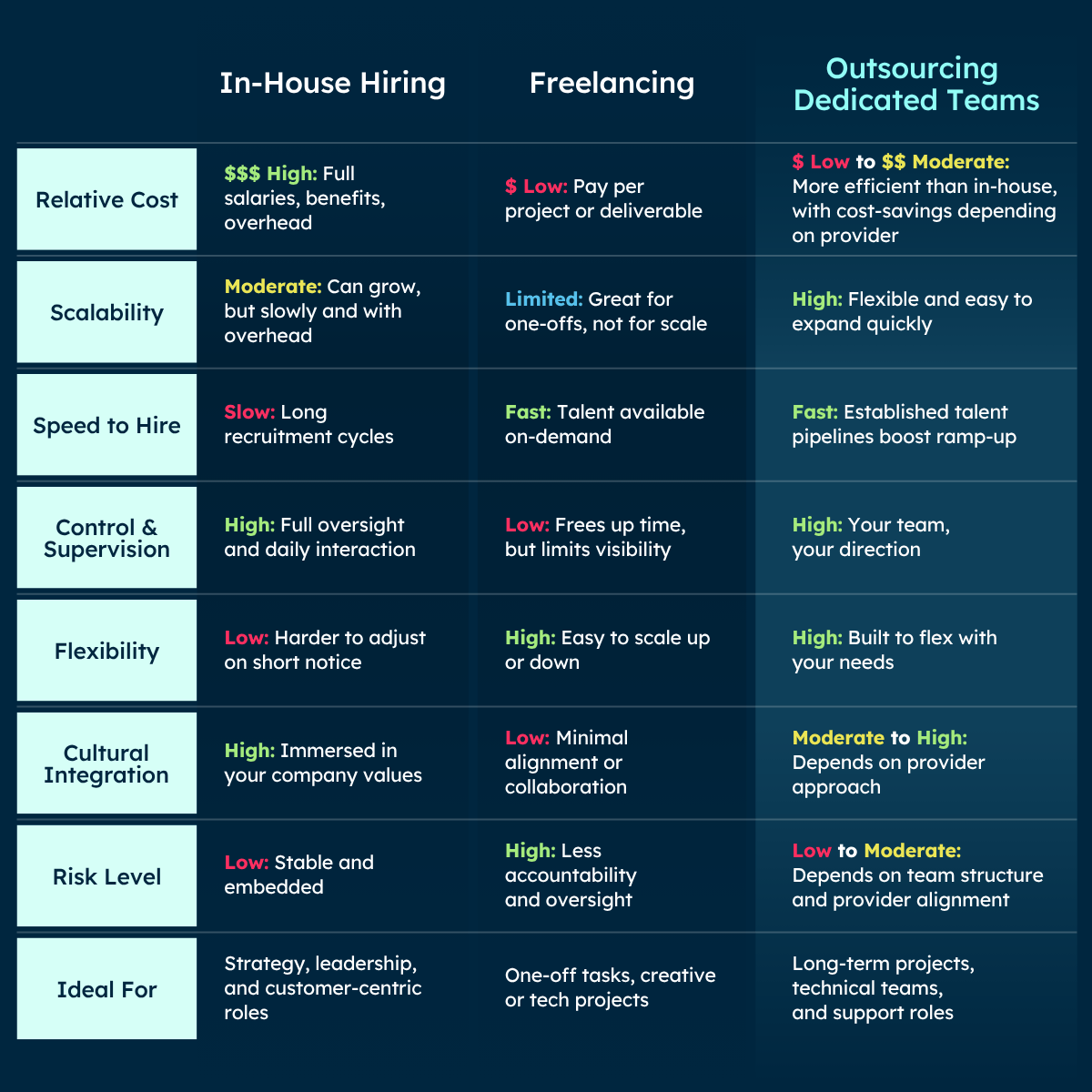
Here’s a simple breakdown to help you quickly compare in-house hiring, freelancing, and outsourcing:
Why More Companies Are Choosing Outsourced Teams
As businesses shift their focus from quick fixes to long-term growth, many leaders are rethinking how they build and scale their teams. More and more, startups and growing companies are turning to outsourcing not just for cost savings, but to build reliable, culturally aligned teams that support their goals and business initiatives.
Here’s why outsourcing is becoming a go-to for so many organizations:
- Faster time-to-market: Projects move forward quickly without months of recruiting or onboarding.
- Built-in flexibility: Your team works in step with yours, using the same tools and processes, just from a different location.
- Solves skill constraints and time zone differences: You get access to specialized talent without being limited by geography or office hours.
- Quality remains consistent: With dedicated team oversight, experienced managers, and shared visibility tools, you stay in direct control of project outcomes.
- Less operational stress: You don’t have to worry about turnover, rehiring, or the administrative overhead that comes with managing in-house roles.
How Emapta Supports Smart, Scaled Growth
Hiring is time-consuming and involves lots of informed decision-making. At Emapta, we work closely with clients to build dedicated teams that not only bring the right expertise but also click with the way you work and communicate.
Our outsourcing services offer you:
- Full visibility and leadership: You stay in charge of priorities, collaboration, and results.
- Seamless cultural fit: From day one, your team operates with your values, communication style, and company rituals in mind.
- Right-fit talent, every time: We match you with people who bring both the technical skills and team mindset you desire.
- Flexible costs for evolving needs: Whether you’re scaling up or refining your operations, our upfront pricing models adapt to your business needs.
Choose What’s Right for Your Business Today and Tomorrow

The truth is, there’s no one-size-fits-all model when it comes to constructing your team. What works for one project or stage of growth might not fit the next. Some roles need the deep roots and everyday collaboration of an in-house hire. Others call for the flexibility and scale that only outsourcing makes possible. And often, the strongest teams are built from a mix of both.
At Emapta, we help you find the right balance. Whether you’re building something new or scaling an existing operation, we connect you with dedicated, high-quality teams that align with your goals, your systems, and your culture. Our model was designed with growing businesses in mind, especially startups and small to mid-sized teams ready to take the next big step.
If you’re exploring ways to speed up business growth without sacrificing quality control or connection, let’s talk. We’d love to show you how the benefits of outsourcing can help you create a smarter, more sustainable team-building strategy.