
Where Global Hiring Is Headed: 5 Truths From Ranking 150 Outsourced Roles
We ranked the 150 most in-demand outsourced roles across 10 business functions. The results show exactly where global hiring is headed, and who’s already getting there first.
Let’s be honest: for most of its history, outsourcing had an image problem.
It meant moving low-complexity work offshore, cutting headcount, and protecting margins. Data entry. Ticket queues. Tasks nobody wanted to own. It was a cost lever, not a strategy.
That definition is now out of date. Domestic talent shortages are widening. AI is absorbing routine work at scale. And the roles companies are hiring for globally look nothing like the roles they outsourced a decade ago. They’re hiring accountants, paralegals, data analysts, and sales reps. Professionals who bring domain knowledge, communication skills, and judgment.
So we went looking for hard data on where that demand actually sits.
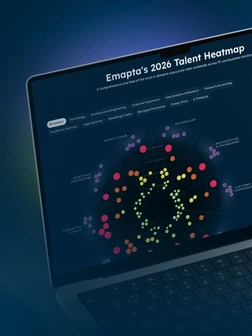
We’ve launched Emapta’s Talent Heatmap™, a ranked view of the 100 most in-demand outsourced roles worldwide across 10 core business functions, along with 50 emerging roles to start building talent pipelines for today and an exclusive spotlight on Robotics.
Emapta’s Talent Heatmap™ is here.
See how 150 roles rank across Finance & Accounting, Technology, Healthcare, Legal, Marketing & Sales, and five more business functions. Free to access, no registration needed.
Why We Built the Talent Heatmap™
Most workforce research gives you one of two things: big-picture trend forecasts, or a vendor pitch. Rarely both in the same place, and rarely with real hiring data behind it.
The Talent Heatmap™ is designed to close that gap. It answers two questions business leaders keep asking us:
- Which roles should we be building globally right now? The heatmap ranks each role by actual hiring activity, so you can benchmark your priorities against the market.
- How do we pick the right partner to build them? The companion Outsourcing Guide covers 10 things to look for in a workforce partner and a print-ready checklist for your next vendor call.
How the Emapta Global Talent Demand Index™ Works
A ranking is only as useful as the data behind it, so here’s exactly what’s under the hood.
The 100 ranked roles are scored using the Emapta Global Talent Demand Index™, a proprietary 1–100 score built on Emapta’s internal hiring data. It isn’t modeled, projected, or scraped from third-party job boards. It reflects actual hiring activity.
The index is calculated within each business function. The role with the highest hiring volume in a function scores 100; the tenth-highest scores 1. Everything in between is placed on a logarithmic scale, so one dominant role doesn’t flatten every other role toward zero. Each role then lands in one of four tiers:
| Tier | Index range | What it means | Roles |
|---|---|---|---|
| Peak Demand | 76–100 | The hottest roles in their function. Expect competition for this talent. | 16 |
| High Demand | 51–75 | Strong, above-average demand. Get ahead of these before they hit Peak. | 21 |
| Growing Demand | 26–50 | Demand is building. A good time to start a pipeline. | 20 |
| Steady Demand | 1–25 | Consistent activity today. Monitor for movement. | 43 |
One important note: scores are relative, not absolute. A Peak Demand role in Legal Services is the hottest role in legal, not necessarily hotter than a High Demand role in Technology. The heatmap is built to help you prioritize within your own function.
The 50 emerging roles use a different lens. They were identified through a review of leading global research, including Deloitte, Gartner, EY, Everest Group, LinkedIn, Indeed, and Forrester, cross-referenced with Emapta’s proprietary data. They’re the roles most consistently flagged to move from niche to necessary over the next two to five years.
5 Truths From the Talent Heatmap™
With that, here’s what the data says about where global hiring is headed, and why waiting is now the riskiest move.
1. “Outsourcing” now means professionals, not just processes
If you still picture outsourcing as call queues and data entry, the heatmap will surprise you. Look at who sits in the Peak Demand tier: Accountants, Bookkeepers, Paralegals, Data Analysts, Loan Processors, and Medical Records Specialists.
These are roles that need domain expertise, regulatory awareness, and sound judgment. Companies aren’t sourcing them globally to save a few dollars. They’re doing it because, in many markets, the domestic talent supply simply can’t keep pace with demand.
2. Revenue roles are the hottest talent market on the map
No function has more Peak Demand roles than Marketing & Sales. Four of its top 10 roles land in the top tier: Outbound Sales Representative, Inside Sales Representative, Sales Development Representative, and Sales Specialist.
The takeaway: companies are trusting global teams with pipeline, not just paperwork. Building revenue capacity offshore is now mainstream. If you’re hiring for these roles, expect competition, and move quickly.
3. AI isn’t killing outsourcing. It’s upgrading it.
AI is absorbing the bottom layer of the task stack: routine processing, first-level support, rules-based decisions. You might expect that to bring work back onshore. The data says the opposite.
According to Everest Group research, 48% of enterprises already outsource high-skill roles, and 57% expect to increase that by mid-2027. The bigger jump is in leadership: only 9% outsource managerial and leadership roles today, but 46% expect to increase it.
AI reduces the human labor a task requires. What’s left is higher-skill work that isn’t tied to any one geography. The companies that understand this aren’t asking whether to build global teams. They’re asking how to do it well.
4. Tomorrow’s most valuable roles barely existed two years ago
The 50 emerging roles in the report read like a preview of the next org chart: Prompt Engineer, AI Compliance Auditor, Agent Fleet Manager, AEO/GEO Specialist, Generative AI Architect, Healthcare AI Data Annotator.
Notice the pattern? Many of these roles exist because of AI, to build it, govern it, or manage it. And they’re spreading across every function, from mortgage compliance to supply chain planning. Robotics is next. The report’s bonus spotlight tracks five Robotics roles, including Computer Vision Engineer and AI-Robotics Integration Specialist, in a field on track to become one of the most competitive talent markets in the world.
The companies that start building pipelines for these roles now will have a measurable head start over those who wait for the market to force their move.
5. The hard part isn’t finding the right roles. It’s finding the right partner.
Knowing which roles to hire is half the equation. The other half is sourcing that talent quickly, compliantly, and without overpaying, and that’s where many workforce strategies stall.
Not all outsourcing models are built the same. The guide outlines 10 things to look for, including:
- Dedicated teams that work only for you – exclusive, highly skilled dedicated teams embedded in your tools, workflows, and culture, with you keeping full control and visibility.
- Employer of record and dedicated staffing under one roof – one partner handles compliance, payroll, HR, and legal obligations across geographies while building the team you manage.
- Seamless extension of your team – your global team should feel like part of your business, built to your standards rather than bolted on to cut costs.
- Radical pricing transparency with no salary markups – a clear breakdown of individual salaries and service costs, so savings come from smarter design, not hidden margins.
- Flexibility without lock-ins – no long-term contracts or minimum hires, so you can scale, reshape, or pivot as your business evolves.
- Speed to scale – pre-vetted talent pipelines and proven onboarding take you from decision to deployed team in weeks, not months.
- Retention and replacement support – a replacement guarantee if a hire doesn’t work out in the first 90 days, plus ongoing support after placement.
- Compliance and data security built in – recognized security certifications, clear separation of employee and client data, and a defined plan if an incident occurs.
- Workforce transformation capability – strategic workforce transformation support that helps you decide what to outsource and when, then sequence the plan around your business goals.
- Teams built for an AI-driven future – pre-vetted, AI-ready talent backed by dedicated client success partners, ready to deliver from day one.
How to Use the Talent Heatmap™
The heatmap is designed to be actionable, not just informative. Here’s how to put it to work:
- Benchmark your hiring plan. Filter the Talent Heatmap™ by your business function and compare its top 10 roles against your current open positions.
- Get ahead of the curve. Use the High and Growing Demand tiers to spot roles worth pipelining before competition heats up.
- Plan for what’s next. Use the 50 emerging roles and the Robotics spotlight as an early signal for where to invest over the next two to five years.
- Pressure-test your vendors. Print the Workforce Partner Checklist and bring it to your next vendor call.
The transition to a deliberate global workforce strategy isn’t as simple as flipping a switch. It takes clarity on which roles to build, where to build them, and who to build them with. The businesses best positioned for the next decade treat global workforce strategy as a capability decision, not a cost decision. The talent exists. The infrastructure to access it exists. What separates the leaders from the laggards is how deliberately they build their teams.
The window for early movers is open.
Turn this data into a hiring strategy. Get the full Talent Heatmap & Outsourcing Guide: all 100 role rankings, the 50 emerging roles to pipeline now, the Robotics spotlight, and a print-ready vendor checklist. Free to access. No email or registration needed.
Frequently Asked Questions (FAQs)
According to Emapta’s Talent Heatmap™, Peak Demand roles include Accountant, Bookkeeper, Paralegal, Data Analyst, Loan Administrator, Loan Processor, Tech Support Representative, Customer Service Representative, Medical Records Specialist, Billing Insurance Follow Up Representative, Associate Vendor Coordinator, Modeler – Exterior, and four sales roles: Outbound Sales, Inside Sales, Sales Development Representative, and Sales Specialist.
It’s a proprietary 1–100 score that measures how actively a role is being hired for relative to other roles in the same business function. It’s based on Emapta’s internal hiring data, not third-party job boards.
Ten: Finance & Accounting, Architecture & Engineering, Technology, Legal Services, Supply Chain, Customer Experience, Marketing & Sales, Healthcare Services, Mortgage Processing, and Data Analytics & Research.
They’re 50 roles that leading research firms consistently flag as near-term priorities, such as Prompt Engineer, AI Compliance Auditor, and Agent Fleet Manager. Many are tied to building, governing, or managing AI.
Yes. Everest Group research cited in the report found 48% of enterprises already outsource high-skill roles, and 46% expect to increase outsourcing of managerial and leadership roles by mid-2027.
Look for dedicated teams, transparent pricing with no salary markups, no long-term lock-ins, built-in compliance and data security, and a replacement guarantee. The full guide includes a 10-point framework and a printable vendor checklist.
Yes. The full report is free to access, with no email or registration required.